TABLE OF CONTENT
Conversational analysis of chatroom talk
1.1
Evolution of language from early utterances to chatroom utterances
1.2
Internet-based communication systems
1.2.1
E-mail, discussion forums
1.3.1
Print to computerization
1.4
Purpose of examining on-line conversation
1.5.1
Problems of researching on-line
1.6 Are Chatrooms Public or Private?
1.8 Personal interest in researching on-line conversation
2.2 Technology of conversation
2.2.2.1 CMC
and on-line talk-texting
2.2.2.2
Analysing electronic textual data
2.2.2.3
On-line writings on CMC
2.2.2.3.3
Role playing chat sites
2.3 Analysing on-line conversation
2.3.1.1
The Reader as interpreter
2.3.1.2
The assumed or implied reader
2.3.1.3
The background of the reader (“mosaic of multiple texts”)
2.3.1.4
The role of the reader
2.3.3 Symbolic
activity in chatrooms
2.3.4
The language/action approach
3.4 Protocol of a transcription methodology
CS
1.0.1 Reason for choosing this chatroom
CS
1.0.2 Background to Hurricane Floyd
CS
1.2.1.1 Skills of shared language
CS
1.2.1.2.1 Knowledge and skills of discourse structure and organization
CS
1.2.1.2.2 Metalinguistic knowledge and skills
CS
1.2.1.3.3 Phenomenological approach to reading
CS
1.3.1 Two readings of a chatroom
CS
1.3.1.2 Three different Hurricane Floyd discussion strands
CS
2.0.1 Choosing an IM chatroom
CS
2.1 Computer-Mediated Communication (CMC)
CS
2.2.1 Is electronic talk comparable to verbal talk?
CS
3.3.1.2 3D virtual chats and ikons
CS
4.0.2 Why I chose this chatroom
CS
4.2.1 Speech situations as speech events
CS
4.2.3 Speech Act Disruptions (SADs)
CS
5.2.2.2 <B_witched_2002-guest> 0HI
CS
5.2.2.3 <jenniferv>
** rofl
CS
6.2.1 Adjacency Pairs and Turn-taking
CS 6.2.2 Moderated/Unmoderated
CS 7.1.2 Functional Sentence Perspective
CS 7.1.2.2 Meaning-Text Theory (MTT)
CS 7.1.2.3 The loss of formal or traditional text
Grammar
CS 7.1.2.3.1 Systemic-Functional Linguistics – the functions of on-line chat
CS 7.1.2.3.2 Stratification grammar
5.1 Findings of Case Studies 1 - 7
5.2 Unique features of chatrooms
5.3
Research Questions and answers
5.4 Assumptions at the beginning
Glossary
(*TN) following a term is
a new glossary word devised by the researcher
(Terrell Neuage) for this thesis.
Casual
Chatroom Chat (CCC) (*TN)
A conversation in a chatroom which is not serious or intended to discover
details on a subject. Most casual chatroom chat, similar to non-formal pub
casual chat, consists of conversation typical of, “hi” “hows everyone”.
Chat
Events (CE) (*TN) These are
all the individual turn-taking texts of a particular participator in a chat
room, including entering, leaving and lurking.
Chatroom graffiti (*TN) The messages conveyed through the work of
graffiti artists are often highly political and deliberately aggressive. Some
people will go from chatroom to chatroom leaving messages but not particpating
in actual chatroom conversation: I refer to this as chatroom graffiti.
Chat
Utterance Sentence Structures (CUSS) (*TN) These are the sentences of
a chat turn-taking. Unlike sentences which use nouns and verbs to establish a
complete thought, chat sentences are typically made up of two to five words or
emoticons. I have averaged the amount of words in twelve chatrooms, consisting
of 1357 lines (turn-takings) and found the average word count, including
abbreviations and emoticons to be 3.7.
Chatter's-Event-Response-Gaps
(CERG) (*TN) This is the pause
between chatters who are “speaking” with one another. There are often other
voices which fill these gaps.
Conversational
“lag” (*TN) Conversational
lag is a pause where the next speaker has been selected but it may be filled
with responses from others in the chatroom responding to other turn-takings.
The “lag” may be caused by many other factors, as I have alluded to above.
Cut
utterances (*TN) Due to
hitting the entrance key an utterance is cut between turn-takings in a
chatroom. In some cases several turns of other chatters could occupy this
space.
Event
Pause (EP) (*TN) This
refers to the break between utterances of a user in a chatroom. The most usual
incidence of this is when the server places an advertisement in the chatroom
and it appears between utterances. It also occurs when no one writes for a
specific period of time.
Lag
is the distance between speech events of a speaker in a chat situation, a
pause between utterances.
Metaphysical-chat-linguistics
(MCL) (*TN) is anticipating
what will be said before the completion of the utterance, either due to the
writer-speaker hitting the “enter” key on the keyboard or the chat server not
allowing more than a couple of lines at a time to be shown on the screen, thus
breaking the conversation before it is completed.
Multilogue
are the many conversations happening at one time within a chatroom as well as
the overall conversation of all who are present.
Multiple Selves Chat (MSC) (*TN) Is a feature of chatrooms.
The author is able to have several different representatives of his or her self
in conversation at one time. As only one person can log on a chatroom at a time
the person wanting to have multiple representation in a chatroom would need to
have several windows open of the one chatroom but be logged on as a different
username in each window.
On-line Discourse Analysis Method (ODAM) (*TN) The method I am developing to study the language of on-line communication using abbreviations, misspelled words and emoticons.
On-line native speaker (ONS) (*TN). Speech behaviours are established first off-line, and are then
modified for on-line use – most notably by the current technology which at
least demands that texted formats intervene in the “chat” processing.
Person2Person-off-line (P2P-off) (*TN)
Person2Person-on-line (P2P-on) (*TN)
Readerly and Writerly Texts These are
translated from Barthes' neologisms lisible and scriptable, the
terms readerly and writerly text mark the distinction between traditional
literary works such as the classical novel, and those twentieth century works,
like the new novel, which violate the conventions of realism and thus force the
reader to produce a meaning or meanings which are inevitably other than final
or “authorized.” (Keep, McLaughlin, Parmar, 2000). http://www.iath.virginia.edu/elab/hfl0250.html
Speech Act Disruptions (SAD) (*TN)
Sponsorship ads appearing in chatrooms are a performative speech act
disruption.
Speech Act Community On-line (
Speech situations (chatroom
situations) are composed of “speech events” (chatroom events) (Hymes, 1974) and
these activities have rules governing the use of speech getting, for example,
getting to-know-you conversations (Gudykunst and Kim 1997 p. 328).
Tangent Topic Thread (TTN) (*TN) This occurs when the
original chat topic is taken over by others in different strands of unrelated
chat.
Text-Based-Chatrooms (TBC). (*TN)
Text-Based-Chatrooms are a blip in the history of human writing and only
represent a short time period of computer-mediated communication (CMC). As more
and more chatrooms add multimedia attributes, writing may become a minor or
even a non-existent form of on-line communication. With voice-boards and
voice-forums such as available from Wimba (http://www.wimba.com/) and
chatrooms being 3D with virtual worlds which use voice and keyboard commands to
move around the screen and with the growing use of avatars, TBCs may fade into
a past genre of electronic writing peculiar to the period from approximately
1993-2003.
Thread is a line of conversation.
Thread-framing Thread-framing
is a phenomenon in chatrooms, where a topic beginning and ending are marked. In
a chatroom these framed pieces of conversation are not necessarily sequential.
They twist around, stop and start, and several may occur at one time in a
seemingly chaotic fashion. Framing gives a starting and finishing point to a
thread.
Virtual-Mindfield (*TN) Creations of one’s
world-view on-line.
Abstract
In
this study I started in a purely empirical mode, “capturing” seven primary
chatroom dialogues. I chose several of these sites randomly, based on the ease
of their access. As the study progressed, I chose several other chatrooms
because of my slowly focusing interest in the varying “talk relations” I was
encountering, and my suspicion that chat users were themselves make chatroom
selections by anticipating the online social relations offered in various
sites, according to the subject matter of the chatroom as signalled in its
name. While this sometimes was or sometimes was not a safe prediction, it
extended the range of sites, techniques and behaviours I was able to collect
and analyse, and required only occasional supplementation with sampling from
sites outside the core selection. For
the most part, this study concentrates on seven case studies, each case study
being based on a saved piece of representative dialogue from one very
distinctive chatroom. Together, these case studies demonstrate features
peculiar to on-line chat which make it very different from the face-to-face
chat of everyday conversation – but also from any forms of text-based
communication. In the broadest sense chatroom “texted talk” combines
face-to-face chat with text-based communication.
There
are however a number of central and distinctive features that disrupt what
might otherwise traditionally be considered a simple conversational
communication model. There is far more in Internet Relay Chat than can be
explained in a “sender-message-receiver” relation. Most obviously such features
include for instance the use of avatars to replace or to represent the
physically absent “speaker”; text-graphic “emoticons” as interfaces to replace
words or aural elements representing emotions; the fleeting motion of scrolling
text; silence or “lurking” by participants as itself a form of message: the complex “braiding” and
overlap of various conversational “threads” and the need to compensate and
interpret discontinuity of posted messages; as well as new forms of word
structure, such as standardised abbreviations and idiosyncratic mis-spellings.
Each of these – and the many more complexities each of them conceals – signals
major shifts in the communicative activities of online “chat” communities.
To test ways in which these new
communicative forms might be examined and understood, in this study, I
capture and sample a moment in time of on-line exchange behaviours, and look at
them through the lens of a wide range of linguistic and discourse theories.
Using these theories demonstrates how, despite the differences in “chat”
conducted on-line from that carried out face-to-face, on-line chat and “natural
conversation” share some features. Analytical theories developed for inquiry
into both conventional speech and print-based text reception, can be used for
examining on-line chat, and are able to produce findings which help explain
these new communicative acts. The seven case studies and the theories and
associated methodologies used to assess are as follows:
Disaster Chat (Hurricane Floyd).
Beginning with Reading Response Theory as a text-based analytical tool,
this Case Study of a natural-disaster-based chat site shows that in on-line chat, both the person writing and the
one (or many) reading are co-language-meaning creators.
Instant Messenger. Using the one-on-one
talk relation of the Instant Messenger system, this Case Study focuses on the
technologisation of online talk, and its foundation in the ideas behind Computer
Mediated Communication. I approached this case
study with two questions related to Computer-mediated communication: “Do
computers change conversation?” and “Are Instant Messenger chatrooms closer to
off-line-person-to-person conversation than the multi-dialogue found in a
multivoiced chatroom? ” The findings suggest that
computers do indeed change conversation, and that Instant Messenger chat is
closest to person-to-person communication – but that even here, the “texted”
nature of the talk has produced differences.
Celebrity Chatrooms (Britney Spears). In
this Case Study the high levels of text-graphic fusion elements and
abbreviations invited a Semiotic analysis; unexamined
on-line communication’s potential to evolve cross-communicative formats. This
study reveals analysis within the same repertoire of images, words and
mixed-mode forms, such as specific “chat community” conventions of
abbreviation.
Astrology Chatrooms. Here, Speech Act
Theory is used to examine the practical and goal-related uses
of online language, and so extends the study into how chat participants on-line
direct their communicative activities towards social actions – and whether
these vary in the on-line world from those used off-line.
General Chat. To assess how the more
open chat communities entering general-topic chatrooms on a less regular basis,
make sense of the chat behaviours present, it is important to understand
exactly what it is that arriving chat participants “read” from the online
texted-talk on screen. Discourse
Analysis examines the message structures organizing
an on-line community into consensual, resistant or negotiative communicative
moments. In the case of
General Chat it is able to assess how the communicative elements appearing on
the screen provide participants with the general or generic “cues” to enter and
participate in a conversation.
Computer Chat (on the topic of expert
software WEB3D). This case study asks does an expert community chat-site
operate in the same conversational environment as general chat participants, or
as in sites offering focused talk relations among strangers. Conversational
Analysis, used to examine the structuring rules of natural or real-world
conversation, has uncovered regulatory behaviours in talk, such as ways to
perform sequential organization of talk, allocate turn-taking and negotiate
repair to conversational break-down. CA is able to depict interactional
competence in conversation. This Case Study examines how useful it might be in
reading the rules of chatroom talk.
Baseball Chat. Here an informal “expert” group, with regular and casual
users intermixed, is examined, to test whether the specialist forms used to
demark a specific chat “community” are annexed in from outside “natural”
baseball chat, or evolve new online “baseball chat” forms of their own. This
study applies techniques for describing grammatical systems drawn from a number
of Linguistic Schools, to examine how many
of the common grammatical conventions – such as word order, sentence structure,
question formation, do not hold up in on-line chat. Further: baseball-chatters
on-line do not use the same specialist formations as their off-line brethren –
raising interesting questions as to the special pressures of online chat, even
in very specific talk communities with strong offline conventions in their
speech.
Other
chat samples saved and referred to in this thesis to enhance and support points
include: 911
Electronic
communication has opened a new realm for communication – both as necessary
information exchange, and as social play and psychological development of
self/selves. With continually evolving innovations enabling new communicative
activities, we must anticipate new and unpredictable – even as yet
indescribable – communicative behaviours and understandings. By applying more
detailed forms of textual analysis to the actual examples of computer mediated
communication (CMC) my project sets out to detect new modalities as they
evolve.
Chat
on-line is “global” only to the extent of accessing many varying “local”
structuring references. A “global” or universal “chat speak” is not evident in
on-line talk selections – for all the emergence of expressive repertoires in
netiquette, emoticons or IRC/SMS abbreviation. In this study, I suggest that
what is evolving here is not – or not yet – separated from speech in the
physical world, to the extent of disconnection from dominant discursive
framings: that on-line texted-talk “chunks” its interactions in familiar ways.
I am also suggesting however that at the level of “chat” or interpersonal
interactivity, new behaviours abound.
Declaration
I declare that this thesis does not incorporate without acknowledgement any material previously submitted for a degree or diploma in any university; and that to the best of my knowledge it does not contain any materials previously published or written by another person except where due reference is made in the text.
All transcription from the Internet was undertaken by the
author/candidate.
All chat logs are on the accompanying CD. They are listed under the
name of the case studies they are used in, for example, the log for case study
1 is called 1a on the CD.
Terrell
Neuage
Acknowledgements
My appreciation and thanks for the
accomplishment of this study are directed to Dr Jackie Cook for her years of
patience and guidance of this thesis. Without her this would not have been
possible. I am much in debt to Dr Cook, of the department of Communication,
Information and New Media at the
I also thank Associate professor Maureen
Nimon for keeping me on track and giving valuable advice and Professor Claire
Woods,
And I thank my wife, Narda Biemond, for putting up with my doing this thesis year after year and for her suggestions and support.
I dedicate this thesis to my sons, Sacha and
Leigh Neuage, who began the process of online communication with me in the
mid-1990s. Sacha’s creative and free spirit has led him to achieve wonderful
things in the world of art and music. As a critical thinker, he has challenged
me often to dig deeper, and to further explore my own position on many
issues. Leigh was a baseball player for
Thanks guys.
1. INTRODUCTION
The Nature of Conversation in Text-based
Chatrooms.
My purpose is to describe in detail the conversational
interaction between participants in various forms of on-line text-based
communication, by isolating and analysing its primary components.
Conversational process, according to
analysts in many fields of communications[1]
is rich in a variety of small behavioural elements, which are readily
recognised and recorded. These elements combine and recombine in certain
well-ordered rhythms of action and expression. In person-to-person off-line
confrontation there results a more or less integrated web of communication
which is the foundation of all social relations (Guy & Allen, 1974, p.
48-51). On-line chatrooms as an instance of electronic text-based communication
also use many of these small behavioural elements, evolving at the same time
system-specific techniques such as emoticons, abbreviations and even
pre-recorded sounds provided by the chatroom (whistles, horns, sound bites or
laughter). The full web of on-line exchange and exchange relational modulation
devices however remains unmapped, and unless every word written on-line is
captured it never will be mapped and analysed fully. In this study of seven
case studies I capture and sample a moment in time of these on-line exchange
behaviours, and look at them through the lens of several linguistic discourse
theories.
1.1 Evolution of language from early
utterances to chatroom utterances[2]
The study of language is one of the oldest branches of
systematic inquiry, tracing back to classical
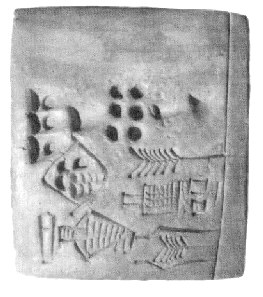 Sumerian
Logographs -- circa 4000 BC
Sumerian
Logographs -- circa 4000 BC
http://www.liveink.com/whatis/history.htm Copyrighted Walker
Reading Technologies, Inc. 2001
Early writing from
|
|
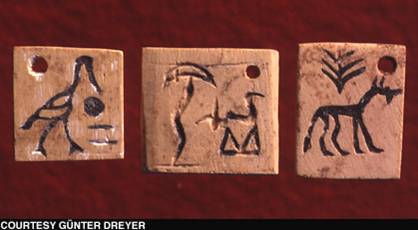
©
1999 by the Archaeological
http://www.archaeology.org/9903/newsbriefs/egypt.html Günter Dreyer.
We cannot know what the world was like before human
language existed. For tens of thousands
of years, language has developed to form modern systems of grammar and syntax,
yet language origin theories by
necessity remain based largely on speculation. In the eighteenth and nineteenth
centuries there were several proposals with labels which tended to signal the
desperation of their authors: “ding-dong”, “bow-wow” and “yo-he-ho” theories
(Barber, 1972), each attempting to explain in general social terms the origin
of language. While such conjecture must always remain unresolved, the rapid
changes in communicative technologies in the late twentieth century, together
with their markedly social or participatory bias, allows us to glimpse once
again the intriguing degree to which ordinary people are willing to push the
limits of communicative systems. With chatrooms, language itself may be going
through new and rapid development – or, on the other hand, enthusiasts may be
taking advantage of a brief experimental moment, acquiring expertise in
communicative techniques which prove to be short-lived. This period of intense activity is however
one among many steps in the long process of human communication. Certainly,
chatroom communication (and its more recent take-up in mobile telephony’s
SMSing) very obviously separates from traditional language through regulated
processes of word corruption and its compensatory use of abbreviations and emoticons.
(I explore emoticons in Case Study Three and abbreviations and other language
parts in Case Study Seven). But how did these new forms emerge? What produced
them? What does it mean that such innovation can arise in such a short time
span? And are these limited, or generalisable, features of modern language use?
These questions can only be answered definitively in the future, but they can
be discussed and elements of the new practices and behaviours described now, as
they are in this thesis.
It is thought that the first humans may have exchanged
information through both aural articulation and gesture: crude grunts and hand
signals. Gradually a complex system of
spoken words and visual symbols was invented to represent what we would
recognise as language. Earliest forms of telecommunication consisted of smoke
signals, ringing a bell or physically transporting a memorised or texted
message between two places. However, during the late 18th and early 19th
centuries, communication codes for meaning were exchanged at a greater distance
across time and became accessible to more users. A standard postal system
allowed people to send messages throughout the world in a matter of days. The
development of the telegraph cable, including the development of radio, made
real-time vocal communication over long distances a reality. The Internet is
the most recent such advance in communication.
It allows us, in a split second, to disseminate a seemingly limitless
amount of information across the globe.
All communication however – from the earliest conjectured
formations to the multi-media flows of today - involves interaction, and thus
forms a basis for social relationships: webs of cooperation and competition,
expressiveness and message-conveying, play and work – social functions which
treat even the human body as a tool for activity. Language itself, evolving as a secondary use
of physiological apparatus with otherwise directed purposes – the tongue,
teeth, lips, breath, nose, larynx – constructs a self willing to sacrifice
time, effort and attention to others, by re-forming that self into a communicating
being.
All consequent communicative developments have at one
level simply elaborated on this drive to “re-tool”, both within and beyond the
body, as communities made more and more demands on socially regulated action.
“Throughout the history of human communication, advances in technology have
powered paradigmatic shifts…” (Frick, 1991). Technology changes how we
communicate; big shifts in culture cannot occur until the communicative tools
are available. The printing press is an
example of this. Before its invention,
scribal monks, sanctioned by the Church, had overseen the maintenance and hand
copying of sacred texts for centuries (see Spender, 1980, 1995). The press resulted in widespread literacy,
with books accessible and more affordable for all. The spread of literacy in
turn changed communication, which changed the educational system and – to some
degree at least - the class and authority structure. Literacy became a demand
tool: a passport to the regulatory systems of the industrial-bureaucratic state
emerging in the modern era.
There are many different ways of analysing the history of
the current dominant communication system.
Whether one studies the historical, scientific, social, political
economic or the psychological impact of these changes, depends on the analysis
of the system. For example
As new communication technologies advance, the individual
using the technology has to come to terms with their identity when they are represented
electronically instead of in person. Technology such as the use of computers
and mobile phones can mask the identity of the user at the same time it reveals
the person. With technological communication the individual’s identity is not
clear. Firstly, there is the opportunity
to create an identity that is different from the real life person. Secondly
this identity can be tracked. There is a larger footprint[8]
to identify an individual than there was with pre-on-line culture. The on-line
user is no longer an individual but a multifaceted product – with a possibility
of a never-ending array of identities. When there was only print, the
communication process, despite offering contact with a multiple audience, was
still considered an individual act. The communicator presented text and it was
interpreted by the witness of the text, a form of deferred and displaced
conversation. With on-line communication the text has moved further away from
the identity of its originator, yet is still directly associated with a user –
recognition of the “gap” opened between author and text signalled however by
acknowledgement of the author as a self-created identity, to which the text
remains linked despite its electronic capacities to wander and to change. The
difficulty is that the communicator is now seen as not in fact present, but
re-presented. Sociology Professor Sherry Turkle says in Life on the Screen: Identity in the Age of
the Internet that “The
primary difference between oral communication and electronic communication is
how we re-address the Self” (Turkle, p.56, 1995) and this feature of on-line presence
is addressed throughout the case studies in this thesis.
Despite this problem of “absence”, familiar from centuries
of texted communicative practices, on-line communication is simultaneously
“restoring the mode and even the tempo of the interaction of human minds to
those of the oral tradition” (Harnad, 2001). With the rapidity of computers
computer “talk” is most often seen as similar to oral communication, creating
an oral-written text.
…when reading on
screen, the contemporary reader returns somewhat to the posture of the reader
of Antiquity. The difference is that he reads a scroll which generally runs
vertically and which is endowed with the characteristics inherent to the form
of the book since the first centuries of the Christian era: pagination, index,
tables, etc. The combination of these two systems which governed previous
writing media (the volumen, then the codex) results in an entirely original
relation to texts…. (Harnad, 2001).
A major feature of and influence on modern communications
is thus those telecommunications systems that have been critical for the new
revolution in communication. In the post-Gutenberg era this can be regarded as
the fourth revolution in knowledge production and exchange, the first
revolution in the history of human communication being talk, emerging hundreds
of thousands of years ago when language first emerged in hominid evolution.
Spoken language is considered a physiological and biologically significant form
of human communication that began about 100,000 years ago (Noble and
The second cognitive and communicative revolution centred
on the advent of writing, tens of thousands of years ago. Spoken language had
already allowed the oral codification of thought; written language now made it
possible to preserve the codes independent of any speaker/hearer.
The third revolution took place in the immediate past
millennium with the invention of moveable type and the printing press. Habermas
considers the press as “the public sphere’s pre-eminent institution” (Habermas,
1992b, p.181). With the printing press the laborious hand copying of texts
became obsolete and both the tempo and the scope of the written word increased
enormously. Texts could now be distributed so much more quickly and widely that
again the style of communication underwent qualitative changes. Harnad, while
perhaps dangerously close to a technological determinist mode of analysis,
believes that while:
…the transition from the oral tradition to the written
word made communication more reflective and solitary than direct speech; print
restored an interactive element, especially among scholars: and if the
scholarly “periodical” was not born with the advent of printing, it certainly
came into its own. Scholarship could now be the collective, cumulative and
interactive enterprise it had always been destined to be. Evolution had given
us the cognitive wherewithal and technology had given us the vehicle. (Harnad,
1991)
These three forms of communication had a qualitative
effect on how we think. Our average speaking rate has a biological parameter;
it possesses a natural tempo dependant on the individual speaker, but with hand
writing the process of communication is slowed down. In opening itself to communication across
space and across time, it also opens the possibility of receptive
interpretation: a more than usually active role for the “reader”. Hence, the
adaptations which evolve in texted communicative practice become strategic and
stylistic rather than neurological. The “performance” of text assesses its
end-user: the reader, who is known to be dispersed in time and place, and so is
less easily controlled than is the “present” and remediable listener to spoken
words. With electronic communication however the pace of oral speech combines
with the necessity for strategic control. While “linked” in an
electronically-mediated relation of reciprocity (whether synchronous or
asynchronous) the on-line communicator is still in an “absent” relation with
co-communicators. While the brain can rapidly scan moving conversation as it
scrolls in a chatroom, reading and understanding many conversations in progress
at the same time, and the chatroom participant can engage any number of the
conversations, no “authorising” presence validates or directs reception. This
absence inherent in a texted communicative act invites compensatory strategies.
1.2 Internet-based communication systems
People are likely to do what people always do with new
communication technology: use it in ways never intended or foreseen by its
inventors, to turn old social codes inside out and make new kinds of
communities possible (Rheingold, 1995).
Together, these
accounts of a developing communicative social order show that it is through the
interactive forms of the day that society changes. The more accessible communication becomes to
everyone, the quicker ideas can be exchanged and new meaning developed and
shared. Through the exchange of ideas and information, we become
better-informed and thus able to make decisions, which affect not only
ourselves but also the world in which we live. Twentieth century electronic
media were a driving force of globalisation, producing an acceleration of
contact (see Giddens, 2000). As globalised economic productivity arises to
affect every person in the world the rapid flow of information gives the advent
to instant communication to make instant decisions for governments and
businesses. Personalized consumption of telecommunication products is driving
production within the global market, and instant electronic digital
computer-mediated communication (CMC – see Case Study Two) is keeping it all
moving fast enough to keep “desire” consumption revolving (see Castells, 1996,
1997, 2000). Wireless LAN technology (Local Area Network) is expected to create
the next boom for the networking industry, making communication anywhere,
anytime, and further driving both production of communications technology goods
as well as increasing the accessibility of communicative services for
consumers. In 1999 the Internet turned 30 years old. The first e-mail message
was sent in 1972. The World Wide Web was started in the early 1990s, and it
went through an explosive expansion around 1995, growing at a rapid rate after
that. (see A history of the Internet: Hobbes’ Internet Timeline: http://www.zakon.org/robert/internet/timeline/).
How then have we come to understand this new eruption of
communicative activity into the core of our social and personal behaviours?
James Carey (1985) has proposed that we have come to an explanation of what
communication is, through two forms of theorisation: a transmission view
and a ritual view of communication. The central theme of the
transmission view shows how information is conveyed or exchanged between
communicators, within a simplified and linear model of communication. Carey
writes that the transmission view of communication is the commonest in our
culture. It is defined by terms such as “imparting,” “sending”, “transmitting”,
or “giving information to others”. It is formed from a metaphor of geography or
transportation (p. 45). Computer-Mediated communication is seen to serve these
functions of transmission at an increasingly rapid rate – frequently its
dominant promotional claim.
Because of the paradoxical distantiation of
Computer-mediated communication, for all its vaunted ease of access, the
individual is left to decipher the information.
Given the rate at which it is transmitted, there is the question of
whether information is being communicated - or merely uploaded, and in such
large packets that it becomes useless. This “inhuman” pace has often been
observed in chatrooms that have many participants. The text scrolls by at a rate that is almost
impossible to decipher in order to respond to a particular utterance. A
transmission success may simultaneously be a communication failure – an
observation which invites a more complex view of what communication actually
is.
Carey’s ritual view of communication focuses instead on the information transmitted. This information is directed toward the maintenance of society in time, and not toward the extension of messages in space. In a communication community the act of imparting information involves a representation of shared beliefs, and a confident expectation that even new experiences and observations can enter a common field of interpretation. Once again, on-line communication raises problems, however. Not all chatrooms can guarantee that their “communities” actually do share beliefs, interests or any other commonality. Language alone no longer specifies common interest, as culture fragments into specialist strands of knowledge, belief and practice in a pluralist context. While topic specific chatrooms often form into restricted communities, controlling entry so that only the same participants may re-visit the chatroom, in open, non-topic specific chatrooms visitors are random communicators passing through the particular communicative repertoire, able to participate to greater or lesser degrees, according to what sociologist Pierre Bourdieu would call the “pre-dispositions” established across their personal “cultural capital” (1977; 1992). For Carey, that “cultural capital” and the behavioural and attitudinal “pre-dispositions” it engenders are the core of the communication “ritualised” within most modern media texts.
...If one examines a newspaper under a transmission
view of communication, one sees the medium as an instrument for disseminating
news and knowledge...in larger and larger packages over greater distances.
Questions arise as to the effects of this on audiences: news as enlightening or
obscuring reality, as changing or hardening attitudes, as breeding credibility
or doubt.
A ritual view of communication will focus on a
different range of problems in examining a newspaper. It will, for example,
view reading a newspaper less as sending or gaining information and more as
attending a mass, a situation in which nothing new is learned but in which a
particular view of the world is portrayed and confirmed. News reading, and
writing, is a ritual act and moreover a dramatic one. What is arrayed before
the reader is not pure information but a portrayal of the contending forces in
the world. Moreover, as readers make their way through the paper, they engage
in a continual shift of roles or of dramatic focus (Carey, 1985).
Electronic communication has been important to
globalisation and the rise of modern society, not simply for its capacity to
“transmit” neutral information globally and in real time, but as a stage for
the enactment of modernity itself, with all of its contending views and forces.
The evolution of the media has had important consequences for the form that
modern societies have acquired and it has been interwoven in crucial ways with
the major institutional transformations which have shaped modernity. John B.
Thompson argues that:
The
development of communication media was interwoven in complex ways with a
number of other developmental processes which, taken together, were
constitutive of what we have come to call “modernity”. Hence, if we wish
to understand the nature of modernity - that is, of the institutional
characteristics of modern societies and the life conditions created by them -
then we must give a central role to the development of communication media and
their impact (Thompson, 1995, p.
3).
In particular, the reinforcement within modern
communications media of an individualised transmission and reception – an
increasingly personalised rather than a massed or communal pattern of use – has
produced the sorts of pluralism, selectivity and inclusivity/exclusivity
witnessed in CMC use. It is arguably these same features which have contributed
to the rise of “interactivity” as a dominant CMC form – one suited, I will
contend, to the “personalised” and “responsibilised” user-consumer central to
contemporary economic productivity and social order. It is within an analysis
of how “chatrooms”, as among the latest forms of communication, “work” or do
not “work” that I explore electronic conversation as a force of social change.
The World Wide Web is one of many Internet-based
communication systems[9] and
the source of this thesis. This study examines in detail examples of the
communicated message within the on-line environment, and seeks in particular to
find how meaning is shared within text-based chatrooms. I am interested in the
current on-line interactive environment, its departure from the culture of a
print milieu, and changes affecting both the reader and the writer in that
environment.
Of the many on-line practices that are available, such as
e-mail, newsgroups, virtual learning environments and chatrooms, both
text-based and multi-media enhanced environments, I have concentrated on
text-based chatrooms during the period 1995 to 2001. This is an historical and
time bound communicative environment, caught at the moment before solely
text-based chatrooms began to change, as they currently are, to include sound
and video. As on-line chatrooms grow in popularity and importance and as the
possibilities of these applications increase, so too, will the analysing of
these environments, both in depth and range. This study offers preliminary ways
of conducting such analysis.
My exploration of the establishment of at least some of
the rules operating within a “natural” language for the “unnatural” location of
text-based chatrooms will extend to how such communication is constructed,
within multi-user chatroom exchanges, in one-on-one Instant Messenger services,
and within discussion group environments such as listservs and Bulletin Boards.
Eggins and Slade in Analysing Casual
Conversation (1997), write that “Interacting is not just a mechanical
process of taking turns at producing sounds and words. Interacting is a
semantic activity, a process of making meanings” (p.6). It will be in the analysing
of the “naturalising” processes which have been establishing text on-line as
just such a communicative activity that I hope to find and describe new
processes of meaning making in participants' conversation.
The main differences I hypothesize at the start of this
study include the view that communicative systems among on-line discussion
groups are not as casual as those evident in Instant Messenger (IM) or chatroom
conversation. In discussion-groups people observably take more time and care
with what they contribute. They may use a spell/grammar check, and think before
posting their text. There appears to be a more formally “textual” format with
discussion groups. Instant Messenger and chatrooms appear, at least at first
sight, to be less disciplined and more varied, with the relative spontaneity of
casual interchange unsettling many more formal communicative conventions.
At the same time however, I am aware that Conversational
Analysis (CA) has itself already shown that this apparent “formlessness” is not
exactly the case even in casual conversation (see ten Have, 1998, 1999, 2002;
Schegloff, 1977, 1991; Eggins and Slade, 1997; Tannen, 1984). Within even
“spontaneous” person-to-person talk there are clear conventions and rules, such
as Sacks’s influential discovery of the rules for “turn–taking” when one person
talks at a time before responding to the speaker, including “Adjacency pairs” (knowing
what comes next), when one turn is related in predictable ways to the previous
and next turns; and “repair” (when there is a mistake there is a correction).
Within each such category of talk many variables are observable: as for
instance in repairing a mistake, where the speaker may correct himself or
herself, or the hearer may correct the speaker, or the hearer may prompt the
speaker by not responding, or the hearer may prompt the speaker, by repeating
back what he or she just said. There is however clearly observable limitation
to such variability – and even predictability in technique selection,
expressive, at least in the Sacksian hypothesis, of the social relations
between speakers. My own research
suggests that there are similar, contextually based, regulatory forms at work
in on-line chat, and that any differences my analysis can establish will be
more a matter of degree than of essence.
1.2.1 E-mail, discussion
forums
At the outset it should be established that even this
study cannot include all the forms of Internet communication. E-mail will be
discussed below and compared to chatrooms throughout this study as well as
discussion groups. It would be impossible to cover every Internet communication
device. I am exploring primarily synchronous communication, which is “talk” in
real time. E-mail and discussion groups are asynchronous formats. Chatroom
“talk” can be viewed by anyone who has access to the chatsite – whilst e-mail
is only possible to read if it has been sent to the viewer one message at a
time. Many forms of discussion forums[10] such
as Google groups which have absorbed many older on-line groups are now on-line.
Google offers a complete 20-year Usenet Archive with over 700 million messages
dating back to 1981. I will however only
refer in passing to these other on-line forms of discourse in this thesis. For
instance, in Case Study One I will give examples of message boards in
comparison to the chatroom “talk” on the topics covered in those case studies.
In that study I compare emergency messages left during a hurricane with the
discourse in a chatroom about the same hurricane. The more formal postings of
the newsgroup discussions will be used as exemplars against which to further
analyse and isolate the features of IRC styles and practices. In other words, I
am hypothesising that there are already established conventions in on-line
communication which distinguish between a more “texted” communicative act, most
often asynchronous and designed to endure for at least some degree of extended
time, and more direct and “talk” formatted postings, usually synchronous, which
obey many of the same regulatory moves as speech, and which are posted within
relatively transient and fast-changing electronic frames.
The most common form of Internet communication, e-mail, is
replacing much of traditional letter writing, its primary difference being the
rapidity of response expected when an e-mail is sent. Unlike letters, which
often are not answered for a varying period of time, it is assumed that e-mail
will be responded to within a day or two. Therefore, e-mails tend to be
answered in haste with at least a short response, maybe even just a “got your
e-mail, am too busy to answer now, but will in a few days”. Though e-mail can
be a form of turn-taking with people writing back and forth immediately after
receiving correspondence, it does not provide the conversational turn-taking
choices chatroom communication does. John D. Ferrier did his PhD thesis at
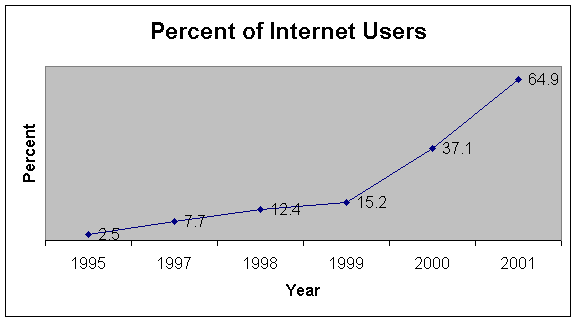
Percentage of Internet
Users in
While e-mail is most often the first CMC service
experienced by new users, it does not always remain a preferred choice. Sending
and receiving e-mail was the dominant on-line activity in 12 countries over the
first six months of 2002, according to the Nielsen//NetRatings: First Quarter
2002 Global Internet Trends report. Nielsen//NetRatings found that at
least 75% of households with Internet access participated in e-mail (http://www.nielsen-netratings.com/).
The China Internet Information Centre (www.china.org.cn) however reports that
e-mail usage in
“
“The decrease is due to a decline of the number of free
e-mail boxes available, a more rational use of web resource and an increase of
various ways of communication,” said Wang Enhai, an official with the Centre.
Many websites accelerated their pace to charge e-mail service and web users
began to give up superfluous e-mail boxes.
The average number of e-mail boxes owned by every web user dropped from
3.9 two years ago to 2.6 last year, and to 1.6 now (Shanghai Daily
At the same time an increasing number of young Chinese
people are reported as going on-line to collect information, “find love” in
chatrooms and play games.
Statistics from China Internet Network Information Centre
showed that by the end of last year, Internet surfers in
More than 50 percent of teenage cyber-surfers in big
cities across
Chinese teenagers spend an average of 30 minutes each day
browsing the Internet, the survey shows. Outside of
1.2.2 Electronic chat
Early forms of text based interactive sites began in the
mid to late 1980s with Internet Relay Chat (IRC) and MUDS (Multiple User
Dimension, Multiple User Dungeon, or Multiple User Dialogue).
1.2.2.1 IRC
Internet Relay Chat
(IRC) is the most used on-line chat software and has many individual server
companies. The figure below shows IRC net in comparison with several other IRC
servers. The table below helps show the popularity of different chat clients.
What is central to this thesis is that as more people begin to connect to
on-line chatrooms the social and cultural importance of the transferring of
meaning via texted chat will increase – and so will the variations to standard
communicative techniques.
|
Year |
DALnet |
EFnet |
Galaxy Net |
IRCnet |
MS Chat |
Undernet |
Webchat |
|
Max. 2000 |
78333 |
63985 |
16737 |
84231 |
15288 |
74945 |
17724 |
|
3rd Q.
1998 |
21000 |
37000 |
n/a |
24500 |
n/a |
24000 |
n/a |
IRC-Statistics / Kajetan Hinner (http://www.hinner.com/) through the year 2000.
(The statistics above are from the individual IRC servers as of November 2002)
Efnet (http://www.efnet.net/)
is the oldest IRC
network. DALnet (http://www.dal.net/index.php3)
claims to be currently the largest Internet Relay Chat (IRC) network, with over
140,000 concurrent users and 600,000 registered users, from all over the world.
The Undernet (http://www.undernet.org/)
is one of the largest real-time chat networks in the world, with approximately
45 servers connecting over 35 countries and serving more than 1,000,000 people
weekly and GalaxyNet (http://www.galaxynet.org/)
has about 25,000 users. Internet Relay Chat has formed a connectivity base in a
single decade that took the telephone more than one hundred years to make. People are using the Internet to expand their social
world. As well as uniting cultures and nations when one has access to an
Internet, communication can take place at any time. This thesis seeks to
discover how this communication amongst so many people, often of mixed social
backgrounds, is maintained. Internet Relay Chat gained
international fame during the First Gulf War in 1991[12], where IRC users could gather
on a single channel to hear updates from around the world as soon as they were
released. IRC had similar uses during the Russian coup against Gorbachev in
IRC (Internet Relay Chat) consists of various separate
networks (or “nets”) of IRC servers, machines that allow users to connect to
IRC. Once connected to an IRC server on an IRC network, one is able to join one
or more “channels” and converse with others there. On EFnet, there are more
than 12,000 channels, each devoted to a different topic. Conversations may be public (where everyone
in a channel can see what you type) or private (messages between only two
people, who may or may not be on the same channel at the same time). Conversations rarely follow a sequential
pattern, “speakers” following one after the other. There are often jumps to an earlier
speaker, or someone beginning their own thread.
This is the first departure point from “casual conversation”. When there are many “voices” at once,
conversation becomes chaotic. The only way to follow who is “talking” is
through the log-on names. To analyse conversation between two or more
“speakers” I need to “cut and paste” the “speakers” I wish to analyse. Even then it is not always clear who is
speaking to whom, unless the “speaker” names the addressee in their message.
The speech is then, seemingly inevitably, a “multilogue” or multi-directional
system, rather than the more conversationally organised “dialogue” we find in
print text (see Eggins and Slade, 1997).
Public IRC is a text-based, international,
message-handling program that is on many Internet servers. Multiple communication
channels (similar to radio channels) can be created. Between them, these
created channels and their range of topic-specific channels, their
text-mediated messaging and their capacity to conceal as well as to express
identity have introduced “communicative rituals”, which have in turned
introduced the meta-message: “Let's make-believe and suspend disbelief”
(Ruedenberg, Danet, & Rosenbaum-Tamari, 1995). Allucquere Stone, professor
in film and media at
Generically the channels which facilitate the more
conversational forms of on-line communication are variously designated “chatlines”
or “chatrooms” and provide for discussion on every conceivable topic. Access
via a client program allows users to join and listen in on (read) conversations
on multiple channels on multiple servers. With experience, four or five
different channels can be attended to at one time. Once the user logs in and
writes, one line at a time, the “talk” is distributed, via the servers, to
everyone logged on and reading that particular channel.
Jarkko Oikarinen in the Department of Information Processing
Science at the University of Oulu, Finland developed Internet Relay Chat (IRC)
in late August, 1988[14]. His
original goal was to create a communications programme which would allow users
of OuluBox[15],
a public access bulletin board service (BBS) administered by the department, to
have real time discussions on-line. Previously, synchronous on-line
communication had been limited to two participants – a process which is now
popular with Instant Messenger services (see Case Study Two). When Oikarinen
began his work, OuluBox already had a programme called Multi-user Talk (MUT),
developed by Jukka Pihl. MUT allowed users to chat in real time, but lacked the
channel concept central to IRC. The existence of channels on IRC allows users
to join in specific discussions by connecting to the channel where the
discussion is taking place, just as a user of a citizen’s band (CB) radio tunes
into a specific channel.
1.2.2.2 MUDs
MUDs as well as other constructs on the Internet, such as
MOOs (MUD-Object-Oriented), MUSE (Multiple-User Dimension), MUCK (Multi-User
Collective Kingdom) and MUSH - the “H” stands for Hallucination (Harry Potter:
Alere Flammas is a MUSH based on the Harry Potter universe at http://digital-web.net/~hpotter/)
are computer programs, which allow users to log in and explore text and
sometimes graphics based virtual environments. Multi-User Dungeons, or MUDs
present a world through text descriptions; players move around by typing
sentences. In MUDs, a user can simulate or “text” such physically impossible
activities as communicating telepathically, shape-shifting, teleporting,
creating little machine selves, and conjuring birds and pleasure domes out of
thin air. Curiously, despite the magical aura of
self-determining expressivity this suggests, second person narrative is the
viewpoint of choice for text MUDs, the user able to type in a direct command to
a character. It is the reciprocity of this unusual modality – the
capacity to respond to and outwit the “actions” and orders of others on-line –
which builds intensity and attraction into a communicative relation which is
otherwise mostly reserved for unequal power relations in “live” or embodied
conversational exchange. First person narratives,
more conventionally the stuff of expressive creativity, alienate the MUD user,
since within this particular texted universe a character focusing all actions
on “I” will be perceived not so much as enhanced in autonomy, but as
disconnected from the creative dialogue of action development. The first-person
text becomes similar to a diary or journal, the other users placed in the role
of passive readers instead of active (co) directors. Within such text-relations
we can clearly see the degree to which and the speed with which on-line “chat”
participants have evolved new, surprising, yet powerful “ritualisations” of
communicative activity. While information is clearly being transmitted in such
MUDs, it is not flowing in anticipated or neutral ways – nor in ways dictated
solely by the technology. Complex social communicative patterns are in
evolution here.
From these MUDs have in turn evolved MOOs, which allow the
players to manipulate the (virtual) world of the game, creating texted or
graphic objects and new computer programs that run within the MOO. Users “read”
these text-constituted virtual realms rather than only view them graphically –
much as one might read the extended scenario texts at the beginning of a Star
Wars film. “Action” is performed via keyboard, either as texted instruction/description,
or as key-command implementation of graphic repertoires or special effects involving
programming solutions. At core both the MUD and the MOO are imaginative
constructs: the players must render all scenes and actions mentally, from text
typed in during the course of play. Text is however an efficient medium
on-line, as with experience a few words can evoke a rich response in the mind
of the user. Text MUDs rely more on
cognition than on sensory perception. Spaces and avatars (on-line characters)
are not – or rarely - viewed on the screen, but in the player's mind. Text MUDs
are abstract and cognitive since the characters and scenes are conveyed
symbolically rather than sensorially (Lisette, 1995; Turkle, 1995, 1996; Utz,
2000; Bromberg, 1996; Cicognani, 1996, 1997, 1998). For example,

“Come to an intricate world where shadowy influences
battle for power in the realm of mortals. Join one of the many classes, and
perhaps practice the combat arts alongside your brother monks, wield the power
of the elements as a mage, or succumb to the dark delights of the vampire.
Dedicate yourself to the Divine Order of one of the ever-present Deities, or
rise to the highest stations of leadership.
Will you manipulate and scheme your way to power and
influence? Will you work to build a vast personal fortune? Will you make your
stand in the light for Truth and Renewal? Or will you strive for that to which
few mortals may aspire, to join the very ranks of the Divine?
Join us now in the Midnight Age, and step into a realm
of intrigue that will test your resolve, where you have the power to tip the
balance in the struggle between light and darkness.
Here, the fate you make is the only fate you deserve.” http://www.aetolia.com
Each user takes control of a computerized persona, avatar,
character or object. Once each has created a “self” they can walk around, chat
with other characters, explore dangerous monster-infested areas, solve puzzles,
and create rooms or worlds and the action within them. When you join a MUD, you
create a character or several characters. You specify each one's gender and
other physical and psychological attributes. Other players in the MUD can see
this character’s description. It becomes your character's self-presentation, or
“avatar” – the on-line persona who carries out actions for you. The created
characters need not be human and there may be more than two genders. Players
create characters that have casual and romantic sex, hold jobs, attend rituals
and celebrations, fall in love, and get married. In many MUDs, players help build the virtual
world itself. Using a relatively simple programming language, they can make
“rooms” in the MUD, where they can set the stage and define the rules. (Turkle,
1996, p. 54).
MUDs and MOOs are used in education as well as in social
skill development. AussieMOO (Theme:AussieMOO)
is an open-styled, experimental and research based MOO for social interaction.
There are MUDs for conferencing, computer-supported cooperative work (CSCW),
lifelong education (beyond just K-PhD), experimental psychology and philosophy. BioMOO is
a virtual meeting place for biology professionals; Cheshire Moon (Theme:
CheshireMOOn) represents the beginning of an important transition from the
traditional classroom lesson to computer-assisted learning, and CollegeTown (Theme:
COLLEGETOWN) is a text based virtual Academic Community. Its purpose is to
serve as a platform for the scholarly pursuits of students and faculty from
around the world. COLLEGETOWN is a place for folks to meet, hold classes and
seminars, do research, carry out class projects, and exchange ideas. “Folks who
share our academic vision are most welcome to apply for membership in our
community! The COLLEGETOWN server is located on the campus of
1.2.2.1.1 MUDs vs. IRC
MUDs and MOOs as with IRC and World Wide Web chatrooms can
be totally text-based. Multimedia (programs introducing graphics, audio and
video) are becoming available in all these programs but text is still the
primary means of navigation and communication. What makes MUDs and MOOs
different from IRC is that in addition to being able to talk with other people,
the user is able to move around in an environment that he or she helps to
create. With IRC, someone opens a channel, others connect to the channel to
chat, everyone enters lines of text in order to communicate, and the channel is
closed when the last person leaves. With MOOs, the user connects via telnet to
a program that is running on one computer, enters lines of text to communicate,
and disconnects when done. Chatrooms do not have virtual structures to move
around in and unless the user leaves the room and goes to another room there
are no locational moves within an individual space. With IRC there is little
more than scrolling “speech”. With MUDs the user must also know commands in
order to communicate. In both applications users can chat in real time, talk to
many people at once or send private messages, and show actions and emotions.
Chatrooms however are much simpler spaces in which to communicate, resting on
foundations of everyday conversational practice, as this thesis will
demonstrate – albeit with additional layers of communicative practice already
beginning to emerge. Despite many fascinating features of MUD and MOO communicative
practice, this thesis is centred on the performance of users in text-based
chatrooms and not MUDs or other role-playing or virtual environments where
participants act out character roles in imaginary worlds, all described in
text. Like IRC, MUDs provide real-time chat, usually accessed by telnetting
into a remote Internet-connected server, whereas IRC can be accessed via the
World Wide Web. The technical difference between the two is essentially that a
MUD or MOO can be programmed, compiled, and saved while it is still running.
This means that the MOO does not have to be shut down for work to be done on
it. In order to program in IRC, however, it must be shut down, hacked,
recompiled, and started up again. And when an IRC channel is closed everything
shuts down and all communications contributed are lost. However when a MOO is
closed any visitor can re-open it and have an environment still in place, with
all the objects left by others. At this point the technology itself influences
the durability of the creation – and so of the autonomy of the users, and
arguably at least, of their focus into and commitment to the site. It is
perhaps in real world terms, the difference between casual visits to an
established social setting, such as a bar or café, which may or may not become
a preferred regular meeting place, and joining a special-interest club, set up
for and controlled by members. As French theorist Henri Lefebvre (1995) has
pointed out, it is the social geography of locations which facilitates the various
forms of social engagement experienced in everyday life, and the insight
appears no less true of the virtual “spaces” and “sites” of on-line
communication. But how have we come – and come so quickly – to regard these
“texted” or mediated, symbolic worlds as able to constrain and shape
communicative relations? And how might we be able to employ analytical
techniques evolved to uncover the regulatory systems behind communicative
practices in the physical world – talk relations between co-present speakers –
to scripted or programmed “talk texts” exchanged between non-present
participants in a CMC space?
1.3 New paradigm shifts
1.3.1 Print to
computerization
Evolving techniques to analyse the specifics of Internet
conversation, whether in chatrooms, America On-line's Instant Messenger (IM),
discussion groups, or in role playing games such as MUDs and MOOS, involves
consideration of two new paradigm shifts: the extension of print or text based
communications into the far more direct and interactive modes of CMC media, and
the changes within the already complex field of linguistics-based human
communications research, where descriptive systems-based work within pure
linguistics has moved on, to accommodate the social, cultural and political
considerations which have produced the contemporary focus on discourse
analysis. Consequently, bringing into being an “electronic interactive
conversational analysis” requires a cross over between print and
conversation-based analyses and theorizations, and a move into the broader
socio-cultural emphases of discourse.
Firstly, there is the shift from print to computerization.
Print relies on hierarchy and linearity, technologising itself into
organizational categories which privilege the producer or author over the
receiver or reader. With their focus on durability through both time and space,
print texts must carefully direct the use-patterns of their “remote” user, to
ensure that their messages remain intact. While CMC technologies have moved to
create a direct and seemingly intimate contact for users, they do so through a
communicative form soundly grounded in techniques of distantiation – a move
which can at times appear curiously regressive; for instance in the return to
screened text messages on mobile phones, a medium with more than a century long
tradition of direct oral contact. Those new forms of texting which are emerging
within CMC media thus seem to call for consideration of both print and oral
communicative practices – as well as of marked changes in the ways we have
traditionally conceived of text-based communication as separated into the acts
of production and reception.
CMC texts mix print and conversational modes, in both
production and reception. On-line texts can be hypertextual as well as or
hierarchical and linear. Webpages for example are hypertextual, with the viewer
becoming the author of how the content will follow, so that the medium promotes
an especially active “reception” of text messages, which many are arguing
amounts to a form of co-production (see Landow, 1992; Poster, 1995, 2001;
Bolter, 1991). Yet in a chatroom milieu, a communicative site often considered
the least formal or regulated in terms of genre control, there is only the
simplest of sequential patternings to structure the text exchanges. Chatrooms
differ from other forms of the World Wide Web in that only one line of text or
one graphic can be observed at a time, with the next following rapidly in
sequence and acting to de-focus what precedes it. Print media have by
definition allowed reading ahead - skipping the present and reading to the end,
or reviewing sections to check meaning - whereas in chatrooms the
near-real-time onward flow of communication limits acts of review or preview.
Textual chatrooms are not clickable hypertextually, except for entries to other
rooms or to leave the Internet all together. Chat-text is not static like print
text, but flows across a relatively small screen space, and disappears above or
below the scroll capacity at near uncontrollable speeds.
In this sense then, while chatrooms at first sight appear
much like any print form where one lines follows another, the key difference
comes from the control the user has of the medium. When the chatroom texts
scroll by there is nothing the viewer can do to prevent the next line from
appearing - unless he or she leaves the chatroom. Print media works on a flow
of conversation or writing directed to an organised progression, and a stable
retention of accessible text permitting revisiting through time. On-line chat-texts
retain as their organizing principle only the sequencing learned from
conversation, and even with many participants co-existing on one screen space,
provide no further “technologised” means for controlling or categorizing the
“braided” texts which result. Unless users select a preferred line of talk from
the screen, and negotiate to shift their talk-partner into an alternative
software service – such as one-on-one chat via Instant Messenger – chat-texts
fragment into the sorts of multi-directionality which most speakers have
trouble with even in oral conversation, with its repertoire of compensatory
“focus” cues. On-line, as text scrolls by at near conversational speeds, are we
already developing similar strategies? If so, are these talk-based, or text based?
And how can we extend current techniques of both print critique and
conversation analysis to witness, capture and understand such devices as they
arise?
Within the very broad field of literary text analysis
there has been a continuum of ideas that have progressively led towards a major
debate over how to define the roles of author and reader (see the Case Studies
in this thesis for further explanation, especially Case Study One, which uses
Reader-response theory to describe the communicative process). In Communication
Studies terms more generally, this dual focus on “production” and “reception”
of messages – terms which admit oral, text, graphic, audio and screen imaged
communications into consideration – has followed the same developmental
paradigm, moving throughout the twentieth century towards admission of an
increasingly active “audience/user” of mediated messages, and an increasingly
problematised concept of “authorship” or “production”.
Chatroom texts in many ways represent a peak enactment of
the dilemmas of this new paradigm of the “active user/absent producer”.
Chat-texts at the level of individual “postings” are near anonymous. Just as
some texts don't require, or create, an “author” – texts such as legends,
myths, folk stories, fairy tales and jokes – “users” or participants in
chatrooms have become accustomed to operating without the sorts of social and
contextual information provided for live conversation by the “author-ising”
presence of the speaker, and in the conventions of print texts, by the complex
apparatus of author name, publisher reputation, critical review, indices,
contents listings, glossaries, and arrangements into such structural codings as
narrative sequencing, chapters, headings, paragraphs, quote marks, footnotes,
titles, etc.
Due to most-often coded or abbreviated usernames
(usernames are discussed throughout this study, see for example: Case Study
One, Three and Seven) the author of a chat posting is not known, except through
what she or he reveals subsequently about her or him self - and notoriously,
this is not necessarily who the author is, but a created identity. The chatroom
situation is a paradigmatic case of “the death of the author” as proclaimed by
poststructuralists such as Foucault
(1969) and Barthes (1972). For Foucault,
the author is decentred within a text: no longer its originary source and
guarantee of its meaning, but only a part of its structure. So too in chat
postings, where what Foucault describes as “the author function” remains in the
tag to each posted line, which attributes each texted utterance to a particular
participant. It is the degree to which chat users still consider this a
guarantee of self-expressive authenticity or sincerity which creates the
chatroom dilemma – and much of its reputation for moral danger and duplicity:
issues taken up elsewhere in this study. If (or perhaps when) chat-texts become
viewed as on a par with movie representations or fictional print texts –
products removed from their originating “authors” by the apparatuses of
production and distantiation – this particular “author function” will change.
Just as Barthes and Foucault deny the traditional view of
the author as the only authority for interpretation and the origin of the text
and its meaning, my own study suggests that chat users are already moving to
both produce, and in turn demand from others, augmented interpretive
repertoires of an especially active “reading” of on-line texts (see Case Study
One which uses Reading-response theory to analyse the chatroom). Barthes in
particular puts into question a way of reading related to the author as an
authority. In 1968 Barthes announced “the death of the author” and “the birth
of the reader”, declaring that “a text's unity lies not in its origin but in
its destination” (Barthes 1977, p.148). For Barthes as for Foucault, the roles
of reader and writer are historically contingent, and open to change. According
to Barthes, “the author is a modern figure, emerging from the Middle Ages with
English empiricism, French rationalism and the personal faith of the
Reformation” (1977). Roland Barthes refers to the writer of a text as the
orchestrator of what is “already-written” rather than as its originator
(Barthes, 1974, p. 21). With this “death of the author”, a text is not a line of
words releasing a single “theological” meaning (the “message” of the
Author-God) but a multi-dimensional space in which a variety of writings, none
of them original, blend and clash. The text then is a collaboration of lines or
a “conversation” between this and prior texts – a point at which the second
element put into question within chat-texts presents itself: its problematic
abandonment of the sorts of structuring conventions used in other “print-based”
communicative forms.
For Barthes and Foucault texts are framed by other texts
in many ways. Intertextuality is a concept used to assert the idea that each
text exists in relation to other texts (see Kristeva, 1980;
This technology -- that of the printed book and its
close relations, which include the typed or printed page -- engenders certain
notions of authorial property, authorial uniqueness, and a physically isolated
text that hypertext makes untenable. The evidence of hypertext, in other words,
historicizes many of our current assumptions, thereby forcing them to descend
from the ethereality of abstraction and appear as corollaries to a particular
technology rooted in specific times and places. (Landow, 1992, p. 33).
Not everyone thinks that this change from
print to electronic publishing is progress. Many critics, such as Sven Birkerts
(1995), view this change as a potential disaster for literary culture and
society in general, suggesting that more is lost than a printer's bill when
books move on-line. In Writing Space
(1991), J.
Florian Brody in “The Gutenberg Elegies”
(1999) argues that people are moving away from books for enlightenment and
turning to the Internet or the electronic text.
The printed word is part of a vestigial order that we
are moving away from - by choice or by societal compulsion… [We are moving away
from] … the patterns and habits of the printed page and toward a new world
distinguished by its reliance on electronic communication (p.118).
If we are moving from “the culture of the book to the
culture of electronic communication”, Brody sees this as being a loss instead
of a gain, largely a result of the lack of distantiating detachment allowing
reflection and critical reading when e-texts move remorselessly forward, as do
chat-texts. The degree to which the electronic accessibility of text however
also permits a broadened “authorising” of viewpoints: cuts across the
categorising and regulatory control of text messages, both as author-status and
structural predictability, further enhances what could be called “the reader
function” – an opening of text to far broader ranges of interpretations. In
other words, while Brody and Birkerts, from well within the high-culture
conventions of complex literary structures and high-status authorship roles,
see the open and active audience/user/reader figures of electronic texts as a
cultural lapse, others – especially those within a Communication Studies and
Cultural Studies tradition focused on popular media and on a commitment to
broadening cultural interpretations (“reading against the grain”) – have urged
an equal if different degree of cultural power in the relatively unstructured
and anonymous or collective texts of the new media.
To follow this debate beyond the confines of established
literary textual study – dominated as it was by high-culture genres – both
moves focus back from print-based to the more fluid, conversational formats of
electronic text, and admits into the subsequent analysis of chat-texts those
considerations of social and cultural influence which Barthes and Foucault,
among others, have shown as creating both the structuring principles and the
“authorship” status of the print tradition. In both cases this moves us to
review those theories which critique the workings of language in both print and
conversational modes: the still quite loose and various conceptualisations of
language in use as “discourses” (Van Dijk, 1986).
1.3.2 Notion of “discourse”
The second paradigm shift crucial for this study is taking
place around the notion of “discourse”, parallel to the shift from print to
active electronic texting on the Internet (see Landow 1992, pp. 1-11). While
studies of “language” have consistently taken us from actual communicative acts
– speech or text – in the direction of those structuring principles which
regulate and enable such communication (Pennycuick, 1988) more recent focus on
discourse has moved to show how socially and culturally regulated language
selectively endorses or pre-disposes social groups and individuals towards
preferred activities, behaviours and attitudes. Discourse is thus important in
this study of on-line communication. Not only did the Internet arrive with just
such sets of predisposed discursive framings around its re-technologisation of
communications (Castells, 2000), but within each of the variant communicative
activities that it enabled (e-mail, IRC, MUDs, listervs, BBSs); “virtual
communities” of users rapidly established innovative discursive cultures of
their own.
In this study I focus on chatrooms - rapidly forming and
disbanding communities – which of necessity, in discourse terms, must be
annexing – and perhaps to some extent establishing – strong discursive
frameworks in order to function as communicative sites. Often participants have
never met and will never communicate with others except in these instant,
momentary communities. How then do chat
communicants establish the principles on which their messages will be
exchanged? Since participants and analysts both report insistent “policing” of
certain selective and preferred chat behaviours on-line, by both tacit and
active means, how have such behaviours become established, constructed around
which models and criteria, and signalled in which acceptable or unacceptable
practices – given the limitation of behaviour to texted language?
1.4 Purpose of examining on-line
conversation
This research on electronic communication is being
undertaken at the same time as chatrooms are being used more (Mogge, 1999; Langston, 1996; Harrison, and Stephen,
1995; Communication
Institute for On-line Scholarship - http://www.cios.org). On-line communication has become common
practice. On-line statistics change rapidly and there are several companies
that track moment-by-moment usage of Internet usage and participants in
chatrooms. (See: Cyber Atlas, http://cyberatlas.internet.com;
Internet Statistics, http://www.internetstats.com;
Nielsen net ratings, http://www.nielsen-netratings.com/;
Internet Society http://www.isoc.org/internet/history/).
What is really happening in this new form, and why is it spreading from
specialist to broad social categories of users? Are all chat users experiencing
and producing the same discursive forms in their chat use? Are there universals
or sub-cultural differences – and how far can discourse analysis help us to see
how, and why, these might be emerging?
Like other areas of the Internet, chatrooms rapidly
established regulatory sets of etiquette, and rules of cybersense are
continuously evolving. Netiquette customs and practices began in the late 1980s
with the widening use of e-mail and have been adopted in order to promote effective electronic
communication[16].
Netiquette has different rules for different on-line formats. The most
generally accepted Netiquette behaviours are based on having respect for others
in the on-line community. For example, using ALL CAPITAL LETTERS is considered
shouting and is hard on the eyes; “Flaming” or attacking others in the on-line
community or inciting or provoking an argument are considered unacceptable to
other users and often evoke banishment from sites by site supervisors, and
“Spamming” - posting something in many places at the same time – is both
actively discouraged and open to technical blocking via protective software.
Beyond these relatively extreme sorts of unacceptable
communicative behaviour however lie many more subtle instances of misapplied
on-line communication. Jill and Wayne Freeze point out in their book
“Introducing WebTV”:
..what is written is not always what is meant. A fair
amount of meaning relies on inflection and body language. It is best to clarify
a person's intentions before jumping to conclusions or getting defensive.
(1998, p. 135).
Since “rules” are
already widely established in on-line communication - for instance, the
convention that capitals imply shouting has extended from e-mail to text-based
chatrooms – it is worth examining whether other regulatory impulses are
becoming equally consensual and universal in e-communication practice. Other,
more subtle conventions may be developing, as well as widespread conventions
for the abbreviated “talk” of CMC sites. This thesis will propose that such regulatory
behaviours are arising not at random, but in ways which reflect the discursive
framings of contemporary social and cultural realities – which include for the
first time significant formational influence from the “virtual” realm of
mediated CMC activities. What may have seemed small and insignificant
conventions, established who knows when or why, operating on the specially
reserved space of the Internet screen, have spread rapidly, extended immense
regulatory power, endured, jumped communication channels (eg from IRC to SMS on
mobile phones) and thus declared themselves meaningful or discursively active –
for discourse, by definition, constrains both concepts and actions. If we find
ourselves accessing punctuation keys to add a small smiling face to an e-mail,
or moving into numeral keys to produce phonetic abbreviations, we are forcing
both our text-composing minds and our keyboarding/screenscanning bodies into a
discourse – and anticipating that our correspondents will too. How universal
may these new behaviours become – and will they attain the power to move beyond
CMC usage and impact upon older communications genres and formats – as
contemporary press reports suggest?
1.5 On-line usage
More and more people are communicating through electronic
on-line services. It is difficult to
estimate the number of users on-line at any one moment. A large number of
surveys of on-line usage are available. According to Nua Internet[17] an
estimated 513.41 million users were on line as of August, 2001. Netsizer (http://www.netsizer.com/) has a counter in
real-time on their site showing both how many hosts and how many users are
going on-line every second. During the re-write of this thesis as of
1.5.1
Problems of researching on-line
Research on-line is different from face-to-face research.
In investigating Internet based communication one comes across a different set
of problems - such as the researchers not being able to verify who the writer
of the text is, thereby determining whether the writing has any validity to it,
and not knowing if what is read is a cut-and-paste of several other writing
sources. Chatrooms offer even more complications to research.
Firstly, I have identified during this study four key
problems of researching on-line: identifying the “speaker’s” intent in joining
the chatroom; selecting from the enormous range of chatroom material for
analysis; identifying those people in cyberspace using multiple names, and a
consequent inability to do follow up work with participants. The distantiation
of the “texted” on-line talk; the capacity for and so invitation to identity
concealment, together constitute advantages for the self-protecting on-line
communicator – but problems for the conventional social-science researcher.
Those assumptions arising from “author function”, as outlined above, mean that
expectations of sincerity or authenticity in on-line communication must be
moderated – if not abandoned. While the personalisation and informality of
on-line texts invites disclosure and spontaneity, these are no guarantee of authenticity
– and, as this study, alongside many others, will confirm, there is a great
deal of counter-evidence for on-line communication as a performative and
calculated activity.
Add in the problems of intertextuality and the technical
ease of cut-and-paste message composition, and expectations of authorial intent
and expressiveness become very problematic. The dilemma is compounded in IRC by
the “multilogue” nature of the discussions. With multiple on-line “authors”,
each with decontextualised origins, who may or may not be reproducing others’
texts, how are the discursive framings established?
Secondly, there is the sheer enormity of the task in analysing
chatroom “talk” as if it were one, stable entity. With millions of chatrooms
there is a wealth of material. Any “sampling” must acknowledge its
specificities, and the impossibility of establishing “universal” rules for all
(chat) spaces or eras. I have narrowed this topic to a very few chatrooms,
concentrating on seven chatrooms in seven case studies - although I have used
several other chatrooms to show a characteristic that may not have been obvious
in one of the chatrooms I “captured”. But this is a minute sample of what is
available. The study therefore is designed not to outline for all time what on-line
chat “is” or how it is “produced” – since the conditions I uncover may already
be past. For instance, one problem with a study of anything involving a
consumer technology is the inbuilt obsolescence and the subsequent brevity of
its relevance.
In this thesis I argue that text-based chatrooms are
already being augmented by other CMC technologies, to the point that currently
chatrooms have many features in common with telephone and Internet conferencing
communicative devices. But at a moment when both of these are moving to video
services, much of what I establish here as “communicative enhancements” to
supplement a visually-deprived communication, may also change. Instead, what I
hope to achieve with this study is to persuade communications scholars and
Internet users generally that what may seem transient, trivial or temporary,
was in itself richly meaningful, and that even the most fleeting of
communicative regulatory systems in one of the most seemingly reduced or
fragmentary forms – which I propose Internet Chat to represent – is still
formed within predominant discursive systems, and able to carry complex
communicative intent.
How
then can “communicative intent” be considered, when, as I admit in my third
problematisation of on-line research, people in cyberspace often change their
name for use in other chatrooms, and sometimes even within a single chatroom?
For example, in an academic chatroom where there is scholarly discussion about
an issue a person may log in as “laProf”. In a sex-chatroom, the same person
may be “lovelylegs”. In a political chatroom the person may choose to be
“senator”. One's on-line character is only part of one's on-line repertoire. A
person can be a feather, fire hydrant, cloud or a riverbank. How the person's
“speaking” persona changes in different chatrooms is an area I explore
throughout this study, not to pursue the theme of on-line identity formation,
common in first-generation Internet study (eg Turkle, 1995, 1996; Rheingold,
1991; Castells, 2000) but to examine how far language itself shifts with
persona change. My first assumption (see Methodology, 3.2. Key
Assumptions) that people change their text-self in different
chatrooms will bring to the fore some of the ways in which such changes might
be described and identified. And it is in doing so: in shifting critical
attention away from the problem of on-line identity as always at least
potentially performative rather than fixed and essential, and instead focusing
on how such performances are enacted, that this study re-routes around the
dilemma of intent. My focus is on what occurs, rather than on what might be
intended - and on how regularly recurring patterns of “occurrence” may be able
to reveal consensually established communicative “rules”.
One methodological constraint which on-line
research at first sight appears to have the potential to overcome is the
capacity to “return” research findings for verification by research subjects.
Given the speed and ease of file exchange, it might be anticipated that
research results on-line could be quickly and accurately assessed by the
original data providers. But in the event, as I indicate in my fourth aspect of
on-line research shortcomings, there is an inability to do follow-up work with
participants in chatrooms. Unless a research subject is identified – accurately
– on-line, and their e-mail address is noted so that they can be tracked within
chatrooms, they become lost to the researcher.
Rarely are the same people in the same chatroom at the same time, so
that on-line chat studies cannot be replicated. And while in early pilot
studies I intervened in chat sessions to outline my project and seek
cooperation – a technique which research ethics required throughout this study
– it rapidly became evident that for many if not most on-line communicators
this acted as an intrusion into the flow of communication: one which they did
not necessarily reject, but which altered, at least for a time, the
communicative dynamic. Their response raises a further contradiction in on-line
communication: its curious and perhaps unprecedented status, somewhere between
the personal and the public.
1.6 Are
Chatrooms Public or Private?
One of the first issues that must be addressed by the
researcher who examines chatrooms is whether chatrooms are public or private
spaces (see articles in the journal of on-line studies, Cybersociology)[21]. All exchanges
within chatrooms, accessible to the public, are legally public, unless there is
a notice saying all the dialogue is copyrighted. A chatroom where the participant
has to log on as part of an organisation such as a university, company or
government web site can be regarded as private and confidential – at least to
that specific community of users. The behaviour of the participants on such
sites may be different from a chatroom that is open to the public without any
registration details, e.g. e-mail address, and where participants make up
usernames which do not reflect or identify them – although there is increasing
evidence from this and other studies that a strongly-emergent “chatroom style”
often overcomes site-specific communicative regulation .
This issue of public access versus privacy is one I had to
consider in regard to ensuring that methods I chose for my study complied with
the principles of ethical research. Mark Poster (1995, p.67) argues that “the
problem we face is that of defining the term ‘public’” and he posits that “The
age of the public sphere as face-to-face talk is clearly over”. However,
chatrooms can be private also if two people agree to talk in a room and not
allow anyone else in. I thus define the term “public” in relation to my work as
referring to what is available to be seen on the computer screen by anyone with
an Internet connection, leaving the implications arising from such matters as
“disclosure-talk” or use of limiting “private” codes – common among “regular”
chatters on a specific site - for
analysis as the study progresses.
There are two primary categories of text-based chatroom communication. Public channels or chatrooms on the Internet that allow anyone to enter without registration are an open conversational arena and what is said is clearly public. But it is also possible to set up a chatroom which is by invitation only, such as those people set up on their computer[22] for IM or ICQ interaction, and these chatrooms are not displayed on the Internet unless the owner of the chatroom chooses to do so. This allows a number of participants to get together for a conference without anyone else knowing. Some chatrooms similarly allow chatters to use a “whisper” or private message mode, preventing unwanted chat inhibitors from witnessing the communicative act. Such activities clearly signal a belief in and desire for “private” chat, and might be expected to reveal different chat behaviours in their usage. Since it is – perhaps perversely – easier to negotiate permission to study the texted chats in such spaces (presumably because the relation of “trust” which occasions the shift into private mode also facilitates the granting of research access) this study will be able to undertake such comparative analysis.
1.7 Is cyberspace real?
There remains the ongoing question within Internet studies
as to whether cyberspace is “real” and therefore worthy of study. Judged from the energy and fervour with which
they participate, to most participants, chatrooms are “real” created
space. People are able to express ideas,
ask questions, and even to make arrangements to meet physically. Many of the same experiences can be gained
within the chatroom environment as among people at a meeting, party or at any
social gathering; “chatrooms are suitable places for developing the self
socially, mentally and culturally, as well as shaping the character traits of
the self” (Yee, 2000). Virtual communities can be as important to those who
visit the same chatroom as any community in RL (Real Life) would be (see
Rheingold, 1994, 1999; Turkle, 1995, 1996; Poster, 1999, 2001; Vallis, 1999 and
2001).
Real social
interchange in person-to-person or real-life situations with “real”
communication does however change abruptly once in an on-line chat environment
where the “other” is not known. The purpose of most
communication is not the exchange of factual information, but the establishment
and maintenance of social ties and structures: Carey’s “ritual communication”
prioritized over “transmission”. On-line,
when we cannot identify the “other” we do not know whether there is credibility in what the “other” has to say, and they have the same
problem with what we say. The traditional philosophic approach holds that
sincerity and competence are the underpinnings of credibility (Audi, 1998),
and while the distantiations of mediated and especially CMC communication have
eroded both confidence in and expectations of the former in favour of the
latter, on-line chat, like other communicative modes, proceeds as though such
guarantees were still in place. We still
need to know something about a person's social identity
in order to know how to act toward them. Even if, as Bourdieu suggests, it is
the “cultural capital” displayed in talk itself as much as anything else which
controls our communicative relation, we interpret this as in itself part of
“character” or “personality.” It is this consensus over social interaction
conducted within language which enables us to operate within on-line chat, in
the absence of other cues – and even to “chat” with those AI (artificial
intelligence) entities emerging to service our information and entertainment
needs (for instance, the on-line news avatar called Ananova at http://www.ananova.com/).
With animated images (a machine attempting
to pass as human) now “communicating” in chatrooms as well as in commercials
and even television talk shows, we can no longer know with certainty whether we
are speaking with another human or a computer program.
Virtual stars translate internationally.
They don't age or throw tantrums; they can master any language or skill, and
can appear in more than one place at the same time. “Real people have limits”,
(Lewis, 1992), but Horipro has created the world’s first virtual teen idol,
Kyoko Date. Kyoko Date is an interesting subject. It/she stands on the edge
between technology and society, and yet is capable of carrying on conversations
on-line.




KYOKO DATE: The world's first virtual idol is eternally
17. She's the daughter of a
Kyoko’s capacity for convincing chat is the ultimate
illustration of my contention that not communicative intent – since it/she can
have none – but communicative competence is the dominant marker controlling our
on-line communicative practice.
This thesis sets out only to examine actual communicative
practice. It defers considerations of whether on-line chat is “true”
communication, seeking rather to merely clarify some of the subtle distinctions
between real life and on-line virtual communication, describe how they work,
present some new research findings regarding on-line conversations that take
place within our current forms of electronic communication, and outline how
some of the analytical techniques evolved for codifying and understanding both
“natural” conversation in real life contexts, and texted communicative genres
presented for “reading”, may be extended to consideration of on-line
“chat”. (Hymes, 1974)
It explores seven text-based chatrooms
during the period of April 1998 and October 2001, using theories evolved in
analysis of conventional face-to-face conversation, to develop methods of
analysis of text-based chatrooms.
1.8 Personal interest in
researching on-line conversation
This thesis is the third phase of my academic research
into new discourse genres. The first was my BA Honours Degree (Deakin
University, 1995) with the thesis entitled, “Graffiti as Text: How youth
communicate with one another through street art,” and the second phase, moving
into new electronic communicative genres, was my Masters thesis (Deakin, 1997),
entitled, “How the Internet changes literature”. Since 1965 I have been
exploring genres of writing as an artist, combining writing and art forms as an
expression of poetic communication.
My interest in electronic communication is first and
foremost an interest in communication. How do people exchange, relate and
create meaning? Having done the 1960s in
the
It is my belief that out of this mixture of 1960s
idealism, 1970s new-age spiritual explorations, 1980s multinational marketing
and globalization and the growth of the Internet of the 1990s, a desire to
communicate with ever-broader social groupings has emerged. The paradigm has become “we are the world”. With
the growth of the personal computer, the Internet and then chatrooms, my once
idealistic pursuit of communication with different mindsets and various
cultures became a reality (for similar expressions of an intensified
expressivity, see Giddens, 1991; Turkle, 1995). After a study of 35-years of
astrology, metaphysics, literature, art and philosophy I felt as if I had found
the sort of social space I had always been looking for; a way of turn-taking in
conversation where there was not an immediate dominance of culture, gender,
philosophy, nationality or age. This
thesis examines whether or not such a possibility has indeed arrived, delivered
by what we so frequently dismiss as “Internet chat”.
2. LITERATURE REVIEW
2.0
Abstract
In examining the literature of conversational analysis and
related techniques for describing language in use, it is my intention to
discover what these techniques can tell us of how chatroom “talk” works. In
what ways is chatroom “talk” similar to or different from natural conversation?
Is it, even within its short history, one or many communicative forms? Are
there common, “core” elements, present on all web-based chat sites? Are there
specialist elements on specialist sites – and if so, is this limited to lexis,
or does it extend to other elements of “texted-talk”? Firstly I will explore
the research on electronic chatrooms that is available, seeking existing
insights into how texted-talk works, and whether these can be extended by a
fuller deployment of any of the language-in-use theories I have examined.
Secondly I will draw on the current theories of conversational analysis to see
whether it is possible, and useful, to establish a theoretical framework and
methodological focus for examining how dialogue in electronic talk operates as
a system of social meaning making within cyberculture.
I will critique books and articles by
researchers in linguistics and social anthropology which
pertain to the special features of chatroom discourse, including, in the field
of Reading-Response theory: Wolfgang
Iser (1974, 1978, 1989, 2000), Stanley Fish (1980, 1990), Umberto Eco (1979, 1986,
1995), Mikhail Bakhtin (1981, 1994) and Julia Kristeva (1980); Computer-Mediated
Communication (CMC): Charles Ess
(1996, 2000), Mark Poster (1988, 1990, 1995) and Michael Stubbs (1996, 1998): Semiotics: Roland Barthes (1970, 1975, 1977, 1978, 1981), Ferdinand de
Saussure (1916), M. A. K. Halliday (1978, 1994), Robert Nofsinger (1991) and
Chandler (1998, 1999, 2001); Speech Act
Theory: John Austin (1962), John Rogers Searle (1965, 1969) and Deborah Schiffrin (1987); Discourse Analysis: Deborah
Tannen (1989, 1998); Norman Fairclough (1982, 1989, 1995) and Conversational Analysis (CA): Paul ten
Have (1999), Suzanne Eggins & Diana Slade (1997), Donald Allen and Rebecca
Guy (1974), Erving Goffman (1959, 1971, 1974, 1981), George Herbert Mead (1934) and Sacks, Jefferson and Schegloff (1973). Theorists are
not strictly always in one “camp”. For
example, I discuss Eco both in Case Study One, where I use Reading-Response
theory to analyse the chatroom dialogue, and in Case Study Three, where I use
Semiotics to look at my data. Here I aim to construct a general theory of how the interactivity of
chatroom talk-texting relates it to both the “readerly” or the “lisible”
elements of dialogism, emergent in mid-twentieth-century reading theory; and an
account of how far the socio-linguistic theories of post-Saussurian language
studies (including especially “speech act” theory, Halliday’s “Systemic and
Functional Linguistics”, and Harvey Sacks’s “Conversation Analysis”) can
provide explanations of the communicative strategies observable in a chatroom’s
(quasi) synchronous talk-texting.
In the more specific area of direct or
primary research into chatroom discourse, I have located and systematised more
than three hundred articles on-line on chatroom communication, seventy-one of
them discussed in this literature review.
In particular, I wish to re-focus the direction of many of these
studies, from the specifics of their research goal – most often to “explain” a
particular chatroom “culture” – to the more generalised and methodological
goals of this study. For example, though much has been written about forms of
person-to-person communication in the areas of cybersex, cyber-communities, and
gender on-line, (Cicognani, 1996, 1997, 1998; Rheingold, 1993, 1994, 1999,
2000; Turkle, 1982, 1984, 1995, 1996 and Bays, 2000), very few researchers have
applied those conversational analysis theories which are used to examine
real-life social interactions to chatroom conversation itself. While chatroom
analysis is a rapidly growing area of academic research and more is available
on-line daily, most studies are directed away from general studies of this type[24].
2.1 Introduction
This literature review is an overview of
the literature both found in print and accessed on-line. The nature of my
research and the nature of rapidly changing technology have meant that the
majority of sources have been found on-line, and furthermore, that some of
these sources are no longer available. I have included copies of all e-journal
articles in my appendix for this reason.
To establish means for rigorous analysis, I “export” my
investigation of chatroom talk into the established linguistic methodologies of
work on off-line analytical linguistics. There is a growing body of print
material on hypertext, the Internet and the World-Wide-Web but there has been
little work done on analysis of interactive on-line texted-talk, which is as
seemingly borderless as other on-line texted realms. My field literature
borrows from previous research into MUDs (Multi User Dimensions) and Internet
Relay Chat (IRC), which I have discussed in the introduction to this thesis
(see 1.2.2.1.1 MUDs vs. IRC).
Overall, work in this new area of study postulates two
major features of the field:
1. That new ways of thinking about conversation
will emerge with the growing widespread use of computers as a form of
communication. (Ess, 1996; Stubbs, 1996).
2. That chatrooms involve exchange more
hastily done than in any other form of electronic talk-texting, and so
therefore more likely to respond to and reflect back the particular pressures
and influences of on-line communication (Spender, 1995).
But how might such new forms of
communication be captured, or new ways of thinking about communication itself
be constructed? E-scholarship has provided one possible answer, in what is
becoming known as the “re-mediation
hypothesis” (Grusin, 2000). Working to find ways to describe the evolution of
the graphic design and textual navigation pathways of websites as they resolve
into convention, Bolter and Grusin draw on earlier hypotheses concerning the
establishment of new literary genres. Watt (1957) famously demonstrated that
the novel, a comparatively new form of literary production accompanying the
rise of extended literacy and a largely unclassically educated leisure
readership in the eighteenth century, was built over a base of related textual
forms: the essay, the sermon, the drama, the political pamphlet, the scientific
report, the romance. Bolter (1991) and
Grusin (2000) demonstrate how similar forces operate to produce website
conventions, from magazine and press layout for the “self-directed” reader, to
the “windows” formats of familiar software applications, to the screen
conventions of television: “fenestration”, the “talking head”, image fades and
dissolves.
If users of the new web-based chatrooms
and related “docu-verse” sites are able to establish meaningful communication
within these new realms, some degree of “re-mediated” familiarity must operate.
Further, we can anticipate that this will arise only in part from the
“production” work of technology designers and programmers. As with work from
Watt to Bolter and Grusin, users extend and innovate within the frameworks
provided, finding new ways to “use” the product in an active reception. Such a
view is a truism of electronic textual theory, Landow for instance suggesting
an unparalleled compliance between CMC designers and avant-garde literary
theorists in the last four decades of the twentieth century.
But this is to suggest that to “license”
the on-line chat user’s practices into a full developmental role in producing
new communicative forms, we will need to examine the highly regulated field of
literary theory. Landow indeed shows clear convergence between on-line
practices – at least as directed by technical innovations – and high-cultural
literary theories of text production (authorship) and reception (reading). But
Landow was, and is, involved in constructing on-line hypertextual aids to the
study of conventional high-culture texts. His work focused on intertextual and
contextual studies into nineteenth century literature. While it may seem
curious to deal first with text, in a study which aims to show the relative
fluidity of on-line chat as a form of talk, it does seem necessary to consider
the degree to which comparatively recent moves to acknowledge the active role
of readers as opposed to writers of literary texts have established legitimacy
for views of language itself as made meaningful as much in reception as in
production. Given the distantiation of on-line text, as noted in the
Introduction above, the “talk” relations of on-line chat rest more securely on
text reception than those of their real-life equivalents. Active interpretation
in reception is as central to chat practice as Landow has established it is for
contemporary literary theorists.
There are many literary theories; so
many that theorist Joseph Natoli has labeled the field a “theory carnival”,
(Natoli, 1987, p. 5, 8, 13, 22). Literary theories overall have become more scientific
and specialist, according to theorist Terry Eagleton, “… as North American
society developed over the 1950s, growing more rigidly scientific and
managerial in its modes of thought, a more ambitious form of critical
technocracy seemed demanded.” (1983, p. 91). By the 1980s what emerged is what
were called “the theory wars” – a period of theory debate which raged across
all Western academic fields in the humanities and social sciences, but
established only a loose consensus on a paradigm shift to poststructuralist or
“postmodern” theories, without establishing a common set of epistemologies or
investigative methodologies. Indeed, the position taken up within poststructuralist
theory is in itself opposed to any possibility of stable or universal epistemology
(see Foucault, 1994). Even within specific fields of study, such as
linguistics, there is no agreement over study goals or tools.
One aspect of this period of conceptual
turmoil centrally relevant to the current study has been the focus on what has
been termed “the reader’s liberation movement” (Reid, 1996). Co-terminous with
the rise of hypertextual logic and CMC technologies has been a move to replace
interpretive focus on “authors” as agents of meaning, with consideration of the
“active reader” (see Foucault, 1969 and Landow, 1987, 1992). Arising first
through literary theory (Holland, 1975; Iser, 1978; Eco, 1979, 1986, 1995;
Kristeva, 1980; Fish, 1990; see Case Study One in this study) and later
extending to the concept of the “active audience” in media studies[25]
(Ang, 1996; Nightingale, 1996; Tulloch, 2001) this theorises the act of
“reception” as richly interpretive, and as firmly central to any communicative
act as the “production” of that text in the act of writing or media
construction.
This active interpretation has been extended to
contemporary understanding of the role of the on-line “reader”.
In a hypertext environment a lack of linearity does not
destroy narrative. In fact, since readers always, but particularly in this
environment, fabricate their own structures, sequences or meanings, they have
surprisingly little trouble reading a story or reading for a story.
As readers we find ourselves forced to fabricate a
whole story out of separate parts… It forces us to recognize that the active author-reader
fabricates text and meaning from “another's” text in the same way that each
speaker constructs individual sentences and entire discourses from “another's”
grammar, vocabulary, and syntax (Landow,
1997)[26].
This helps us to
position a review of active reception of print based texts alongside subsequent
examination of the interactivity of conversation, the two uniting as joint
influences on e-texted chat, in unprecedented ways. But before either strand of
review can be implemented, it is necessary to examine those studies of
web-based communication which have already been undertaken, and to isolate the
sorts of theorisation which have dominated web studies to date.
2.2
Technology of conversation
Initially, studies into web communication focused on the
innovations introduced by the new technologies themselves (see Blommaert, 1991;
Crystal, 2001; Featherstone,
1996). Case Study two introduces technology into consideration of the on-line
texted communicative act. However, a survey by WorldLingo[27] in April
2001 showed that as much as “91% of Fortune 500 and Forbes international 800
companies cannot respond correctly to a foreign language e-mail,” showing that
Computer-Mediated communication is very much in its infancy, and that even
technologies which have been available for some time have not necessarily been
assimilated into the everyday repertoire even of professional communications
practice. It seems that take-up of CMC technologies has been selective, and
that actual practice must be examined to establish the influences of these new
technologies on communication. Computer-Mediated Communication (CMC) has itself
evolved to permit the analysis of any number of aspects of the use of computers
in communication fields, such as education or language learning, as well as in
its own distinctive interactive communicative acts such as e-mail, bulletin
boards and chatrooms. Within CMC studies, methods such as Computational
Linguistics[28]
and Text and Corpus Analysis make archives of texts and use computer programs to
read and analyse large pieces of data. To this extent CMC technologies can be
shown to have impacted directly on communications use – and even on
communications research. But while many claims have been made for the
transformative qualities of CMC, there has been far less certainty, consensus,
and even in many cases, methodological rigour in the collection or analysis of
research data on CMC uses.
2.2.1 The World Wide Web
My initial search of literature spanned the period between
July 1998 and November 2000, though I have added to this search somewhat during
the remaining years of writing this thesis. The proportions of articles that I
have accessed that are available on on-line interactions are in themselves
interesting. Appendix 1 on the accompanying CD shows that fifty-six articles
are directly about on-line interaction.
Of these 62 percent are research articles about
relationships on-line and related issues. Thirty-one percent are about cyber
community and MUDs. Three percent are about the development of the on-line
self. Twenty-three percent are about MUDS and only 4 percent are looking at
on-line discourse from a linguistic point of view. So by the year 2000 we had a
marked lack of studies in this last area, with a heavy emphasis instead on
discussion of interactivity and community establishment – for the most part
without any methodological techniques for establishing or illustrating either
of these qualities or practices, beyond the assertion that they exist. As the
Internet has become more widely used, especially at the academic level, the
number of available researched articles continues to grow. In the current
studies on the World Wide Web, I have found research done on
on-line-communities, gender issues, discussion groups and cyber sex.
2.2.1.1
On-line communities
Many academics have explored the on-line communicational
milieu, including Anna Cicognani[29], who
built her Ph.D. around the design of text-based virtual worlds (1998) and Dr.
Sherry Turkle[30]
(1995) who looks at computer “talk” from a clinical psychologist's perspective.
The field literature is growing, with several people a month e-mailing me to
inform me that they are doing post-graduate study into computer-mediated
communication. There are several unpublished theses and papers that explore
on-line environments such as MUDs and MOOs as well as many discussion groups,
but once again these discussion groups look at the topic mainly from a
sociological or psychological perspective. Other writers who are working in an
academic milieu are Bechar-Israeli (1998), Camballo (1998), Cicognani[31]
(1996, 97, 98 - Cicognani develops an analysis of the architecture of MUDs,
1998), Cyberrdewd (1999)[32],
Hamman (1996, 98, 99)[33],
Turkle (1984, 1995, 1996), ten Have (1998, 1999)[34] and
Collins & Murphy (1999)[35]. There
is a growing body of on-line journals (e-zines) which contribute to
cyberculture and I have reviewed these further down in this literature review
(2.2.2).
Howard Rheingold (1985, 1991, 1994),
according to his own homepage, is the
acknowledged authority on virtual community. In his book, “The Virtual
Community”, he tours the “virtual
community” of on-line networking and questions whether
a distinction between “virtual” communities and “real-life” communities is
entirely valid. “The Virtual
Community” argues that real relationships happen and real communities
develop when people communicate upon virtual common ground. He describes a
community that is as real as any physical community. Rheingold gives examples
of virtual communities where people talk, argue, seek information, organize
politically and fall in love. At the same time he tells moving stories about
people who have received on-line emotional support during devastating
illnesses, yet acknowledges a darker side to people's behaviour in cyberspace.
Rheingold goes as far as to argue that people relate to each other on-line much
the same as they do in physical communities. It is this relating to each other
that I explore in my case studies as I attempt to determine how meaning is
exchanged between chatters.
Anders in his on-line article, “MUDS:
Cyberspace Communities” (1999), explores many forms of MUDs, such as “AberMUDs”[36],
MOOs (Multi-user Object Oriented), MUSHes (Mult-User Shared Hallucination),
MUSEs (Multi-User Shared Environment) and MUCK (
Those few examples of linguistically-based research into
on-line communications report similar “mixes” of real-life and on-line-specific
practices. Discourse analyst Paul ten Have for instance finds chatroom titles
indicating to users both social contextual information – place, race, culture –
and content:
A first
look at this collection of room names suggests two broad classes of categorisation:
first a local/national/cultural/ethnic class and second one oriented to topics,
with a large dose of sexual ones. For the first class, different kinds of
indicators are available, such as naming as in Australia_Sydney_Chat_Room, and
the use of a local language as in hayatherseyeragmensürüyor, or in combination:
german_deutsch_rollenspiele. (Paul ten Have, 2002).
Ten Have’s discussion
suggests both a sophistication in selection and “coding” of information
on-line, evolving very quickly as part of CMC practice, and a “remediation”
process in play, using existing off-line communicative experiences to construct
and regulate on-line behaviours. The “virtual” seems in many ways to be
interpenetrated by the “real” – so that researchers can expect to find on-line
issues and practices familiar in physical social communication.
2.2.1.2 Gender issues
Identity concealment on-line acts to
confuse issues such as gender, age, social background and race (see Turkle,
1995, 1996; Mantovani, 1995, 1996; Spears & Lea, 1990, 1992; Coates, 1998).
Gender is not always discernable in person-to-person off-line interactions.
On-line, it becomes even less possible to tell whether a person is male or
female, even if the person claims to be one or the other. For example, Cherny in
Gender Differences in Text-Based Virtual Reality (1994) speculates that “women's use of physically aggressive emotes
with male characters is an example of women adapting to the different discourse
style in male-dominated groups. Recent work on language as gender performance
by Butler (1990) and Coates (1998) reveals that linguistic strategies that are
acceptable and prevalent in our culture-society shape how we present (or
“perform”) our selves and our gender. On-line identity is especially fluid as
users are able to shift who they are. Gender performativity on-line is
especially interesting and it may be acting as a space for social
experimentation. Therefore chat can be studied as an important space for
research into identity work through language, and for a space indicating early
signs of social change. Gender is not a primary focus in this study, but since
it is so central to social identity; it will recur and be picked up from time
to time in my analysis.
M. C. Morgan’s “A First Look at Conversational Maintenance by Men and Women
in Computer Discussions: The Maintenance and the Meaning” is a study
carried out in a classroom setting where the gender was known. However, people
may behave differently when they know they are being observed. The researcher
uses Pamela Fishman’s argument that the “responsibility for maintaining oral
conversation between men and women falls disproportionately to the women”
(1978, 1980), and supports her findings. But can such gender-identified
research apply in chatrooms, where gender may be disguised, or not indicated
except in subtleties of on-line behaviour? The question becomes important as
researchers report conventions of gender –differentiated behaviours
transferring into virtual space. Daphne Desser’s Gender Morphing in Cyberspace (2000) is another well researched
paper with a lot of data. Desser concludes that “It is clear to me that the
ability to mask one's off-line gendered identity and to “morph” among various
gender instructions does not necessarily empower women or create safer spaces
for them. Rather, these on-line experiments present a bewildering array of
possibilities to learn more about how the power of sexism, racism, and
homophobia persist despite even our most conscious attempts to eradicate them.”
Attempts to evade or
re-route gender preconceptions prove difficult, even in virtual environments.
Lara Whelan experimented with giving her students gendered names such as Duck,
Drake, Hen, Rooster, Doe, Buck to try and discover whether the male or female
students chose which animal for their username (see Whelan,
2000). Whelan did not come up with
a definitive answer, and found that there was a problem with students firstly
not wanting to say which they chose, and secondly with some of the animals not
being known by the students as female or male animals: terms such as “drake”
and “doe” were too unfamiliar to cyber-savvy youth to drive gender behaviours.
2.2.1.3
Discussion Groups
Another source of useful information was the on-line
discussion groups which can be found in great numbers on the Internet. I have
been an active participant in one of these, called “the Languse Internet
Discussion List”[37].
This discussion list is described as being:
… dedicated to issues relevant to the study and analysis of discourse,
conversation, talk-in-interaction, and social action in general. As of April,
2002, over 1,700 people, worldwide, have subscribed to Languse.
The interactive
communicative ethos of CMC technologies has become part of my research in
interesting ways. While working on Case Study Six, in which I drew upon the
theory of Conversational Analysis, I posed the question to this discussion
group, In chatrooms would a person
signing in and lurking be considered a TCU? (Turn-Constructional-Unit, the name for the units
out of which turns are constructed.) As lurking is an important feature of
chatroom “talk”, but there are as yet no complete studies of it as a
phenomenon, I have used a selection of responses from Languse participants who
are actively doing work in this area of conversational analysis (ten Have[38], Noblia[39], Vallis[40], Bays[41], Rintel[42] and Lerner[43]). I have discussed these responses in Case
Study Six where the theory of Conversational Analysis contributes to the
development of my ODAMs (On-line Discourse Analytic Methods). In this discussion group, I was involved in an
interesting and informative discussion on the question of lurking (see on CD, lurking.htm
for the complete transcripts) showing the ways research can proceed in a
chatroom process:
…I
think the expression “notable absence” fits very well here. That's from the
early papers on adjacency pairs, prob. Schegloff & Sacks, 1974, or
Schegloff 1968… (ten Have)
…when
I was doing my thesis on chatrooms I wondered about the same thing and in the
end I decided to go with treating “lurking” as members oriented to it. That is,
the members in the chatrooms I studied seemed to treat 'lurking' as “presence”
rather than a “turn” in conversation… (Rhyll
Vallis)
…a
lurker prefers to remain "silent" at least in the public arena,
because we don't know really if he or she is pursuing a private conversation on
a different level… (
…Whether
“turn-taking” “exists” in chatrooms is a difficult question. I agree with Rhyll
Vallis's answer (glib generalization: “it depends on how members orient to it”)
and Hillary Bay's answer (glib generalization: “the system's technical
structure makes turn-taking very different from FTF interaction turn-taking, so
it needs to be evaluated on its own merits”), but think that a more interesting
question is what work (for academics, for users, for designers) would proving
that it “does” or “does not” exist (and
“is” or “is not” similar to FTF turn-taking) do? What do we gain from
the answer (explanatory power, political
power, etc) Afterall, almost ALL of the interaction is visual and cannot be
spoken, contrary to the definition given by SSJ and by Paul ten Have, more
recently, have expressed…” (Sean
Rintel)
There was little agreement on whether lurking in a
chatroom is a form of “speech”, and Rintel’s response in particular alerts us
to the ongoing difficulties of linguistic analysis in chat spaces, where so
much of contemporary linguistic analysis encounters just such problematic
differences. Any analytical study of on-line communications, such as that
proposed here, must return to examine CMC practices with all their specific
qualities, before attempting to apply research techniques transferred from the
otherwise rich resources of sociolinguistic – or any other – study. And on-line experience itself, as with the
discussion above, remains a useful illustration of this as a research problem.
2.2.2 The literature of CMC
There is an ever growing mass of literature (Rheingold,
1985, 1991, 1993, 1994, 1999, 2000; Stubbs, 1996, 1998; Herring, 1994, 2002;
Jones, 1995, 1997; Donath, 1998, 1999; Schiano, 1997) which addresses CMC
techniques and compares them to other modes of communication.
The first issue addressed in contemporary CMC studies is
the insistence that CMC is not in itself an isolated “driver” of communicative
innovation. Most theorists are opposed to technological determinism, and
consider rather that CMCs are in themselves driven by precisely the same
processes which structure those communicative acts, which they subsequently
enable. Charles Ess (1996), in “Philosophical Perspectives on Computer-Mediated
Communication” may talk about how “Rhetorical Theories derive their basic
orientation from the modes and technologies of communication that prevail in a
given society, and new technologies and communication practices propel the
evolution of new forms of consciousness and culture” (Ess, p.237), but other
theorists (see especially Landow, 1992) see only a simultaneity in the rise of
new technologies and new cultural theories, while UK technology historian Brian
Winston (1998) reminds us of the length of time new technologies – among which
CMC technologies are prime examples – take to achieve cultural centrality.
Without some “supervening social necessity” Winston suggests, many technological
innovations remain inert. And when a technology achieves the centrality
witnessed in recent CMC uptake, it must also demonstrate cultural sympathy to
dominant conceptual paradigms – of the type uncovered by Landow. Whilst discussing Nelson, Derrida, Barthes
and van Dam, Landow (1992) states:
All four, like many others who write on hypertext and
literary theory, argue that we must abandon conceptual systems founded upon
ideas of centre, margin, hierarchy, and linearity and replace them by ones of
multi linearity, nodes, and networks (1992, p. 63).
When technical writers and cultural or textual
theoreticians speak at the same time in the same frame, it is easier than
usual, Landow suggests, to detect a dominant cultural paradigm in play. It is
possible then to concede that on-line chat, one among many forms enabled by CMC
technologies, may reveal equally dominant cultural formations within its
otherwise distinctive meaning-making processing. But, as Landow recognises,
meaning-making within the interactive paradigm enabled by CMC may permit and
even participate in concepts of cultural dominance, but it does so from within
a Gramscian view of “hegemonic” or contestational cultural formation. Castells
(1997) points out that central to CMCs is a strong shift away from
“institutionalising” identity formation which he terms “legitimation”, and even
beyond “resistance” identity, towards the “project” self of late consumer-led
capitalist production, in which constantly shifting and multiple meaningful
identity formations are made and remade daily, within variable and mobile
locations. Within this intensified variability, CMCs themselves act as agents
of intensification, providing not only so many more cultural “spaces” for
meaning-making transactions, but marking those spaces with increased
consciousness of the “virtual” or experimental basis of the activity. To this
extent CMC technologies can be said to “legitimise” interpretive work: text
production and reception – as a newly dominant cultural activity. And if so,
then it becomes more urgent to consider the exchange relations in play within
that activity: exchanges conducted in virtual space, with diminished social
markers available to participants, and a commensurably enhanced focus on
language use.
2.2.2.1 CMC and on-line
talk-texting
There are several prominent journals on CMC on-line,
including the Journal of
Computer-Mediated Communication[44] from
the
… each person who is connected to the chat's server
appear as a circle. When the user posts a message, their circle grows and
accommodates the text inside it. Postings are displayed for a few seconds (the
exact time varies depending on the length of each posting) after which they gradually
fade into the background. This approach mimics real life conversations where at
any given time the focus is on the words said by the person who spoke last.
Over time, those words dissipate and the conversation evolves. The sequence of
growing and shrinking circles creates a pulsating rhythm on the screen that
reflects the turn-taking of regular conversations. By building visual
interfaces to on-line conversations and their archives, our goal is to increase
the ability of this medium - computer-mediated discussion - to carry subtler
and more nuanced messages, both by giving people a richer environment in which
to interact and by providing them with greater insight into the underlying
social patterns of their virtual community.
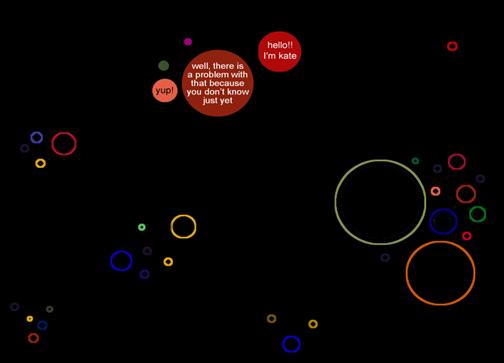
The
point of view is that of the red circle (shown saying “Hello I'm Kate”). As she
moves from one location to another, different conversations are brought into
focus.
http://www.ascusc.org/jcmc/vol4/issue4/donath.html (viewed on-line
I have not however found any chat site with this model of
presentation, and the two models which are thriving in Internet communities,
text-based chat and 3-D chat sites, continue with the limitations on “subtler
and more nuanced messages” – suggesting, as I consider throughout this study,
that there are in fact expressive and interpretive systems in play which can be
picked up with careful analysis, and shown to satisfy existing users.
One of the world's first peer reviewed electronic
journals, The Electronic Journal of
Communication[45] is a
part of the large on-line site, “Communication Institute of On-line
Scholarship” with articles and links to many studies being carried on in the
area of electronic communication. Several of the journals that have been useful
in this thesis include: “Computer-mediated communication”, Volume 3 (2) April
1993 (edited by Tom Benson); “Computer-mediated Discourse Analysis”, Volume 6
(3) 1996 (edited by Susan Herring); “The Future of the Internet”, Volume 8 (2)
1998 (edited by Peter White); “Community Networking: Mapping the Electronic
Commons”, Volume 11 (2) 2001 (edited by Joseph Schmitz); and two issues of The
Electronic Journal of Communication with the article, “A Digital Divide? Facts
and Explanations” to be on-line early 2003: (edited by Jan van Dijk) and “Liberation in
cyberspace…or computer-mediated colonization?” (Ess and Sudweeks). Computer-Mediated Communication
Magazine[46]
ran issues from May 1994 to January 1999, reporting about people, events,
technology, public policy, culture, practices, study, and applications related
to human communication and interaction in on-line environments. The only issue
that is particularly useful for this study is Organizer Participation in an Computer Mediated Conference Volume
5, Number 6 / June 1, 1998, in which the author hypothesizes that there is a
relationship between the number of messages posted to an on-line conference by
the organizers of such a conference and the number of posts made by the
participants. Organizers must continue to actively participate in their
conference in order to insure that participants will also actively participate.
I have found this to be true in moderated chatrooms (see Case Study Six) where
the moderator, like the organizer in an on-line conference, needs to keep the
“talk” going by contributing, and answering each turn taking. The insight
confirms the interactivity central to CMC and especially to chat, returning the
active user to the core of the equation. The “computing” part of the CMC
formula is useful for the analysis of CMC usage as the researcher is active
during the collection phase of data by being in the research. Computing can be
used to assist in the minute and detailed examination of the reams of chat
exchanges produced daily on an ever-expanding list of sites by collecting and
sorting the data instantly.
2.2.2.2 Analysing electronic textual data
Computational linguistics involves the use of computing
and its powerful capacity for measurement and detection of recurrent patterns,
in the analysis of complex networks of language construction. In Foundations of Statistical Natural Language
Processing, Manning and
Schütze (1999) give an overview of one form of computer analysis of language:
natural language processing (NLP). Their work presents
all the theory and algorithms needed for building NLP tools. While such models
may seem ideal for handling the vast numbers of talk-transactions within daily
chat use, research into text-based conversational analysis is not yet
encompassed in NLP. At one level, I share Manning and Schutze’s concern with
analysis of real language, focusing on language in (on-line) use.
Analysing patterns of words and grammar in chatrooms,
Instant Messenger, and within discussion group environments, will present
challenges not faced in other forms of textual analysis. Linguistic researcher
Michael Stubbs begins his book, “Text and Corpus Analysis” (1996), with the
question: “How can an analysis of the patterns of words and grammar in a text
contribute to an understanding of the meaning of the text?” (p.3). Stubbs
continues with an explanation of text, which will be the working definition of
text I will use in my own research:
By text, I mean an instance of language in use, either
spoken or written: a piece of language behaviour which has occurred naturally,
without the intervention of the linguist. This excludes examples of language
which have been invented by a linguist merely to illustrate a point in a
linguistic theory. Examples of real instances of language in use might include:
a conversation, a lecture, a sermon, an advert, a recipe... (Stubbs, p.4).
Chatroom talk, despite its
apparent artificiality in that it is constructed through CMC and represented in
script, is such a form of “natural” language in use. And, since it is already
transported by the complex algorithms of CMC, why not re-apply them to help
explain its techniques? The problem with NLP is in its focus on “processing”,
or the reconstruction of individual pathways of meaning-making. Without
tracking individuals it is impossible to know how an individual is dealing with
language – and chatrooms move too fast and are too enmeshed in cultures of
anonymity and even active identity concealment and experimentation, to conduct
ethnographic follow-up on meaning processing.
Such work is useful for people doing research into text-based chatrooms
in areas such as education, where students can be accessed in person to find
out how they process what is on the screen. But for on-line chat analysis, at
least at this period of its history, study cannot depart from what is available
on the screen. Further, with chat-texting (and its mobile telephony variant SMS
texting) having so rapidly and so recently developed an entirely new repertoire
of linguistic abbreviations and codes, on-line chat must be described and
codified, before it could be accessible to NLF structuring codes of analysis.
In its current developmental phase, such work seems especially problematic –
yet another illustration of the degree to which on-line chat seems to be
producing qualities which defy easy application of existing communication
theories or means of analysis. Are we then able to conceive of the current CMC
literature as beginning the groundwork for establishing the specifics of CMC
practice, and use at least the dominant threads of CMC scholarship to date, to
focus the central dilemmas for analysis of on-line chat?
2.2.2.3 On-line writings on
CMC
There are already many articles on CMC and in recent years
the literature on-line has been rapidly growing[47].
Search engines on the Internet result in the discovery of any number of
articles one wants to review, many of them grounded in actual practice, and
keen to extrapolate to overviews of how on-line communication “is”.
That said, it is also important to realize that not every
form of on-line talk provides equal access to productive techniques of
analysis. For instance, Edward A. Mabry in “Framing Flames: The structure of
argumentative messages on the net” (2000) hypothesizes that “framing strategies
are related to the emotional tenor of a disputant's message, and that a
speaker's emotional involvement with an issue should be curvilinearly related
to the appropriation of framing as an argumentative discourse strategy.” Mabry carried out an analysis of 3000
messages, obtained from a diverse sampling of computer-mediated discussion
groups and forums. He wanted to find a
correlation between on-line argument and off-line person-to-person argument.
The obvious conclusion was that without physical cues arguments on-line cannot
be fully determined as effective. This work may seem immediately relevant to
tracking meaning-making in chatroom talk – yet Mabry’s work was on on-line
discussion groups, where long postings are common, and where topics are very
clearly focused. I found I could not translate
his findings into a text-based chatroom as the feature of fleeting-text (see
Case Study Five) and the constantly appearing and disappearing authorships
(chatters coming and going and lurking – see Case Study Six) make it impossible
to track arguments. While argument clearly exists in on-line chat, the format
restricts its full development.
In text-based chatrooms not only are the two categories of
initiating messages and continuing messages present at all time but because of
the nature of threads (see Case Study Four) the multilogue of chatters and the
presence of lurkers (see Case Study Six) and the never ending chat (chatrooms
can be going for years with no stoppage) it is difficult to determine the path
of messages, especially whether they have “dead ends”. Mabry’s arguments do not
hold up when one considers that the Internet never sleeps and neither do
mailing lists; making it difficult to say that there is a beginning or an end
to any on-line communication. Simple conceptual structures will not transfer
from CMC application to application, and are eroded by the very conditions of
CMC technologies themselves: their boundarilessness and incessant
interactivity.
2.2.2.3.1 Universal language
In the Volume 12 Number 2, 2002, issue
of “The Electronic Journal of
Communication” several papers were published from those presented at the
second biennial conference on Cultural Attitudes towards Technology and
Communication co-chaired by Fay Sudweeks and Charles Ess, and held in Perth,
Australia, 13-16 July 2000. The journal
issue entitled “Liberation in Cyberspace … or Computer-mediated Colonization?” raises the
question of whether CMC can be effective on a world-scale, as there are severe
cultural differences that make communication via computers on the Internet and
the Web difficult to maintain and understand[48]. Though there is much
written on CMC the effect between cultures has had little attention paid to it.
I address how different languages are to be auto-translated so as to be
readable in any language in the discussion of this study (see 5.3,
“Will chatrooms as part of an on-line discourse become a universally understood
language?”).
But problems remain in relation to cultural contextualisation of communication
systems and exchanges – a further indication of how far simple or reductive
commentary on Net communication in its early phases, may prove inadequate as
increasing numbers and increasingly diverse communicative “communities” come
on-line. Analytical work of the detailed kind urged in my own study:
linguistically rigorous, yet attentive to social and cultural contexts, must
attend to inter-cultural and cross – cultural communications, rather than
postulate “universalist” explanations of on-line practices.
2.2.2.3.2 E-mail
Next to e-mail communication[49],
chatrooms are of primary CMC importance, in terms of both use rates and the
complexities of communicative exchange – and yet even e-mail services are only
in their infancy, in terms of our understandings of what is actually achieved
in this form of on-line communication. Kirk McElhearn’s Writing Conversation: An Analysis of Speech Events in E-mail Mailing
Lists (2000)[50] expands on Gruber’s (1996) four
possible types of message posted to a mailing list. Gruber outlined strategies
such as: initiating messages which successfully stimulate a new discussion;
initiating messages which fail to stimulate further discussion; continuing
messages which cause further discussion, and continuing messages which are
“dead ends”. This set
of categories can be used to define chat-types as well (see 5.2 Features
of chatrooms) – but even in the early phases of chat, is it a sufficient
analytical categorization? As chat matures, and especially as different social
and cultural groups – real life or on-line developed – begin to assert
identity, will these categories continue to be meaningful, or to convey all we
need to understand of how chat works?
According to “Consumer Technographics Brief On-line”, chat has three
times the users it had in 1999[51]. With the use of the Internet, distance and time differences seem to
play a more important role within chat practices – features unimportant for
asynchronous e-mail. An e-mail message can be read at a later time, however,
for chatrooms people need to be physically present, although usually at
different locations – and the complex interaction of these complex modes of
“absent presence” is still not clearly described or analysed in communications
terms. My research shows that in CMC
literature the least discussed is the “real-time” communication and this study
undertakes to bring this form of CMC to the forefront.
Trevor Barr breaks down the different kinds of interaction
on the Internet into six categories:
·
one-to-one asynchronous remote
messaging (such as e-mail);
·
one-to-many asynchronous remote
messaging (such as “listservs”);
·
distributed asynchronous remote
message databases (such as USENET news groups);
·
real-time synchronous remote
communication (such as “Internet Relay Chat”);
·
real-time synchronous remote
computer utilisation (such as “telnet”); and
·
remote information retrieval
(such as “ftp”, “gopher” and the “World Wide Web”) (Barr, 2000)
As more services evolve within each
category, the need for descriptive and analytical techniques to capture and
understand differences both between categories, and within categories as used
by different populations, increases in urgency.
2.2.2.3.3 Role playing chat sites
“Your words are your deeds; your words are your body.”
(Turkle, 1995)
“Multiple-User Dimensions”, also known as ”Multi-user Dungeons”
(MUDs) are role-playing chatsites which have played a large part in the
development of what has become the popular current text based chatrooms. There
has also been more research on this area than any other area of the Internet,
beginning a wave of research and discussion on Internet interaction at the end
of the 1990s. MUDs are more behaviourally oriented than most chatrooms, and so
have been studied extensively by sociological and psychological researchers,
because they have more to do with gender, sex and role-playing than simple
text-based chatrooms. Chatroom users may
not even respond to someone else or indeed be involved in any discussion (see
Case Study Six on lurking), however MUDers tend to display high levels of
commitment and focus on their site activities. Most MUDs are text based, i.e.
all activities on-line in this environment are based on keyboard commands. As
technology advances more MUDs as well as chatrooms will have a more multimedia
presence; people will add sound, graphics and animation to their interactions,
but in the meantime such sites have much to offer researchers seeking to
understand the innovations and practices arising within texted interactive
communication.
On-line there are several academics and researchers who
have written on MUDS[52].
Frank Schaap’s thesis for the Master of Arts Social Anthropology at the
In
chatrooms conversations are informal and often experimental with participants
experimenting with various personae as virtual conversations can have little to
no real life significance… (Turkle, 1995).
The popularity of MUDs and other role playing areas can be seen by
going to some of the larger sites which list many MUDs available on the
Internet, such as, http://www.mudconnect.com/,
which provides a frequently updated list of text-based MUDs. On this site over
1400 MUDs were described and listed (as of
We are using life on the screen to engage in new ways
of thinking about evolution, relationships, politics, sex, and the self. When I
began exploring the world of MUDs in 1992, the Internet was open to a limited
group, chiefly academics and researchers in affiliated commercial enterprises.
The MUDers were mostly middle-class college students. They chiefly spoke of
using MUDs as places to play and escape, though some used MUDs to address
personal difficulties. By late 1993, network access could easily be purchased
commercially, and the number and diversity of people on the Internet had
expanded dramatically. Conversations with MUDers began to touch on new themes.
To some young people, “RL” (real life) was a place of economic insecurity where
they had trouble finding meaningful work and holding on to middle-class status.
Socially speaking, there was nowhere to go but down in RL, whereas MUDs offered
a kind of virtual social mobility. [55]
Her interpretations are psychological as well as
sociological. Sherry Turkle’s 1995 book, Life on the Screen: Identity in
the Age of the Internet, postulates that “the personal
computer is an “object-to-think-with” for understanding the changes computers
are inducing in our minds”. And in Seeing Through Computers,
Education in a
Culture of Simulation, Turkle writes:
RL is just one more window, and it's usually not my
best one.” These are the words of a college student who considers the worlds he
inhabits through his computer as real as RL--real life. He's talking about the
time he spends “being” four different characters in three different
MUDs--multi-user domains--as well as the time he spends doing his homework on
the computer. As he sees it, he splits his mind and “turns on one part” and
then another as he cycles from window to window on his screen. The computer and
the Internet allow him to explore different aspects of himself. As another user
puts it, “You are who you pretend to be.”
Such commentary, even when ethnographic,
takes user understandings and comments on their on-line activities at face value.
If a user suggests that “You are who you pretend to be”, then it is so. But
research at this level risks a form of universalisation or essentialising,
which runs counter to the very diversities and self-directedness which CMC
enables. If, as Turkle and her research subjects assert, CMC has opened a new
realm for social play and psychological development of self/selves, then the
innovations produced will in and of themselves be introducing new and
unpredictable – even indescribable – behaviours and understandings. It is these
which my own project sets out to detect, by applying more detailed forms of
textual analysis to the actual CMC
modalities as they evolve.
2.3 Analysing on-line conversation
I next look at the
literature of those varying methods used to capture and analyse language in
use, with a special emphasis on conversational analysis, firstly in the
narrowest sense of classic Sacksian CA, and then broadening it progressively,
to include other text and socially based accounts of how CMC might be operating.
By examining chatroom communication and adding the theories below in
parentheses to a chat-analysis lexicology, I will establish further dimensions
for electronic dialogue.
·
The reader
(reader-response theory)
·
Computers’
role in communication (computer-mediated Communication, CMC)
·
Introduction
of socially embedded elements (pragmatics)
·
What is
the language “doing” (speech act theory)
·
The reasons people enter
chatrooms (discourse analysis)
·
Details of communicative
exchanges (conversational analysis)
2.3.1 The Reader
The most fundamental difference between face-to-face
communication and chatroom communication is that is that in the latter, a
reading of text is essential. I have therefore chosen to begin my Case Studies
(see Case Study One) and the continuation of my search of the literature with
contributions addressing reading.
2.3.1.1 The Reader as interpreter
What does the literature say about the role of the reader
of a text and can this be applied to the reader in the chatroom milieu? There are many researchers, writers and
schools that concentrate on reader-response theory. One such researcher is
Norman Holland[56]
who is a scholar in English at the
In Poems in Persons,
An Introduction to the Psychoanalysis of Literature, (1973)
2.3.1.2 The assumed or
implied reader
What
Iser reveals some of what we are looking for when we speak
of “The Reader”. He begins by noting two broad categories of readers: real
readers and hypothetical readers. Iser refers to real readers as those who have
been documented; their responses recorded in some way, while hypothetical
readers are those “ideal” readers predicted within the text. Interestingly for the present study, this is
very much the case in chatrooms, where there is
“documentation” of the “real” reader’s response by noting their
response-utterance, as well as textual recording of the “hypothetical” reader,
presented in the initial text evoking response (and requiring it in “preferred”
ways). Iser however further subdivides the reader, saying that hypothetical
readers can be broken down into two groups: the ideal reader and the
contemporary reader.
There is no escaping this process, for the text cannot at
any moment be grasped as a whole. But what may at first sight have seemed like
a disadvantage, in comparison with our normal modes of perception, may now seem
to offer distinct advantages, in so far as it permits a process through which
the aesthetic object is constantly being structured and restructured (Iser,
1978, p. 112).
By reading we uncover the unformulated part of the text,
and this very indeterminacy is the force that drives us to work out a
configurative meaning while at the same time giving us the necessary degree of
freedom to do so (Iser, 1974, p. 287).
...The significance of the work.…does not lie in the
meaning sealed within the text, but in the fact that the meaning brings out
what had been previously sealed within us. Through gestalt-forming, we actually
participate in the text, and this means that we are caught up in the very thing
we are producing. This is why we often have the impression, as we read, that we are living another life
(Iser, The Act of Reading, p. 157).
Not only then does Iser give text reception
an active role within reading, but he sees that there are certain types of text
strategy which optimize the chances of this “indeterminacy”, and so invite
interpretation at a level of self-consciousness which reaches out to
identity-formation:
The ability to perceive oneself during the process of participation is an
essential quality of aesthetic experience; the observer finds himself in a
strange, halfway position: he is involved, and he watches himself being
involved. However, this position is not entirely nonprogrammatic, for it can
only come about when existing codes are transcended or invalidated (Iser, The Act of Reading, p. 134).
Iser does not analyse actual readings of texts, but
proceeds from an ideal “implied reader” to valorize readings both with and
against the predispositions of the text. For Iser, the reader does not mine out
an objective meaning hidden within the text. Rather, literature generates
effects of meaning for an actual reader, in a shared virtual space created
between reader and text. Although reader and text assume similar conventions
from reality, texts leave great portions of that “reality” unexplained to the
reader, whether as gaps in the narrative or as structural limits of the text’s
representation of the world. This basic indeterminacy itself “implies” the
reader and begs her participation in synthesizing, and indeed living, events of
meaning throughout the process of reading.
Iser writes of the interaction between a published text
and its reader. If then we take this phenomenological approach to the reading
process in a chatroom, we see how an interaction between the text and the
reader can occur, and how it focuses attention onto the text. For meaning to
occur [in a Chatroom] according to Iser, the underlying theory of a piece of
work first consists of its author and an “aesthetic” (reader) situated at equal
poles, in equal measure, with meaning production situated somewhere in between,
as a result of that interaction. The main motivation for the interaction
between text and reader is for the “space”- the “fundamental asymmetry” that
exists between them, to be filled. All texts (and this is very evident in a
chatroom) are thus made up of numerous spaces (“gaps”) in the dialogue, which I
refer to as “the chunk and chat segments”, and these spaces denote that a piece
of information has been omitted or only made implicit. This has the resultant
effect of making the reader (the witness of the chat event) find connections
and implications in what has been written, and thus become in turn “the
writer”. It is this combination of what
has been written and what has been left out, that permits the completion of the
whole picture, enabling the production of meaning. Moreover, this process is
also dependant on certain terms set by the chatroom protocols i.e. there is
some structuring of the blanks and spaces, which the
reader-witness-writer-witness has to follow. In other words, chatroom
“texting”, by both “author” and “reader-as-author”, is as complex and as
reciprocal as Iser suggests of the reading act – and as close to identity
formation. Yet at the same time it is distinctively different, arising as it
does within a CMC space, and influenced by the technological dictates of that space.
Iser has further explored how literature functions in the
human experience, saying that:
… if the reader is to identify with a text, then he or
she must combine the artistic, which is the author’s creation of the text, and
the aesthetic, which is the realization that the reader brings to the text.
Once the artistic and the aesthetic[59] are
united then the reader will enhance the text, by allowing his or her intimate
experiences to flow through the text. As the reader becomes more involved with
the text, then meaning, which comes of experience, can be used to interpret the
text (Iser, 1974, p.45).
2.3.1.3 The background of the reader (“mosaic of multiple texts”)
Kristeva in Desire
and Language; a Semiotic Approach to Literature and Art (1980), and The Kristeva Reader (1986) builds on the
works of Jacques Lacan, Jacques Derrida and Mikhail Bakhtin to examine the
speaking subject and the signifying structures of social practice. It is
Kristeva's work on intertextuality, which is useful in this study of Internet
“conversations”.
The concept of “intertextuality” was first
developed by Julia Kristeva, in connection with the numerous implicit
references in each text to other texts. No text is written in complete
isolation from other texts nor can it stand entirely by itself. Hypermedia
technology can express such intertextuality by linking selected parts of a
text, image, sound or other multimedia format with other texts, image, sound or
other multimedia format (Bolter, 1991; Landow and Delany, 1993; Landow, 1992;
Nelson, 1965, 1993).
Kristeva, like
The word's status is thus defined horizontally (the
word in the text belongs to both writing subject and addressee) as well as
vertically (the word in the text is orientated towards an anterior or
synchronic literary corpus) ... each word (text) is an intersection of words
(texts) where at least one other word (text) can be read ... any text is
constructed as a mosaic of quotations; any text is the absorption and
transformation of another (p. 37).
Essentially, every text is informed by other texts which
the reader has read, and the reader's own cultural context. The simplest
articulation of intertextuality can be seen in the footnotes that indicate
source materials to which a given text is alluding, or which are known to have
influenced the author. A constructive hypertext can make this notion of
intertextuality an externally accessible “mosaic” of multiple texts, placing
the internal connections about which Kristeva theorizes into a visible forum,
which can be expanded by each subsequent reader.
My own work seeks to extend Kristeva's modelling of the
layering of text, into the ever more complex and shifting systems of
talk-texts. By combining her highly theorised models with the analysis of
conversation and discourse linguistics, I establish both a theory-rich, and
methodologically complex, means of analysing contemporary electronic talk-culture.
And in particular, I demonstrate that the “syntagms” or text-to-text
comment-response patterns which in Chat are fragmented across multiple
postings, are similarly paradigmatically fractured – not always relating to
shared cultural contexts, even if “coded” within the para-linguistic on-line
markers of consensus, such as syntactic abbreviations and emoticon graphics.
Mikhail Bakhtin (1981)
uses the term heteroglossia (Emerson, 1981) to describe the inscription of
multiple voices engaging in dialogue within the text. Paul Taylor (1992) points
out that “heteroglossia focuses on the production of meaning through dialogue
except that heteroglossia avoids the emphasis on (narrowly defined) consensus
and explicitly celebrates diversity” (p. 138). Baktin is useful in this study
to show how many varying meaning-makings intersect with the rapidly moving
voices and constantly changing threads of the chatroom conversation.
2.3.1.4 The role of the reader
From Kristeva’s idea of a text as a
“visible forum” occupied by cross-referencing textual elements pre-disposing
the act of reception, we move to the work of Stanley Fish[60],
who suggests that if texts are crossed by multiple interpretive potential, so
are “readerships” as “interpretive communities”. Stanley Fish in Doing What Comes Naturally: Change, Rhetoric in the Practice of Theory
in Literary and Legal Studies (1990) extends Vandergrift’s belief that
“interpretative communities are meanings internally experienced in the
consciousness of the reader and not necessarily shared” (1987), seeing it as
mirroring what Fish himself says, “…interpretative communities are no more
stable than texts, because interpretative strategies are not natural or
universal, but learned” (Fish, 1990, p. 172). Immediately we become able to see
that in chatrooms, unless prearranged meetings are agreed to, “communities” are
actually instant gatherings of strangers, and only if the flow of turn-takings
has a shared meaning, i.e. others in the chatroom know what is being said, can
there be shared dialogue which will continue as conversation. Fish reminds us
that for all the talk of “liberation”, play or individualizing interpretive
reception, “reading” – on which chat depends – is a learned, acculturated
behaviour. Not only can we expect to see such regulatory behaviours in action
in on-line chat; without them no communication would occur. How then are those
behaviours taught and learned? Which techniques and activities monitor them,
control them, reproduce them? And since on-line chat is, potentially at least,
non-proximous and even global, how overt must the regulation of its
interpretive communities become?
Italian semiotician and cultural analyst Umberto Eco moves
further, developing a somewhat complex formula to show how the reader engages
in constructing meaning when reading a text. In The Role of the Reader (1995), Eco states that natural language (or
any other semiotic system) is articulated at two levels: the expression-plane
and the content-plane. On the expression-plane, “natural languages consist of a
lexicon, phonology and syntax”. These are the regulatory foundations from which
we draw in any expressive act. The
concepts which we can express however are on a distinctive content-plane (Eco,
1995 pp 20-24). To explain the difference, Eco further subdivides these two
planes into “Form, Substance and Continuum”. How we think and express
ourselves, according to Eco, is dependent on our “content-form” – the distinctive ways we twine content into the
expressive repertoires available in our language community.
In chatrooms where the content and depth of content are
both fragmentary and extremely reduced, Content-form
is more than usually reliant on the “expressive plane” established by an
“interpretive community”. In Case Study One, I examine the role of the reader
in a particular sample of chat discourse to discover how users must read a
previous text in order to be able to express meaning. Before meaning can be expressed; in Eco’s
terms, before a Content-form can be
established, an earlier turn in the chatroom must be interpreted. Chat is establishing an “expressive plane” of
possible talk-text strategies – or in Fish’s sense, delimiting its particular
“interpretive community” of actively-receiving “readers”. How far might such a
specialised “interpretive community” be established through the sedimentation
of daily acts of talk-texting; how far by technical limitations set up within
the design of the “applications” software which enables internet chat to occur?
2.3.2 Rules of chat
In theory, we can say anything we wish, however, in
practice, we follow a large number of social rules (many of them unconscious)
that constrain the way we speak (Crystal, 2001, p. 120-122). Pragmatics is the
study of linguistic communication, and so of actual language use in specific
situations, and as such can assist in my research. It studies the factors that govern our choice
of language in social interaction and the effects of our choice on others
(Levinson, 1983, 1996; Nofsinger, 1991). It offers the possibility of extension
of its regulatory features into the new interactive or interpersonal speech
formations of chatrooms – and the chance of discovering whether what occurs
there constitutes new regulatory features.
Amongst the many areas of linguistic enquiry however,
several main areas overlap. Pragmatics and semantics both take into account
such notions as the intentions of a speaker, the effects of an utterance on
listeners, the implications that follow from expressing something in a certain
way, and the knowledge, beliefs, and presuppositions about the world upon which
speakers and listeners rely when they interact. Pragmatics also overlaps with
stylistics and sociolinguistics, and psycholinguistics, as well as with
discourse analysis. In attempting analysis of an extended field of language
use, is one school of inquiry adequate – or does each have something to offer?
To the degree at least that these are considered complementary rather than
competing theories of language in use, this study will take the position
offered in van Dijk’s monumental five-volume study (1986)[61] of
the foundations of the linguistic methods constituting discourse analysis: that
each technique borrows from the others; that some, like discourse analysis
itself, borrow from all in an otherwise-directed methodology (in the case of
CDA, an ideological commitment to social reform) and that it is often in the
areas of overlap that the most fruitful discoveries and insights occur.
2.3.3 Symbolic activity in chatrooms
It is just such moments of overlap or cross-disciplinary
study which are most fruitful for CMC and especially chat study. Patrizia Violi
in Electronic dialogue between orality
and literacy. A semiotic approach
(2000) comes the closest to my research. Her research is on e-mail as a specific
genre and she looks at it as a “rebirth” of letter writing, but with some very
different features. She talks about writing itself as a technology, as well as
computers as a technology. This makes e-mail a “double technology”, which
reveals practices drawn from both: a fusion form, altering many of the accepted
modes in other more conventional communicative practices. For instance, Violi
discusses what she calls the “sloppiness” of spelling in this genre, and the
high tolerance for poor spelling. This is an issue which I explore further in
Case Study Seven, suggesting that what at first appears a speed-impelled lapse
in regulatory communicative behaviours is already evolving into something quite
new. She touches on the issue of emoticons, which I explore in Case Study
Three, with mention of “smilies”, a
conventional form of communication, codified for the electronic medium, and
displaying similar forms of innovation and creative renewal.
2.3.4 The language/action approach
A return from texted to spoken
communication reminds us that language is a dual form: expressive as well as
representational. Speech is not just representing information or ideas. Speech
is action. When we make an utterance we are performing an action. In chatrooms
the chatter is trying to achieve goals, e.g., making a request, giving an
instruction, asking a question. Even stating the obvious has a function. (Austin, 1962;
Searle, 1969). Speech Act Theory is based on
In MUD conversations there have evolved
several conventions for expressing feelings, gestures and facial expressions
verbally through writing. Language alone is used to create situational, real
time events – actions and responses enacted only through the talk-texts
generated by players. But such
interactive constructs also make the transference of a speaker's authority
possible, dependent, of course, on the situation and relation between the
interlocutors. Speech acts created in MUDS as current technology stands will
never be physically rendered, as in the real world. But by adding non-verbal
signs like face-expression and feelings through emoticon commands chatters come
close to signaling intent. “Written
discourse cannot be rescued by all the processes by which spoken discourse
supports itself in order to be understood - intonation, delivery, mimicry,
gestures” (Ricoeur, 1981). But in MUDs players have learned not only to adapt
new modalities of command, but to enact and acknowledge relations of power,
respect for skills or status, and ways to represent levels of passion or intent
which help assess other players’ moves and strategies. Deceit, duplicity, conspiracy,
disguise have all become possible in this texted world, as players become more
and more skilled in representing and interpreting “characterized” or properly
motivated action.
Anna
Cicognani’s PhD, A
Linguistic Characterisation of Design in Text-Based Virtual Worlds (1998) constructs the architecture structure for a MUD system. Her
thesis considers the “organisation of the virtual environment, virtual space
architecture, which defines the relationships between entities. The virtual
environment organisation is approached with the view that language is the matter
for its construction.” As her primary work is on the technology of a MUD room I
have not used her work in this thesis, other than to understand MUD constructs,
and the ways in which they draw on texted language interaction.
Anna Cicognani’s Design Speech Acts: How to do things with words in virtual communities
applies the theory of speech acts to text-based virtual communities, such as
MOOs (MUDs Object Oriented). Cicognani (1996, 1997, 1998) notes several
performative verb forms used in a virtual communities, stating, “In a VC, I may
be able to open the door simply by typing the command ‘Open door’”. What
subsequently “happens” is that co-players accept the instruction as having
enacted the command; they apply to a world which “exists” in language only, the
same performative relations as those experienced in the physical world, where
real doors can be opened by really present persons. In a situation reminiscent
of the professional actions represented in television dramas, where actors both
carry out the physical processes of a medical emergency routine or move their
spaceship to warp-drive, and “speak forth” these activities so that viewers can
understand the procedures, MUDders and on-line chatters learn to “enact”
through language.
In a virtual community verbs that are
not considered to be performative verbs in face-to-face talk can act as
performative verbs. For example in a text based chatroom verbs such as move,
close, open, enter or leave all work to perform those actions that they
represent. To “enter” another room means a chatter is accessing and activating
software to represent themselves electronically as “present” in a new
electronic screen-space, and to potentially at least participate in the
activities and conversations of that space. While the illusory term “enter” may
originally have drawn its performative power from use of the “enter” key often
used to activate a software command sequence, it has conventionalized as a new
on-line performative verb, with the power to command response and adaptation
from others “present”. Greetings sequences from existing MUDders or chatters
have already evolved and are used to acknowledge newcomers. But the
performative repertoire already extends well beyond this. Anna Cicognani and
Mary Lou Maher use the following performative verbs in an experimental MOO
(StudioMOO) that they are using as support for research activities and
education, which derives from the LambdaCore:
·
communication
(say, whisper, emote, page, think, etc.)
·
navigation
(go, teleport, move, etc.)
·
manipulation
(open, close, move, give, take, drop, lock, etc.)
·
design
(create, dig, recycle)
These categories identify four different types of actions
in a VC. The communication acts are developed to provide flexibility and
expressiveness in text-based communication that mimics the gestures and body
language that are used in speech-based communication. The navigation acts
provide alternative ways and modes of moving around the VC environment. The
manipulation acts allow the user to do things with (and on) the objects in the
VC. The design acts are less developed than the other three categories, since
so far the emphasis has been on effective interaction with other objects/people
in the VC rather than in the design of the VC.
Already Cicognani and Maher have found categories of
performativity which extend this speech act mode – and as the informational
environments and the interactions around them evolve further, regardless of the
technologies or formats used, usages will change too. What is emerging already
though is an understanding that virtual communication as a field is directing
our linguistic creativity into new areas which are extending our traditional
categorisations of language use. For analysts of on-line communication, which
existing theorisations and descriptive systems for language use offer the best
means of capturing, describing and analysing these new ways of communicating.
Sociologist G. H Mead (1934) in Mind, Self and Society together with philosophers John Austin
(1962, 1975) and J. R. Searle (1969) carried out studies into verbal
communication. Whilst Mead looked at conversation from a sociological
perspective, developing symbolic interaction theory as a means of examining how
social roles are enacted and represented through social relational work, Austin
and Searle, focusing on the performative or pragmatic and illocutionary element
in meaning, drew attention to the many functions performed by utterances as
part of interpersonal communication. From this base of work arose the detailed
capacity to examine interactivity in language, most influentially developed in
the work of Harvey Sacks and his followers.
2.3.5 Conversational Analysis
Current Conversational
Analysis (CA) builds on the earlier works of the American sociological movement
of the 1970s, most notably that derived from the works of Harvey Sacks in
collaborations with Emmanuel Schegloff and Gail Jefferson (1974) in their work
within ethnomethodology (1974, 1977, 1979). Sacks's major studies into CA were
in the early 1970s whilst teaching at the Linguistic Institute,
CA
advocates Eggins’ and Slade’s work on how conversation consists of “chat” and
“chunks” is particularly useful when talking about turn-taking in a chatroom
setting. Their isolation of “chat” segments focuses on those where structure is
managed “locally”, that is, turn by turn, which is essentially how text-based
chatrooms during the period I examined them function. The “chunks” are those
aspects of conversation which have a global, or macro-structure, where the
structure beyond the exchange is more predictable. “Chat” equals move-by-move
unfolding of talk. “Chunk” segments need an analysis which can capture the
predictable macro or global structure (Eggins and Slade, 1997. p.230). The
distinction allows for both turn-by-turn examination of individual postings,
and acknowledgement that there is already in existence a generic or consensual
set of models by which such postings are constructed, received and
interactively managed by chatters.
Eggins
and Slade, working on “natural” or informal language use, provide a useful set
of clues to the notoriously “unstructured” features of on-line chat. While such
analysis continues the work of the Conversational Analysis (CA) theorist Howard
Sacks, it is more focused to revelation of the evolving and changing regulatory
systems of specific speaking groups, and less to the establishment of CA as a
theorized systematics for language analysis. Like my own study, CA for Eggins
and Slade is a tool for discovery of how a given group communicates, and not –
or at least not primarily – to promote a perfected and universalist means for
language analysis. I explore how Sacks’s
CA can detect change in the rules of engagement in chatrooms, where
conversation is moved from an oral environment of physical presence to an
on-line texted environment of virtuality. At the same time, Eggins’ and Slade’s
work on “chunks” takes us closer to DA or Discourse Analysis: a means of analysing
language as it relates to cultural paradigms and as it deploys certain favoured
frames of explanation. DA’s driving focus is on establishing ideological
positions for its (talk) texts. My study locates “chunking” impulses within
some – though by no means all – chatroom speech – but when it does, finds high
variability in the directedness or selection of “global” or “macro” structuring
repertoires. In other words, chat on-line is “global” only to the extent of
accessing many varying “local” structuring references. A “global” or universal
“chat speak” is not evident in on-line talk selections – for all the emergence
of expressive repertoires in netiquette, emoticons or IRC/SMS abbreviation. I
intend to suggest that what is evolving here is not – or not yet – separated
from speech in the physical world, to the extent of disconnection from dominant
discursive framings: that on-line texted-talk “chunks” in familiar ways. But I
am also suggesting that at the level of “chat” or interpersonal interactivity,
new behaviours abound. CA, with its fine-focus analysis on relational talk, is
an ideal tool for such inquiry into isolating new texted-talk gambits and
techniques in use.
Allen and Guy (1974), writing on conversational analysis
before it became a widely-used technique, in “Conversation Analysis: The
Sociology of Talk” define the verbal act "as a word or group of words
which functions as a separate element in the verbal stream" (Allen &
Guy, p. 162). What might such a separable “element” involve? In particular, are
there identifiably new structurings and usages for words or groups of words in
on-line chat? CA has for instance observed that within “real life” speech,
support for a statement, as agreement or disagreement, can vary in length from
one to dozens of words. Within chatroom conversation fragmented conversation is
the norm. Rarely are full sentences made – however “conversation”, argument,
discussion, debate, all continue within an intensely abbreviated communicative
interaction. My analysis aims at revealing the often complex issues dealt with
through these elliptical talk-strategies, and hopefully to tease out how some
of them are constructed. In contrast to the behaviourists’ view that language
and thoughts are identical, my examination of IRC’s condensed interactive
speech formulae will suggest that “screened” communicative elements: visual
codes added to text and working semiotically, as well as adapted linguistic
modes operating at the “chat” level, are conveying thought and patterning
social interaction, even (and perhaps especially) in the most reduced forms. To
behaviourists, there is no “non-verbal thought”; all thought is seen as
determined only by the language used (see for instance Watson, 1930; Sapir
1929; Whorf, 1940, 1956). The problem of describing how verbalisation conveys
thought rests in the complexities of measuring the techniques used. Thought
anchored in a complex phenomenon such as language can contain thousands of
discreet elements within a short time span. Allen and Guy for instance have
identified some twenty types of basic elements in the action matrix of relatively
simple two-person conversation.
Yet many of these elements are not available to current
chatroom speech, as they rely on the physical cues of co-presence for
interpretation. As a result, those linguistic markers for social relations
which ethnomethodologists and CA analysts have demonstrated as imposing limits
on conversation are not useful in chatroom analysis. In face-to-face
conversation participants must be concerned with the impressions which they
make on the others (Goffman, 1959, p. 33). The absence of such regulatory
features in electronic talk is said by many to be marked by the emergence of
the practice of “flaming”, or intense escalations of abusive exchange (Turkle,
1996). Yet on-line chat can and does also produce daily and extended sequences
of consensual discussion, with finely-tuned practices of inclusivity and mutual
support – much of it increasing in complexity as a chatroom “community”
establishes itself and asserts identity through patrolling the boundaries of
“acceptable” linguistic relations – all carried in the abbreviated on-line
codes. If it is the fragmentation of chat that marks it out from “real life”
conversation, then this must clearly not be conceived as regressive, primitive
or unsophisticated.
In interactive Internet “speaking”,
especially through chatrooms and Instant Messenger, Bakhtin's concept of the
utterance builds upon the work already done in Conversational Analysis. Bakhtin
identifies “utterance” as the primary building block of dialogue; utterance is
to dialogue what lexia is to hypertext. Without more than one utterance there
can be no dialogue for, as Michael Holquist (1990) argues, every “utterance is
always an answer to another utterance that precedes it, and is therefore always
conditioned by, and in turn qualifies, the prior utterance to a greater or
lesser degree” (1986, p. 60)[62].
It is this sense of multi-connectedness my work seeks in IRC/IM talk, where the
“flattened” screening of postings renders the selection of response patterns
difficult, and so directs chat towards the multi-threading structure of
hypertext. How then does social relationality – that “politic of power”
discovered within such CA categories as turn-taking – work in on-line chat? How
is language oriented towards both self-assertion within a group, and the
different behaviours and speech selections which act to structure speech
relations?
Astri Wold in “De-coding oral language” (1978)
emphasizes the importance of whom we are speaking with. In direct oral
communication we have the cues of the other person, either from sight or from
hearing their intonations, tonal variations, vocality and so on. We then choose
our words in a way which we perceive will suit (or occasionally not suit) the
other person. For example, if we know our listener is from a higher or a lower
social background than us and we want to appear as of the same social grouping
we will take on the air of their social background. This could include such
utterance selections as slang, accent (accent referring only to distinctive
pronunciation, for example, sounding as if from East London, Brooklyn, or
Queensland) or speaking a particular dialect (dialect referring to grammar and
vocabulary as well; for example saying “He
done it” or saying “He did it”).
Wold (1978) adopts
an explicit social-psychological approach to language, similar to that of
Ragnar Rommetveit (1972, 1974). This communicative perspective implies that as
communicators we have to consider definite constraints on language selection,
both with respect to the ways in which an individual expresses him/herself and
to the information then interpreted. A chatroom social-psychological approach
to language differs though in several ways from Wold's view, since the cues of
the other person are not so readily available, and as participants we have to
work in other ways to know “who” we are speaking with. The
ways we choose to understand human behaviour have become inextricably linked to
the ways in which our understandings are linguistically represented (Garfinkel,
1972) and in a text-based chatroom this can only be done through the
interpretation of what appears on the computer screen.
Taking an existing methodology into a new area such as
on-line chat creates an initial problem of project definition and data corpus
management, in that since no other analyst has tackled the field, there is no
established approach to follow. This is not however a problem without
precedent. For instance, in the field of Conversation Analysis itself there is
a similar dilemma, and a productive methodological solution. Ten Have (1999)
suggests that with CA, what counts is the project’s selection from within the
CA methodological repertoire – a selection which is entirely at the discretion
of the analyst, and in the final accounting, a mark of their expertise in
applying the most suitable elements of the method. There is no distinctive
protocol to be applied; no guide to the extensiveness of the data to be
sampled; no set rules about the order of procedure, or the ways to display
findings.
My research design builds on this advice
from ten Have, using his ideas about “good CA”; and not following prescriptive
protocol, but rather devising my own methodological practice from elements most
useful to my forms of data and means of data collection.
In extending an existing method into a
new field of text, CA thus offers a way of viewing on-line conversation.
Conversational turn-taking is, for example, according to conversation analysis,
integral to the formation of any interpersonal exchange (Boden, 1994, p. 66). Boden compiles a succinct list of the
“essential features of turn-taking” which also applies to chatroom talk:
·
One speaker speaks at a time
·
Number and order of speakers vary freely
·
Turn size varies
·
Turns are not allocated in advance but also vary
·
Turn transition is frequent and quick
·
There are few gaps and few overlaps in turn
transition.
When Richard Parrish in
“Conversation Analysis of Internet Chatrooms” (2000) talks about chatrooms as
having a role in the way people discuss politics, he is able to show
turn-taking in IRC as influencing patterns of debate. IRC gives people the
opportunity, he says, to discuss issues without the usual constraints of power
relations exerted between authority and audience. He talks about the
egalitarianism of chatrooms and how people are able to construct their own
personal and group perceptions of a situation. He writes a few paragraphs on
conversational analysis, and lists some essential features of turn taking, analysing
a 15-minute segment of chatroom talk. He makes the observation in his
discussion (amongst other things) that chatroom conversation, unlike group
conversation off-line, is not dyadic; that is, the speaking does not tend to
break down into two party talk. Parrish
concludes that this more open and hyper-linking system suits a consensual and
cooperative model of political discussion – a proposition that my own research
into more varied IRC settings and their equally variable language uses will
test. His work however asserts one instance of an extrapolation from “chat” to
“chunk” – from specific instances of talk relations, to their linking into
broader forms and formats constituting recurrent chat behaviours – and it is at
this point that IRC analysis moves from the micro-analysis of such techniques
as CA, to the paradigmatic work undertaken in Discourse Analysis.
2.4 Conclusion
As can be seen by my discussion of the
literature, though there has been significant research done on aspects of
chatroom and other forms of on-line discourse, I have not been able to find
research using conversational analysis as a lens to examine the broad diversity
of chatroom talk, nor the finer complexities of its structures and patterns of
use. I use the next chapter to describe established linguistic methodologies on
off-line analytical linguistics and outline how I propose to apply them to an
on-line analytical linguistic study of the chatroom milieu.
3. METHODOLOGY
3.1 Introduction
From a conventional perspective,
referring to the data samples in this study in terms of “conversation” is a
misnomer, as what is currently considered conversation has a history as an
interchange through speech: an act requiring physical proximity to permit
audibility – and an act therefore precluding written text. In this section I
will describe the theories that I will use to establish an interpretation of
conversation for use in this study of on-line, texted-talk. Chatroom
“talk” in this study is analysed in accordance with the general
requirements of conversation analysis, i.e. turn-taking, sequential
organisation, repair organisation and turn construction design. Other
researchers have found conversation analysis to be a good tool for studying CMC
(see for instance Dingley, 2000; Titscher, Meyer, Wodak, and
Vetter, 2000; Garcia and Jacobs, 1999).
From the outset it is clear in
all CMC studies that methodology in cyberspace is different from that used in
studies conducted in any other environment. Sherry Turkle writes for instance
in relation to her own ethnographic work into on-line communication:
Virtual reality poses a new methodological challenge
for the researcher (Turkle, 1995, p.34, quoted by Hamman, 1996).
The communicative relation on-line – including that for
researchers – changes in both predictable and unpredictable ways. Some of these
we may still be unable to determine, leaving much uncaptured for analysis by
current techniques. On-line “conversation” falls partially inside, and
partially outside, the specialized repertoires of conventional linguistic and
social research. Not only then does any attempt to examine its already
observably rich repertoires of communicative practice demand a hybridized and
appropriative methodological practice, but even then it seems likely that many
aspects will remain obscured. What is evident though is that whatever
strategies are adopted (or adapted), these must optimise a critical and
reflexive practice: one which can critique the potential of whichever
techniques are utilized, within the inquiry act itself. The dilemma thus
appears to demand a qualitative or even post-qualitative-experimental approach.
3.1.1 Qualitative research
Not only does the
researcher-research subject relation change on-line, but problems of validity
and verification of results occur, since it is impossible to guarantee either
participant identity or ongoing site-access for replication. Criteria developed
by Guba and Lincoln (1989, 1994) focus on truth, value-credibility,
auditability, fittingness and neutrality-conformability within qualitative
research. Over the past two decades qualitative social inquiry has developed
both approaches and instruments for assessing the validity of its techniques.
Methodological rigor in on-line qualitative research is however difficult to
carry on, not least due to its recency. Given the diversity of the on-line
activities under question; the widespread debate over and suspicion of the
authenticity behind on-line communicative acts, and the lack of consensus about
rules to which on-line behaviours should conform, the research object itself appears
notably unstable. Meanwhile, the fast feedback loops of CMC informational flows
mean that quantitative research is an inherent dimension of on-line usage – so
that the territory is enmeshed within methodological practices contested within
qualitative work. Why then attempt to conduct such research, given such a
seemingly intractable research object?
To some extent the broad field
of qualitative research methodology has of itself resolved these issues. The
view that there is in fact nothing special about qualitative research, and that
it should be evaluated by the same criteria as quantitative studies, with
mechanisms for validity, reliability and generalisability (Jasper, 1994;
Cavanagh, 1997; Appleton, 1995[63])
has become commonplace. Yet this newly developed confidence changes with
cyber-ethnology, due to the constancy of advances in CMC technology. While it is perfectly possible to propose
application of a research design arising in now quite conventional models of
qualitative social inquiry, drawing for instance on established methods used in
socio-linguistic or communications research, on-line communications presents
unprecedented instabilities and insecurities, even at the most basic levels of
observation or data collection. For
example for this study I have ‘captured’ conversation from chatrooms by cutting
and pasting the chat turn-takings, to archive a secure and revisitable data
corpus of chat. But in the java script
chatrooms rapidly coming to dominate the mode, the only way to save the chat
texts is either by writing down the chat – which is difficult if the chat is
scrolling by at a rapid rate – or by taking a screen-shot of the chatroom,
which would show only a few lines of chat captured at a particular time.
While it is possible to design
and provide text-saving chat services, technical designers presumably do not
consider the act of research collection a sufficiently dominant demand to
provide such a function. Instead, chat, like its off-line social equivalent, is
treated as an ephemeral and perhaps trivial activity, not worth preserving. The
rapid scrolling of speed-entered postings; the de-structured sentences and
incomplete spelling; the crunching into abbreviations and semi-graphic
compounds, and the mixing of unrelated “threads”, all signal a scrambled and
ill-valued communicative form, operating at a basic and seemingly
underdeveloped level. And yet the demand for space in these new facilities
simultaneously signals them as of significance for increasing numbers of
on-line participants. And while quantitative research can, and does, provide
statistical evidence in support of this observation, it cannot inquire into why
chat has evolved so rapidly, and is in such demand. Nor can it observe or
categorise the on-line behaviours developing inside the new communications
space. Qualitative research, with its observational-descriptive foundation and
its subsequent analysis calling on increasingly rich repertoires of
socio-cultural explanation, offers a much greater chance of both recording and explaining
what is going on in on-line chat, and why.
Qualitative research, using
multiple methodologies, is at core about the behaviours of people studied in
their own social settings and understood in terms of the meanings those people
themselves bring to their situation (Lincoln and Denzin 1994, p. 2). Chatrooms
are “momentary” social settings created not to last further than the immediate
“talk”. Pursuit of these on-line participants beyond these fleeting moments of
their talk is difficult. Qualitative research however, arising primarily within
the broad field of social sciences, has more recently allied itself to the
critical textual techniques of inquiry typical of the new humanities. Turner
(1994, pp. 205-219) outlines the development of this dual focus within varying
traditions of the study of communications media.
In the
While acknowledging the ongoing
usefulness of the semi-quantitative empirical methodologies on which US media
study was based (in particular, the power of Content Analysis to locate
powerfully repeating narrative structures and selective representations),
Turner sees the textual turn as supplying some key deficiencies in the ongoing
analysis of communications media.
The idea of the text, then,
corrects precisely the flaw in empirical or social sciences-based communication
theory and its dealing with “the message”: it problematises the ways meanings are
generated. It interests itself in the various textual forms employed
(television genres for instance), and it privileges the reader-text
relationship over the sender-receiver relationship (Turner, p. 219).
For Turner, this renewed and re-theorised communication
studies, by adopting the stances outlined in European structuralist philosophy,
opened a whole new set of “close reading” analytics for media forms, and
re-oriented understandings of what mediated communications activities enacted,
socially and culturally.
A couple of key moves made within the
various streams of structuralism are relevant to the methodologies we are
dealing with here. Firstly, there is the work within structural linguistics
which reorients the study of language so that it is understood as a system of
relationships rather than a system of nomenclature. Understood in such a way,
language does not describe reality, it actually constitutes it.
Our language system determines, delimits and shapes the way we understand the
world. Therefore, to examine the structures of our language is to examine the
structures of culture in general (Turner, p. 219).
Extending outwards from the
linguistic structuralism of de Saussure (1916) and the theorization of the US
semiotician C S Peirce (1966)., a generalized
semiotics allowed for the examination of the multi-formatted communication
systems of the modern world: speech, text, audio, graphics, each contributing
to the acculturative processing of the various selves and social sectors and
pre-dispositions within the relatively loose social formations operating after
the “de-legitimation” of social institutions from the mid-twentieth century
onwards (Castells, 1997). Returning to the inquiry paradigms proposed by Guba
and Lincoln (1994), we can see that social science has in itself followed a
similar trajectory of transformation, moving from the relative certainties of
positivism, to a more open and reflexive set of methods under postpositivism, a
re-examination of the social embeddedness of social inquiry itself with the
introduction of critical theory, and finally an assimilation to the
structuralist and post-structuralist positions on the constitutive role
of knowledge, as expressed and exchanged – communicated - through
language and texts. With this arrival at what social sciences terms
constructivism, the inquiry paradigm stresses not which meanings are present,
but how they are formed, and what their presence signals about the society and
community of users from which they arise, and to which they return
significance. Following this lead much qualitative research today is construed
as interpretive inquiry within
a constructivist paradigm.
3.1.2 Research techniques
Such a position legitimates
analysis of the new texting-enterprises of CMC – but it also anticipates that
these too will have powers of social and cultural formation. With the growing
attention paid to CMC and to the Internet, as well as to other technologies of
instant communication such as mobile phones (cell phones) and hand-held
devices, establishing ways to analyze text-based “talk” will involve multiple
methodologies, as discussed in the previous literature review chapter – yet in
all cases, with an emphasis on the social constructivist role of those
repeating tendencies uncovered through the text-analytic techniques. In this
study I am using a different analytical approach in each case study of a
particular chat community, to examine what works with describing on-line talk,
at the same time as I outline those varying forms of on-line talk already
evident from site to site. Using one approach for communication processes as
complicated as chatroom “talk” is not sufficient. Nor is there yet in evidence
any strong disposition towards a particular or preferred method for on-line
communication analysis. Scholars from various traditions have contributed to
early examinations of on-line communication, without dictating or even
privileging any one technique.
This study thus proposes not
just a mixed set of approaches, but intends to problematise the entire issue,
testing the strengths of a range of existing language and text based methods,
against a selection of different CMC styles of on-line “chat”. In some cases,
the analysis will move in close to the talk techniques, annexing for instance
Conversational Analysis in the Sacksian ethnomethodological tradition, to
capture how speech exchange is regulated on-line, and to assess whether this
new “technologisation” of talk relations alters the regulatory practices and
systems established within real-world or physically present speech. I similarly
use Discourse Analysis in Case Study Five to examine the message structures
organizing an on-line community into consensual and resistant or negotiative
communicative moments. How chat is organized, how it is used and how is it
understood are each newly problematic when the social and possibly cultural
contexts are stripped away, along with the negation of physical proximity and
accompanying cultural cues. How are we able to string words together to make
meanings acceptable to a given on-line chat community? How far do such
communities display specialist chat repertoires of language selection and use –
and how do these relate to off-line usage?
Discourse Analysis is the
analysis of language beyond the utterance: the meaning systems annexed in a
given set of utterances, which in their turn work “constitutively” to transform
or reinforce meaning systems. Since the capacity to enter an on-line “site” is
so “unnaturally” heavy in its reliance on linguistic cues, this study must
anticipate the display of certain language behaviours and practices
co-extensive with those operating off-line – perhaps generally, within a
language group, and perhaps specifically, demarking select or specialist
communities within a language group. Yet, in spite of the relative recency of
the evolution of on-line chat and its communicative relatives (SMSing for
instance), there is also strong evidence for an emergent yet already rich set
of on-line language behaviours – and this too must be examined, often in the
absence of any descriptive categories from within linguistic analysis. Owing to
chatrooms having a strong emphasis on special communicative forms such as
abbreviations and emoticons, one of my case studies (Case Study Three) uses
semiotics to examine on-line communication. Its potential to
cross-communicative formats: to analyse within the same repertoire images,
words and mixed-mode forms, such as conventions of abbreviation, allows a more
thorough study of this emergent communicative format.
Beyond such attempts to capture
new and hybrid communicative formats for examination, lies the need to find
analytic techniques to assess what such formats are enacting, and why on-line
users have moved to them. I use both semantics and pragmatics to study the
meaning of the language of chatters, each oriented to a different aspect of the
formation of meaning. Pragmatics is more concerned with what people intend to
communicate in real life situations than semantics, which is concerned with
what language selections (on-line, abbreviations, emoticons, usernames, ikons)
“mean” in isolation from its social context, and in relation to its positioning
within an overall language system. Semantics and pragmatics are concerned with
two types of questions, respectively: Semantics: “What does X mean?” and
Pragmatics: “What did you mean by X?” (Leech, 1983, p.6). Speech Act Theory
(Case Study Four) examines the practical use of language to achieve a goal, and
so extends the study into how chat participants on-line direct their
communicative activities towards social actions – whether in the on-line or
off-line “world”. A speech act is a basic unit of language not just used to
designate something; it actually does something – and the recognition that
language in the “virtual” world of the chatsite enacts outcomes just as it does
in the physical world, is central to a study which ranges as far as Discourse
Analysis, and which is founded in constructivist social inquiry. Overall
therefore, this study will be arguing for a wide-ranging and mixed methodology
in its examination of seemingly trivial “chat” activities, hoping to reveal
both some of the complexities of on-line communication, and the potential of
existing linguistic techniques, in combination, as a means of explaining the
attractions of chat. Finding commonality in conversational practices and ways
of analysing them, along with differences, is a way of establishing an on-line
discourse analysis method (ODAM) – simultaneously recognizing the challenges of
such a task:
Multiple methods give a fuller picture and address many
different aspects of phenomena, however multiple sources of data demand
multiple data analysis skills (Silverman, 2000, p.50).
In sum,
this study is embedded not within any one specialist tradition of
language-based research, but seeks instead a general overview of chat usage,
deploying more focused linguistic-based techniques to approach specific issues,
within specific sites. Overall, it remains an ethnographic study, collecting,
observing and reporting on the specific social and cultural practices of a
specified population: on-line chat participants.
3.1.3 Ethnographic approach
My proposal creates specific
theoretical and methodological “focus points” within this multidisciplinary
study, and establishes a new direction for study of on-line communicative
practices.
I have taken an ethnographic
approach to researching text-based chatrooms as it provides a method for
learning about, and learning how to talk about, chatroom cultures, by placing the
researcher in the research. I am inevitably part of the research I am
investigating, as I need to enter a chatroom in order to “capture” the dialogue[64].
Most research conducted on-line uses ethnography as a methodology
(see
Hamman, 1996, 1998, 1999). Ethnography at its simplest is just writing
about cultures. On-line cultures are discussed throughout this thesis (see
Hamman, 1996, 1998, 1999; Rheingold, 1991, 1993, 1994; Stubbs, 1996, 1998;
Cyberrdewd, 1999; and Turkle, 1995, 1996). Ethnography is one of the approaches
within anthropology that emerged in the late nineteenth century (for histories,
see Stocking, 1968, 1983). A linguistic observer in a cyber-ethnography field
studies the chatroom as a cultural field, makes records, and interprets some
aspects of the taken for granted culture of the people in the chatroom.
There is however ongoing debate
within ethnography over the relationship of the researcher to the research
object, and especially to the research subjects, given the researcher’s
presence within the data field, and the problem of their influence on that
field (see Schaap, 2001; Hammersley
and Atkinson, 1995; Seiter, Borchers, and Kreutzner,
1989; Moerman and Sacks, 1988 and Hymes, 1974). To
capture chatroom data, I had to be present myself. So I became a participant in
each cited chatroom, albeit mostly a silent one. A direct response was made to
my presence in only one chatroom. There
may have been indirect responses, but they were not clear enough for me to have
responded to. In the sole instance of a response, after informing the
participants that I was doing a PhD and conducting research, someone asked me
what I was doing and why. The other participants stopped talking, so I logged
out. Unfortunately I was unable to capture this segment as it was all done in
Java script. In two other chatrooms (see example on the next page) the lines
following my words could have been responses to me, but they also could simply
have been responses to what had been said earlier. In all the other chatrooms I
was simply ignored, or at least not spoken to.
In Case Study Five, these two
responses follow my utterance:
|
<Neuage> ‘‘I am saving
this dialogue, as long as I am in this room, to use in research on Internet
Chat for a postgraduate degree. If anyone is opposed to me saving their
conversation say so and I will not save the chat’. |
|
1. 1a. <SluGGiE-> lol |
|
2. 2a. <Mickey_P_IsMine> LoL |
Whether, <SluGGiE-> and
<Mickey_P_IsMine> were responding to me or to something said before I
entered the chatroom is unclear. The abbreviation “lol” has several
interpretations[65]
in English speaking chatrooms:
|
LOL |
Laughing Out Loud -or- Lots of
Luck (or Love) |
Any one of these
might or might not have applied to my announcement of intention to study the
chat texts, so that my impact on the communicative environment remains
unassessable – a timely reminder of the degree to which all ethnographic
research remains problematic in relation to the issue of researcher presence,
and of the relative fluidity of utterance-response relations within chat
generally (see Case Studies, below). But, as throughout the field of
ethnographic research generally, these issues should continue to be
foregrounded as the research continues: that is, within analysis, as well as
during data collection. Indeed, chat participation is in itself shot through
with issues concerning varying possible or actual, levels of surveillance,
control, and regulation – the same sorts of influences attributed to
ethnographic research.
There are for instance various
“types” of text-based chatrooms. For example, chatrooms can be divided into
either moderated or non-moderated, altering the expectations among chatters as
to their freedom to post whatever they wish. Moderated chatrooms can be further
subdivided into chatrooms where people submit questions and answers are
provided. This is most common in cases where people who are publicly known are
in the chatroom, i.e. sport stars, politicians, and experts on a particular
topic. Moderated chatrooms are “controlled” by a particular person who controls
the movement, the turn-taking, of chat. For example, if there is inappropriate
language, which is considered offensive to others in the chatroom, the
participant infringing can be prevented from continuing in the chatroom. Or if
the “speaker” wishes to dialogue on a topic that is not the assigned topic at
that time, the moderator can block the “speaker’s” messages from appearing in
the chatroom. Nine of the chatrooms that I investigated were however open,
non-moderated chatrooms, as these provided the opportunity to analyze flowing
chat interactions, where participants did not anticipate regulatory
intervention – although, as will be shown, such interventions do spontaneously
arise within chat communities – and for varying reasons. The remaining three
chatrooms were moderated, providing the opportunity to compare communicative
behaviours within chat known as under surveillance, and that considered more
open. The issue of my own role as a possible inhibitory influence remains less
resolvable, however.
Adapting the conventions of minimal interference standard in
ethnographic research, I enacted my role as on-line participant observer by
“lurking” and not attempting to direct the flow of the conversation. But more
subtle levels of influence on the study are undeniably present. The list of
chatrooms observed for instance has a clear bias to its selection. I chose a
chatroom about Hurricane Floyd as I was an American living in
I had also moved on to a more complex
mode of fieldwork known as participant observation, and I was getting an
education I hadn't expected. Their experience of the world, their ethical
sense, the ways they interpreted concepts like work and play were becoming part
of my own experience (Stone, 1995).
In cyber-ethnography, the advantages of participation are
less than usually counter-weighted by researcher influence on community
interaction. Whilst in chatrooms, using technology hardware and software, the
user is invisible: not a social actor in the usual sense of communicative
relations, but a new form of social actor, intersecting actual and
technologised or mediated communication: an “actant”. Akrich argues that an actant is “whatever acts or shifts actions, action
itself being defined by a list of performances through trials; from these
performances are deduced a set of competences with which the actant is endowed”
(1992). This
view of communication as situated somewhere between the user and the machine
requires a constant movement between the technical and the social, a trajectory
experienced as usefully by the participant-observer as by other community
members, and perhaps more so, given the problems of recontacting on-line
actants for reflective comment.
The technologisation of chat
however produces other problems in relation to data analysis. Major
theoretical studies have examined conversation as interaction between
participants with conversation understood as spoken communication (see Stone,
1995; Goodwin, 1981). One
primary characteristic of conversation is that it is fully interactive; at
least two people must participate in it, and they exchange messages in
“real-time”. Participants take turns in exchanging these messages, so
conversation is fundamentally a sequential activity (Nofsinger, 1991, p.3).
However, on-line sequential activity is rare. Conversation is often
similar to bumper cars in a sideshow amusement park. Dialogue seemingly bumps
and weaves, often without any discernable reason for its existence. The
participants seem to be “thinking out loud”, expressing, without directed
communicative intent. In a chatroom,
turn-taking has to be isolated and re-ordered in order to assemble conversation
into meaning. My “gridding” of utterances in the case studies reveals problems
and mis-directions in the flow of “talk”. I experiment with
arranging the turn-takings in rows and columns, looking for clusters of
threads. I elaborate on those theories and
methods of empirical research that already exist for assessing conversational
exchanges in Internet-based communities (see Bays, 2000; Bechar-Israeli, 1998; Rheingold,
1991, 1994, 1999, 2000).
“The ethnographic approach
emphasises the understanding of behaviour in context through the participation
of the investigator in the situation being studied as an active member of the
team of users involved in the situation” (Whiteside, J. 1988, p. 805). Ethnography is defined as “the acts of both
observing directly the behaviour of a social group and producing a written
description thereof” (Marshall, 1994, 158). At one level it can be argued that
on-line chat produces its own written description: its own archive of talk
exchanges. But, as outlined above, what appears in the screened dialogue box
must be rearranged: re-sequenced, in order to reconstruct dialogic structures.
And, as I will argue, it is not only researchers who undertake such
rearrangements. For on-line chat to work at all, participants have had to
evolve new skills at recombining dialogic sequences: a major key to the
discursive codes of this new communicative form – and one most often reported
by “newbies” as initially alienating. In this study I will observe, analyse and
present these and other discourse structures of chatroom and on-line discussion
group cultures. In ethnography the “description of cultures becomes the primary
goal... the search for universal laws is downplayed in favour of detailed
accounts of the concrete experience of life within a particular culture and the
beliefs and social rules that are used as resources within it” (Hammersley
& Atkinson, 1995, p. 10). My study anticipates not one, but many
“particular cultures” on-line, and seeks the possibility of generalisable
regulatory system-wide behaviours only as a final outcome.
Culture’s influence on
conversational styles in systematic ways or the search for a totalizing
“ethnography of communication” is a central tenet of Conversational Analysis,
which examines how culturally-generated rules determine the underlying
structure of conversation (see Wittgenstein, 1965). Net communities have not
for the most part yet problematised either the sociological or the linguistic
issues associated with on-line communication: that is, asked “what the rules of
language let us say” or “how language is organised to let us say these
things”.
Yet these communities are in
some circumstances concerned with deepening their sense of cultural
connectedness, establishing additional tools for intensifying the information
flows. On some chatroom servers such as America On-line (AOL) and Microsoft
Messenger (MSN) there are methods of obtaining data on the number of people
using a specific chatroom and of determining the total number of chat rooms at
a given point in time. With Instant Messenger (IM) servers, as discussed in
chapter one (Introduction), there is also a way to access a “profile”, a
personal biography stating characteristics such as age and gender as well as
listing hobbies and other interests, for chat room participants who wish to
make their personal details public.
The researcher’s data on the
parameters of the population of on-line chat room users is however so far at
least, limited to the above. Unless the user reveals such data within their
chat, it is not possible to know the age, race, or gender of chatroom users. We
don't know how many people, over an extended period of time, use on-line chat
rooms. There is no data on how long each individual user spends engaged in
on-line chat, and we don't know at which times they are likely to come and go.
Demographic information that we do have about users of on-line chat rooms is
self-reported and unverifiable (Hamman, 1998).
An understanding of internet
cultures is extended by the work of this thesis by recording and interpreting
some of the ways in which meaning is produced and interpreted by strangers who
know nothing more of one another than the characters they see passing on the
computer screen. As I have shown in my literature review in chapter two, there
has been other work done on Internet culture that addresses it as community
(Rheingold, 1985, 1991, 1993, 1994, 1999 and 2000; Stubbs, 1998; Cyberrdewd,
1999; Turkle 1982, 1984, 1995, 1996) as a place of power (Poster[66],
1990; Rola[67],
2000; Schneider[68],
1997) or a place to explore one’s self (Hamman[69],
1998; Albright[70],
1995). While each of these contributes to an understanding of on-line
“talk-texting” as the relational base of Internet chat, none acknowledges the
foundational act of Internet communication: in this case, its contact mechanism
of rapid text exchange.
Essentially, I am interested in
the meaning-making capacities of the marks on the screen as they appear, and in
turn how meaning is derived from the often rapidly passing text on a screen,
whether a computer or a device as small as the screen on a mobile telephone. I
am concerned in this study with text-based chatrooms; however a possible heir
to chat communicational conversation, SMS, is a growing field close to IRC in
its techniques of using abbreviations and emoticons to communicate. One can
send, reply or forward e-mail from mobile phones and users can gain access
using any browser and computer connected to the Internet in the world. One
particular “snapshot” (shown below) of who was connected via the Internet to
their mobile phone showed twenty users, between the ages of 13 and 34, in ten
different countries and these figures are similar to surveys of who is in
chatrooms[71].
The advantage to doing research on a site that profiles users currently on-line
is that the users’ location, age, sex and interests are revealed (providing the
user provides their details accurately) whereas in chatrooms they seldom are.
|
Location |
Age |
|
|
22 |
|
|
34 |
|
|
24 |
|
|
14 |
|
|
19 |
|
|
13 |
|
|
16 |
|
|
26 |
|
|
24 |
|
|
24 |
|
Kolkata ( |
24 |
|
|
27 |
|
|
23 |
|
|
14 |
|
|
25 |
|
|
16 |
|
|
19 |
|
|
34 |
|
Kota Baharu, Malaysia |
20 |
|
|
34 |
It is this current text-based
form of communication through writing on-line that I believe will affect the
future of communication. For example the speed of communication amongst people
of different cultures, ages, gender and countries has been rapidly increasing
with the use of non face-to-face interaction (see Internet Statistics. http://www.internetstats.com), as
shown in the chart below:
|
|
E.U. |
|
|
World |
Source |
|
Number of computers1 Percent of total |
93 25 |
141 52 |
36 29 |
387 6 |
ITU |
|
Web pages2 Percent of total |
13,9 3,7 |
65,9 23,9 |
4,5 3,9 |
94,3 1,6 |
Netsizer |
|
Internet Users3 Percent of total |
98 26 |
154 56 |
39 31 |
407 7 |
NUA |
|
Mobile Phones4 Percent of total |
147 39,1 |
86 31,7 |
57 45 |
481 8 |
ITU |
1 Millions in 1999
2 Millions in October
2000
3 Millions in November
2000 4 Millions in December 2000
Source for the above table is
from Global Experts: http://www.globalxpert.net copied
January 2001.
3.1.4 Conversation Analysis
My study focus is on the
utterances in text-based chatrooms where chatters engage in screen-texted
dialogue as if it were conversation. There are other text-based chat areas,
used in education and in entertainment, where character development and
role-playing are more important than just turn-taking “talk” sequences. Those
studies that exist however focus mainly on MUDs (see Reid, 1996; Warshauer,
1995; Bromberg, 1996; Churchill, and Bly, 1999; Lisette, 1995 and Utz, 2000).
These studies show that MUDs used for entertainment or education give the user
the ability to construct a complex linguistic self that is in constant
communication with others. These constructs are at first sight more complex
than the communication in chatrooms as they also construct environments to
communicate in (see Introduction to this thesis). The pragmatics of such
communicative action have produced a focus on cooperative communications and
community-building, which has detracted from other aspects of on-line
talk-texting activity. A lot of research has for instance been done on the use
of chatrooms for “cybersex” (see Gilbert, 2000; Hamman, 1996, 1998). It is from these studies of MUDs and
cybersexual domains that this study builds the sorts of interrelational work
and collaborative structures, which can be carried into the fine-focus work of analysing
text-based chat. But some of the less well analysed areas of chat: its inherent
discontinuities; its capacity for exclusivity as well as communality; its
adaptation of combined verbal and visual codes and the elaboration of these
into distinctive communicative forms – all of these are still under-examined.
The purpose of my selection of a
“language-in-use” methodology is to discover the structuring principles behind
chatroom language. Internet communication is a form of rapid conversation. It
is rarely “frozen” for analysis, as it is when the chat is saved to examine. In
other words, while my selection of chat-text makes it available for subsequent
examination, it also tends to “reify” it into scripted text – a direction
contrary to the principles established in my earlier account of linguistic and
“reader reception” theories, in which I endorse a strongly active role for the
act of interpretation in reception of internet chat “utterances” – even
suggesting that the less “formal” the setting and technique, the more active
and creative the meaning-making inside the exchange. By developing an analytical framework to
study chatroom conversation on its own terms, as a set of distinctively
different “speech act” genres, I will show how the communicative act is
represented when the source of the communication is unknowable. I will for instance identify differences
between casual conversation used for entertainment and that found in
information-seeking dialogues. For
example in the first case study, “Storm”, because there is an emergency as the
basis of the chatroom conversation, utterances occur mainly as
information-seeking dialogue, whereas in several of the other case studies
information seeking gambits are not present (Case Study Two, 3, 4, 5 and 7) and
the “conversation” tends to drift- or is at least differently oriented.
As on-line conversation is a casual form of communication,
denoted by the term “chat”, analysis differs from studies in other generic
structures (Eggins and Slade, 1997, p. 268) such as narrative (Labov and
Waletzky, 1967), gossip (Eggins and Slade, 1997) and opinion (Horvarth and
Eggins, 1986).
The primary concern of
conversation analysis in genres other than chat is with sequential
organization, or the ways in which speakers organize their talk turn-by-turn.
With on-line chat there is no obvious organization. It is to help focus this
non-sequential organization that a method to describe this conversational genre
will be developed.
Most conversation analysis of face-to-face dialogue is in
the tradition of ethnomethodology, which is the careful and detailed study of
how different social groups cohere around consensual behavioural practices –
including the conversational exchanges used to elaborate and confirm and
reinforce that consensus (see Schegloff, 1979, 1987; Pomerantz, 1978, 1984;
Jefferson, 1972).
Jellinek and Carr (1996)
identify three broad purposes of conversation:
Transacting: conducted
for the purpose of negotiation or exchange within an existing problem setting;
Transforming: conducted
when individuals suspend their own personal opinions or assumptions and their
judgment of others' viewpoints; and
Transcendent: where the
purpose is to move beyond or “leap out” of existing mindsets.
Within chatrooms we find all
three purposes used, often appearing at once, given the technologisation of the
technique of “posting” or entering text into dialogue boxes. Transacting or negotiation is more apparent
in purpose-driven chatrooms such as in the examples I use of “Storm”,
“astrology”, “baseball” and “web-3D”. As there is more purposive turn-taking in
these sites, for example, to discover or exchange information, participants
will often wait for a response. In Case
Study One, Storm, a person inquires about the current location of the
hurricane.
|
[turn 74] <guest Tom> does anyone know where floyd isnow |
To find out something involves a
process of negotiation. In chat however, such negotiation is more than usually
complex. In this turn-taking example
above, the answer, to <guest-Tom> could be
|
[turn 83] <davesbraves>
120 mi. se of cape look out nc |
But maybe the answer is
|
[turn 103] <Werblessed>
In |
Is the answer to
<guest-Tom> number 83 or 103? It
would be assumed that the answer is turn-taking number 83 and not 103 just
because there are nine turns in between the turn 74 and turn 83 whereas there
are 29 turns between turn 74 and turn 103.
However, without reading all the turn takings in between we cannot know
for sure, as neither <davesbraves> nor <Werblessed> addresses
<guest-Tom> by name. This indeterminacy of response is just one of the
new complexities in on-line communication.
Transforming and Transcendent
turns are the least used of Jellinek and Carr’s three broad purposes of
conversation, but in on-line chat, even transacting turns are difficult to
detect and manipulate. How then can analysis move beyond this most basic of
communicative relations, to evaluate the more complex elements of on-line
meaning-making?
The methodology I propose to
pursue for the textual analysis within this project is a selective mixture of
several approaches to linguistic studies. As what I am proposing includes
several fields of study, as shown below, I have to be clear at all times that
what I am doing is at core a linguistic study. My approach to this study
therefore differs from a psychological or sociological approach to the use of
language. The psychologist asks why we have conversation the way we do and what
are the needs of the individual which drive them to engage in a certain
chatroom. Sociological conversation analysis asks what governs how we perform a
given conversation, what processes are involved, and what social relations
result. Linguists ask, “How is language structured to enable us to do
conversation” (Eggins & Slade 1997, p.7). By extending the detailed
analysis enabled by this third linguistic approach into electronic
interactions, I can retain for my study a focus on evolving practices within a
sphere still loosely considered textual rather than talk-based. In other words,
I anticipate the possibility of being able to capture emergent conventional
patterns of use within Internet chat behaviour, as my original contribution to
this field of study.
3.2. Key
Assumptions
As a result of my review of the
literature on chatroom talk, I begin my study with a number of key assumptions
which I have set out to test throughout my research.
1. That language used in chat
rooms is more deliberate and calculated than the predominantly “informal”
styles might suggest.
One notable feature of chat is
the heavy use of compound forms in “tags” or on-line user names – a source of
intensive creativity in most cases. A chatroom can be like going to a costume
party where no one knows who the masked participants are. The “theme” of the
chatroom can influence the username of the participants. For example, in Case
Study One <IMFLOYD> is in the Hurricane Floyd chatroom. And because of
the username and the chatroom the utterance, <when i pass into the colder
north atlantic.......i will lose energy and die> has meaning. In Case Study
Three the user < baby_britney1 > is in the Britney Spears chatroom, while
<AquarianBlue> is in an Astrology chatroom (Case Study Four) and in the
baseball chatroom (Case Study Seven) <MLB-LADY> is representative of
Major League Baseball. If users are “texting” selves in these ways at the level
of designing user names to suit their contexts, how else might they be
developing and tailoring their talk-texts? At the very least, such activity is
evidence of a carefully chosen texting, and suggests that all aspects of
on-line talk need to be examined in detail.
2. That conversation within
Chatrooms changes how we come to “know” others, and therefore demands a highly
sensitized “reading” of texted-talk gambits from participants.
Taking away physical cues and
having only written text in a turn-taking milieu creates new demands on
communicative groups. Studies of people who have met off-line after developing
an on-line relationship are one indication of the changes in how we come to
know someone differently with on-line interaction. Because communication is
textual it is also self-evidently performative, which liberates the self from
any concept of authenticity (see Turkle, 1995, 1996; Rheingold, 1991, 1993,
1999; Hamman, 1998, 1999). The most obvious difference between in-person
meetings and virtual meetings is the separation of distance, but the
synchronicity and interactivity create an illusion of contact which has proven
very compelling.
3. That observational study of
chatroom conversation can capture adaptations to conversational behaviours.
In one instance analysed in Case
Study Seven below, communication revolves not only around self conscious use of
the texted form of on-line chat, but utilizes the keyboarded techniques of chat
entry. In turn number 98 of the recorded
baseball chat <NMMprod> asks < if you like the yanks press 3> and a
series of responses offers only numbers as the answering utterances. While the
Case Study will make more of this episode, here it is introduced to indicate
the presence of a markedly creative approach to deployment of the otherwise
limited range of communicative and expressive gambits available to chatters. As
with many of the behaviours collected in the data corpus for this study, it
signals a new set of impulses in the chat repertoire.
4. That this work gives us a better understanding of how, and why,
chatrooms are an important area in which to extend current conversational
research theory.
Without a method soundly grounded in language-in-use analysis,
there can be no bridging through examination of the language used in CMC
exchanges, into the social contexts or consequences of these speech acts: in
other words, no understanding of chat as related to and productive of
discourses, and as impacting on broader social issues. Chat will remain an
on-line curiosity: part of the moral panic responses to communicative
innovation, with its content abstracted from the special circumstances of its
enactment – a dissociation which can distort the chat experience in the service
of many interpretive agendas.
5. That “chat” does not differ
from natural conversation in certain key aspects.
In other words, this study postulates that chat is open to
ordinary users and to specialist linguistic analysis, since it is grounded in
existing “live-talk” experiences – yet increasingly is developing its own range
of divergent and specialized codes and behaviours.
A useable definition of chatting for this study describes
chat in the following terms:
On the
Internet, chatting is talking to other people who are using the Internet at the
same time you are. Usually, this “talking” is the exchange of typed-in messages
requiring one site as the repository for the messages (or “chat site”) and a
group of users who take part from anywhere on the Internet. In some cases, a
private chat can be arranged between two parties who meet initially in a group
chat. Chats can be ongoing or scheduled for a particular time and duration.
Most chats are focused on a particular topic of interest and some involve guest
experts or famous people who “talk” to anyone joining the chat. (Transcripts of
a chat can be archived for later reference.) http://www.whatis.com.
This definition describes chat in its simplistic form: one
which emphasizes the conversational origins of the form. What is lacking in its
“unproblematised” view is the shift from talk to text: the need to read to
establish the context and regulatory systems behind the chat of a certain site,
and to replicate at least the basic formatting conventions in order to be
“heard” and to gain response. So, while chat continues to be interpreted as and
to represent itself as talk, its text base also needs acknowledgement.
3.3 Theoretical Framework
Because of the developing
diversity of chatroom talk-texting practices and their clear formation around
both textual and conversational styles, this study encompasses several
linguistic descriptive and analytical methods. The theories, and the chatrooms
in which I apply them, include:
Reading-response Theory (Case Study One),
Computer Mediated Communication
(Case Study Two),
Semiotic Analysis (Case Study Three),
Speech Act Analysis (Case Study Four),
Discourse Analysis (Case Study Five),
Conversational Analysis (Case Study Six),
and several linguistic theories
relating to discourse theories, and Linguistic schools of thought, which
explore grammar in conversation and the construction of meaning, such as the
Prague School of Linguistics (Case Study
Seven).
Together these methods provide
sufficient range to enable me to develop a combined method for chatroom
analysis, which encompasses more of the various attributes of this set of
communicative behaviours than is possible within any one of the existing
“off-line” frames. By selecting from descriptive and analytical techniques
which can capture different facets of what is distinctive about on-line chat,
this project hopes to create a compound strategy for chat analysis. And by
selecting from methodologies which investigate language not only as a
communicative system but as a tool for activation of ideas and establishment of
social relations, this study aims to demonstrate that on-line communication has
communicative efficacy: that is, operates as a significant element of
contemporary social and cultural activity, rather than providing a space for
trivial – and perhaps even self-delusional – “compensatory” social
connectedness. While still under formation, and yet while already demonstrating
a diversifying range of sub-genres, on-line chat demonstrates distinctive
discursive features. The method I will develop in this thesis I term an
“On-line Discourse Analysis Method” (ODAM) which combines traditional
conversational analysis theories with several features and behaviours (lurking,
fleeting text, on-line grammar, special graphic and text-based symbols) that
are particular to chatroom talk. By attending not just to the technological
features which structure and constrain on-line communication, but to the
adapted speech practices which result, I hope to reveal a richer set of
adaptive talk behaviours and regulatory developments than has so far been
demonstrated. With this method I will
show for instance how a specialist on-line turn-taking is related to the
establishment of a distinctive on-line discourse, as well as linking to various
broader social and cultural discourses. The ODAM construct and its uses in
examining on-line talk-texting behaviours will be shown in the conclusion of
this study, in the hope that some of its techniques may assist in other studies
of other on-line sites – either as these continue development, or as a record
of a special moment of Internet communications history (and possibly both).
3.3.1 Assumptions
Assumptions about conversation which remain necessary to the proposed ODAM
construct arise in various contexts.
Gudykunst and Kim (1997) make
several assumptions whilst conceptualizing communication (pp. 6-13) which hold
true in my analyses of text-based chatroom communication and are a useful guide
toward a method of understanding on-line talk.
ASSUMPTION
1: communication is a
symbolic activity
Gudykunst and Kim (1997)
identify symbolic activity as occurring when “all have agreed on their common
usage” (p. 6). Due to the rapid communication aspects of chatroom dialogue
graphic symbols are frequently used as well as abbreviations. Because a symbol
such as :) to represent a smile has no particular cultural basis in any given
language, everyone easily adopts it. However, an abbreviation such as “btw” (by
the way) may not be as easy for someone not used to English. Therefore,
chatroom conversation in other languages[72]
is able to follow a pictographic symbolic convention, depicted by emoticons
(see Case Study Five in this study on emoticon similarities in other
languages), while the abbreviation of words and phrases will be language
specific. However, the evolution of these two systems; the degree of
conventionality across and within chat ”communities”, and the ways in which
conventions evolve and are applied, will all be examined, adding to the
semantic load of messages. Studying chat, in which conventions are still
establishing, offers the opportunity to observe “common usage” under new
pressures, and still depend on practice – that is, on actual social use, where
communication-location specific symbolic systems are only partially available.
To this extent, chat must be regarded as either only partially within a
symbolic system or straddling dual systems of off line and on-line
communication – or else the view of communication as a symbolic activity must
in itself be modified, to accommodate the
influence of material aspects – such as the technologisation of talk, or
new interventions from within material culture or social contexts.
Robin Hamman’s work (1996, 97,
98, 99) on chatroom participation attempts to show how on-line speech is
constructed, and his work will be added to the analyses enabled by the range of
language-in-use analytical techniques introduced in each case study[73].
ASSUMPTION
2: communication is a
process involving the transmitting and interpreting of message.
Gudykunst and Kim identify
transmitting messages as “the process of putting our thoughts, feelings,
emotions, or attitudes in a form recognizable by others. We then refer to these
transmitted symbols as a message. Interpreting messages is the process of
perceiving, or making sense of, incoming messages and stimuli from the
environment” (p. 7). With the multivocal changing threads of on-line chat it is
necessary to identify individual chatters’ interactions to find chat chunks of
an individual’s conversation. As “meaning is not static.... during the on-going
flux of conversation, what will follow the speech event that is happening now
is unknown” (Barnes & Todd, 1977, p. 18). Thus chat in its turn-taking and
technologisation problematises a simple producer-receiver model of
communicative exchange.
Nor do the communicative
conditions of on-line chat tend towards certainty in message exchange.
Transmitting and interpreting several messages at once can cause confusion. If
people leave the chatroom as we are quickly typing out what we want to say, we
have “hanging” conversations. To add to the confusion, a person may log on
three times into the same chatroom using different log-on names. At some points
the chatroom can disintegrate into nonsensensical communication. One aim of
this study into chatroom conversation will be to establish the limits of
conversational analysis within the chatroom environment. One limiting
conclusion to three years of on-line chat analysis is that, due to the
instabilities within the chatroom milieu, the analysis of conversation is not
always conclusive - a limit on the ODAM research paradigm, which will be
revisited in the concluding chapters of the thesis.
ASSUMPTION
3: communication
involves the creation of meaning
Let us revisit here the
Gudykunst and Kim proposition (pp 20-23) that only “messages” can be
transmitted from one person to another. Meaning cannot be transmitted, due to
its ambiguity, and to the degree of load contributed within the act of
reception. With this assumption the channel used to transmit a message also
influences meaning, at least in as far as it predisposes interpretation, or
selects participants liable to interpret in certain ways (thus the
communications technologist’s argument:
“the medium is the message”). Within chatrooms there is rarely formality
in conversational exchange, which affects the form of the dialogue. There is
often a sense of instability, as people come and go, at times without greetings
or salutations. Texts are fleeting, moving across the limited display screen
quickly. It is a medium wherein one can express whatever one is feeling at the
time and not worry about the immediate social consequences of the words written.
Precisely how the medium itself contributes towards or evokes such uses and
behaviours will emerge within the case studies.
Gudykunst and Kim point out that
if we do not know others, we use our stereotypes of their group memberships to
interpret their meaning, such as their culture, ethnic group, social class and
age. In chatrooms we seldom have such clues readily available, although we may
still be able to decode such matters from within the utterances posted – a
proposition tested within the case studies.
We can also stereotype chatters by the room they are in; for example, in
Case Study Seven “baseball chat” we would assume participants are baseball fans
or players and not ballet enthusiasts. Despite the comparative brevity of chat
postings, there is rich evidence for complex semantic layering: plenty of space
and detail for provision of cultural cues.
And yet many analysts, along
with new chat participants, comment on the reduction in talk forms on-line.
Conversations in chatrooms with others are usually carried on with short
sentences. There are several reasons for this. Firstly if several people are
“speaking” at once, then it is necessary to respond quickly. Unless paragraphs
of text are available to cut and paste, one is limited by both the speed at
which one types, and the number of people in the chatroom. Secondly, if we do
not know anyone in the chatroom short sentences may be “spoken” in order to
decrease misinterpretation as much as possible. The nature of the conversation,
and its context, will always determine how brief the conversation can be.
Before we say “the Indians suck” we have to be comfortable with whom we thought
was in the chatroom, otherwise we would find ourselves being misinterpreted.
Was the chatter referring to the Cleveland Indians baseball team, Native
Americans, people from
Gudykunst and Kim (1997 pp 124 -
126) list Beck's (1988) five reasons why misinterpretations occur within
communication, and these reasons also show at least part of the range of
problems to be dealt with in chatroom conversation:
1. We can never know the state of mind - the attitudes,
thoughts, and feelings - of other people.
This is clearly shown in text-based chatrooms, where we have
no indication of who the other chatters are and what they are feeling or
thinking, except by what they decide to post.
2. We depend on
messages, which are frequently ambiguous, to inform us about the attitudes and
wishes of other people.
Many messages are ambiguous in chatrooms, and because they
are offered in a multilogue situation, they may be differently received by
different participants – or even as is often seen on-line, by the “wrong”
participants.
3. We use our own
coding system, which may be defective, to decipher these messages.
This is discussed extensively in Case Study Three, using the
analytical techniques of semiotics and pragmatics to decipher how meaning is
read from signs such as emoticons.
4. Depending on our
state of mind at a particular time, we may be biased in our method of
interpreting other people's behaviour.
Since we are unable
to access or assess the context in which postings arise or into which they
arrive, the text-talk itself carries a heavier than usual load. Reception is
thus more than usually active in on-line chat, and must be traced wherever
possible in responses.
5. The degree to which we believe that we are correct in
divining another person's motives and attitudes is not related to the actual
accuracy of our belief (Beck, 1988, p.18).
As various Case Studies will
show, some participants in chatrooms achieve dominance, such that their responses
and interpretations prevail over others’. But this does not always imply that
their “readings” are correct, or that they lead a conversation along the lines
intended by original posters or all contributors. The “power relations”
deployed in texted-talk need to be examined, and techniques drawn from both
Sacksian CA and Fairclough’s CDA will be used and extended to do this work.
ASSUMPTION
4. Communication takes
place at varying levels of awareness.
“A large amount of our social
interaction occurs at very low levels of awareness” (Abelson, 1976; Berger
& Bradac, 1982; Langer, 1978, 1989).
Chatroom conversation is not
necessarily a routine part of everyday life, because a person is rarely in a
chatroom because they have to be. Chatroom conversation is intentional
conversation. Unlike conversation in which we engage because we need to: i.e.
the person is there in front of us (a partner, supervisor, friend, neighbour,
family member or shop assistant) or because we have received a letter or e-mail
and need to answer; chatrooms are where we go when we really don't need to have
communication with anyone in particular.
As we do not know with whom we
are speaking or their background in a chatroom, our awareness of the act of
communication is heightened. To be a part of a chatroom conversation we need to
pay attention to what others are saying. However, due to the speed of
conversation in chatrooms there is rarely the opportunity to ask someone to
clarify what they are saying. People either intuit conversation or respond in
whatever way seems to fit at the time. Chatroom conversation may appear to us
to be one of the rare instances in human communication where there is little
retribution for saying the “wrong” thing – however as Case Studies will show,
this is not always true in on-line communicative relations, which display as
much abusive deployment of communicative power as all other forms of
communication.
ASSUMPTION
5: communicators make
predictions about the outcomes of their communication behaviour
“When people communicate, they
make predictions about the effects, or outcomes, of their communication
behaviours: they choose among various communicative strategies on the basis of
how the person receiving the message will respond” (Miller and Steinberg, 1975,
p. 7).
Communication in chatrooms is
based on each participant’s pre-conceived concept of what types of people are
in the chatroom. The nature of the chatroom will dictate the sort of
conversation one is engaged in for the most part. Whether the chatroom is an
Orthodox Christian, sexual, political, sport, or educational site, will make
the conversation much more predictable. For example, a physicist wishing to
chat on string-theories or wormholes in space may not find the people to speak
with in an Eastern-Orthodox chatroom.
The communicative strategy is to be in the chatroom that appears to be
of the same mindset – or in general chatrooms, to “read” the likely responses
to one’s own postings, from those of earlier contributors. Analysis of on-line
chat needs to evolve strategies to capture the “reading” strategies of
participants, as displayed in how they manoeuvre within the chat strand topics.
ASSUMPTION
6: Intention is not a
necessary condition for communication.
At the same time, Gudykunst and
Kim argue that intentions are instructions we give ourselves about how to
communicate (Triandis, 1977, p. 11). Intent exists in all speech situations;
what is different in a virtual space is that intent is more than usually
opaque, and the anticipation of concealed or subversive intent is heightened by
the lack of physical contact and non-linguistic cues. Are participants there to
gather information, exchange information, or play performance games? Finding
intent in a chat is to determine, by following a user’s turn-takings, what the
participant is doing in terms of their linguistic or discursive enactment of
the communicative repertoire. To establish a method to research what is being
accomplished in a chatroom I will work to identify standard categories of chat
utterances, such as greetings, responses to other chatters or initiating
statements. But beyond this, the often multiple possibilities of talk relations
and response sequences mean that new categories need to be considered: ways of
assessing utterances and sequences as less determinate than is usual, operating
within a dynamic field of talk, under the pressures of a new and unstandardised
technologisation, and evoking speech behaviours which may or may not establish
themselves within a permanent communicative repertoire.
3.4 Protocol of a transcription methodology
Chatrooms with many interactants
are “multilogue” (Eggins and Slade, p. 24) environments. Separating these
voices as conversation is a focus of this study, and something of a
methodological challenge, involving the creation of new transcription
protocols. As I have “captured” small numbers of turn-taking exchanges in these
chatrooms I have not made use of Qualitative Data Analysis Software packages[74].
In developing a
transcription system to accommodate and “capture” IRC multilogue, I will use
symbols to indicate categories of utterances between participants. I have based
these categorisations on relatively established human interactions of greetings
or salutations, and either questions or answers (see table below). But it is
important to note that to assess turn-taking in chat according to conventional
systems, there must be an addresser and the addressee who must submit to one
primary turn and sequence management protocol – that of only one person “speaking”
at a time, as utterances are displayed on the computer screen in order of their
insertion. Immediately, turn-taking in
on-line chat complicates this relation. Nor is this the sole processing of talk
which is altered by the conventions of on-line communication.
Assessing the addressee of an utterance is one
way of guaranteeing the talk relation – yet this too is less determinate in
chat. Possibilities can be coded using the following categories, to include
addressing either an unidentified participant (where it is not clear who the
speaker is addressing), and addressing all participants in the chatroom - which
can of course also mean addressing nobody, since the indeterminacy of the
relation often means that no-one feels directly addressed, and so no response
is offered. The table below shows the different types of conversational
relation that I have identified, which occur in a chatroom, as well as the
transcription method in the table below. I will indicate when there is a change
of topic[75]
and an introduction of a new topic. Each case study uses the same coding as
below:
|
A/
= greetings or salutations |
|
B/ = statement- open;
addressed to no one in particular, just whoever is in the chatroom |
|
C/
= statement - to someone named or previous (earlier) speaker |
|
D/
= answer - to someone named or previous (earlier) speaker |
|
E/
= answer - open - to whoever is in the chatroom |
|
F/
= question - open - to anyone – whoever is in the chatroom |
|
G/
= question - to someone specific or previous (earlier) speaker |
|
?/
= undetermined or not classifiable by one of the criteria above |
|
**
= users’ abbreviations such as lol |
|
*)
= users’ emoticons in places of words |
|
#/
= new thread or direction of talk |
·
A/ = greetings or
salutations
According to Erving Goffman
(1972, p. 79), greetings and farewells put “ritual brackets around a spate of
joint activity”. Greetings result in increased access between persons and the
farewells result in decreased access. Goffman collectively designates greetings
and salutations “access rituals” (p. 79ff), a subspecies of which he terms
“supportive interchange ceremonies” (p. 64) or “supportive rituals” (pp.
62-94). As a form of interactive behaviour, greetings are a universal
phenomenon. In any communication the desire to establish relations between
“self” and “other” within an intercommunity greeting dispels the tension
between strangers. Within a chatroom devoid of knowing who else is on-line a
greeting shows the others the user is not going to just lurk but desires to be
part of the chat community.
Opening a conversation in a
chatroom with a greeting is standard, with <hi> showing a high degree of
frequency. In face-to-face meetings
greeters usually have the first topic, “How are you?” and so in the beginning,
whoever greets controls the conversation. This control from greetings is
problematic in a chatroom, due to the chatter being able to give a greeting at
any point in time – even after having been in the chatroom (with or without the
knowledge of others) for a long period of time. As the two turns below (see
Case Study One) demonstrate, a user can simply say <hello all>, or he or
she can add more information, as <guest-Jojo> does in turn 96. Turns 96
to 186 frame all of <guest-Jojo>’s conversation (five-utterances) in the
chatroom with a greeting and a salutation.
|
96. |
A/ |
24a |
<guest-Jojo> |
Hello Folks~~Greetings from |
|
97. |
A/ |
25a. |
<KBabe1974> |
hello all |
|
186. |
A/ |
24g. |
<guest-Jojo> |
gotta run....y'all take care down there...be safe |
- B/
= statement - open; addressed to no one in particular, just who ever who
is in the chatroom
Opening speech functions are
conversational moves which open up new exchanges (Eggins and Slade, 1995, p.
192-195) between participants. Opening
moves can be greetings as noted above, or they can be used to change the topic,
as discussed below in “new thread or direction of talk”. In a chatroom an opening move can be to get
anyone in the room to respond. For
example in Case Study Six <Justin> is making her or his opening, not with
a salutation but with a question directed at the room:
|
4) |
B/ |
4a. |
<Justin> |
my first visit here; what's
normal? |
- C/
= statement - to someone named or previous (earlier) speaker
In Case Study One, for example,
the highest incidence of what I refer to in this study as chat behaviours
involves statements to whoever is in the chatroom, as the table below shows.
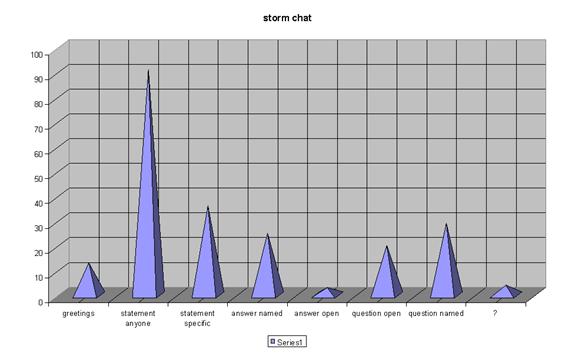
|
36) |
C/ |
7d. |
<Miss Zena> |
I believe this storm will weaken |
This statement type does not
address a specific person. As the
conversation in this chatroom was about a storm <Miss Zena> is addressing
the chatroom in general, stating that it is her or his belief that the storm
will weaken, and opening to any number of possible responses.
- D/
= answer - to someone named or previous (earlier) speaker
|
48.
|
B/ |
6c. |
<ankash> |
Tornadoes
in Pender Count |
<ankash> in Case Study One
is answering <guest-mandy> in turn 39 who has asked <any tornados>?
The difference between this utterance and the one above it in turn 36: <I
believe this storm will weaken> is that no one has asked whether the storm
would weaken. <Miss Zena> is just
offering an opinion.
In
answer to chatters earlier in Case Study One who were inquiring where Hurricane
Floyd was, <Kitteigh-Jo> in turn 13 says:
|
13) |
B/ |
4b. |
<Kitteigh-Jo> |
We have rain n NJ |
Here a generally addressed
comment also has a specific response relation.
- F/
= question - open - to anyone – whoever is in the chatroom
In other instances however, open
comments invite responses, rather than offer them. For example in Case Study
Six <Justin> is making her or his opening, not with a salutation but with
a question directed at the room:
|
4) |
B/ |
4a. |
<Justin> |
my first
visit here; what's normal? |
|
181) |
B/ |
14j. |
<SWMPTHNG> |
WHERE IS THE BLASTED DEVIL AT RIGHT NOW |
- G/
= question - to someone specific or previous (earlier) speaker
Questions inviting response
from any participant can also be delimited to specific respondents – but to do
so must use direct address:
|
189. |
D/ |
36a. |
<guest Beau> |
Calvin, your last name wouldn’t be Graham would it |
|
171. |
G/ |
31d. |
<ger3355> |
Where you at EMT? |
- #/
= new thread or direction of talk
New threads or Topics are
usually accomplished by a putting a space between the old topic and the new,
and then opening the new with some sort of question or statement as a topic
introduction.
|
104. |
D/ |
6h. |
<ankash> |
/\94 |
Hi guest JoJo......I'm from |
An example of a complete
turn
This posting can also
indicate the different types of notation this study will use to capture the
complex enmeshing of individual postings within a complete chat sequence.
Here, “104” means the 104th turn in
this segment. In the turns I have “captured” this is the 104th turn.
What went on before these turns is not knowable, however as it is turn 104 in
the captured sequence, we know that it not the first utterance in this
chatroom. In fact it is the eighth turn by this person, as denoted by 6h – the
6 being the sixth person shown to speak in this extract from this room. Rarely
is a log available for the complete chat. I do however have a complete log in
Case Study Six, in which eight speakers entered 511 utterances – so that
position 6 in an extended chat sequence could well be at the upper limit of a
given chat community.
An example of a
captured conversation arranged with these indicators in place shows how far the
notations can assist the analyst in reconstructing the flows of postings. It
should be remembered however that to the participants, sequencing and response
design are decided far more quickly, and with far less information:
|
27) G/ /\23 2c. <dingo42> its in the AIR |
|
28) G/ /\26 3f. <AquarianBlue> she wont be in |
|
29) C/ /\26 3g. <AquarianBlue> sniff sniff |
|
30) D/ /\27 6f. <Nicole528> oh yea ok |
|
31) D/ /\28 5h. <judythejedi>i don't think so..she's
bringing amtrack down maybe |
|
31) G/ /\27 6g. <Nicole528> whats your sign
dingo? |
|
32) F/ 10a. <Night-Goddess_> anyone cool in
here? |
|
33) A/ /\32 5i. <judythejedi> hi night |
|
34) D/ /\32 3h. <AquarianBlue> hmmmmmmm |
In each sample, some of the indeterminacy
of on-line talk relations can be witnessed. What is offered to participants –
and so to the analyst – is the “turn” based on the pressing of the
“enter-button”, and not necessarily the complete utterance intended. The
enter button cut-off does not always constitute an utterance, since it can be
mistakenly – or deliberately - pressed midway through an utterance, as the
example from Case Study Six below shows.
Here turn-197 is continued in turn 200:
|
197) B/ /\191 6p. Gordon the funny thing is |
|
198) B/ 3nn. brian
sgi visual workstatio demos by sam chen are great |
|
199) C/ /\198 2zzz. web3dADM yeah the new |
|
200) --- 6q.
Gordon that when I try to view those
SGI vrml, or any VRML with .gz extension to it |
This
fracturing of an utterance is similar to “repair conversation” in CA, where
someone corrects what he or she has said. There are often instances of either
self-initiated self-repair or of other-initiated self-repair in chatrooms.
However, in a chatroom the repair may not occur for several turns.
Whatever one says lies dormant and does not appear in cyberspace until the
utterance has arrived through the network. Unlike person-to-person conversation
when what is said is heard instantly, even if momentarily disregarded, in a
chat dialogue what is said is not “heard” until the speaker-writer wishes to
reveal the content to the chatroom, and until it has traveled the distance
through the system. Once the enter button is pressed there is no taking back
what was said. If the chat can be saved, either by saving the screen shot of
the chat or by copying and pasting or by reading the chat logs the dialogue can
be “captured” for future reference. Two
examples of repair from my case studies are given below. In the first, from
Case Study One, we see an example of self-initiated
self-repair with <EMT-Calvin> realising that the last word of his or her
utterance ended in the typographical error “worl”. He or she changes it in turn
72 to “work”, but only by posting the single letter “k”. In Case Study Six an
example of other-initiated self-repair in chatrooms
occurs when <Leonard>comments:
<Sort night for me tonight. Gotta take my oldest to scouts> and is immediately questioned in the
very next turn. Three turns later he or
she responds with an apologetic explanation of what was meant by the original
utterance.
|
self-initiated self-repair |
other-initiated self-repair in chatrooms |
|||||
|
|
“D”
shows that this is an answer to a previous question or statement, in this case
both turns 2 and 6 responding to turn 1.
Only if the whole chat is logged and analysed can we know
how many turns the person has taken in most chatrooms. In some chatrooms the
time of the person entering is placed before the utterance, but this has not
occurred in any of the chats that I have used in the seven case studies. Some
spaces also indicate automatically when a participant arrives, but this too is
not standard – one reason why chatters often announce themselves formally.
|
|
|
||||||||| Sascha just entered this channel |
|
|
|
MissMaca: the first plane to hit? |
|
|
|
oscar: sascha, ere you from NY? |
This chat was “captured” from a chatroom on the 911 event
in
(See
To conclude the outline of transcription codings of talk
exchanges, a number a codings are used to move beyond the simple counting of
participant postings:
|
speaker |
# of entries |
|
1. <EMT-Calvin> |
34 |
|
2. <TIFFTIFF18> |
1 |
|
3. <Werblessed> |
11 |
|
4. <Kitteigh-Jo> |
6 |
|
5. <RUSSL1> |
1 |
|
6. <ankash> |
16 |
·
I use letters to
separate from numbers, i.e. “h” is the 8th letter of the alphabet so that “h”
after the participant number (eg “6’) shows the number of times this “speaker”
has spoken thus far – in this example,
this is this person’s eighth turn.
|
106. D/ 6h. <ankash>/\94 >12Hi guest JoJo......I'm from |
<ankash> - the brackets
indicate the user name; in this case the user name is “ankash”
“/\”
means “relates to posting above”.
“/\
94” would refer to turn 94 above. I do
this to show that the person is referring to turn-taking 94 above, answering or
making a comment, or asking about the chatter in turn 94.
These codings allow the research
to unpack some of the multi-dimensionality of on-line chat, indicating if
nothing else, the complexity of its interweaving format.
3.5 Data collection
The data for each chatroom is online at
the URLs below and on the accompanying CD:
- Case Study One http://www.geocities.com/picture_poems/thesis/a1.html
- Case Study Two http://www.geocities.com/picture_poems/thesis/a2.html
- Case Study Three http://www.geocities.com/picture_poems/thesis/a3.html
- Case Study Four http://www.geocities.com/picture_poems/thesis/a4.html
- Case Study Five http://www.geocities.com/picture_poems/thesis/a5.html
- Case Study Six http://www.geocities.com/picture_poems/thesis/a6.html
- Case Study Seven http://www.geocities.com/picture_poems/thesis/a7.html
There are diverse
possibilities for on-line text collection and collation. Firstly, there
are several text data mining software packages available[76] with varying methods of
collecting and collating chatroom text. Technological packages
maintain a permanent record of exchanges that occur in computer-mediated
communication; data that is recorded automatically can be stored for future
analysis (Gates and McDaniel, 1999; Mena, 1999) making computer-saved text
easier to scan for patterns than verbal conversation, where CA researchers must
obtain tape recordings. There are
however, problems with doing on-line research.
Firstly, there
is the problem of verification. With the volume of communication in e-mail, newsgroups, and chat, manual
techniques of information management are difficult to cope with. A “sampling”
protocol must be established, since entire flows of text are unmanageable for
research purposes. It has been estimated that over 430 million instant messages
are exchanged each day on the
Verification to this extent, seeks to establish the
legitimacy of findings through comparative location of coherences from study to
study – in the hope that this may help overcome the problems of verifying
sources, and duplicating studies. It is for instance difficult to “triangulate”
inquiry methods in on-line research, as recommended in Denzin’s calls for “rich
description” and multiple sampling techniques. Such triangulation seems ideally
structured for communications research, given its capacity to survey the
classic “sender-message-receiver” processing, or in Hall’s culturalist
formation, moments of “encoding” (the production process) and “decoding”
(reception or audience response), each locatable within the central “codes” of
the text, But the constant flow of on-line chat makes it difficult to detach
and extract such fully “encoded” or formed texts, while the instability and
transience of on-line communities makes it unlikely that “reception” can be
studied – at least in particular instances.
Once again, this returns the researcher to the texts – but with the
appropriate cautions in place, both from the methodological strictures of
describing the limitations of sampling, and aware of the special difficulties
of studying on-line behaviours, given the well-established literature on the
culture of identity play and even deceit, on-line. So, while on-line data
collection offers some advantages - Data Mining for instance being a pattern
recognition technique that does not require consent of the individual – there
is at the same time a set of new problems for the on-line researcher. There is
no method to ascertain the identity of chat participants, other than requesting
an e-mail account, password and username. Data mining can assist the researcher
in discovering previously unknown patterns about the word usage and topics or
threads in the chatroom, but it can say nothing – or at least nothing reliable
– about whom those users “are”, where they are from, and how their on-line
practices arise in and impact upon their off-line cultural locations or selves.
Secondly then it is necessary to accede that with on-line
data collection, the sample is not secure in its representation of any
particular population (see Kehoe and Pitkow, 1996; Bradley, 1999). It is
however possible to probe this issue. This study for instance deliberately
chooses several special-topic chatrooms likely to attract a certain type of
person, and assesses the talk-texts for distinctive patternings and recurrent
behaviours. For example in Case Study Three I chose a chatsite dedicated to pop
idol Britney Spears and in Case Study Seven a chatsite dedicated to baseball.
By choosing topic specific sites I sought to find particular language usage and
to suggest its connection to language behaviours and discursive practices
reported elsewhere, in studies of off-line communicative groups.
Thirdly, even beyond this focus on the “talk” of on-line
chat, there is no universal method used to research on-line projects,
generally. By some estimates, the number of studies on the Internet is more
than doubling each year. The American Psychological Society[78] (APS) for instance now lists more than 80
links to on-line psychology experiments, up from just 10 links in 1996, the
year in which the list was started. But this is still a research mode, which is
under development – drawing, as does this study, on methods established
off-line, with all the associated limitations. Each on-line researcher
encounters anew the problems of fitting the research tools to the research
object, weighing down the inquiry process with ongoing discussion of the
specifics of on-line conditions. For this study, given the open appropriative
strategy of testing various language and text based analytics across a range of
chat behaviours, this is less a problem however than a central part of the study
aim. Not only is on-line communication of every type constrained, and perhaps
differently enabled, by the conditions of on-line technologisation, but this
study has as one of its two goals, the intention of submitting these conditions
to the descriptive and analytic powers of the various research methods
employed.
Fourthly, it
is difficult to control the study environment on-line, given the broad
variability of circumstances available to those who access the World Wide
Web. Web users use unlimited types of
software, hardware and Internet connections – so that there is no reliable way
to ensure that either production or reception of on-line texts is the same for
all users. While this study is very likely to encounter some of the
communicative consequences of these variable conditions, it cannot either
reduce them, or codify their presence. If on-line communication is often
indeterminate for the user, it is even more so for the analyst. Here the sorts
of constraints operating generally upon the ethnographic researcher must apply,
since the data as observed and collected can only be examined and categorized
in good faith, as offered to a generalised on-line participant, represented in
this case by the researcher. This is why the analysis in this study is limited
to the “texts” entered and retrieved from the sites. What participants intend,
or understand, is not retrievable, except insofar as their talk strategies and
techniques represent them. And while the various passes made over this text
data can help clarify those representations, these are complex and often
laborious analytical techniques, not available to the everyday on-line chat
user. For instance, unraveling
threads as topics or changes in topics is one challenge in identifying what a
user is saying. I approach this by using several methods. Firstly I separate
postings in the text by a particular user. For example, a few lines from
<EMT-Calvin> below from Case Study One show that he or she is working
through a self-continuing thread without much change produced by whatever else
may be going on in the chatroom. In this thread <EM-Calvin> has made five
utterances during a 20-turn block in this chatroom, and these can be read as a
relatively coherent statement:
|
Chat turn |
Utterance |
|
153 |
folks my God is able |
|
158 |
i have faith in jesus |
|
163 |
if he aint done with me |
|
164 |
i wont get hurt |
|
173 |
thats whty i have such a peace in my heart tonigjt |
But this is not the coherence offered
to the chat user with their interrupted readings. Further, to read this as the
sort of statement of faith it represents here is to assume that it was produced
in an integral way, while ignoring the intervening postings of others – a
proposition which would have to be checked against the actual sequence of
scrolling turns. Add to that the fact that the intervention of these comments
within other conversations may well alter them, either in relation to
accidental meaningful juxtapositions, or confusions – and these too may well
influence subsequent postings. In other words, both the extraction of chat
sequences by the researcher, and their subsequent analytical repositionings,
are part of the reception processing of ordinary chat itself – albeit at a more
complex and much slower level.
In some cases data may be excluded and
disregarded altogether, for technical reasons.
It is not possible to save chatlogs on some sites, due to the use of
java programming or 3D software that will not produce a sequential log to
research. If - as certainly seems possible – such sites are among the more up-to-date
or innovative, this could well exclude whole categories of chat and chat
behaviours from such as study as this – and may in turn skew results.
I collected my raw data
by copying the transcription (chat-log) in each chatroom and notifying the participants.
I then saved each transcription to the relevant appendix, which is on-line with
this thesis. My data ranged from eight-minute sessions with 70 turn-takings of
chat to more than one-hour sessions that had several hundred turn-takings. I
saved only the text-based chat in non-java scripted chatrooms as some chatrooms
preserve chat logs of what is said in the chatroom which can be viewed at a
later time[79]. However since mid-2000 most chatrooms
are written in java script and appear in an applet[80]
which disappears once the chatroom is logged off.
I have chosen 12 examples to try to
capture a wide variety of chatrooms. The chatrooms were selected at random;
however I sought themes in order to differentiate them as communities. The
chatrooms were found by using the search engine “Google”, at the time of the
study the most used search engine service on-line, and so most likely to be
used by potential chatters, seeking a themed and so sympathetic chatspace and
topic. In Case Study One I copied an
emergency based chatroom, where people were discussing ways of dealing with an
impending hurricane in the
3.6 Ethical issues
On-line research presents a number of challenges to the
researcher who seeks to obtain the subjects' informed consent while maintaining
their privacy.
Many of the traditional research techniques and their ethical
safeguards do not adapt well for use on the Internet (see Roberts, 2000;
Denzin, 1999; Frankel and Siang, 1999).
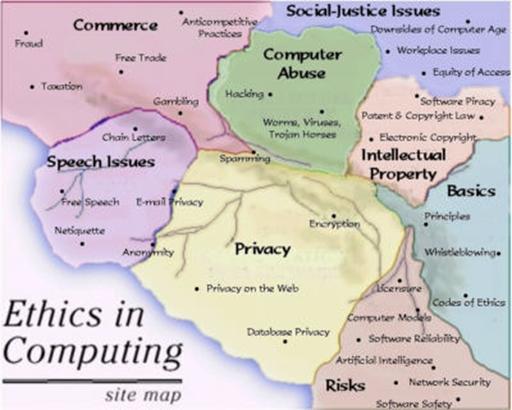
Image from http://legacy.eos.ncsu.edu/eos/info/computer_ethics
/
In the first instance it can be argued that the anonymity
of the Internet and the ease of use of pseudonyms blurs demographics, such as age,
gender, beliefs, ethnicity, and country of origin, so that anonymity has extra
guarantees. Some argue that capturing chatroom dialogue is not the same as
collection of other on-line communication. As it is often impossible to know
who is on-line in a chatroom there are no identification issues, as there would
be for instance with e-mail, where once a user’s e-mail address is known they
can be contacted later. Identifying the computer the person is using will not
necessarily yield results as the user could be using a computer at a library or
Internet Café that would show no identifying link with the actual person. And
it is even claimed that this protective dissociation has impacted on how people
communicate on-line. Studies have documented what they consider the tendency of
people to become more open on-line than they are in person. Under a false or
exaggerated expectation of privacy, participants may reveal more than they
might have done under conditions in the physical world (see Reid, 1996;
Childress and Asamen, 1998). If such hypotheses are correct, then ethical
practices may in fact have to be even more rigorously applied, to compensate
for the expectation of secure expression. However, this study, at least in
part, examines whether “openness” on-line is universally a reality, or rests on
more complex and variable foundations of discursively-established community.
This research does not automatically accept therefore that the technologisation
of on-line chat guarantees expressive security for subjects, and so takes up
the usual off-line protocols for human subject ethics protection.
To collect data for this study I
“lurked” in the selected chatrooms, making one entry at the beginning of each
chat that I saved. When such a declaration is made, and no rejection is
returned, the consent of the participants is assumed. This is standard Internet
practice (see Parrish, 2000; Bechar-Israeli,
1998).
|
“I am saving this dialogue as
long as I am in this room to use in research on Internet Chat for a
postgraduate degree. If anyone is opposed to me saving their conversation say
so and I will not save the chat”. |
Ethical issues are an important facet of data collection
and analysis. Traditional academic research that relies on human subjects is
governed by ethical standards and laws designed to protect the privacy and
anonymity of the individuals serving as research subjects. Because the nature
of qualitative observational research requires observation and interaction with
real-world social groups, ethical issues that arise in person-to-person contact
are much the same as ethical issues within captured chatroom talk. Miles and
Huberman (1994) list the following requirements when analysing data taken in
real-life contact:
·
Informed consent (Do participants have full knowledge
of what is involved?)
·
Harm and risk (Can the study hurt participants?)
·
Honesty and trust (Is the researcher being
truthful in presenting data?)
·
Privacy, confidentiality, and anonymity (Will
the study intrude too much into group behaviors?)
·
Intervention and advocacy (What should
researchers do if participants display harmful or illegal behavior?)
This study
undertook to remain aware of these issues, and to act to protect the interests
of on-line participants over those of the researcher and research project,
should such instances as those outlined above, arise.
Many on-line researchers currently take
cyberspace to be part of the public domain, since newsgroups, bulletin boards
and chatrooms are as accessible to anyone as a television, radio or newspaper
interview. These researchers believe that the responsibility falls on the
disseminators of the messages to filter out what they might consider revealing
or private information. Hence, they adopt the position that this type of
research should be exempt from the informed consent requirement (see King, 1996).
This study however, given its appropriation of methodologies developed for
off-line communications research, acknowledges a more integrated insertion of
on-line talk into repertoires and expectations of other forms of social
communicative exchange. It will therefore, as it begins analysis of its seven
selected exemplar chat sites, work to remain aware of the very real people
enacting the communicative exchanges which it will otherwise come to regard as
“data”.
4. CASE STUDIES
Case Study One
CS 1.0 Introduction
There are millions of chatrooms on the
Internet, catering to a huge range of discussion topics. A majority of
conversations in chatrooms however appear to have become stuck in the “hello”
or “anyone want to chat privately?” categories. The chatrooms I am analysing
have been selected to be rich in turn-taking and developed conversation. This chapter on “storm talk” is a study in
chatroom language use during an emergency and is my starting point in working
with real-time interactive discourse.
It is my desire here to focus in detail on the interactive
complexities of on line talk which led me to discuss the ideas of five of the
leading proponents of “Reader-Response” theory in my literature review (2.3.1):
Fish, Iser,
CS 1.0.1 Reason for choosing this chatroom
The first chatroom I examine was set up for Hurricane
Floyd, a high-impact weather event in the
A prior question arises as to the relativity of
formational influences on chatroom behaviours. Put simply, does the speaker
make the chatroom or does the chatroom create the speaker? It is certainly
observably true that, just as in physical speech situations, the style of talk
in chatrooms parallels the specific environment. For example, one may speak
differently at a church supper and a brothel. Later in this study I explore
this concept of developing styles of “speech as home” or how chatrooms can
become a particular socially-regulated environment, even in the absence of a
constraining set of architectural and culturally-binding physical cues: see
Case Study Three, “Speech Acts as virtual places” (CS 3.3.1.2). At this stage
however it is important to discover how, and how quickly, chat room
participants adjust to the communicative practices current as they enter a
given chat environment – and especially so under unusual circumstances.
The first chatroom under investigation arose from an
emergency situation; therefore I assumed when I first entered this chatroom,
based only on the title, “Hurricane Floyd Chat”, that only conversation dealing
with the emergency situation would be conducted. I did not expect topics or spontaneous
exchanges about relationships, politics or sports, for instance. One of my
interests in this room was how a “textual self” was to be presented. I expected
an emergency chat to be different from the casual-chatroom-chat (CCC) which
constitutes the major part of most chatroom conversation. In an emergency, I
expected those present to be seeking information that they could use to protect
themselves, or to reassure themselves that friends and relatives were safe. I
remembered experiences from earlier emergencies, where authorities had often
appealed to citizens NOT to use personal communications systems, such as
telephones or even public streets or walkways, leaving them free for emergency
services, and depending on official media channels for “reliable” information
and advice. What I found was that indeed there were few deviations from the
topic, and every contributor discussed the storm at some point. Though many
different threads developed in the conversation, each of which I “captured”,
they were all related to the storm. Though there were no prescribed rules of
etiquette for the use of this chatroom to focus talk on the storm, users, by
entering and then subsequently remaining in this chat arena, were declaring a
concern with the storm. The primary way to set up a structuring model for topic
control in a chatroom is to have a chatroom that offers to address only one
particular topic, as is the case with this chatroom, which had the issue of
concern being the events surrounding Hurricane Floyd.
CS 1.0.2 Background to
Hurricane Floyd
“On

Photo
from NASA saved
http://rsd.gsfc.nasa.gov/rsd/images/Floyd/Floyd_19990915_2015_md.jpg
Floyd was a large and intense
“
CS 1.0.3 Research Questions
In attempting to tease out how participants
negotiated their way into a chat transaction around the Hurricane Floyd issue,
I aim to deploy some of the key research problems raised within reader response
theory, as a way of thinking about how what a potential chat contributor
understands of their selection of conversational gambits, from what they read
of already existing chat postings. In reader response terms, my questions
involve considering the following issues of chat initiation and continuation:
1. Is the reader also a writer who is writing
the reader – in other words, do participants adjust to the speech acts of
others, or to their own interpretations of those acts?
2. Does the reader or the writer produce
meaning within “this” chatroom, or do they create meaning together?
3. How important is the particular chatroom context for
the reader-writer interpretive relation?
These three questions, elaborated below, are based on
Reader-Response Theory. This may appear a paradoxical framework for a study of
“chat”, even within this textualised talk environment of the chatroom.
Reader-Response Theory evolved as a re-examination of Literary Reception
practices, at a period which had over-stressed the authorial function of
literary texts, focusing on author biography or the social context in which
literary works were created, with little or no attention paid to the biography
or context of the reader – arguably just as influential on the interpretive act
of “reading” (see for instance Fish, 1990; Iser, 1989, 2000; Holland, 1968,
1975). Reader-Response Theory analysts study the ways readers’ own life
experiences and situations influence the understandings they construct as they
read, often tracing interpretive differences according to such social variables
as age, gender, ethnicity, or educational background (see for instance studies
by Schilb, 1990; Bakhtin, 1994; Holland, 1975; Vandergrift, 1987). The
implication central to this view of the reading act is that a text is in fact
“co-written” at the point of “reading”, since the writer can offer only a
potential reading – or set of potential readings – which the “reader” may or
not be able to or choose to follow. To some degree, all readers will
reconstruct a version of the text, to suit themselves – thus performing in the
act of reading, an act of self-construction or transformation – which may or
may not be of lasting influence.
Reader-Response Theory thus poses some interesting
questions for the act of chatroom text-talk, where participants “respond”
visibly and immediately to the text-talk of other – usually unknown –
“authors”. All participants are here simultaneously writers and readers,
constantly adjusting their own and their interlocutors’ texts, and so possibly
“selves”. With Reader-Response Theory practitioners then, my research needs to
pose for chatrooms such seemingly impenetrable questions as:
“Is the reader the writer who is writing the reader?”
In others words, is a chatroom participant in the first
instance a reader or a writer – and if they are a reader first, encountering
others’ chat before posting their own, is the act of reading a simple and
unproblematic “reception” of what has been said/written (“posted”), or does
this act of reading, like those of the literary texts analysed in
Reader-Response Theory, involve the (re)construction of views about the writer,
the context, the topic focus, to build a view of “what has been said”. This
leads to the second question:
“Do the reader or the writer produce meaning within ‘this’
chatroom, or do they create meaning together?”
And finally,
“Is there any role played by the location, “this
chatroom”, in the meaning-making processing of reader-writers in chatroom”?
That is, how important is the particular chatroom context
for the reader-writer interpretive relation? Is it a standard or a
location-variable process?
Each of these questions is important to the reading
process as the written text creates a reader’s response.
CS 1.1 Methodology
The dialogue under examination here was “jumped” in to as
analysis began, in order to replicate the “immersion” experience undergone by
most ordinary users of chatrooms – both in their first introduction to a given
space, and in subsequent visits. The
complete interaction that I “captured” lasted approximately 20 minutes, and
left me with a transcription of 279 lines from 45 speakers. The participants did not all enter or speak
at the same time as they would in a pre-announced moderated chatroom, such as
in Case Study Six, when a certain topic was advertised to be discussed at a
specific time. This very focused “present-ness” is one of the most obvious
differences between a chatroom transcription and a transcription of a spoken
conversation - but there are others. In chatroom transcription everything
enacted is present: what is seen is all there is, whereas in taped
transcriptions sound qualities and pauses, interruptions and “false starts” are
significant, and must also be recorded. Casual live conversation may have
several “speakers” talking at one time. This is also often the case in
chatrooms, as contributors’ text-utterances arrive in random order, even though
they may have been entered and posted almost simultaneously, but are delayed by
the technologies of packet-switching which operate across Internet
communications. Because the “speakers” did not all arrive at the same time in
the chatroom they are represented in what is possibly a false sequence – yet
that is how they appear to participants, and so I have numbered them according
to the CA transcription rules for sequential chat-events.
There is thus a visual representation in chat rooms of an
orderly and sequential flow of “chat events”. This is one of the contradictory
situations in chats. They are at the
same both structured and unstructured. This is also chat’s chief departure from
casual conversation. In casual conversation
there is no going back to an earlier chunk of speech. What is said has come and gone and may be
referred to only within memory, as it cannot be re-run as “captured” text. In most chatrooms one can at least scroll
back to what was said earlier, and respond specifically to that. Below are
several of the transcription methods I applied to this case study, and in
chapter 3, Methodology (3.3 Protocol of a transcription methodology)
I show transcription methods used across all of my study, suggesting some of
the ways that this new complexity in such speech conventions as “turn-taking”
or “code changes” is influenced by chatroom texting practices.
In this chatroom I have taken the raw material and
represented it in several formats. First
is the raw data as it appears in the chatroom: for example –
|
Table 5 Case Study 1. |
|
173.
<ankash> noworry in |
|
174.
<guest-kodiak> MANDY, whre did you
hear that UNCC is closed |
|
175.
<guest-sweetthing> no trees flying yet
thank god |
|
176.
<EMT-Calvin> thats whty i have such a peace in my heart
tonigjt |
It is immediately obvious that while all speakers can be
said to stay focused on topic – even 176, whose comment on “peace in my heart”
can be resolved in the context of a possible life-threatening experience from
the Hurricane – the specifics of each contribution appear to be following a
non-consecutive logic. Posting 174 for instance is not addressed to the poster
of 173 – unless 174 knows something about “ankash” that we don’t (i.e. that her
name is “Mandy”). Posting 175 does not reply to 174, and 176 appears to be
either “musing” across all or any of the other contributions, or else
responding to some utterance outside this sampling. While all contributors here can be said to be
“writers” by reason of the act of posting, which among them can be shown to be
“readers”, interpreting and responding to other text? The sequencing of
dialogue is – at least arguably – entirely disrupted, so that little responsive
or interactive logic is evident. How then are these “conversations” being
constructed? From a sampling such as this, it is possible only to hypothesize
that a) there is no dialogue: each participant is operating at least primarily
in a monologic mode – a proposition which my subsequent analysis will suggest
does have some validity in some cases; or b) that the dialogic mode has been
stretched across much longer exchange relations than in live natural
conversation, and will need to find a transcription method which can reveal it;
or that c) chatroom “readers” are able to perceive and respond to very subtle
or newly-coded forms of “topic focus”, and so are “writing” within the
“reading” act, in ways not yet analysed within traditional text studies, or
linguistically-based conversation analysis.
Each of these hypotheses has some validity within this
study, and will be taken up at some point of the subsequent analysis. At this
stage however I want to pursue the problem of the extended “response”
sequencing in chatrooms. Is it possible to actually locate an “initiation
point” for all chatroom utterances: a clear “sourcing” statement, no matter at
which degree of extension from the “reply”, which can prove a logical dialogic
ordering of the kind proposed for live speech, and required in the act of
Reader-Response Theory’s “writerly” or interpretive “reading”?
As a second transcription modelling, I have therefore
isolated speakers within chatroom discussions, and grouped each speaker’s text
together. For example the chat-author, <EMT-Calvin> in the sequence below,
even though saying as early as chat-event 45 that there will be no more
dialogue, is still writing at turn-taking 275.
I did not record any more of this particular chatroom - but the speaker
could have gone for much longer. The
point to grouping individual speakers is to attempt to identify specific
linguistic patterning within their language: in this case for instance a
strongly assertive modality. Each contribution is an unqualified statement:
<those folks WILL BE sent back…>; <the locals WILL BE the ones to get
jobs>: <folks NEED TO BE CAREFUL>. A strong continuity in the
contributions: both linguistic-structural: <And those folks…> and in the
response structure: a progressing logic rather than a disruptive one – no
“buts” or “on the other hands” - suggests a consensual discussion with
co-contributors. Finally, there is of course a very clearly established
antithesis being set up between <those folks> – Mexicans – and “the
locals” (who in an interesting appropriation also become “folks”: presumably “THE
folks” as opposed to “THOSE FOLKS”) – which supports the rather more overt
politics of the equally strongly moralized <folks need to be careful for con
artest [confidence artists –
researcher’s note] after the storm…>. In chatrooms there are chatroom-event
response gaps which prevent the clear continuities of logic and style being
surfaced, as they have been here. But they are clearly present, and equally
clearly “readable”, in a “writerly” or high-skilled interpretive way, to chat
room participants.
|
84. <EMT-Calvin> and those folks will be sent
back to |
|
87. <EMT-Calvin> The locals will be the ones to
get jobs |
|
99. <EMT-Calvin> folks need to be careful for con
artest after the storm |
Even in instances of entry-corruption in a given posting –
such as posting “99” and the use of the term “con artest” – respondents are
able to maintain an interpretive flow and stay “on topic”. In a third
transcription protocol, I have isolated those conversational turns which were
most clearly focusing a specific topic. In this case the protocol highlights a
discussion topic about Mexican roofers that took place between turns “75” and
“130”:
|
104. <KBabe1974> /\97 >5 i agree with emt-calvin |
|
105.
<guest-MoreheadCityNC>/\ 97 >5 Fortunately our best friend is a roofer! |
|
106. <playball14> /\97 >7 everybody out for a buck ufortuneately |
|
107. <SWMPTHNG> YOU AINT TALKING ABOUT MEX ROOFERS
ARE YOU? |
Here too, by
grouping the various contributions which can be seen to be “responses” to this
discussion strand, we can see very clear consensus being established – once
again within the linguistic and political repertoires. <Kbabe1974>
asserts openly: <I AGREE…> while <guestMoreheadCityNC> endorses the
consensus (on the criminality of itinerant Mexican workers) by expressing
relief that he can evade their services: <Fortunately our best friend is a
roofer!>, while <playball 14> sighs over a moral judgement:
<everybody out for a buck>. <SWMPTHNG>’s over-assertive
(capitalized) entry can thus be read as a bid to join the consensus, rather
than to actively oppose it: <YOU AIN’T TALKING ABOUT MEX ROOFERS ARE
YOU?> suggesting the following gambit: “Thought I recognized the sort of
complaints”, rather than something more like “How dare you: my best friends are
Mexican”. This is thus another consensual bid, underlined by the abbreviation
“Mex”, one among a long, sad vocabulary of ethnic-marking diminutives usually
found in racialised discourses, though in a chatroom “Mex” could be a a simple abbreviation for “Mexican” as often words are
shortened to fit into the rapidly scrolling chat appearing on screen.
Grouping “response
statements” in this way does then indicate the sorts of “interpretive reading”
demonstrated in reader-response analyses. These respondents are working from
cues operating at both the ideological level of content - such as lexical
selection: “Mex roofers”, and from syntactical positioning:
<Fortunately…> … <I agree…>. Even the use of class or regional
dialectical usages, such as “aint” or “folks”, invites consensual
identification at the level of community. “Folks” round here say “aint” – and
are suspicious of “Mex roofers.” “Fortunate” folks have friends who will do
their roofing properly, and not just “for a buck”. These “writers” are
“reading” each others’ cues in heavily reciprocal ways – especially given the
quite restricted length of the utterances used.
Fourthly I have
created a transcription protocol which can frame two speakers’ interactions.
This helps to display the inconsequence of all other dialogue being placed in
the chatroom between the utterances of two interacting chatters, and so lets us
see whether a) chatters appear to be uninfluenced by the interpolated strands
of “other” conversations, or b) in some way respond to them as they formulate
(“write-read”) their responses to their active dialoguing partner, or c) engage
in multiple strands of response simultaneously, or d) “receive” or are
influenced by all utterances, and somehow display their reactions in their
“returns” directed only to certain utterers. Below for instance, <ankash>
jumps across 6 utterances to make her “second” contribution – but who is she
addressing? The only possible answer is <guest-sweetthing>, assuring
<ankash> that all is well in Concord North Carolina (NC) – presumably
where <ankash>’s sister lives – and that <ankash> sends her
respondent kisses (“XX”) and intensifies her guest-name from <sweetthing>
to <SweetNsexy> – perhaps even a pun on “NC”. The response indicates a
deeper relationship of familiarity than the text provides for the uninitiated
“reader” – such as us – and reminds us that there are within this form of
reading as many possible layers of past experience with these texts as with the
literary texts of Reader-Response Theory. Here too there is a cumulative
“intertextuality” of overt and covert references, which initiated and
uninitiated, experienced or inexperienced, “readers” pick up. But here this
inter-text also contains the clutter of other dialogues, which may or may not
at any moment intrude upon and influence the reading/writing.
|
67. |
<ankash> |
<ankash> |
|
68. |
|
<Kitteigh-Jo> They are better than frogs spiders are my thing |
|
69. |
|
<playball14> oh really |
|
70. |
|
<guest-sweetthing> I
AM IN CONCORD NC AND NOTHING BUT RAIN AND LOTS OF WIND RIGHT NOW |
|
71. |
|
<EMT-Calvin> dont
have to worry about someone telling me to report to worl |
|
72. |
|
<EMT-Calvin> k |
|
73. |
|
<lookout4110> How ya
holding up Werblessed? |
|
74. |
<ankash> |
<ankash> Thanks
XXsweetNsexy! |
Here,
<Kitteigh-Jo> may be contributing something completely irrelevant to any
“hurricane talk” and impossible to access by anyone except her immediate
conversational interactant – or she may be commenting on folk beliefs in the
pre-storm behaviours of various animal species, and their reliability as
early-warning agents: a topic which could be picked up and recognized by other
members of the chatroom. And it is also worth examining the small “corrective”
contribution made by <EMT-Calvin> at utterance “72”, where he recognises
his previous mis-spelling of the word “work”, and adds the <k>. This tiny
incident shows very clearly the “reading” role of the writer, and the desire to
clarify for other readers the comment being made. Chatroom “writers” clearly do
read back contributions appearing in the chatroom dialogue box – noting even
their own errors – so that the chances of all participants ignoring all
contributions other than those from their direct interlocutor are thus
diminished. It will be worthwhile examining the full sequencing of future
transcriptions, to analyse the influence of the “clutter” between reciprocal
strands, as well as the clearly emergent conversational dialogues. To borrow a
term from genetics, this “junk” posting may turn out to be as significant and
as meaningful as what was originally called “junk DNA” – the segments of gene
sequences considered uncoded and undecodable, but which subsequently turned out
to be as important as recognizable key sequences, embedding their codes and
supporting their messages.
So what creates
this clearly new and developing form of interactive “texted” talk exchange, and
moves it towards the directions we are beginning to see in its distinctive development?
Before one can engage in a chatroom conversation one needs certain technical
requirements – and some of these technologically controlled contexts influence
the posting behaviours we are seeing.
Firstly, chatroom
“talkers” need a means with which to communicate such as a personal computer,
or other transmission device. Currently mobile phones, palm computers, laptop
computers as well as desktop computers are used in chatroom dialogue.
Communicating via chatroom is available in many airports worldwide, as well as
on planes, trains, buses and ships and within shopping centres, and even
restaurants. This extension of a “private” or “personal” form of communication
– a feature clear from its current formation around the talk-exchanges of
casual “chat” rather than the more formal textual genres of business documents
or “literary” writing – into mobile technologies and public spaces has already
blurred the social contexts of this chat. “Private” talk on mobile phones is
now quite commonly enacted in company of strangers, while as we have seen,
strangers are able to achieve rapid consensual talk, in the midst of many
surrounding but unrelated dialogic exchanges. The growing availability of
access to these new talk-texting technologies – even the somewhat perverse
emergence of texting via the audio-device of the mobile phone - will mean that
eventually it will be as common to chat via computers and as easy as making a
phone call.
Short Messaging
Services, (SMS) like chatrooms are a rapidly growing way of communicating.
Currently, there are approximately 16 billion SMS messages sent globally each
month. One-on-one dialogue is growing across all media. The tables below show
the growth of Internet-borne instant messenger services (IMs are discussed
further in Case Study Two):
|
Unique Users of Instant Messaging Services Source - Media Metrix (http://www.jmm.com - 2002) |
||||||
|
|
Unique Users (in thousands |
|||||
|
|
Nov-01 |
Dec-01 |
Jan-02 |
Feb-02 |
Mar-02 |
Apr-02 |
|
All Web and Digital Media |
104,811 |
106,412 |
109,951 |
112,017 |
114,119 |
116,420 |
|
Rollup of Instant Messaging Services |
61,199 |
62,823 |
68,080 |
68,164 |
71,826 |
72,130 |
|
AOL AIM |
29,301 |
29,821 |
31,869 |
30,918 |
32,412 |
31,456
|
|
MSN Messenger Service |
22,968 |
25,189 |
26,043 |
26,199 |
28,968 |
29,121
|
|
AOL Instant Message* |
21,811 |
21,779 |
22,684 |
23,009 |
22,986 |
23,442
|
|
Yahoo! Messenger |
17,084 |
16,865 |
17,827 |
17,396 |
19,406 |
19,165
|
|
ICQ Instant Message |
8,599 |
8,524 |
8,351 |
8,222 |
8,335 |
8,113
|
|
Trillian |
... |
... |
... |
344 |
525 |
610
|
|
Media Metrix Source - Media Metrix (http://www.jmm.com - 2002) |
||||||
|
|
Average Minutes Per Month |
|||||
|
|
Nov-01 |
Dec-01 |
Jan-02 |
Feb-02 |
Mar-02 |
Apr-02 |
|
All Web and Digital Media |
1,273.90 |
1,250.20 |
1,399.20 |
1,307.80 |
1,424.00 |
1,398.80 |
|
Rollup of Instant Messaging Services |
303.4 |
295.1 |
328.4 |
314.8 |
324.1 |
332.7 |
|
Trillian |
... |
... |
... |
366.9 |
532.7 |
433.6
|
|
AOL AIM |
293.5 |
288.3 |
291.8 |
297.8 |
300.7 |
324.3
|
|
Yahoo! Messenger |
204.1 |
240.4 |
284.6 |
272.4 |
264.3 |
284.4
|
|
AOL Instant Message* |
170.3 |
169.3 |
170.1 |
157.6 |
162 |
155.3
|
|
ICQ Instant Message |
139.5 |
120.1 |
129 |
112.8 |
125 |
119.8
|
|
MSN Messenger Service |
120.1 |
86.8 |
116.6 |
107.9 |
115.9 |
109.6
|
Minutes Spent Per Month Per Person
|
Media Metrix Source - Media Metrix (http://www.jmm.com - 2002) |
||||||
|
|
Average Days Per Month |
|||||
|
|
Nov-01 |
Dec-01 |
Jan-02 |
Feb-02 |
Mar-02 |
Apr-02 |
|
All Web and Digital Media |
15 |
14.6 |
15.6 |
14.5 |
15.9 |
15.6 |
|
Rollup of Instant Messaging Services |
9.9 |
9.7 |
10.3 |
9.9 |
10.3 |
10.3
|
|
AOL AIM |
10.3 |
10.2 |
10.3 |
10.2 |
10.6 |
11 |
|
Yahoo! Messenger |
9.7 |
9.9 |
10.5 |
10 |
9.9 |
10.2 |
|
Trillian |
... |
... |
... |
8.4 |
7.8 |
10.2 |
|
ICQ Instant
Message |
10.2 |
9.8 |
10.5 |
9.6 |
9.8 |
9.8
|
|
MSN Messenger Service |
8.3 |
7.6 |
8.2 |
7.7 |
8.2 |
8 |
|
AOL Instant Message* |
6.2 |
6.3 |
6.3 |
6.1 |
6.3 |
5.9
|
But of more
significance for this study is the degree to which chatroom participants must
develop different communicative skills and strategies in order to participate
in both forms of texted chat talk. One
often overlooked is simple typing ability. The fast typist has an advantage –
although perhaps one equalized by the necessity to learn new non-alphabetic
commands on the mobile phone keyboard in order to SMS; a signal too that the
emergence of the sorts of specialist “graphic coding” of such symbolic forms as
emoticons and recombinant keyboard usage – for instance phonetic and acronymic
compounds such as “C U 4 T @ 3pm” – is rapidly evolving completely new types of
communicative ability. At the same time,
there are clearly certain requirements of face-to-face conversation that need
to be adapted in order to converse electronically.
The overt
processes involved in language, the four skills of reading, writing, listening
and speaking (see CS 1.2.2 “Linguistic skills”
below) change their focus dramatically in a chatroom. Electronic conversation
is carried on most successfully through a process-task approach. The emphasis
is put on reading and writing and the processes of listening and speaking are
done through text on the screen we are reading from. This in itself adds to the
complexity of the text-talk process – and to even begin to see its differences,
we need to consider the act of text creation and use in far more detailed ways.
Each of the
process-tasks of reading and writing is composed of component sub-skills. Grabe
(1992:50-3) lists six in particular in the case of reading. These are: 1) the
perceptual automatic recognition skill; 2) linguistic skills; 3) knowledge and
skills of discourse structure and organisation; 4) knowledge of the world; 5)
synthetic and critical evaluation skills; and 6) metalinguistic knowledge and
skills (McCarthy, 1999). Below I will consider
the use of each of these sub-skills in the analysis of “Storm”. But before
moving to such detailed analysis, it is important to return to the major
precepts of reader-response theory, to remind ourselves of the ways in which
the variant “process tasks” we will uncover in the chatroom came into being in
the service of these new communicative
groups.
CS 1.2 Reader-Response
theory
For
Reader-Response Theory, there can be no pre-ordained ways of approaching and
interpreting texts. No matter how far an author may attempt to control the
reading of a text: no matter how overt his positioning of his preferred reader,
for what he may think is the ideal reading, actual readers will create variant
interpretations. And in the chatroom, where no posting can be made without an
initial reading – where even the first participant of the day who “arrives” on
site will “read” that circumstance and comment on it (perhaps with “Hi! All
alone here: doesn’t anybody use this space?”). The authorial role of the
“utterer” is heavily dependant for its continuance on the ongoing act of
reading.
Most simply put,
it is the participant-observer in the chatroom, the writer-reader of the text,
who influences and is influenced by the chat milieu. But while this is at one
level a shared and negotiative act, it is at another a private and
self-assertive one.
A group of readers
together in a reading environment, often a classroom or a library, sometimes
for extended periods of time may be thought of as an interpretive community.
Although this is a community of readers, a particular reader's initial
engagement with a text is ordinarily a private event with meanings internally
experienced in the consciousness of that reader and not necessarily shared
(Vandergrift, 1987, p. 34).
As Vandergrift
states above, a group of readers together in a reading environment may be
viewed as an “interpretive community” – perhaps producing the sort of consensus
seen above in the “Mexican roofers” discussion during the Storm chats. In this case study I will argue that on-line
chatters are just such a community of readers, who engage with one another,
usually, after they have read and given meaning to a prior utterance. Even
before they become engaged in a chatroom conversation, participants need to
read the title of the chatroom, so as to “go” to a particular chatroom,
selected for one of many possible reasons: for example, to gather information,
meet others or to proclaim a position.
|
145
<BASSALE53> im from conn its heading our way |
|
146
<guest-kodiak> where did you hear this |
In
turn 145 <BASSALE53>, making the first entry in what is thus far
captured, is stating that the storm is headed toward Connecticut and
<guest-kodiak> seemingly responds, asking where this information was
gathered from. But this is an assumed answer, interpreted as such only if one were
reading these lines sequentially and had just entered the chatroom prior to
turn 145 and had not read any previous lines.
However, scrolling back, an earlier utterance of <guest-kodiak> in
turn 127 <does anyone know why UNCC has not closed> has a response in
turn 138, <uncc is closed>, from <guest-mandy> and
<guest-kodiak>’s response could be to <guest-mandy> and not to
<BASSALE53>. A few turns later, at turn 148, it is revealed that
<guest-kodiak> was indeed not responding to the turn before of <BASSALE53>
but instead to <guest-mandy> and this is clear with
<guest-kodiak>’s next response <i didnt know uncc was closed>.
Putting together all the turns of <guest-kodiak> we see there is no
concern about the storm heading toward Connecticut and <BASSALE53> makes
no more contributions to this particular chat during the “captured”
period. <guest-kodiak> is not
reading carefully or he or she would have seen that <guest-mandy> in turn
140 has already answered the question, perhaps thinking that someone would ask
where he or she had received the information and giving the source of the information
<gocarolinas .com>. <guest-kodiak> makes three enquiries as to
where this information was collected from, in turn 146 <where did you hear
this>, turn 150 <it doesnt say it on any of the broadcasts> and in
turn 174 <MANDY, whre did you hear that UNCC is closed>.
|
127
<guest-kodiak> does anyone know why UNCC has not closed |
|
138
<guest-mandy> uncc is closed |
|
140
<guest-mandy> gocarolinas .com |
|
146
<guest-kodiak> where did you hear this |
|
148
<guest-kodiak> i didnt know uncc was closed |
|
150
<guest-kodiak> it doesnt say it on any of the broadcasts |
|
174
<guest-kodiak> MANDY, whre did
you hear that UNCC is closed |
Not
only is the reader reading a previously posted text, but as he or she becomes
the writer, it is clear that they are also reading their own writing at the
same time as they are writing. There is, in effect, a metatextual awareness
obvious. In some chatrooms[83] we can even see what is being written at the
same time as everyone else in the chatroom does.
Furthermore, a
reader may respond, even before the first utterance is complete. The responder anticipates the remainder of
the writer’s thoughts. This moves the chatroom’s “conversational” style into
yet another realm of Reader-Response Theory, involving more than simply reading
the text.
I am concerned
with on-line conversation which is text based[84]. When I began this thesis (1998)
textual interfaces in chatrooms were the norm, following the early stages of
direct on-line communication, when e-mail, newsgroups and chat-rooms were
developed (Zakon, 1993; Lynch, 2002). Text based chatrooms are easy to download
to computers as they do not take a lot of computer memory to operate. As
computers have become more powerful however, chatrooms have developed
multimedia applications such as web cams and voice based systems for chatters
to add to their conversation (See Virtual
Web Cams at http://www.virtualfreesites.com/cams.html
which boasts more than one-thousand sites with web cameras for any topic). As a
medium for exchanging ideas, communicating using text on-line has a number of
qualities that are useful in exchanging information. The text is highly
adaptable. The alphanumeric keyboard is
common[85], and therefore people can assemble
discourses on any topic. Using emoticons and abbreviations, discourse on-line
can be quite expressive. Communication can be done in almost any situation.
Reader-Response
Theory can be used to reveal the complex web of authorship, readership and
intersubjectivity established in the chatroom texting activity. The first
difficulty in using an unmodified Reader-Response Theory is however that it is
often impossible to identify the author. The author may be using an avatar or
username representative of some aspect of him or her self that is being
revealed, stressed or constructed at that particular time. For example,
<ANGELICSTAR> says <MY PRAYERS ARE WITH ALL OF YOU ON THE EAST COAST....takecare....bye>.
The posting so suits the name as to suggest a careful crafting of an on-line
persona, which colours the content and modalities of the contributions. But
on-line, an author is even able to have a multiple-representation of him or
herself within the same chatroom, by having several usernames at the same time
(See Case Study Four for further discussion of multiple usernames). Another
complication of reading chatrooms is the fact that not only is the author
unknown, but the reader is equally unknown, and therefore unpredictable in
response[86].
The reader of the
text is defined variously by such theorists as Umberto Eco, who writes of “The
model reader” (1979); Julia Kristeva: “The ideal reader” (1986), Wolfgang Iser,
“the ideal “implied” reader’ (1978); and
Fish’s (1980) “informed reader[87],” while Gadamer (2000) talks about the “original reader”[88], and Barthes gives total power over the text
to the reader (1975, 1977), going as far as to say that the reader is “no
longer the consumer but the producer of the text” in his writing on “the death
of the author” (see Introduction 1.3.1). Barthes held that everyday culture in
all its forms could be analysed in terms of language of communication (both
visual and verbal) and culturally specific discourses. As this thesis
progresses it will become clear that this same principle applies in the
chatroom. There are others who offer variations on this construed “perfect
reader”, and almost any discussion of philosophy, psychology, or sociology will
have discussions on who the reader is. But who is the proper reader in a
chatroom? After careful examination of many varying types of chatroom
talk-text, I believe that any definition must include the idea that the perfect
reader in a chatroom is one who is able to interact with what is written, so
that others can in turn respond to what he or she writes. In other words, the
chatroom reader is dually an author: in the Reader-Response Theory sense of
co-constructing the “read” text, and in the sense of enabling the talk-text flows
by enacting that “active-receptive” role.
The only way we
can know if someone has responded in a chatroom to what we wrote is by what
they write in answer. The person in the chatroom can perform one of two roles
or both roles. One is the role of the witness, who is at one level the reader;
the second is the role of the responder; the one who in turn writes, or speaks.
Even before the roles are enacted, there is the choice of whether to play both
roles. For example, one can lurk[89] in a
chatroom: read only, and not respond. In
Case Study One, there were 48 participants who took 279 turns (Appendix One,
table 10). However, four of the 48 people in the chatroom made only
introductory comments - although it may be impossible to consider them as
classic lurkers, as they entered toward the end of my recording of this event,
and may subsequently have contributed. However, they showed they had taken on a
lurker’s attributes by commenting on earlier dialogue, such as at turn 208,
<BayouBear> saying, “LA sent a bunch of crews today”,
signifying that he or she knew what the chatroom topic was about.
The classic convolution of the Reader-Response Theory
question posed at the beginning of this chapter: whether “the reader is the
writer who is writing the reader”, is firstly explored for chatroom texts by
asking “Does the reader or the writer produce meaning
within this chatroom, or do they create meaning together?” Reading-Response
theory claims that a text, any text, has no meaning whatsoever until it is
actually read (Iser, 1978; Eco, 1979; Kristeva, 1989). Other writers examine
such active or interpretive reading from a psychological perspective (Holland,
1975; Barthes, 1970; Fish, 1990) and take into account the reader’s mindset and
what they bring to the text from their personal experiences, which, in turn,
influences their interpretation of the text. Language features that are common
to all communication are what make interpretation possible. Using
Reader-Response theory to bring meaning to a chatroom text is dependent on
varying language skills.
CS 1.2.1 Language features
The following
features of language common to all communication are relevant to an analysis of
chat by means of Reader-Response Theory and will be discussed in this study:
skills of shared language; linguistic skills; knowledge of the world skills and
metalinguistic knowledge and skills. Each has relevance to our interpretation
(Bruti, 1999). To be able to communicate effectively, one needs to have at
least two of the four skills needed to share language; reading, writing,
listening and speaking. There are other means of communication that can be used
in person-to-person communication, such as body language, but the overt
processes involved in language sharing are some combination of these four.
CS 1.2.1.1 Skills of shared
language
In
text based chatrooms we take away the two skills of listening and speaking. We
are left with reading and writing as the only means of sharing information. In
this model, for an on-line shared language, I equate “listening” with reading
and “speaking” with writing.
Each of the “four
skills” of reading, writing, listening and speaking are composed of sub-skills,
according to Grabe[91]. I have adopted the following
six skills necessary in order to create a meaning sphere from chatroom readings[92]: the
“perceptual automatic recognition skill”,
“linguistic skills”, “knowledge and skills of discourse structure and
organisation”, “knowledge of the world”, “synthetic and critical evaluation
skills” and “metalinguistic knowledge and skills”. “Perceptual automatic
recognition skill’ demonstrates the semiotic argument that perception of a
meaningful new system of coding is a “language” in evolution.
“Recent
findings on language processing suggest that basic strategies focusing on the
most important words in a text for example, and activating background
schemata are the same in listening and reading...” (Danks and End, 1985).
Despite the wealth
of experience this offers chatroom participants in relation to “reading”
chaotic texts: those more akin to “multilogue” live chat in crowded social
settings; chatroom technology limits the degree to which “complex” texts can be
uttered: those with sufficient richness to alert recipients to complexities in
their meaning. With the fast paced conversation in most chatrooms, if someone
writes a long text, others in the chatroom are not able to read and grasp the
whole text before dozens of new texts make the message disappear on the screen.
Therefore, in an active chatroom with dozens of people speaking, only the words
which stand out are noted. Below is an example of a contribution with too many
words, and a response to it, which raises interesting questions about the
interpretive relation between participants. It cannot be assumed with certainty
that <guest-MisterD1> is responding to <SWMPTHNG>, although the
response can be read that way. Because
<guest-MisterD1> has not made any contributions since turn 45 it could
also be assumed this response was made to some element in regard to any of the last
dozen or so turns, and although <SWMPTHNG>’s posting is the most likely,
even then the reader has to work to extract/construct a meaning. Interpretable at several levels, the posting below
indicates above all the impossibility of addressing all levels at once: the
racism of the content; the complexity of the complete message, coded by its
relative length, and the over-assertive nature of its “shouted” use of capitals
– and each of these alone could be evoking <guest-MisterD1>’s
“sigh”.
|
91.
<SWMPTHNG> WHOSE GONNA SEND THEM CLIMBING ALL OVER EVERY HOUSE ON THE
COAST SE HABLO ESPANOL |
|
93.
<guest-MisterD1> sigh... |
Thus we confront a
multiple problem of interpretation: that of <guestMisterD1>, “reading”
from somewhere on the site a posting which produces an emotional response; and
subsequently that of all other participants – ourselves included – left to find
an explanation for both postings. Which literacy skills are called forward to
handle such communicative situations? Can we operate from within a conventional
range of skills, learned outside CMC encounters – or are there new pressures
acting here, and demanding new repertoires?
CS 1.2.1.2 Linguistic skills
In
normal reading situations one is able to re-read a statement, passage, chapter
or even a whole book to locate what the author is saying. In writing, even in
e-mails, we can change what we wish to say, and edit the text – even re-run our
comments after posting, if we need to correct things. There is control over
what is conveyed. However, in chatrooms we seldom have the time to reread, let alone
rewrite text. Are we to trust the words
we read? What about the words we
write? If we are in a conversation on
the Internet, and we want to have an exchange of meaning, and our spelling and
typing are a disaster, how do we say what we have to say? What linguistic
skills do we need to communicate effectively on the Internet?
Observation shows
that the ability to communicate in a chatroom is not based on conventional
assessments of command of language, but on an entirely new set of skills. As these evolve, the formal rules governing
the language in use are overturned and adapted. At some point in our language
acquisition, we learn for instance rules of sentence structure and word order.
We learn how to use pronouns to replace noun phrases, or the order of
adjectives before a noun or when to use plurals. In chatrooms we seem to pay little attention
to such rules of grammar. I investigate conventions of grammar in Case Study
Six (CS 6.2.3) and will only mention this in passing here, as an illustrative point
to the creativity of how people communicate on-line, under the constraints of a
high-paced keyboarded texting.
In turn 176
<EMT-Calvin> writes,
|
176. thats whty i have such a peace in my heart
tonigjt thats
whty i have such a peace in my heart tonigjt |
and in turn
217 he
or she writes,
|
217. i am one of the |
The two examples
sound almost as if they could be two different people. Turn 174 is not
particularly literate, in conventional terms, compared to turn 214, although
there seems to be more accuracy in grammar and textual structure, and even a
literary turn of phrase. It would take
longer to write the 20 words in 214 than the 11 words in 173, and yet the
spelling is correct, even for complex lexical items such as the Latinate
“evacuated” or the proper nouns for place names. Because we have no idea of what someone is
doing when communicating in a chatroom - any number of simultaneous tasks is
possible - we cannot know why a participant writes the way they do. What
produces the shifts in formal literacy levels between postings 174 and 214 is
impossible to fathom – but for the reader such individual elements as the
dropping of punctuation in “that’s”; of capitals in “Carteret”; the use of
uncapped abbreviations: “ms”; spelling errors: “personal” for “personnel”;
run-on sentences “… we evacuated the beach…” can all be over-ridden in the act
of reconstructive reception. There appears to be no sense of discontinuity as
linguistic control over formal presentational levels shifts in quality: yet
another way in which the interpreting “reader” contributes actively to the
formation of these texts.
Within a given
language system and its social contexts of use, we also learn various social
aspects of language usage, such as when to use slang, whether we make racist or
political statements, and when not to. Here, Grabe’s category involving
knowledge and skills in discourse structure becomes relevant. To contribute
meaningfully to a discussion, it is necessary to be familiar at some level with
the understandings and terms used within that topic: to understand and be able
to deploy its particular language practices. For example, in turn 77,
<SWMPTHNG> writes,
|
77. THERE'LL BE
PLENTY OF MEXICAN ROOFERS IN |
There were no
statements about Mexican roofers or anything to do with roofing prior to this
utterance. Furthermore, <SWMPTHNG>
had contributed four turns in the chat which I captured, and nothing implied
that he would begin a conversation about Mexicans, with a racist tone. To
initiate such a discourse in the absence of previous explicit cues indicates
that <SWMPTHNG> sees himself as comfortably amongst friends, or
like-minded individuals, and so able to begin this thread. Indicators from the
previous talk exchanges however reveal only reciprocal flows on other topics,
suggesting that <SWMPTHNG> reads the easy and fluent FORM of these
exchanges as equivalent to a linguistic “habitus”, perhaps similar to his
experience of both his “lived” speech community, and/or to other chat spaces,
in which the politics he is about to reveal – the racialised discourse he is
about to enter – are permissible and expected.
I will discuss this issue of “linguistic or discursive comfort level”
more when I speak about the theorist,
Certainly then we
need to apply prior knowledge and experience when trying to make sense of
utterances. The goal is not to understand words, per se, so much as to
understand the ideas behind the words. And yet, in a chatroom, words are all we
have: words from many different contexts and so arising within many divergent
discursive frames – and yet all scrolling in standardized form across a
standardized screen in a standardized font. Communicating in a chatroom is akin
to learning a new way to apply language.
Yet beneath our use of it as either reader or writer lies the standard
social expectations of communication: that there will be at the foundation of
each text-talking gambit an intention to communicate something: a rationally
motivated and executed act, which can be interpreted accurately and responded
to.
The
core of psychological understanding revolves around the notion of
motive—desire, want, wish, reason. We understand an action when we know what
motivated it. The motives for action are usually clear, since action itself
usually indicates the motive that prompts it. Why am I paying money to the
cashier in a supermarket? So that I can buy food and eventually eat it. We generally
act in order to fulfill our manifest wishes. Sometimes the motives for action
can be obscure, as when you see me searching frantically in a drawer and don't
know that I left a lot of money in there and now can't find it. Motives are
internal mental states that cause action and that make sense of actions; action
is seen as rational in the light of motives that lead to it. We apply this
reasoning to both the motivation for the ideas of a text as well as to the
author's motive for writing that text. (McGinn, 1999).
The motivation for
a text in a chatroom is not easily known, since it can only be interpreted from
the text on the screen – filtered through the “reader’s” own experiential
pre-dispositions. Is the writer
attempting to change the course of the dialogue, upset others who have a topic
of discussion in process, sell something or use any of an array of tactics for
a personal reason? Motivation can only be assumed. In the Hurricane Floyd
chatroom the overriding motivation appears to be to find out information on the
whereabouts of the storm. Within that chat however, there are personal beliefs
stated by several users that take the topic of the storm into a much wider area
of discussion. For example, even though the discussion is on the storm, one chatter
below shares his or her religious belief in regard to the dangers of the
impending storm, while another presents yet more opinions about Mexicans. As responses one to the other, these
exchanges make little sense - in fact
invite a reading suggesting the rather alarming view that Jesus will intervene
to fight off marauding Mexican roofers. Within the “local” context of the
scrolling exchanges however, there has been enough “experience” of this debate
so far, to permit participants to “read” each posting from within its correct
thread – just as, within the “local” contexts of religious faith and racialised
politics, participants are able to recognize a particular discursive strategy
being deployed.
|
121.
<KikoV> we got gun laws to deal with them......... |
|
161.
<EMT-Calvin> i have faith in jesus |
CS 1.2.1.2.1 Knowledge and skills of discourse structure and organization
Discourse
structures refer to the specific levels of skill in reading and writing which
involve the analytical capacity to determine and select in response the
“correct” phonology, morphology and syntax for use in a certain communicative
context. Discourse structures mediate the interrelationship between language
and society, allowing <EMT-Calvin> to assert his religious belief with
such suitable terms as “faith”, and to offer such a comment at the suitable
moment in a talk exchange, where issues of danger and deliverance are being
discussed. They are the bridges built between what language systems offer, and that category titled “Knowledge of
the world”, which Grabe (1992) suggests allows us to reciprocate in
conversation: to build in our own minds a sense that we are sharing meanings
with others.
In this Case
Study, the knowledge of the world is localized to knowledge of the East Coast
of the
CS 1.2.1.2.2 Metalinguistic knowledge and skills
At first sight,
chatrooms seem as close to being pre-literate as they are to being an advanced
literate textual state. Language appears to be in a process of being broken
down to its simplest rudimentary format. At the same time there is a certain
advanced form of communication involved, when one is limited to a few words to
state irony, belief structures or humour, and so required to have a command of
enough emoticons and abbreviations to create meaningful interaction.
Metalinguistic ability is the capacity to think about and talk about language,
or the function of language in referring to itself; cf. metalanguage which is called by Jakobson the “metalingual”
function:
The metalingual
function is focused on the verbal code itself, that is, on language speaking of
itself, its purpose being to clarify the manner in which the verbal code is
used… (Jakobson, 1960 p. 365).
In the
Reader-Response Theory critical approach, the primary focus falls on the reader
and on the process of reading rather than on the author of the text. There are two basic theoretical assumptions
in Reader-Response Theory. The first is that each reading is a performance,
similar to performing a musical work. The text exists only when it is read,
giving rise to a new meaning, which in this case, becomes an event. The second
assumption is that the literary text has no fixed and final meaning or value;
there is no one “correct" meaning. Textual meaning and value are
“transactional,” or “dialogic,” created by the interaction of the reader and
the text.
There are many
reasons why a person may be in a chatroom and this may determine how the text
is read. For example:
Pleasure
(this person does not live in the storm area but seems to be just saying hello:
extracting pleasure from social contact),
|
Turn 96. <guest Jojo> Hello
Folks~Greetings from |
Identification,
|
104.
<KBabe1974> i agree with emt calvin |
Information
seeking,
|
89.
<lookout4110> Have the winds been strong? |
Looking for
companionship,
|
198. <ankash> ImFLOYD would you like to chat privately? |
Assertion of
personal beliefs, (Gun laws - see CS 1:8)
|
121. <KikoV> we got gun laws to deal with them......... |
|
161. <EMTCalvin> i have faith in jesus |
We can also see
chatroom turn-taking as a transaction, much as Louis Rosenblatt did with her
transactional theory model for literary analysis. In Literature
as Exploration (1938) she saw reading as a transaction between reader and
text. For Rosenblatt, as for other proponents of Reading-Response theory,
meaning is as dependent upon the reader as it is dependent upon the text. There is no universal, absolute
interpretation of a text; rather, there can be several probable
interpretations, depending in part upon what the reader brings to the text. In
other words for Rosenblatt, the reader is not passive. This is obviously the
case in chatrooms where the reader shows his or her assertiveness through
writing a response to an earlier text, or by submitting a statement, opinion or
question to the chatroom.
Participants are able to scan back to earlier
contributions, or perhaps hold them in memory, and to add in a reply specific
to a particular comment, no matter the sequencing of contributions arriving
since on the site. While the direct sequential juxtapositioning of texts
creates an “intertext” of one type (chaotic, random, inconsequential) the
capacity to “suspend” these “random” flows, and to selectively create
meaningfully responsive ones, lies at the core of the chatroom ethos. For
example in the table below <guest-kodiak> asks a general question to
anyone in the chatroom [i.e. there is not a user name in the request], in turn
138, <guest-mandy> answers and in turn 146 <guest-kodiak> questions
<guest-mandy>.
|
127
<guestkodiak> does anyone know why UNCC has not closed |
|
138 <guestmandy> uncc is closed |
|
146 <guestkodiak> where did you hear this |
There is more
discussion on this matter in the next hundred turns I recorded. However, this
is an example of meaning generating within a chatroom where a simple question
elicits an answer. Yet <guest-mandy> makes no more contribution to this
chat and we can assume perhaps he or she left the arena of chat.
Stanley Fish
(1990) like Wolfgang Iser (2000) focuses on how readers adjust to the text.
Fish is interested in the developing responses of the reader in relation to the
words of sentences as they follow one another in time[93]. This perspective is useful for an analysis
of chatroom talk in many ways. One
interesting and quite frequent case is where the writer, usually through
pushing the return or enter key on the keyboard by mistake, says only half of
what they had intended to say, and the remainder of their utterance appears
several turns later. For example,
|
Turn 278
<IMFLOYD> i've got a sister........want to see |
|
Turn 281
<IMFLOYD> her she is again |
In a sex chatroom,
turn 275 would have received a different response. Here no one commented on the oddness of this
phrasing. Reading this text it is possible to use the context of the ongoing
discussion to see that <IMFLOYD> is saying he is concerned about seeing
his sister. Knowing this is a chatroom about a hurricane we can assume, as other on-line readers appear to
do, that <IMFLOYD> is hoping to
see his
sister because the storm may have a bad effect on her. So it seems that
there is evidence enough to show that readers are able to use at least the
current context of discussion to reconstruct meaning where only partial
contributions are presented. And from the analysis above (dealt with in more
detail in Case Study Three below) of the shift to a “racialised” discourse
during conversation ostensibly on the approaching storm, (the Mexican roofers
chat sequence), we can deduce that chatroom “readers” are also able to make
assumptions about broader social, cultural and even political contexts, to the
extent of believing that they are operating in an environment of shared belief.
How is it then
that we process such textual cues? Is this learned from the practices of
intertextual linking, established within our reading background and acquired
alongside literacy – or is it a part of our dialogic skills developed in talk:
a central feature of “natural conversation”, rehearsed in everyday chat, and
transferred across into text-based chatroom behaviours? How much more can our
text-based “reading” traditions tell us of the chatroom texting act?
CS 1.2.1.3.3 Phenomenological approach to reading
The
phenomenological method accounts for the reading process by focusing on what
happens in the reader's mind as he or she reads (Iser, 1990; Fish, 2000;
Holland, 1968). Fish defines his own phenomenological approach as “an analysis
of the developing responses of the reader in relation to the words as they
succeed one another in time” (Fish, 1980). This
definition of how a reader assesses meaning could accurately be applied to real
time, written, Reader-Response Theory in a medium such as a chatroom or SMS
messages on a mobile (cell) phone. Where the “flow” of words suits the
already-established contexts of both the chat session itself, and the
“chatters” in their broader social settings, a consensual flow of “developing
responses” occurs – as we have seen in examples above. More indicative of how
chat practice differs from other forms of “conversation” or writer-reader
exchange however, are those moments at which a writer introduces a directional
change. In chatrooms this change can drag
several others along. For instance, speaker <SWMPTHNG> begins to speak
about Mexican roofers in a negative way in turn 75,
|
Turn 77
<SWMPTHNG> THERE'LL BE PLENTY OF MEXICAN ROOFERS IN N CAROLINA NEXT
WEEK |
which leads
<EMT-Calvin> in turn number 82 to say
|
Turn 84
<EMT-Calvin> and those folks will be sent back to |
During this
exchange, with the topic being offered by <SWMPTHNG>, six other people
added comments. There were a total of 23 speakers during the turn-taking
between 75 and 130 (see table 5 in Appendix One) with seven, 30 percent, being
part of this thread regarding Mexican roofers. This dialogue was thus 20
percent of the chat during this time. How <SWMPTHNG> leads close to
one-third of the chatters to follow his/her views is strategically and
technically similar to how topics are changed and people follow in face-to-face
conversation. In Case Study four, where I look at chatroom talk using
Conversational Analysis, I discuss the rules for turn-taking in conversation, using the work
on CA by Eggins and Slade (1997), Austin (1962), Nofsinger (1991), Sacks
(1974), Schegloff (1979), and Tannen (1989).
In
phenomenological studies of language meanwhile, speech (the particular
signifying act) is considered to precede writing (the field of signifying
possibility), in that an utterance must exist as a “phenomenon” to which the
interpretive receiver responds. Such interpretation, calling on multiple
repertoires of contextual cultural experience, is thus in itself a form of
“writing”: a linking of the uttered “clues” back to their possible
significatory referents. However in a chatroom, speech itself – the act of
uttering - becomes the written text.
Writing in chatrooms is thus always a signifying act at the same time as
it is filled with signifying possibilities, i.e. one can initiate or respond in
any number of ways, with the expectation of intersecting the “preferred
readings” of at least some of the many participants present.
The
phenomenological theory of art lays full stress on the idea that, in
considering the literary work, one must take into account not only the actual
text but also, and in equal measure, the actions involved in responding to that
text (Iser 1978, p. 43).
In chatrooms this
analytical consideration of the act of reception of a text extends forward,
into a complex mesh of “pre-consideration” of that reception process. This is
conversation OVER-heard as well as heard, and at least semi-archived, in that
while contributions scroll quickly through dialogue boxes, they do remain on
screen long enough for experienced chatters to run multiple threads
simultaneously. Isolating one speaker, <EMT-Calvin>, in the turns below
we can see he or she goes from telling what the weather is, to discussing
Mexican roofers, to answering questions, to giving information.
|
speaker |
turn |
Turns |
|
|
<EMT-Calvin> |
1 |
hahahaha lol |
|
|
|
16 |
That weather building in cherryt point says it s
126 degrees in cherry point |
|
|
|
37 |
well folks im signing off here |
|
|
|
44 |
i need some sleep |
|
|
|
65 |
i like being self employed |
|
|
|
71 |
dont have to worry about someone telling me to
report to worl |
|
|
|
72 |
K |
|
|
|
84 |
and those folks will be sent back to |
|
|
|
87 |
The locals will be the ones to get jobs |
|
|
|
99 |
folks need to be careful for con artest after the
storm |
|
|
|
114 |
i aint worried our new 99 home is under warrentyu |
|
|
|
120 |
morehead guess how many tie downs are on here |
|
|
|
123 |
68 tie downs |
|
|
|
137 |
well our home is really
not considered double wide |
|
|
|
156 |
folks my God is able |
|
|
|
161 |
i have faith in jesus |
|
|
|
166 |
if he aint done with me |
|
|
|
167 |
i wont get
hurt |
|
|
|
176 |
thats whty i have such a peace in my heart tonigjt |
|
|
|
182 |
so howdy neighbor |
|
|
|
191 |
but i know alot of graphms |
|
|
|
196 |
i am a member with beaufort ems |
|
|
|
203 |
folks dont worrry we have got power crews comiong from other states |
|
|
|
217 |
i am one of the |
|
|
|
225 |
and a mandatory evacuation for folks in flood prone areas |
|
|
|
234 |
Swmp are you near |
|
|
|
242 |
morehead you got a plane at beaufort air port |
|
|
|
255 |
Hmmm |
|
|
|
262 |
and yes i been to topsail beach just last month to unlock
a car |
|
|
|
265 |
hi wes |
|
|
|
266 |
Im a talkcity op also |
|
|
|
275 |
i am a room op in room called fire-4-God |
|
The sophistication
here rests not in the first instance in the “writing” as “utterance”, but in
the phenomenological reception “writing” of attaching those utterances to
conversational and broader cultural contexts: to “receive” them as meaningful.
The phenomenon of chatroom communication thus doubles the phenomenological
“status” of each participatory act, to produce not “writers” and “readers”, but
“writer-readers”, who consider the reception of their posting and pre-dispose
its possible interpretive ambits, and “reader-writers”, who actively connect
the utterances they scan to known contextual repertoires, to render them
meaningful. Once again chatroom texts, seemingly so reduced and basic in
semantic loading; so primitive and abbreviated in linguistic form, prove to be
the complex constructions of a carefully considered communicative processing.
CS 1.3 Discussion
The
reader is left with everything to do, yet everything has already been done; the
work only exists precisely on the level of his abilities; while he reads and
creates, he knows that he could always create more profoundly; and this is why
the work appears to him as inexhaustible and as impenetrable as an object
(Jean-Paul Sartre, What is Literature, 1949, p. 176).
The
sorts of pre-dispositioning of interpretation or “reception” involved in
chat-reading are captured here in Sartre’s attempt to describe the complex
processing of literary texts. Interestingly however, Sartre here, like Eco
rather later (1979), glimpses the degree to which the literary texts he is
discussing are already heavily invested with what later commentators called
“preferred readings”. These pre-empted interpretive strategies are built in to
serious literature, which attempts, as Sartre puts it, to already do
everything: to make certain that the reader “gets it right”, or reaches the
same interpretive conclusions as the writer. Eco goes as far as to suggest that
those “popular” literary creations which critics consistently accuse of being
“formulaic” or over-simplified in their techniques, actually offer the newly
creative and “liberated” reader of the post reader-response moment, MORE freedom
to interpret than those of high-literature. In popular texts, according to Eco,
everything has NOT “already been done”. The formulaic structure leans heavily
on prior texts, inviting memory to make comparisons. Plots are often ill-knit,
and character motivations unexplained. There is indeed much for the active
reader to do: part of what Barthes described as the openness to interpretive
“pleasure” in such texts, which he called “writerly” (scriptible), in that they
leave the reader to “co-write” in the otherwise incomplete spaces.
Is this
part of the “doubling” in role which operates inside chatrooms? While the term
“scriptible” or “writerly” is useful in describing the work done by the heavily
interpreting chat reader, its opposite: “lisible” or “readerly”, is used by
Barthes and Eco to describe not the “active” interpreting reader of the “open”
text, but the “disciplined” and more “passive” readers of literary texts, in
which in Sartre’s formula, “everything has already been done”. In chatrooms, where
everything is very much still to do – where the rapidity of text entry and
scrolling and the multiplicity of strands produces especially “scriptible”
texts, entries are far from “lisible”. We thus need not the “either/or” of the
old postructural binaries in which Barthes and Eco were at that time working,
but the “and-and” of poststructuralism, to allow both “posting participant” and
“reading participant” to work on texts which are heavily “scriptible”. Here, I
argue that we have both a “writerly writer”, and a “writerly reader”.
CS 1.3.1 Two readings of a
chatroom
CS 1.3.1.1 Chat title
There
are two actual moments of reading which a participant undertakes in
understanding meaning within a chatroom. Firstly, the title of the chatroom is
read. Chatrooms are divided into what could be closely referred to as communities
and within the communities there are further divisions or rooms. This is like
being in a section of a city that appeals to us. Chat servers are large entities
with many areas for people to engage in chat[94]. For
example, TalkCity.com is one of the larger chat servers and it has divided its
services into three areas[95]. TalkCity reports more than 10,000 chat
sessions a month, and with over 5 million active participants each month it can
be seen as a significant city[96]. There are rooms for any topic imaginable and
my purpose in visiting the various rooms within the TalkCity arena was to get a
“feel” for the variety of conversations in different rooms. I hoped to find
whether the chatters carried on conversations which were reflective of the
chatroom title. Does the “specific use” chatroom I have been analysing above,
the emergency chatroom for Hurricane Floyd, display the same reading techniques
as a general chatroom?
I was
unable to “capture” dialogue in TalkCity as their rooms appear in java applets,
which will not allow cutting or copying and pasting. My comments therefore will not discuss cited
examples of actual text as I do in the chatrooms in this and other case studies.
Instead I will give a general overview to identify whether there is turn-taking
as described in the individual case studies above. I was not looking for actual
turn-taking in these rooms but to discover whether topics of conversation were
based on the title of the chatroom. Here, I sought to find how the
writerly-writer who initiates a conversational thread, and the writerly-reader
who responds, can be shown to demonstrate especially “open” and “active”
strategies of initiating text and responding to it, based on the title of the
chatroom. Barthes would see this turn-taking as ever present:
The
writerly text is a perpetual present, upon which no consequent language
(which would inevitably make it past) can be superimposed; the writerly text is
ourselves writing, before the infinite play of the world (the world as
function) is traversed, intersected, stopped, plasticized by some singular
system (Ideology, Genus, Criticism) which reduces the plurality of entrances,
the opening of networks, the infinity of languages (S/Z 1975 p. 5).
The
eight TalkCity rooms I visited: dealing-with-disability, diddling’n’doodling,
flippinchicks, massachusetts_flirts,
not-necessarily married, married-lonely-hearts and sexy-adults-who-arent-shy, displayed something of the experience
of rejection frequently reported when readers with a predisposition towards
“lisible” text enter a chatroom and encounter the apparent chaos and
impenetrability of “scriptible” texting. There is so very frequently no
neatly-waiting, well-formatted, accessible text to “read”. Chat seekers have to work hard even to find
that “already done for you” site, selecting from variously titled offerings,
which may or may not be comprehensible to the uninitiated “newby”. In this case I had selected the site called
dealing-with-disability. I checked into this room on several occasions and
there was no one in it. The time of day
I visited was between
It is
possible then that even the very undirected titles of these spaces discourage
the “writerly writers” of chat, who seem much more drawn to the totally
opportunistic exchanges offered by rooms titled around social relations. For
chatters, these spaces are not places for texting around topics, but for talk
directed to “meeting people”. In the chatroom, massachusetts_flirts
there were 21 visitors. In massachusetts_flirts there was a lot of
“talk” with no more than the usual chatroom greetings, “hi”, and the usual
predominance of people enquiring whether there were “any females who want
cybersex”. There were a few topic-strand initiating statements, such as “I will
never eat McDonalds again”, with no follow up, even by the same person. It seemed in this chatroom people were just
passing time without an obvious purpose to communicate – or perhaps wishing
only to communicate their boredom and opportunistic “cruising”, awaiting the
arranged or spontaneous interest-fixing gambit. This curious semi-engagement,
half cruising half lurking, is one of the features of chatrooms, which makes it
a new genre of social engagement. It is unusual in other forms of conversation,
such as person-to-person at a public gathering, for everyone to continuously
say hello and to ask if anyone wants to talk – but since this is the
foundational means of representation of presence in chatrooms, participants are
learning to code and decode social availability around these very basic
conversational cues.
When in
the not-necessarily married chatroom,
which had five participants, I said I was doing a PhD on “Conversational
analysis of chatrooms” the five people already in the room used that topic to
dialogue on my PhD for about half an hour.
It became a question and answer chat and shows that whatever was being
discussed in a chatroom can be changed – as well as suggesting that in these
“social-relational” spaces, there is most often an absence of topic.
Of
course, I don’t know what was previously said, but for the approximately 200
turn takings I was involved in questions and answers which were almost
sequential. Someone would ask a
question, and I would answer, effectively de-tracking the chatroom-title focus
activities of the site, and yet perversely creating a very centred and active
talk-text. If the goal is simply to encounter others, my otherwise irrelevant
or at the very least marginal discussion topic achieved that. Indeed, the
frustrations of this lack of topic focus have already translated for many chatroom
users into a ritualesque exchange sequence, as motivated users attempt to cut
through extended chat and select chat-partners directly to their purpose. The
a/s/l coded question so common in chatrooms (“Age? Sex? Location?”) is at a
social level produced by the restrictions of a texted exchange, and has been
interpreted by many commentators as the residuum of the need for physical or
embodied cues in negotiation of social relations. But from a reader-response
perspective, it indicates the problems of the drive to the scriptible in
chat talk-texting, where participants want not to exchange talk in the service
of topic, but to achieve sociability.
The !sexy-adults-who-arent-shy room had seven participants – and once again, when
I entered, everyone wrote in something to the effect of “neuage are you a male
or female?” As a possible “sexy adult” I had to be “screened” for
compatibility: literally “made to appear”, in texted-talk, as the physical
entity desired – or at least a convincingly text-coded facsimile. The fact that
the embodied features “revealed” by my (claimed) gender were unverifiable
remains irrelevant. What matters is that I perform the required exchanges, in
the required categories. While my
physical anonymity is guaranteed by the technology, it must appear to be
breached in my talk. And while in topic-focused chatrooms that anonymity is
unproblematic, since the topic and not the person is central, in the seemingly
topic-generalised spaces for sociability, a persona must be enacted – and to truly
satisfy, as richly as possible.
The
chatserver Chatropolis (http://www.chatropolis.com/whochat/x.html,) had 1684 users when I visited. The rooms on
this server, unlike the ones in Talkcity, appeared at first glance to be very
topic-specific, and certainly the users participating were interested only in
the topic in question. Chatropolis is
very much a sexual encounter service, with a number of specific areas: Cybersex,
Image Exchange, Alternative Lifestyle,
Vampires, Bondage, S&M, Fetish,
Gorean Lifestyle, Role Playing and Bars, each with many rooms. Cybersex for
instance itself has sub-rooms such as [Analopolis
“Anal Sex Chat”],
[Bed & Breakfast
“General Chat”],
[Bits of Tits “Breast
Chat”], [Five Knuckle
Shuffle “Masturbation”],
[Gang Bang “Cyber
Sex”] and [Hairless and
Horny “Shaved Smooth”]. As with TalkCity above these can be read as
topic-specific rooms – yet in each the persona-presentation is demanded in the
same ways listed above. Rather than a
central topic dominating conversation and rendering persona-projection
secondary, what might at first sight appear to be a topic-focus is instead a
location for initiating persona-performed inter-relational talk. When these
spaces are active, newcomers are cued less by topic than by behavioural
observation of talk strategies – and are “positioned” within the ongoing flows
by the anticipatory responses their arrival produces – and most often in
intensely coded ways. But when these spaces are inactive, no relational strategies
are available to cue incomers. In other words, it becomes possible to
hypothesise that in topic-headed chatrooms the topic itself acts as a lisible
and a scriptible space, forming and structuring a first texted-talk gambit. But
in social-relational spaces the “topic” is the relation – and until activated,
can be neither “read” nor “written”.
I
explore this more in Case Study Two when I use a pop-celebrity site on Britney
Spears, to explore how people in a topic-headed room focus on the topic of that
room. But where the chatroom’s title invited chat for the purposes of
establishing social or personal relationships, the texting was in fact
minimalised.
Before
anything can be understood in a chatroom what is being said needs to be read.
There are thus two readable texts available within chatrooms that are important
to guide a person who is new in a room. Firstly, the title of the chatroom
draws one to it, and establishes some predispositions towards both initiating
postings, and responses to any chat already posted. However, unlike the title
of an article or a book which gives an indication of what the subject matter
is, the title of a chatroom may be unrelated to what is actually there. For
example, in Case Study Three the title of the chatroom is Britney Spears Chatroom but in the 70 lines I “captured” there was
only one mention of Spears, in line 39,
|
Turn 39.
<Joypeters> hello.....is.the real |
So was
this title misleading, or could there have been discussion of Britney Spears
for days, while the few lines I captured had nothing to do with her? Discussion
of that site in Case Study Three will demonstrate the degree to which chatters
may be seeking more the social context of “Britney” chat, than its actual
enactment – in effect, seeking fellow Britney fans as social companions, rather
than information about the idol herself. In such cases, it is this second,
social-relational “readable text” which new entrants to a chat space use to orient
their subsequent postings, through the reading of the first few lines seen when
the chatroom is first entered.
Everyone
who enters a chatroom has an agenda or reason to be there. It could be because
they simply want to be part of an on-line community, or because they want to
experiment with a persona, or with writing styles, or to share or gather
information. Not all motivations are
central for all participants – and nor are all utterances “readable” as related
to all postings. With these conventions of talk-sequencing suspended by the
multiple posting and the randomized entry points into the dialogue box, it is
often impossible for participants to assess whether the responses are for them.
When I entered the Hurricane Floyd chatroom I pasted in my initiating
explanatory statement, which the ethics committee at the
|
<Neuage> “I
am saving this dialogue, as long as I am in this room, to use in research on
Internet Chat for a postgraduate degree. If anyone is opposed to me saving
their conversation say so and I will not save the chat”. |
The
first utterance I saw after submitting my above statement was;
|
3.
<EMT-Calvin> hahahaha
lol |
How
should this be read? Was this chatter
commenting on my statement about saving chatroom dialogue or is <hahahaha
lol> in response to something said earlier?
Chatrooms are discourses already in process and so one is entering into
an established conversation. What is “read” is not necessarily what is being
“said”. The same problem would occur if we were to begin reading any text at
random in a book. Until more is read one cannot correctly enter into discourse.
For me, the next few lines clarified that this chatroom discussion was about
the hurricane, as the title indicated:
|
4.
<TIFFTIFF18> DO U MOW IF ITS GONNA HIE
|
|
5.
<Werblessed> Where your hous thilling |
|
6.
<Kitteigh-Jo> near |
|
7. <RUSSL1>
right over my place |
|
8. <ankash>
New Jersy in under Tropical Storm Watch now Right? |
Listing
the first few lines I “captured” from each chatroom however gives an indication
only of what is being discussed at the time. Along with the reading of the
title to the chatroom, the reading of these first few utterances seen in a
given chatroom determines how the new participant will respond. Because most
text-based chatrooms are already conversation in progress the first lines seen
are rarely the starting point of the chat, yet must act so for the newcomer. It
is at this moment that the accessing of “scriptible” text - already entered
utterances which are both meaningful, yet open to interpretive contribution –
is crucial to successful, and maybe to worthwhile, participation.
I
examine this issue, applying different analytical tools, in the next case studies.
In Case Study Three, the Britney Spears chatroom, the dialogue is very much the
reduced, relationally-oriented chat exchange that one would expect in a very
general non-topic-specific (NTS) chatroom – suggesting that the topic-specific/non-topic-specific
rule for anticipation of chat behaviours is heavily modified once participants
“read” a site’s talk-texts. The Britney Spears site shows heavy use of
abbreviated codes and SMS styled exchanges:
|
1. <SluGGie-> lol |
|
2.
<Mickey_P_IsMine> LoL |
In
contrast, Case Study Four is titled “Astrology Chatroom” so we would expect to
find a discussion on astrology occurring here. In the first two lines I read as
I entered this was the case.
|
1. <gina2b>
everyones a know it all! |
|
2.
<dingo42> nicole wahts your sign ?? |
What is
shown here is that the users in this chatroom were first and foremost
interested in the title of the chatroom, wished to discus astrological
analyses, and did so in a discursive frame established outside general
talk-texting codes: within the specialist terms and phrasings of astrology
itself. While the tensions and demands of chat exert various influences on this
talk, it remains centred in topic.
In
contrast, for Case Study Five I chose a room at random from one of the thousands
of rooms available on the TalkCity.com chat site. It was simply called “room
#50”. The lines I first read upon entry confirmed that this might indeed be a
non-topic-specific chatroom.
|
1.
<tab_002> HI nice to see you too Jennv :))))))) |
|
2. <Leesa39>
ooooo my sweetie jake is angry |
In this
chatroom there was no specific topic and with no expectation of what the
subject matter would be the visitors to this room seemed not to have a set
agenda – at least, beyond the saturating relational play of their talk, which
suggested ongoing familiarity and long-term chat acquaintance. Thus the almost
complete non-referentiality of the chatroom title: significant only to those
already “in the know”, or sponsored onto the site by a regular user (“meet you
in room# 50”).
I chose
a software development site chatroom for Case Study Six because I particularly
wanted to collect topic specific chat from a moderated chatroom. In this case
study however it was not until turn ten that the topic of software was brought
up. The nine turns before were greetings and utterances unrelated to the topic
of the chatroom. Turns 10 and 11 mark the beginning of a chat on 3D animation
which continued for five-hundred more turns.
|
10. <web3dADM> just got the Cult3D folks to agree to show
up on March 3 |
|
11. <Justin> what's cult3d |
Here,
the topic appears to have controlled the talk behaviours to such a degree that
entrants to the site meet at pre-arranged moments. The social-relational work
is formulaic, even phatic, in socio-linguistic terms, acting to re-establish
cooperative talk-texting relations, before the “real work” of the discussions
begin.
For Case Study Seven I have used a chatroom on
baseball. Here, not only are the usernames related to baseball, but the
statements are all about baseball teams:
|
4. <BLUERHINO11> sox beat the tribe |
|
5. <NMMprod> Nop |
|
6. <MLB-LADY> no clev fan but like wright |
In this
space I suggest that a combination of the intense specialist expertise of the
participants “focuses” the talk – but since this is a general or socially
widespread expertise, as opposed for instance to that of the software
specialists above, the tags or on-line “handles” of participants’ names act as
part of the script ability processing.
If, as I therefore hope to establish in
ensuing case studies, there is such variability in “writerly-readings” of chat
practices, are there then any standardized techniques which could be said to
particularly mark chatroom texting from that encountered in other on-line communicative
spaces?
CS 1.3.1.2 Three different
Hurricane Floyd discussion strands
I have
saved three samples of non-chat approaches to on-line communication for this
topic-focused case study, to illustrate some of the ways in which chatroom
“talk” differs from other Internet based conversations. The first is a bulletin
board of one-way communication, where people were able to leave messages for
others in the “1999 Message Line of World Wide Inquiries Lost and Found
Hurricane Floyd Review”. An example from this communication shows that the
writers are not engaged in real-time conversation, i.e. there is a day in
between the correspondence, and yet they are still leaving messages to describe
their situation[97],
|
|
Graham,D |
Gone to |
|
|
Greene,G |
Am fine, hatches
battened out, |
Here
the text, while reduced in terms of syntactical formulae, shares little with
on-line chat. It is “corrected” in the sense of using standard spelling,
capitals for proper nouns, complex punctuation, and interestingly a strongly
verb-dominant selection of strong-modality assertions. It’s “telegraphese”
signs it in semiotic terms as a message of urgency, while its use of referents
(“Betsy”; “Mother’s”) indicates a selectively limited set of addressees in each
case. The contributor’s name is - unusually in on-line text – formal and
geographic. Yet despite the specific directedness and even exclusivity of the
text, it is lisible in its familiarity to audiences more broadly. This is a
regulated communicative genre, built around written memos and notices and
perhaps their more recent audio extensions (phone messages) – with all of the
codings intact for conveying that status. We may not know “Betsy”, but we know
what she is being told, and why.
The
second on-line message shows the difference between a chatroom correspondence
as in Figure CS1.31 and a text which may have been planned before sending
on-line. This too was on the Hurricane Floyd Messages board[98],
|
By
<wpapas> on |
|
Significant
safety concerns for family, friends, and property on Sincerely. Wp |
|
48.
<ankash> Tornadoes in Pender Count |
The
difference between a text-based chatroom and the bulletin board and message
board above is shown in the immediacy and shortness of statements in the
chatroom. There is little Reader-Response time to evaluate what is said in
text-based chat. Word usage to transfer meaning must be short and
comprehensible by others in the room. However, as those “others” become more
familiar, either by constant participation or by the hardening of practices
into communicative codes – general across chat spaces or topic specific –
talk-texting can become more and more reduced: less generally lisible, but more
powerfully an invitation to writerly participation. With BBS or e-mail, texting
remains more formal and closer to traditional “written” communicative genres.
Often there is not an expected immediate response with bulletin board or e-mail
messages, as the others addressed may not be on-line. The time lag acts as a
pressure towards more generally readerly textualising: it opens access to more
users, even when still specifically addressed to one.
Put
another way, the role of the reader in a chatoom is ultimately to become the
writer of a text. If the person is only an observer or lurker, then the role of
the reader can involve any number of motives. But when one participates fully
in a chatroom, strategies must come into play in order that the reader may find
meaning not only in the words, with their misspellings and often improper
grammar, but also in the use of much reduced forms such as emoticons and
abbreviations.
One of
the features of “Reception and Reader-Response Theory” as I am using it in
chatrooms is that it shows how a reader brings certain assumptions to a text,
based on the interpretive strategies he/she has brought to a particular
talk-texting community, from other social-cultural contexts. Increasingly, such
socio-cultural contextual experience and therefore capacity for interpretation
involves on-line communities themselves.
“The community” here then is the Internet community, and every chatroom
is an individual textually based social community. Interpretation of a text
will depend on the perceived purposes or dynamics or cultural sphere of the
chatroom community. And reactions to specific instances of chatroom utterance
will depend on general regulatory features established within that talk, even
if nowhere else. The fact that such “talk” within a community can at times be
“policed” by others within the chatroom, indicates that users are consciously
developing special regulatory systems. For example, a “speaker” may be harassed
into either conforming or leaving a chatroom if their talk is inappropriate for
that room. In this regard, the extended “greetings” sequence used by the
specialist software developers on their moderated board can be seen as
reconfirming the cooperation and collegiality necessary to their task of
specialist information exchange.
A mild
form of this is present in the lines I have been working with in this first
section. The “speaker” on the Hurricane Floyd chatroom, <SWMPTHNG> in
turns 107 and 117 is starting a process of getting the chatroom interested in
talking about Mexican roofers. The
“speaker” <Zardiw> in turn 125 makes a short sharp comment to let
<SWMPTHNG> know that his/her lines of dialogue are not necessarily
appropriate. Of course this is a very
mild rebuttal compared to when several participators push a person out. Nevertheless <Zardiw> deploys direct
address (smptthing>) – even with an enraged stutter on the keyboarding of
the “t” – as well as a “shouted” punning insult on the respondent’s name, to
express rejection of <SWMPTHNG’s> views.
|
107. <SWMPTHNG>
YOU AINT TALKING ABOUT MEX ROOFERS ARE YOU? |
|
117. <SWMPTHNG> i
SAW A BUS LOAD HEADING ACROSS THE |
|
125.
<Zardiw> smptthing................go back to your SWAMP |
Clear
from this small exchange is the capacity chat participants have already evolved
to work within the regulatory systems of on-line chat, to patrol the boundaries
of their on-line community. <Zardiw> rejects racialised political views
being expressed on a non-political site – even though, as shown earlier,
<SWMPTHNG> has felt enabled to express these views by the very
communalism which the supportive information exchange during a crisis has
evoked. In other words, what <SWMPTHNG> reads as consensus and safety and
therefore shared social values, <Zardiw> demonstrates is only to be read
as a temporary informational communality. As a reader, <Zardiw>
“re-scripts” <Something’s> contributions, and shows a clash of social
discourses – yet all without abandoning the specialist codings of on-line chat
itself. A semiotician might feel
compelled to note even the “space” opened by <
CS 1.4 Answers
The
Reader is the writer who is writing the reader J.
The Reader is the writer who is writing the
reader J
was my original question for this chatroom.
To write in a chatroom is to seek to be read, to provoke recognition and
the response which guarantees socially constructed identity. It is an
existential act – perhaps even more demonstrably so than the physically embodied
exchanges of “rl” communication. The
reader’s response is also the response the writer seeks – and works to provoke.
A reading of any
text however produces a set of responses or gives us variation in feedback, as
I have shown in this Case Study. Even my question above, “The Reader is the
Writer who is writing the reader :)” can produce a large number of sequences of
textual responses – and especially so on-line.
For example in a search engine we can get thousands of websites just by
putting in almost any words. If I put in
“Hi” into Google, I get, “20,800,000” responses (as of January 2002 by March
2004 there are more than double the pages for that entry, giving “50,900,000”
responses). How difficult is it then in a chatroom, when there are so many ways
to group our two to six words, to interpret the words or phrase we write?
|
“Pretty freaky” has 128,000 responses in
Google as of March 2002 and two years later there are 297,000 responses showing
that it will always be increasingly more difficult to find what we are looking
for on-line. It is only in context that our words can mean anything and it is
this, content in relation to context, which I attempt to explore in each of my
Case Studies.
In
relation then to my final research question for this section: “does
the reader or the writer produce meaning within this chatroom, or do they
create meaning together?”
an answer has become clear. As with the central precept of reader-response
theories, both the person writing and the one reading are co-language-meaning
creators. Meaning cannot exist in a vacuum and the only time a vacuum of
communication exists in a chatroom is when there is only one person present –
and even then, in some circumstances, their response to the “cues” of the
chatroom, such as title, can be significant. I could be present in a chatroom
and write my whole thesis, with questions and answers and text continuing
forever. However, if no one joins me or even if someone does join the chatroom
and only reads my writing and does not write anything, then there is not a
conversation. Chatroom text takes us further than Sartre’s comment: “The reader
is left with everything to do, yet everything has already been done…” (1949, p.
138). Of course he was not anticipating
the type of reading done in chatrooms, where not everything is done for the
reader. Later commentators come closer to the interactive or inter-textual work
enabled by chatroom technologies, seeing the rather more active role played by
readers as (at least) co-authors of texts. The passive reader is no longer
passive. In a chatroom even the one who reads and does not engage with other’s
occasion’s response, being denounced or at best tolerated by participants, and
called by the derogatory title of a lurker: one not involved, but considered
close to the socially unacceptable role of the voyeur or stalker. For this
thesis I have been nothing more than a lurker in all my Case Studies. I have
saved the log files of the chatters and not contributed once in any of the
chatrooms. I have sought to be a reader only, defending this role as
observer-researcher who is tracking conversation to develop a theory or theories
of how people communicate on-line. Yet ultimately even the very extended and
indirect “writing back” of my thesis analysis and commentary produces
interactivity: a long delayed, but nevertheless culturally and socially
responsible, “response”.
Case Study Two
CS 2.0 Introduction
Computer technology in and of itself impacts on the
“interactive” writerly-reader/writerly-writer who is responding to the reading
of on-line text, as shown in Case Study One. This impact changes the exchange
of information. Chatrooms have much in common with oral folk telling. The story
is not put into print, to be archived and resuscitated at whim. It is written,
and then lost. Ideas are written and read and re-written without “readers”
often knowing where they originated.
What differs between computer technology and oral folk telling is that
computers can “capture” the story and allow readers to examine it - and yet
unless oral speech is recorded there is no permanence to its existence. Memory alone allows it to be reviewed,
critiqued, reconstructed – or even to achieve its intended outcomes in
affecting or motivating listeners.
In chatroom postings the fusion form of the “talk-text”
has qualities of both speech and writing. As was established in Case Study One,
how meaning is given to the utterances in a chatroom is dependent on the reader
of the text as well as on the writer of it – a processing which is arguably
more clearly understood in this combined communicative form than it is for
conventional speech. The “distantiation” effects of Computer-Mediated
Communication (CMC) act to problematise chat texts: requiring us to think more
carefully than is usual about what is going on, and to act more creatively than
usual in ensuring that our intended messages are received. CMC provides the
technology for speech communities to exist with no more than typed characters
to hold the chatters together. Into these few standardised characters we pour
all the complexities of our selves and our social interactions. It should then
be no surprise that complex codings are so rapidly evolving, to convey at least
something of those complexities.
At one level, CMC systems are themselves diversifying,
providing more and more distinctive services, with users selecting multiple
specialist channels for different communicative tasks and situations. One such
aspect of CMC I will discuss in this Case Study is Instant Messenger (IM).
“Over 41 million people (40 percent of Internet users) use it at home. Almost
13 million people use it at work (nearly 31 percent of the work population),
spending 45 percent more time on it than at home. Approximately 63 percent of
all Internet users are regular participants.” According to Nielsen NetRatings[99], approximately 63 percent
of all Internet users are regular participants. So what is distinctive in
Instant Messenger as a CMC service? When are users selecting it – and how are
they developing its functions into their communicative repertoires?
CS 2.0.1 Choosing an IM
chatroom[100]
Because Instant Messenger (IM) chats cannot be viewed by
anyone outside the specific cyberspace of two participants, unless permission
is granted, it is impossible to save an IM chat. I received permission from the
two participants to use this in my work providing I did not identify them in
person. For this case study I “captured” two Instant Messenger conversations.
The first is an Instant Messenger conversation in 1999 between mutual
acquaintances, (A and B) who have never met physically. They had been connected
to the same religious cult in
CS 2.0.2 Questions
I approach this case study with two questions related to
Computer-mediated communication.
- Do computers change conversation?
- Are Instant Messenger
chatrooms closer to off-line-person-to-person conversation than dialogue
in a multivoiced chatroom?
Does the technological design of computers in itself
change conversation? In asking such a question, is it worth considering whether
Instant Messenger chatrooms, with their one-to-one talk relations, are closer
to off-line-person-to-person conversation than dialogue in a multivoiced
chatroom? In other words, is chat room talk more affected by CMC interventions,
than by its approximations or deviations from familiar speech relations in the
physical world?
My first question seems obvious in the light of knowing
that many of the person-to-person cues of conversation are removed with
text-based chat. A study of the medium people use to communicate through, such
as this case study will attempt, is important in answering a subsequent
question: see 3.2 question 3 “how is
electronic chat reflective of current social discourse?” As the
inter-relational elements of communication pressure CMC to expand its service
modes – from BBS (Bulletin Board Systems) to
IRC; from IRC to IM, and so on – how is each new mode formed from existing practices
– and what pressures, in turn, does it exert on its users?
CS 2.1 Computer-Mediated Communication (CMC)
Computer-Mediated Communication is the process of
one-to-one, one-to-many, and many-to-many communicative exchange using a
computer-based communication channel; currently at least, taking place
predominantly in a text-based environment (Oshagan, 1995; Boudourides, 1995).
Computer-Mediated Communication (CMC) is today being theorized within multiple
disciplinary frames, including: Spears & Lea's SIDE Model, Speech accommodation theory, Walther's Social
Information Processing model and Fulk's Social Influence model. Each attempts
to locate what is specific to computer-mediated communicative exchanges, as
distinct from their “real life” counterparts – but given the disciplines in
which each arises, a different emphasis ensues. What then does each have to say
about the rapidly diversifying forms of CMC – and which are of most use to this
study?
Lea and Spears (1992) in their SIDE Model (social identity model of de-individuation effects)
explore the social-psychological dimensions of CMC. One of their observations
of most significance to this study is that groups communicating via computer
sometimes exhibit more polarization[102]
than equivalent groups communicating face-to-face, but less polarization on
other occasions (Lea & Spears, 1991; Spears, Lea & Lee, 1990). Spears
and Lee found that “True co-authoring stresses the need for support of
multiple writers which have equal control over the text and within the
interaction”. It is evident that communicating via computers is more time
consuming than face-to-face as in face-to-face communication participants are
able to quickly shift from person to person. Galegher and Kraut found that “the
greater amounts of time that people in the restricted communication conditions
spent working and communicating about the project can be seen as adaptations to
a difficult set of circumstances” (1994). As is discussed throughout this
thesis, chatrooms can become a community, where the individual takes on the
chatroom single-mindedness. Fish’s (1980) “interpretive community” and
Bizzell’s (1982) “discourse community” are appropriate models by which to
explain the acquisition by the group of shared meanings and understandings – shared
cognition – which are vital elements in community formation (Giordano, 2000;
December, 1993). For example if the topic in a chatroom is very specific:
perhaps sports, sex, politics or
religion, as I have shown in these Case Studies, chatroom users tend to display similar thinking; in time even coding
responses in specialized forms. A “speech community” can be identified by
linguistic convergence at a lexical and/or a linguistic structural level.
Because Computer-Mediated Communication is strongly oral in nature, even in its
texted modes, (Giordano, 2000) the turn-taking that builds discussions, and
from them, communities of consensus, is often performed in a playful
manner. One form taken in this play
across words is the way people in chatrooms accommodate others in the room by
“speaking” the same language: mimicking one another’s lexical selections,
modalities, specialist codes. I show this in several chatrooms, specifically
Case Study Seven, with the chatters using baseball-related usernames and discussing
baseball at an intensely referential level, so that only those who understood
the game could follow. What emerges is a linguistically-defined community,
where only those who can access the codes of exchange can access the
communality. In Spears’ and Lee’s terms, the polarization in such groups is
especially low – except in relation to attempts by non-experts to “enter” the
space and contribute to the discussion. Social identity and de-individuation
are high – but demarked purely in language, since that is the only available
register. To return to the research frame of the previous case studies, this is
a discourse not lisible to the general reader, and that alone seems to
attract the scriptible or writerly participant: someone who wants not to
consume, but to help enact this discourse. Paradoxically, entrée to such
on-line communities appears more accessible as the discursive modes become more
specialized – they offer higher levels of de-individuation as they demark
themselves more clearly from “everyday” registers. To first time or casual
Netizens this is a curious and frustrating phenomenon: either you encounter
specialist chatrooms where you cannot easily “read” the evolved and evolving
local codes, or you enter general social spaces in which no codes dominate, and
so must exchange unprofitable and even phatic conversational gambits before a
“scriptible” relation can emerge.
One complex and as yet under researched issue in relation
to this perversity of site-accessing practices lies in the dominance to date of
linguistic behaviours arising in English.
It must be anticipated that non-English speaking communities on-line
have based their chat practices on their own culture, and that they will be
demonstrating specific practices arising out of the structuring systems of
their own language traditions. On-line communities have to date been dominated
by English speakers, because of the work done by Microsoft and other English
centred software companies. However there are many language-cultures entering the
computer age of communication – and even some experiencing renaissance because
of CMC services supporting diasporic interconnectedness. After English the most
common language on the Web is Spanish, followed by Japanese, according to the “Courier International” (July
5, 1998) – and with
But even without entering the “macro-level” variations
encountered by changing entire language systems on the Net, specialist
researchers in linguistics are able to provide ways on investigating in detail
how particular specialist speech communities, even within one language group,
and even in aberrant “speech” communities such as on-line texted-talk, can be
revealed as adaptive and responding to new circumstances. Speech accommodation
theory or “accommodative processes” (Giles and Powesland, 1975) in
person-to-person talk involve the changing or learning of elements of
language-centred behaviours such as accents, in order for a speaker to “fit in”
with their environment. In chatrooms we
find change in language, just as would be found in oral communication. “Language is not a homogeneous, static
system. It is multi-channelled, multi-variable and capable of vast
modifications from context to context by the speaker, slight differences of
which are often detected by listeners and afforded social significance” (Giles, & Clair, 1979). People make themselves accommodative to those
they are with (Edwards, 1985; Fouser, 2001, p. 268). And while features such as
“accent”, an audio performed technique, cannot (yet) appear in on-line chat,
there is plenty of evidence in the chatrooms selected for these case studies to
reveal the invention and widespread use of substitute codings in texting.
Indeed, as users play across language to display their communality with other
chat participants, they create many elements of on-line texted-talk which make
it a distinctive new set of linguistic creations, and not a single
entity, replicable and recognizable in every case – as it often seems to be
now.
Already some evidence for this is occurring. According to
the Social Information Processing Model (Walther, 1992) people will be able to
learn to verbalize on-line that which is nonverbal off-line, by using emoticons
and images (Utz, 2000). The use of verbal paralanguage becomes an important
factor in the development of impressions. Walther and others (see also Hiltz
& Turoff, 1978; Rice & Love, 1987) have constructed models which explanations
of communicative behaviours which allow us to see that on-line presence may not
be entirely similar to off-line communication. People are motivated to exchange
social information with others only if they are able to decode the verbal
messages of the communicative partner.
Walther argues that with enough time spent together, people – here
including on-line participants - will move to form relationships by decoding
one another’s messages. This includes those who persist in the “general topic”
or social-encounter chatrooms, mentioned above as problematic to many new
entrants, because they are so loosely topic-defined, and display too few
behavioural cues. The popularity of such spaces, even after many reports of
negative experiences, suggests that clearer sets of cues and discursive strategies
will evolve and become commonplace. In fact some commentators are certain that
such spaces are the latest in a long line of socially-evolving cultural
locations controlling and forming communication. Computer-Mediated
Communication is regarded by some as the fourth age of civilization and its
prime new model of communication (Strassmann, 1997).
|
Period |
Medium |
Economic |
Civilization |
|
1 million BCE-10,000 BCE |
speech |
tribal |
hunting |
|
10,000 BCE-1500 AD |
script |
feudal |
agriculture |
|
1500 AD-2000 AD |
print |
national |
industrial |
|
2000 AD- |
electronic message |
universal |
information |
From “Information Systems and Literacy” by
Paul A. Strassmann (1997).
There are already several on-line journals dedicated to
Computer-Mediated Communication, each indicating the seriousness of
communicative activities across a wide range of social pursuits. The Journal of
Computer-Mediated Communication (http://www.ascusc.org/jcmc/)
published by the University of Southern California and the Hebrew University of
Jerusalem has had numerous specialist articles, focused around specific
communicative uses, such as issues on CMC and Higher Education, which show the
value of using computers for distance education; or Play and Performance in
CMC, an edition discussing the use of Chatrooms. The largest and third oldest on-line journal
on communication is The Communication Institute for On-line Scholarship (http://www.cios.org/)
based at the University of Albany, New York (SUNY) containing thousands of
links to academic institutions and scholars who write on topics of CMC. Computer-Mediated
Communication Magazine ran issues from May 1994 to January 1999, reporting
about people, events, technology, public policy, culture, practices, study, and
applications related to human communication and interaction in on-line
environments. Volume 5, issue 1, (January, 1998) had a special focus:
“Disability and CMC” to shows the value of communication through computers for
the disabled; while Volume 5, issue 1 had a Special Focus: “On-line
Relationships”, focused on the meeting of people on-line and couples who had
later met off-line and formed relationships.
This proliferation of studies suggests an already rich
variability in on-line communicative repertoires – as well as a flurry of
academic and analytical attempts to describe and explain these new processes.
The very existence of such a rich new literature supports a view that diversity
in CMC practices is likely to expand rather than to standardise across all
formats.
What follows then is an attempt to add to this diversity
of inquiry, as well as to the growing awareness that on-line communication and
its texted-talk is already not one but many phenomena, each with special
responses to the particular pressures of the technologisation of the speech
relation enabled in the software, but also with evidence of creative
re-positionings around those pressures. In pursuit of my programme of the
testing of a range of existing analytical tools for understanding speech
relations and practices, in this Case Study I intend to review speech
behaviours in a one-on-one use of the IM or Instant Messenger site. And in the first instance at least, I seek to
uncover and foreground those distinctive speech practices which are either
appearing only within IM, or are especially heavily used there. Without wishing
to imply that such changes in linguistic behaviour are technology driven, I do
want to assess how far the software appears to restrict or enable certain types
of communicative act – and whether such preferred IM forms are sufficiently
recurrent as to characterise this type of texted-talk.
CS 2.2 Discussion
“It is in the history of any particular communication that
the utterances can be studied for their
mappings”[104].
For example, grammar could be derived from distributional analysis of a corpus
of utterances without reference to meaning. What is reflected is the consensus
users establish at a certain social and cultural moment and location, as to
what is or is not utterable, and as to how it may be uttered. The World Wide
Web however, as we have seen, brings new ways of engaging in conversation which
are emerging with the growing wide spread use of computers as a form of
communication. How much people begin to rely on the Internet or other
computer-based mediating devices as a source of communication will determine
many of our future practices in communicating – even impacting on
person-to-person conversation. There
have already been surveys suggesting that the amount of time some people spend
on the Internet in chatrooms is disproportionate to the amount of time they
communicate face to face with others[105].
In Case Study One I discussed how chatroom users respond
to reading chatroom text. In this case study I consider in more detail the
technology which mediates the communicative act. The introduction of computers
has changed the communicative act of “conversation” by allowing for new forms
of discourse exchange which are not possible with physical off-line
person-to-person contact. The most obvious is the ability to speak with others
over large distances through synchronous textual dialogue, providing an
“interactive written discourse” (Allen & Guy, 1974, p. 47). Without the
physical cues associated with off-line person-to-person conversation, in a
chatroom, the “speech splits off from visual co-presence” (Hopper, 1991, p.
217). Other ways of transferring meaning then become important, including
specific chatroom features, such as emoticons, abbreviations and font style,
size and colour of text. Computer-Mediated Communication (CMC) with its new
repertoire of possibilities has several functions to play in the chatroom
communicative act. Several researchers
have found for instance that the more emoticons a person uses, the more friendships
he or she builds (see Ultz, 2001 and Roberts, Smith, and Pollock, 1996).
Firstly, computers can be considered to enhance or to
hinder person-to-person communication. Computers can for instance enhance
communication for individuals with disabilities, who cannot easily converse;
for people who do not have access to other forms of communication or
information sources due to distance or social restrictions; and for people who
have social difficulty in communicating with others in face-to-face situations
(see Grandin, 1999; Rheingold, 1991, 1993, 1999; Turkle, 1984, 1995, 1996).
Computers can however also hinder communication: because of technological
problems such as networks malfunctioning, or people hacking into computer
systems and disrupting discourse flow or sending information as someone else (Harvey, 1998). Social interaction
skills can be underdeveloped within real-world encounters, leading to equal or
even intensified inhibition with computer communication (see Perrolle,
1998). As society becomes more dependent
on computers those without them may be disadvantaged in communicating with
others. And as is discussed throughout this research it is the interchange in
on-line communication that may have the most impact on how we “speak” in the
future.
Secondly, computer exchanges are now fast enough and their
repertoires similar enough to physical real-time communication to replace or be
an adjunct to off-line person-to-person talk. Because of the capacity for
anonymous communication in a chatroom environment fellow chatters have little
to judge an individual by, except his or her statements (Kollock, 1996, p. 109;
Schegloff, 1991, p. 49). Chatrooms are a virtual “mindfield” where only the
mental activities of chatters are known. It is not possible to know about the
other chatters in a chatroom except from what they choose to tell us in their
written statements. Therefore, “the most
important criterion by which we judge each other in CMC is one’s mind rather
than appearance, race, accent, etc” – at least insofar as the text can be
thought of as equivalent to or representative of, “the mind” (Ma, 1996, p.176). Therefore computers, as an
extension of at least the socially represented self, become part of the speech
act (see Case Study Four).
And thirdly, CMC embraces several genres of communication,
with the multi-layeredness of on-line communications such as e-mail, or
discussion lists, as well as chatroom interactions. Together, these provide a
range of new genres for the transference of ideas, information and creativity.
There are many ways to create new textual landscapes within the possibilities
of collaboration available with on-line communication. This study will suggest
however that linguistic, lexical, and stylistic convergences form faster in chatrooms
than in discussion groups and newsgroups, due to the instant collaborations
between chatters. Asynchronous study allows time for reflection between
interactions: it offers the same forms of critical “distantiation” offered by
print-based media – in effect merely dispatching printed text more speedily
than physical means, and making it more readily available for transformational
use in reception than in competitive contemporary text transfer systems, such
as faxing. Synchronous interactions
allow real-time interactive chats or open sessions among as many participants
as are on-line simultaneously, creating for the first time the possibility of
immediate text based reciprocal exchange – and so for very rapid consensual
development of new linguistic behaviours and codings.
CS 2.2.1 Is electronic talk comparable to verbal talk?
Chatrooms are close to combining “spoken” and
“written” language. Computer-Mediated Communication is still largely a
narrow-bandwidth technology and it will be another decade before world- wide
usage of fibre optics or 4th generation WAP will be available to carry videos
and the amount of data needed to enable full oral and visual communication
world-wide (Technology Guide, 2001). Much of the information we obtain in face-to-face
interaction is from body language, sound (phonetics and phonology), and other
physical codes. In narrow-bandwidth communications, such as on the Internet of
2000, this information was not transmitted, causing frequent misinterpretation.
When cam-recorders are mounted on the top of computers and combined with
text-based chatroom “written” language, and participants can see one another
and write at the same time, we will have other tools to analyse how language
between people is exchanged. In the meantime, it is important to assess
existing techniques for observation and analysis of the emergent new “talk” of
this interactive communicative format.
The impact these forms
of communication may have on future interactions between people is just
beginning to be studied. Verbal language was the first major step toward
interconnection of humans (Chomsky, 1972, 1980,
2000, 2001; Pinker, 1994) which led to a fundamental change in the way
we collected knowledge about the world. With symbolic language people are able
to share experiences and learn about others’ lives as well as share information
on their own. Chatrooms are one area of this rapid evolution in the sharing of
minds. Language has allowed us to become a collective learning system, building
a collective body of knowledge that far exceeds the experience of any
individual, but which any individual could, in principle, access. We have made
the step from individual minds to a collective mind. As shown in the table
above (From “Information Systems and Literacy”) individualized communication
has evolved from tribal to feudal to national to the current universal
collective sharing of ideas and “talk”. The Internet provides a global brain
that is based on the integration of computer technology and telecommunications
(Russell, 1983; Bloom, 2000). With the various
forms of on-line communication chatrooms are the closest to person-to-person
off-line conversation. Chatroom
conversations are more hastily carried on than e-mail is. Conversations in
chatrooms are rarely planned out, making this environment an ideal source of
casual conversation analysis. Chatroom conversations are informal, often
experimental and frequently used for entertainment and escape (Rheingold,
1999). Virtual conversations, as they are in chatrooms, can be undertaken with
the intention that they have little to no real life significance, or they can
be as real as any off line community is.
The Internet provides the link for an electronic
interactive conversation – and so its hypertextual format has an immediate
impact. Electronic digital technologies
lack a sense of linearity; in fact, they are based on a non-linear structure
that tends to facilitate a more associative way of organizing information,
through the hypertext principle (Landow, 1994 and 1997; Bolter, 1991). While
print media work as a flow of conversation or writing directed in an organized
progression, on-line conversations fragment multi-directionally. Conversation on the World Wide Web, whether
in chatroom, Instant messenger (IM), discussion groups, or even in role-playing
games such as MUDs and MOOS involves two new paradigm shifts (See Introduction
1.2.4). Firstly, there is the shift from print to
computerization. Print relies on hierarchy
and linearity (see: Comte, 2002; Landow, 1994;
Computer interactivity however can be either asynchronous
or synchronous. Instant Messenger, ICQ, and PalTalk have only two voices at one
time, but not necessarily following one another. In text-chat only one line
shows at a time, unlike the overlaps in voice-chat or in real-life chat. People
still “talk” at the same time. One does
not always wait for a response. If two people are typing rapidly back and
forth, they can return and respond to something which was said whilst the other
was typing. But their typed lines appear as if in dialogue. The software mimics
a conversational relation, at least in its reciprocal relation on the screen.
Therefore IM and its variants are a synchronous CMC format.
Asynchronous
communication is communication taking place at different times or over a
certain period of time. Several currently used examples are
e-mail, electronic mailing lists, e-mail
based conferencing programs, UseNet newsgroups and messaging programs.
Asynchronous communication requires computer conferencing
programs and electronic mailing lists that reside on a server that distributes
the messages that users send to it. Any computer user with e-mail and a
connection to the Internet can engage in asynchronous communication. Web-based
conferencing programs that distribute many messages, or messages containing
attachments, require more system power and a current model computer with a
sound card and speakers and a fast connection to the Internet (Aokk, 1995; Siemieniuch
& Sinclair, 1994).
Synchronous
communication is communication that is taking place at the same time. Several
voices can be going at once or there can be multiple conversations involving
multiple subjects happening at the same time. Several
currently used examples of synchronous communication are: Chatrooms,
MUDs (multiple-user dungeons), MOOs (multiple object orientations),
videoconferencing (with tools like White Pine’s CUSeeMe and Microsoft's
NetMeeting) and teleWeb delivery systems that combine video programs with
Web-based resources, activities and print-based materials.
To use synchronous communication in a text-based
environment one can have the chatroom on their server or the chatroom can be
imported into their Web site as an applet. An applet is a program written in
the Java programming language that can be included in an HTML page,
much in the same way an image is included. These programs open in a separate
window from the main source window being used. Real-time interactive
environments like MUDs and MOOs are Unix-based programs that reside on servers. In both kinds of synchronous communication,
users connect with the help of chat-client software and log in to virtual
“rooms” where they communicate with each other by typing onscreen. Because MOOs
and chatrooms frequently attract many users, it is advisable to access them
using a high-end computer and a fast connection to the Internet. MOOs and
chatrooms often have their own sound effects to denote communicative gestures
(such as laughter and surprise); to use or hear them; the computer must be
equipped with a sound card and speakers.
|
544.2
million |
|
|
4.15
million |
|
|
157.49
million |
|
|
171.35
million |
|
|
4.65million |
|
|
181.23
million |
|
|
25.33
million |
As we have
familiarized ourselves with all of these new possibilities, a second paradigm
shift is currently taking place around the changing environment of on line
discourse, parallel to the shift from print to the Internet (see Introduction
1.4.2). Within the Internet interactive
environment, there is a shift from e-mail and discussion groups, to chatroom
and “Instant messenger” and ICQ by users of on-line technology (Cassell, 1999;
Atkinson, 2000). E-mail and discussion groups are more or less a one-way road.
For example, one usually waits for a return e-mail, which often is a complete
response with several paragraphs: a considered and edited “textual” piece. Conversely, chatroom environments are
composed of one or two lines of text from one person followed by a response of
one or two lines from another person. Chatrooms thus consist of spontaneous and
casual “conversational” text, while discussion groups are e-mailed “texted”
responses, which are usually thought out and spelling and grammar checked
before they are sent to the discussion group. Discussion groups, I hypothesize,
are even more controlled and planned than e-mails, more “textual”. In other
words, the Internet has already produced its own set of “text-talk” genres and
practices. The on-line universe of discourse is rapidly diversifying.
Because of Computer-Mediated Communication (CMC), the
World Wide Web activities of ordinary users have taught a new form of
communication to hundreds of millions of people in less than a decade. Such
learning is a social and interpretive activity in which multiple members collaboratively
construct explanations and understandings of materials, artifacts, and
phenomena within their environment[106].
In the past five to ten years millions of
people have learnt how to send e-mails and use computers to participate in
chatrooms. As the figure above
shows there were approximately 544.2 million people on-line at the beginning of
2002[107],
whilst an estimated thirty-million people were on-line world-wide in 1995. One
in twelve people world-wide have learnt a new communication technology and its
associated texting and talk-texting behaviours over the past six years.
This case study then introduces the technology into
consideration of the new on-line discourse between people. To summarise: the
technology used for text based interactive chatroom discourse is CMC
based. As technology advances and
changes so too does communication – and CMC techniques are proving no
exception. One of the primary changes away from the text-based-chatroom (TBC)
is the move to new technologies which replace text with talk and multimedia
capabilities of videos, DVDs, webcams and sounds as well as 3D animated worlds
and author/avatars. In the new chatrooms the text is replaced by sound waves,
which may not be the author’s actual voice, but a simulation of his or her voice,
tone and mood: a constructed “other” as
substitute “self”. Already in graphics enabled chat “habitats” the author’s
username is replaced with a representational avatar. Even the simple one-to-one
messaging services of ICQ and IM are now multimedia communication tools which
contain features such as file transfer[108],
voice chat, SMS paging, post-it notes, to-do lists, greeting cards, and
birthday reminders. Chatrooms which were once text-based only are in the
process of incorporating virtual worlds and the use of “intelligent agent”
avatars[109]
instead of just usernames. Meanwhile,
each variant within the new sets of on-line interactive communications media is
establishing its own sub-culture of use.
CS 2.2.2 Instant Messenger
Computer-Mediated Communication which uses the Internet
takes users via e-mail, discussion groups and chatrooms beyond the immediate
physical world. Within on-line communication a user becomes socialized by
learning a number of new “socio- technical” skills such as typing, reading and writing
at the same time and learning the protocols of on-line discourse which includes
emoticons and abbreviations. The different forms of interactive or
“conversational” CMC genre such as e-mail (see Hawisher and Morgan, 1993),
Homepages (see Dillon and Gushrowski, 2000;
Within the chatroom genre the Instant Messenger chat
arenas are the closest to one on one off-line dialogue. The popularity of the
format is already some guarantee of the likelihood of a generic (re)development
in process. ICQ which began in
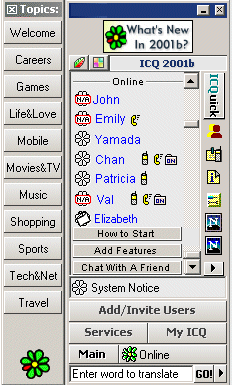
ICQ
Screen
The importance of on-line communication has been
highlighted by a study released by Jupiter Media Metrix (http://www.jmm.com, November 2001) which
found that Americans in the previous year spent over 18.5 billion minutes, or
309 million hours, logged into IM services such as ICQ and Instant Messenger.
Accurate world-wide studies of how much time people spend on-line in chatrooms
are not currently available but one would assume the amount of time spent
world-wide, with people logged into IM services would be high, since the number
of people logged into on-line chatrooms of all kinds is growing. The Australian
Bureau of Statistics in 2002 reported that half of Australians now use the
Internet, and a third of all households have Internet access. About ninety
percent of 16-20 year olds use the Internet regularly. Almost 55 percent of all
Australians, or 10.6 million people, had Internet access in January 2002,
according to Nielsen NetRatings (http://www.nielsen-netratings.com/).
These are higher levels of penetration than most European countries.
E-mail/chat remains as the Internet’s “killer application” since 92% of the
users reported using e-mail/chat and 71% of the users ranked it as the most
frequently accessed application (http://www.abs.gov.au/).
One study reported in BetaNews (Niese, 2001) estimates that more than
one-hundred million people are in chatrooms each day. Computers as a form of
communication thus affect many aspects of human discourse from daily
correspondence to entertainment and information purposes.
The sheer mass of such activity once again raises the
question: do computers in and of themselves change how people communicate?
Firstly, Computer-Mediated Communication (CMC) can be expected to promote more
diversity of thought than off-line communication primarily because people from
so many cultures and social groupings, i.e. age, race, gender and beliefs, are
able to be together without the hindrances of physical presence. As my
subsequent analysis will show, such discourse is already observably different
from that between people in off-line-person-to-person conversation. It has been
argued (see Berge and Collins, 1995; and work by Sloman, 1978), that
Computer-Mediated Communication (CMC) enhances dialogue[111].
A study by Ruberg, Moore and Taylor (1996) reveals that the CMC discourse
encourages more experimentation, sharing of early ideas, increased and more
distributed participation, and collaborative thinking compared with
face-to-face communication.
Instant Messenger Services are an outgrowth of MUDs and
MOOs which are textual created games and learning environments, as discussed in
the Introduction. Chatrooms, ICQ and IM especially, are reader/writer driven
interactive sites. One participant enters and writes text and another person
responds. Often there is the feeling
that one is writing and reading at the same time. In chatrooms this can become
chaotic due to the near impossibility of following the rapid scrolling of text,
and it is especially difficult in a room where there may be dozens of people
waiting for one person to say something then answering that one person. What
differentiates “speakers” within chatrooms is their logon names. If there are
several voices, none following any particular protocol, all “talking” at once,
the question becomes, “what is being said?” and at the same time “what is being
heard?” To date, no explicit protocols have emerged for managing the flows of
talk, or even for identifying the flow of talk, though for my analysis in the
individual case studies, I have developed a transcription methodology to
examine on-line chat flows and types of speech.
Instant messenger services however come closer to an
off-line-person-to-person conversational turn-taking environment. Unlike
multi-voiced chatrooms and discussion groups no one else can enter the
dialogue. Here the “talk-text” dynamic comes especially close to that isolated
in the “turn-taking” categories of Conversational Analysis, so that IM can
operate as a foundational text for other Net forms, such as the multi-voiced
Internet Relay Chat (IRC) services. But is IM “the same as” live dialogue? Are
alternative behaviours and functions emerging from its use?
One other aspect of Instant Messenger
“talk” that is different from the multivoiced chatrooms is that with some
computers there can be a voice wave used. Instant Messenger utilizes
Text-to-Speech technology. When a new message appears the computer reads it
aloud in a chosen voice. You can hear the voice whilst running any program,
such as a graphics or word program, and do not have to bring AOL IM to the
front to hear it. The
voice is however not the other person’s actual voice, but a simulation by the
computer, that is picked from a limited range of options, by the user. For
example, I was using an Apple brand computer during my dialogues with the
person I have referred to in this case study. I was able to choose from a large
range of voices and chose a voice called “princess”. Every time my IM buddy
wrote words the computer would read the words back to me in the “princess
voice”, which was a soft feminine vocalisation. Over several months I equated
this person with the voice of my computer. After nearly six months of daily
correspondence in Instant Messenger she telephoned me. She lived in
In the film “You’ve got mail”, (1998, Warner Bros.) Tom
Hanks and
In Instant Messenger someone steers the conversation into
a particular area of discussion, establishing, in CA terms, the “flow” or
speaking space for a topic (See Case Study Six). This allows me to look at a
simple two-person chatroom before I begin to analyse the multi-voiced
chatrooms. Multi-user chatrooms are public and anyone in the chatroom is
capable of viewing what others are saying, unless participants go into a
private chatroom and only allow one other person to join in. Instant Messenger
chatrooms can only be used by the two people in them. This in itself can be
expected to change the speech dynamic and behaviours available in this space.
My research data for this Case Study consists of two
conversations, one between two people I knew to be IM users, and one between
another person and myself. Otherwise the very privacy of this format makes it
extremely difficult to observe and study.
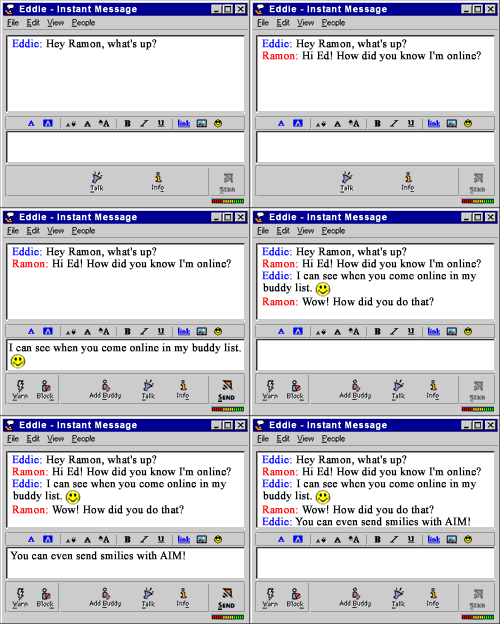
IM Screen
When I “captured” these two chats in 1997, AOL (American
On-line) Instant Messenger (above) was the only IM available and it was only
useable as a text-based turn-taking instrument. The two people “speaking” could
observe letter by letter what was being written by both themselves, and the
other person on the screen, in real time. Instant Messenger does not have the chaos
of multi-chat entries that most chatrooms have. By 2002 there were several
other IMs. Microsoft Messenger is available in 26 languages. Yahoo Instant
Messenger, begun in March 1998[113],
has entered the virtual world chatworlds with the release of Yahoo Messenger
5.0[114]. As
such “themed” environments become available, it will be interesting to observe
whether the on-line environment, such as the background images of the chat
area, influences the dialogue. Yahoo IM is available on mobile (cell) phones as
well as hand-held computers.
As well as Yahoo, ICQ and American On-line, which started
its service in May 1997[115],
there are IMs from Lycos, Odigo, Microsoft, begun in July 1999[116],
Netscape and Paltalk, which have video conferencing facilities as well as IM,
voice-mail and PC-Phones.
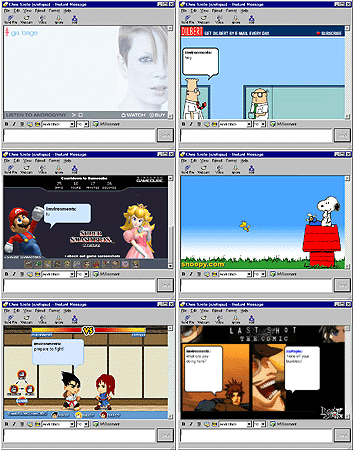
American on-line IM
Odigo, Inc., founded in 1998, claims to have a worldwide
community of over 8 million users (2002). Their IM screen is shown below.

The IM services are thus already diversifying in
themselves, a direct result of ISP competition. But some features remain the
same – especially those conditions under which a user of any of these variant
services experiences the processes of use. In each case, as well as being
engaged in a chat with another person in Instant Messenger, a person may
simultaneously be doing other things, such as writing a thesis whilst having
the Internet on. A little icon  appears on the screen showing when the person
is working on-line. Unlike text messaging on mobile phones which is currently
limited by the use of 26 characters typed in at a time, and the limits of
sending, and then waiting for a response, IM users are capable of writing as
much as they wish and at speeds close to real-time synchronous conversation. In
addition to this, IM users have the ability to engage in texted chat with
another user at any time and any place (using a palm computer or a laptop).
appears on the screen showing when the person
is working on-line. Unlike text messaging on mobile phones which is currently
limited by the use of 26 characters typed in at a time, and the limits of
sending, and then waiting for a response, IM users are capable of writing as
much as they wish and at speeds close to real-time synchronous conversation. In
addition to this, IM users have the ability to engage in texted chat with
another user at any time and any place (using a palm computer or a laptop).
CS 2.3 IM Chat Data
The feature I have emphasized in this Case Study is the
ability for people to engage in real time conversation with people in different
locations far removed from each other. This has always been possible for
telephone or telegraphic correspondence but not until the World Wide Web has
this been possible with conventional written text. For example in the IM that I
use in Case Study Two one person is in California and the other is in
Australia, and as the characters are typed on one keyboard they appear on the
other person’s computer.
In this conversation the two speakers had started out
discussing spirituality, but the male (speaking in capital letters) quickly
turned it into a sexual theme, with the female then ending the conversation:
|
34. ******: oh my god!...thats what i thought you were
going to say.....but i didnt want to go there! |
At this stage the female writer (lower case text) could
have been revealing a familiarity with social norms (eg male sexual behaviour)
or with IRC practices or both. Without other cues: visual, knowledge of the
participants and their familiarity with one another, it will be difficult to
define the “talk”. Yet the female participant suggests that she manages to do
just that - because she is familiar with her interlocutor.
For the conversation analyst, not familiar with the
co-speakers, the grammar, fonts and abbreviations are all significant. Several
of the standard on-line abbreviations are for instance already used as
shorthand for several phrases. How font size is used on-line is also well
illustrated in this chat. The male uses what is conventionally considered
“shouting” by writing everything in capitals, as illustrated in example 3. In
net-etiquette[117]
using the caps key all the time in an on-line conversation, whether it is
e-mail, a user group or in a chatroom, is considered rude and aggressive.
However, when a reason is given or understood as to why someone carries on
certain behaviour, it may not be considered rude. The person who types in capitals in this
Instant Messenger posting types in capitals all the time whether it is in
chatrooms, in usergroups or in e-mails. He believes he is a master teacher of a
religious cult[118]
and that the only way he can show his “authority” and “high attainment” by
using capitals. It is possible though for an experienced IM user, habituated to
the “shouting” code from other CMC encounters, to suppress one interpretation
and accede to this rather more idiosyncratic rule in line 10, “LOL” is used as
shorthand for “lots of laughs”. In chatroom talk LOL is also used for “lots of
love” or “laughing out loud”, but in this context I am able to interpret it
as “lots of laughs”, as it follows the
word “HE” – itself ambivalent, but here signalled by its repetition as part of
the laughter representation, “he he he”.
|
10. ######: I PRACTICE THE 4 RULE. I HOPE YOUR NOT INTO
THE EQUALITY TRIP BUT I FEEL THE MAN ONE THE WOMAN 4. THAT WORKS GOOD SHE
REALLY SMILES A LOT AFTER THAT HE LOL |
IM dialogue II
The talk-text is therefore providing cues for the
“writerly” or actively interpreting reader/writer. The problems of this
“emergent” genre are however constant. Two abbreviations in this IM I am not
familiar with. That, and the way that both abbreviations are used within a few
lines of one another, suggests that these two speakers have their own rules of
engagement for meaning exchange. This talk-text is not immediately “lisible”
for the outsider. The two abbreviations I am referring to are “OBE” in line 11
and “IBE” in line 14 - though in line 15 the writer clarifies IBE by saying
that the “I” is for “in”. To an outsider such as myself who does not know what
the abbreviation represents it would not be possible to know what is being
said. Language here is used as an antilanguage where the ones who know what is
being said are the participants who at some time must have given a shared
meaning to the used words or abbreviations (see Halliday on “antilanguage”,
1978).
|
11. ******: and where does she live....I hope not in
Australia.....thats too far even for a good old fashioned OBE |
|
14. ######: WE DO A
|
|
15. ######: THE I
FOR IN |
To some extent the textual “appearance” of these examples
of IRC script in IM is accidental. If people are not skilled at typing, they
make a lot of errors trying to keep up with IRC conversation. This is
especially true in chatrooms where there are several people “speaking” at the
same time. Nevertheless, contributors in Instant Messengers do also use text
forms in deliberative ways.
As the chat below shows, sequential dialogue, even in
an IM space is difficult to maintain. If there is not a turn-taking process in
which one person waits for the other before “speaking again” the dialogue is as
difficult to follow as in a multi-user chatroom. In the example in Table
4 CS 2:1 below the IM chat on the left, even though between
two people, does not show a “listening then responding” regime. Speaker <******:>
does not respond to <######:> who has made references “to knowing her in
another lifetime”. Unlike in off-line person-to-person conversation, topics are
rarely pursued. In this instance there is no more discussion after turn number
seven on the topic of other life times. In multi-user chatrooms there are
similarly few times when topics are continued, but
that is often because there are so many people “speaking” at once. In the same
number of turns as the Instant Messenger example, the multi-user chatroom shown
below shows few instances of continued dialogue,
|
From Instant Messenger, two person chat. |
Afghan Chatroom. |
|
1. ######: WE WERE TOGETHER IN THE HAREMS OF CHINAS
THRONE, THE GOOD OLDL DAYS 2. ######: MINE 3. ******: ah...one of those past life miracles 4. ######: COOL LETTERS. I LIKE GRAPHICS AND BIG BLACK
LETTERS, COOLNESS 5. ******: oops....better get a little more humble again 6. ######: WE WERE INDIANS IN THE NEW WORLD TOGETHER TOO 7. ******: WOW! far out man! |
1. [MrAnderson] hopefully Zahir Shah will help to bring
all AFG tribes - together in peace & establish fair governing body 2. [ZtingRay] Si 3. [FRANKY] I CAN RECOGNIZE HIS MORONIC SPEAKING WAYS
ANYWHERE 4. [fRANKIE] you are so low you have to have an umbrella
to keep the ants - from peeing on you 5. [MrAnderson] texasrose: are U in 6. [afraid] gina, where are youu 7. [oliv] HEI FRANK YOU AFRAID MAN |
IM
dialogue VI compared with Afghan talk
Discontinuity however exists even in the IM space. In
Chatrooms, notes Werry, “successive, independent speech acts are simply
juxtaposed, and different topics interwoven.
The kind of sequencing evident contrasts significantly with that
of oral discourse, as well as most forms of written discourse” (Werry, 1996, p.
51). Conversations branch out constantly as participants follow several streams
at once and interact with many others at a time. The demands of this multi -processing mean
that many threads snap and discontinue. However, in the Instant Messenger
genre, with only two speakers, there is still overlapping and checking – focus
going backward - especially if the conversation is not strictly in the question
and answer genre of talk. In person-to-person conversation the classic CA
talk-relation of adjacency pairs: direct response interactions, is one method
by which people structure conversation.
But due to the overlapping conversation enabled by the “first come first
served” packet-switching of Internet software, in chatrooms, this is rarely
found. Similar software provisions impact on IM dialogue. Both people in an IM
situation could be writing at the same time, but because of the longer life
span of text printed on the screen (when compared to verbal speech) a speaker
is able to scroll back up and read what occurred earlier, while they were
distracted by their own act of writing. This “recoverability” of text-entries
enables a more considered, second-guessing approach, which can be shown to
intensify the focus of IM users, shifting their attention from their own
assertions to those of their talk-partner.
In IM there are not
as many people to contend with as there are in multi-speaker chatrooms,
therefore the chatroom users do not constantly have to contend with overlapping
conversations. But as shown in the example above sometimes they do. In the
second example of an Instant Messenger dialogue, between me and the female in
the sequences above, the dialogue is more continuous and there is a classic
conversational turn-taking, based on writing, then reading the other person’s
writing before responding. This is difficult in a multiperson chatroom because
of the interruptions of other chatters and even of advertisement ads, which
some chatservers put in between turn-takings. Here however the conditions of IM
allow me to think more carefully about my responses – and there is textual
evidence in the contrast between the performance of my talk-partner here and
her previous chats with her other talk partner, that IM users act responsively
to the texted-talk-strategies within given exchanges. By using the tools
provided by IM, this woman was able to react differently and enact different
talk relations during her two captured IM chats.
As I was one of the participants in the chat below I am of
course able to give a different and more informed interpretation than for the
previous IM example. There are limitations to how people speak, even with
others they are already familiar with. One of the areas of on-line conversation
that would be worth study in future is the differences between conversations of
already-known participants and unknown chatters. Most chatrooms conversations
are between participants unknown to one another. In IM however, the “speakers”
are generally known to one another to some degree, as they need to know each
other’s “handle”, “screen name” or username before they can access one
another’s personal account – and some degree of affinity sensed in the existing
on-line relation must motivate the move to IM. Instant messenger is thus
similar to face-to-face talk in that participants already are familiar with
each other, even if through only a few correspondences.
One person whom I met in a chatroom and got to know quite
well over a short time period on IRC is the person in these two Instant
Messenger examples. This person has a history of psychiatric illness, confirmed
not only by her, but also several others on my buddy list. (IM has category
lists such as Buddy, family, Class-mates). Most of our chats were just
bantering and at times quite silly. Our IMs were more entertainment than
anything and provided me with a break from the stresses of every day life.
However, there were times when this person drifted into suicidal talk, wanting
“to return to her home in the cosmos”, her cue that she “wanted to die”. Mood
and directional changes affect the dialogue even without having tonal or
gesture signals. This can be read back within the flow of talk by creating a string
of text of lines 1, 7, and 9, or as coded above: 1>7>9. It is line 9,
when the person says “on this plane”, that the message becomes clear. Even
though it is using the same text: “on this plane”, by line 9 it has taken on
new meaning, following line 7 “I am am (sic) not going to be around too much
longer”. It is now clear the person is thinking of dying.
The following
dialogue has the other party's name deleted. Until this scenario begins the
respondent was telling jokes and seemed quite happy. As this stage I have only
arranged the text into single exchanges, omitting the full transactional
coding, which I have used in other case studies as my transcription method. In
those I have shown the order of discourse,
[34/\ 33/\ 32/\ 31/\ 29/\ 10], the numbers showing the
previous turn-takings which are part of the topic or thread[119] and
so build a sense of the inter-weaving of the talk. Instead, here I have added interpretive commentary;
to indicate the response processing underway in my own mind as the exchange
proceeded. At a later period I intend to use the more objective “coding” on
this transcript as well, to test the efficiency of my own “intuitive”
conversational responses.
In the conversation below my comments, which are not part
of the original transcript, are written in italics. These comments help to
clarify sections of text as the conversation went forward.
|
1.
@@@@@@:
Terrell......we will probably never meet on this plane |
|
2.
@@@@@@: realize
that |
|
3.
T Neuage:
really we will never meet [at this
point I thought she meant because she lived in California and I lived in Australia – and due to the
distance this would never go beyond a cyberfriendship.] |
|
4.
T Neuage: why
not [I second posted here as there was
a long pause of several minutes without a response] were you scrolling
back to pick up that “on this plane” comment? |
|
5.
@@@@@@: I dont
know |
|
6.
T Neuage: but
you believe that? |
|
7. @@@@@@: I am am not going to
be around too much longer [here I first
realize she is talking about leaving the world] |
|
8.
T Neuage: that
is not true |
|
9.
@@@@@@: on this
plane |
|
10. T Neuage: why do you say
that |
|
11. @@@@@@: it is so |
|
12. T Neuage: that is silly
stuff |
|
13. T Neuage: it is not so |
|
14. T Neuage: for what reason
would you leave [I triple posted here
as there were several minutes with no
response and I was feeling impatient at the time] |
|
15. @@@@@@: it ois time soon |
|
16. T Neuage: i am not into
control but you can't go |
|
17. T Neuage: it is not time
soon |
|
18. @@@@@@: but I will always be
with you [a metaphysical translation
being that she believes she will die and her spirit will be with me] |
|
19. T Neuage: who told you that
that you will leave |
|
20. T Neuage: it is not true |
|
21. @@@@@@: I am not
sure.....but I am am being taken soon [here
begin the 'I will be taken' beliefs. She claims to be an 'experiencer' - an
“alien” abductee. An alien
abuductee is one who believes they have been kidnapped by a being from
another planet or galaxy or realm of existence. There is a support group for
victims of alien abductions on the Internet at: http://www.cosmiverse.com/paranormal101102.html
] |
|
22. T Neuage: you need to be
around different people |
|
23. T Neuage: by whom [this refers back to 21] |
|
24. @@@@@@: it is not people [this confirms she is not talking about
earthlings] |
|
25. T Neuage: if they take you
can they come and get me too |
|
26. @@@@@@: I have had a good
life [proclaiming her death sentence
here] |
|
27. T Neuage: and you will have
a better one Here on this planet |
|
28. @@@@@@: I have to go home
soon |
|
29. T Neuage: where is your home |
|
30. @@@@@@ : inside my heart |
|
31. @@@@@@: because.....this is
not my life |
|
32. T Neuage: It is not fair for
you to have information that yhou won't share with me |
|
33. T Neuage: I thought we were
mates |
|
34. T Neuage: mates share |
|
35. T Neuage: tell me |
|
36. @@@@@@: I gave up my
life.....so what is left is not up to me |
|
37. T Neuage: what |
|
38. T Neuage: come on you can't
believe that |
|
39. @@@@@@: I should be
dead.....should be....and am not [proclaiming
her death sentence again] |
|
40. T Neuage: no you should not
be dead |
|
41. @@@@@@: yes |
|
42. T Neuage: you can not trade
or sell your soul |
|
43. T Neuage: that is myth |
|
44. @@@@@@: no |
|
45. T Neuage: reality is what
you are in right now |
|
46. @@@@@@: my daughter was my
dear friend and she died 26 years ago from an overdose of heroin |
|
47. T Neuage: what about your
daughter now |
|
48. @@@@@@: I really better not
tell you anymore |
|
49. T Neuage: up to you |
|
50. T Neuage: we can change the
subject |
|
51. @@@@@@: she is still my friend.....we
are not like mother and daughter....not at all |
|
52. T Neuage: what about the
daughter you said died |
|
53. T Neuage: mixed me up |
|
54. @@@@@@: never mind |
|
55. T Neuage: ok |
|
56. T Neuage: how is your bird [time to # - change the topic] |
The next day this respondent was back
on-line, seemingly with little memory of the conversation from the day before.
Apart from the psychological implications of such conversations, systematic
analysis shows that such conversation may seem aimless in structure, but it is
in fact a structured conversation in a “casual” format carrying serious social,
and maybe psychological, consequences. Yet I had not met this person at the
time of this interaction. Nor can I be sure of how our interaction operates
within this construction of a social self. There is more involved than casual
conversation with someone I would never be in touch with again. Probably I
would have left the chat and gone on to another person if I were not in IM, and
merely seeking to have a conversation with someone at the time. This is one of
the primary differences between on-line chatting and face-to-face conversation,
where the user cannot simply disappear and never be seen again. It is also a
key difference between IRC and IM. Here
we had each other’s e-mail address and even home phone numbers, and we had
shared similar experiences decades earlier, of being in the same religious
order in the 1960s. My talk-partner here could anticipate in me a capacity to
decode her less obvious comments – even if, as shown above, I attempted to deny
her vision. It may be that the comparative reversion to formal lexis and even
syntax, in contrast with the abbreviated IRC forms used in her other talk-texts
above, relates to this earlier – pre-Net – relationship and its talk exchanges.
At the same time, the re-focus work that I carried out here during the chat,
scrolling to check earlier statements and multi-posting to create dialogic
continuity out of silences, was dependent upon the capacities of the software.
The exchange displays both elements of face to face dialogic practice,
constructed under circumstances of turning-taking breakdown, and on-line
technologisation, permitting forms of conversational “repair” not easily
available in either person-to-person or IRC chat. Already, chat genres and
practices are demonstrating diversity in relation to both real-life
conversation, and within the varying on-line chat formats.
CS 2.4 Findings
My question and the reason for choosing Computer-Mediated
communications as an analysis tool for Case Study Two was to find whether
computers change conversation between people, especially when only two people
are able to correspond at a time. To some extent I have found that they do. As
discussed above and throughout this thesis, computers do not replace but
supplement and extend communication - though how that communication actually
occurs is dependant on both the sender of the message and the receiver, and the
relations between them, enabled by the varying software applications. What is
different between the multi-speaker chatrooms, where the CMC influence is
extreme and creates heavy pressures on conversational behaviours, and the
Instant Messenger services, where dialogue can shift both towards and away from
its physical equivalent, is that when there are only two speakers at a time in
a conversation, the speaker’s lack of “voice” is more noticeable. The captured
data suggest that IM participants “work” far more on managing and compensating
the loss of physical cues supporting the conversation, seeking clarifications,
offering more gambits, teasing out meanings and nuances. With many “speakers”
in a chatroom the absent cues from vocalization (see lurking on the CD at
lurking.com) are not as readily missed.
Is Instant Messenger, with its one-to-one dialogue, then closer to
off-line person-to-person conversation than dialogue in a multivoiced
text-based chatroom? Multivoiced
text-based chat confuses and complicates talk
to the point that not only is dialogue difficult to follow but it is
difficult to know who is dialoguing – and maybe at least to some extent, this
relative anonymity is becoming part of the point of such talk. One-to-one
on-line discourse is more personal, uninterrupted and closer to “normal”
off-line conversation.
One technologically introduced feature of text-based
multi-person chat is the random placement of an utterance – a circumstance
which decidedly alters the dynamics of chat conventions. This happens when the
enter key is pressed[120]
following the typing on a keyboard of what one has to “say”. The utterance made
can fall entirely in a place not expected, due to the rapid movement of text.
In a multivoiced text-based chat this can give a very random effect to dialogue
and unless a chatter identifies who he or she wishes to communicate with, the
line can be out of place. Meanings produced may be quite other than intended,
but nonetheless create impact – as will be shown in later Case Studies. IM in comparison
appears as more focused, and so enables more depth, and perhaps, as shown
above, confessionalism. As with the movie “You got mail”, key transitions
within the talk-texting – moments when the depth of the relation and the topic
shift – are signalled in both annexation of prior relations between the
talk-partners; social context, and in activities enabled by the software design
– such as scrolling to check earlier contributions, or multi-posting to
recreate dialogic processing amidst extended silence.
This raises two further questions. Firstly, since both
existing and real-life conventions of talk practice and new regulatory features
introduced by CMC technologies can be shown to be impacting on chat behaviours,
should these new behaviours be considered to be mere adaptations to limiting
circumstances, or more broadly influential changes to the social talk
repertoire? Secondly, since the CMC features impacting on and evoking these
changes are in themselves products of the same social contexts, do they display
certain “pre-dispositions” towards particular types of conversational or
communicative exchange?
It is already being suggested that the use of CMC has
changed the broader communication landscape in some societies, as is shown
below. In a recent study (2000, Nomura Survey -
|
Q. Do computers and other information technology increase
human communication? |
|||
|
|
|
|
US |
|
Yes |
43.2% |
75.4% |
73.8% |
|
No |
56.4% |
23.6% |
25.0% |
Each of these countries has a strong base of CMC industries,
and a clear pre-disposition towards technology uptake. But there are
interesting differences in relation to the ease with which CMC systems could be
inserted into communicative exchanges through the respective languages. One of
the major problems with Asian languages being used on the Internet is the
obstacle of inputting into a word processor in non-Roman scripts. For example, in Japanese the writing system
requires two stages of inputting, which slows typing and makes chatroom
participation difficult. Users must press the space bar to bring up the desired
combinations of Chinese characters, which are then entered in the text by
pressing the enter key. This contrasts with English and Korean, both alphabetic
languages, in which the typed letters enter the text directly as they are typed
on a complete alphabetic keyboard. The Nomura survey shown below reveals that
|
Typing proficiency – Nomura Survey on keyboard literacy |
|||
|
|
|
|
US |
|
Fast without looking |
6.2% |
16.8% |
29.8% |
|
Fast but Look |
17.5% |
14.8% |
24.6% |
|
Slow and Look |
39.2% |
26.2% |
31.8% |
|
Barely Use |
36.7% |
42.2% |
11.4% |
Typing
proficiency January 2001
-http://www.nri.co.jp/english/news/2001/010131.html
While these figures show only very basic and technical
aspects of IRC and IM access, they reveal something of the more detailed
interactions between technologies and users, operating together to reform and
reshape communication practices as we develop on-line conversational
behaviours. Perhaps broadband access, with its break away from texted
communication and its introduction of speech, graphics and video will resolve
these text-entry problems for some language groups. Perhaps “texted” talk of
the type analysed here in IM transactions will prove an historical anomaly, and
simply a convenient moment for the talk analyst, providing useful access to
ready-texted transcription. But at this stage it has certainly revealed a
complex interrelationship in users’ negotiations of the new interface space
between CMC technologies and the social interactions that we loosely call
“talk”.
In the next Case Study I will begin to examine the
on-line-chat-specific elements of communication, such as the use of emoticons,
to discover whether meaning is found in a chatroom when more than just text is
used.
Case Study Three
CS 3.1 Introduction
In Case Study One, using analysis drawn from
Reader-response theory, I explored the dual role of authorship and readership
and argued that the writer needed to be the reader of the text in order to contribute
meaningful discourse. The author does not have to read in order to write or
“speak” in a chatroom, as he or she could just enter a chatroom and enter text
into the chatroom, then leave. However, for shared discourse the writer has to
read, in order to produce a “response worthy” response. Chatrooms are, to this
extent, dialogic. But that definition alone cannot cover the intricacies of
chatroom discourse.
In Case Study Two the technology that makes chatroom
discourse possible was introduced. Computer-Mediated communication (CMC)
involves the study of the process of using computers to exchange
information. However, without
significance being applied to the characters on the screen during some process
of reception, the “communication” of CMC cannot have a purpose. In this case
study I combine awareness of both how information is mediated by CMC, and how
users (reader-writers) interpret that information. This chapter will look at
how meaning is read from keyboard characters and iconic representatives, and
especially in the complex semi-graphical textual configurations used in
chatrooms, which often cannot be read as traditional text. The current CMC
keyboard also now enables the user to upload an image which can be used as a
representation of him or herself, or as a visual “cue” or “prop”, in the
theatrical sense. Analysis of chatroom practice and communicative “production
and reception” thus requires a visual as well as verbal-textual analysis.
As I argue throughout my case studies, here the only way
to identify communicative intent in the chatroom is through first attempting to
identify what the chatter is doing in the room. The only cues that are provided
are the utterances and the username. For example a chatter with the username
<guest-MoreheadCityNC> is telling people that he or she has something to
do with
Given this tendency towards user-identification with the
topics and spaces of chat, what then might we expect from the
chat-expressiveness of a group self-selecting into a Britney Spears- focused
chatroom? I saved 70 turns from such a chat in March 2000, (see Case Study 3
data on the CD). At the time I knew little about Britney Spears except that she
was another pop idol among children. I chose this particular chatroom at random
out of a list of thousands on the popular Talkcity chat server, at a period
when it was among the top of search engine Google’s selections for chatroom
servers. Talkcity.com went out of business in early 2002, making it impossible
to replicate this series of chats – however the tendencies displayed on this
site at this time and shown in this sample, reappear on other similarly focused
spaces.
To capture both the self-aware linguistic expressiveness
and the multi-layers of identity affiliation processed in the chat in such
rooms, I will use semiotics alongside semantics and pragmatics. In a space
centred on the image or style culture of a popular, almost iconic figure – and
especially of one so successfully appealing to young audiences deeply immersed
in adolescent and pre-adolescent self-formation, my focus will be on the ways
users take up and rework cues offered by the celebrity image, the site itself,
and the talk texts and image-props of other users. I hope here to introduce a
socially embedded reading of chatroom communication, examining not just the
textual surfaces, but recognizing, where possible, the social origins and
outcomes of such otherwise symbolic activity as celebrity-centred chat.
CS 3.1.1 Questions
“Can a celebrity’s name as title of a chatroom create a
difference in dialogue in chatrooms?”
My first question in researching the dialogue in this
chatroom cannot be answered by any form of statistical analysis. People pass in and out of chatrooms, and
unless there is a pop-up box with questions to answer – and some constraint on
the honesty or accuracy of replies - there is no way to know who the chatters
are, or why they are in a particular chatroom. Even with forms put on a site
for people to answer there is no way of knowing whether the answers are
accurate, as anyone can put in any information they wish at any time – with
single or multiple responses (Danet, 1998; Bromberg, 1996; Turkle, 1996).
However, the chatroom in Case Study Three had the name of a celebrity and could
be presumed to be limiting the group likely to find the chat topics appealing,
so that the possibility was produced for an open or empirical study of whether
such a limited group might display special discursive or chat-behavioural
characteristics, exclusive to such a self-selected group. I therefore pose the question, “Can a celebrity’s name as title of a
chatroom create a difference in dialogue in chatrooms?”
To some extent this proved to be a naïve question. Before
I entered this chatroom and copied the log for the ten-minute 70-turn
discourse, I believed the talk would be solely about the person whose name the
chatroom bears: a “Britney Spears Chatroom”. An extensive and growing
literature of fan culture suggests however that this is rarely if ever the case
(Jenkins, 1992; Modleski, 1982; Baym, 1993, 1998). The very role of the
celebrity in identity formation (Lewis, 1992; Schickel, 1985; Giles, 2000)
suggests that much of the talk in fan discussions will be about life and
lifestyle for the devotee. Work on use of soap opera texts for instance by
Modleski (1982) and Mary Ellen Brown (1994) shows adult audiences creating
continuities between the narratives and characters of the serials, and their
own and their friends’ lives or personalities. Buckingham in the
Research done on the difference in male (between the ages
of 9 and 18) and female behaviour on the Internet found boys were attracted to
pictures and games and females to TV, movie, and soap opera sites and chatrooms
(see Cobb, 1996). The “National School Boards
Foundation” found that girls appeared even more likely than boys to use
chatrooms on the Internet: 73 percent of girls and 70 percent of boys use
chatrooms at least once a week, according to their parents (http://www.nsbf.org). See also WHO: Working to halt on-line abuse: http://www.haltabuse.org for statistics
of on-line habits by gender and age, and http://www.clienthelpdesk.com/statistics_research/
for statistics of on-line viewing by gender and age).
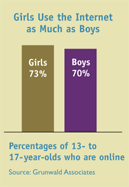
From
a survey by The National School Boards Foundation (2002)
Survey results suggest that work done in other media
reception studies bears out the view that social activities – such as chat –
centred on celebrities or popular media texts is directed less at simple
celebration of such identities and texts, than at their insertion into the
lives and self-formation of participants. In on-line inquiry, one way to test
this hypothesis is to examine the text-generating habits of chat users for
elements of expressive-emotional response: possible markers of a self-aware
relation to the meanings being constructed in talk around celebrity figures,
and indicative of their meaningfulness in identity construction. How rich is
the emotional response to celebrity issues as displayed in the talk around
them? How conscious are those talking of their represented orientation to
particular issues – and how can this best be read in on-line chat?
Because of the special repertoire offered to on-line
chatters by the keyboarded symbols called emoticons, the second research
question I have posed in relation to “Britney chat” asks: “are emoticons used
more frequently in a youth orientated chatroom than in an “adult” chatroom?” Emoticons
allow users to emotionally “colour” their texted contributions: to attend to
the tone of the talk relation they are constructing with others, or to
affiliate to or distance themselves from particular issues, ideas, postings. I
have compared the use of emoticons and abbreviations in the seven case studies
I have discussed as well with postings from several other chatrooms (see
“comparison tables” on
the CD) to firstly assess how emoticons add to the signification processing of
chat postings, and secondly to assess whether Britney chat, as oriented to
younger user groups, displays especially rich techniques for identity formation
work – and if so, what these techniques might be, and how might they best be
captured and theorized.
CS 3.1.2 Britney Spears
From statistics of her album sales and appearances,
pre-adolescents make up the bulk of Britney Spear’s fan base[121].
There are hundreds of fan clubs on the Internet devoted to Spears, many with
sexual notions of youth attached[122]. I
have used this chatroom as an opportunity to observe whether there are
differences in “talk” in what I believed to be an adolescent chatroom, from
language used in what I would assume to be adult orientated chatrooms, such as
that used in Case Study One, the emergency “storm”, or a chat on 3D computer modelling
discussed in Case Study Six.
CS 3.2 Methodology
For this case study I have applied three linguistic
analytical tools. Firstly, semiotic analysis or the study of signs, verbal or
visual, (Chandler, 2001; Saussure, 1983; Eco, 1979; 1986; 1995; Kristeva 1980;
1984) is used to search for recurrent meaning-structures or “significations”
within “Britney chat”. In this chatroom I will discuss in particular the
chatroom feature of avatars and usernames, as well as emoticons, suggesting
that each can be used as an identity cue. The Britney usage is compared to
examples of iconic usernames from two other chatrooms, both 3-D chatrooms, to
test for any distinctive features. Emoticons
and abbreviations and the “identity” sign-tag of the chatter are of course
features that are important to all chatroom discourse (Crystal, 1985, 1992,
2001; Rivera 2002). I am however particularly interested here in the use of
non-word representation, emoticons and abbreviations, seeking them in
particular from a strongly “image-identified” user site, to optimize the
chances of discovering how important visual or design-representational aspects
of chatroom practice might be, as chat-room-specific communicative
behaviour. Semiotics is thus used as a
method to uncover not just how “talk” is accomplished in a chatroom, but how
far chatroom “talk” generally may be
said to include a broader than usual repertoire of representation.
Secondly, I use pragmatic theory (Ayer, 1968; Peirce, 1966) in an attempt to reveal a socially embedded
reading of chat “talk”. Pragmatics[123]
looks at the “meaning” of an utterance, considered as part of a social system,
and not just as an example of “talk performance” – however rich in its
construction. Here I use this to focus on how the various communicative items
in chatrooms; emoticons, abbreviations and misspelled words as well as chat
utterance sentence structures (CUSS)[124], are
used within a delimited linguistic or a chat society: to locate both the
specifics of this site, and to suggest that they may be extensible into other,
similar, usage-subcultures. And thirdly I use semantics, (Korzybski, 1958; Chierchia
and McConnell-Ginet, 1990, 1995) which investigates the “meaning” of a
linguistic item, considered as part of a syntactic system, in terms of how the
item, (in this case even an abbreviation or an emoticon), relates to everything
else within its co-location. Through
this web or matrix of levels of inquiry, I hope to show that something as
seemingly inconsequential as Britney-chat is both richly designed and enacted,
embedded within layers of social significance, from which it draws
comprehensible formations, in turn contributing new formations to such
repertoires, and finally, how it selects and possibly highlights particular
meanings and meaning systems to construct core cultural values for the central
topic focus (Britney) which are potently relevant to this community of
chat-participants.
CS 3.2.2 Transcription
This multi-layered analysis requires a chat transcription
different from those used so far in this study. For the Britney Spears chatroom
analysis I have divided the “utterances” or chat-turns in ways promoting a
clearer view of individual chat “styles” or the specific identity-codings of
participants. The data for Case Study Three can be found in appendix 3a on the
accompanying CD. Table One presents the types of phrases used, identified
within pragmatic or “function” categories (i.e. greetings, answers, etc).
|
TABLE ONE |
|
A/ = greetings or
salutations |
|
B/ = statement-
open no one in particular, ever who is in the chatroom |
|
C/ = statement - to
someone named or previous (earlier) speaker |
|
D/ = answer - to
someone named or previous (earlier) speaker |
|
E/ = answer - open
- to ever who is in the chatroom |
|
F/ = question -
open - to anyone - ever who is in the chatroom |
|
G/ = question - to
someone specific or previous (earlier) speaker |
|
?/ = undetermined
or not classifiable by one of the criteria above |
This allows for recognition of the range of talk-functions
present, and displays the seriousness of chat which might otherwise be
considered trivial. It also permits the analyst to represent the particular orientation
towards social significance in chat, taken up by individual chatters.
Table Two denotes the use of abbreviations, emoticon use,
and the beginning of threads of conversation. This allows consideration of the
“colouring” of individual contributions, and so examination of their orientation
to topics as signifying the social or cultural loading of their talk.
|
TABLE TWO |
|
--- = (NOTE: THIS IS A CONTINUATION OF --- ABOVE) |
|
** = uses abbreviations such as
lol |
|
*) = uses emoticons in places of
words or identify |
|
#/ = new thread (if a particular
thread (direction of talk) |
In table three are the user names of the participants,
separated to allow for careful examination of their usually multi-layered
semantic codings, as significant in identity formation work around the
celebrity figure.
|
TABLE THREE |
|
1. SluGGie- |
|
2. Mickey_P_IsMine |
|
3. JeRz-BaByGurL |
|
4. Paul665 |
|
5. guest-Wild-cust |
|
6. Pretty_Jennifer |
|
7. baby_britney1 |
|
8. IM_2_MUCH_4U |
|
9. AnGeL_GlRL |
|
10. MADDY_CICCONE |
|
11. msbbyblu12 |
|
12. IM_2_MUCH_4U |
|
13. Luvable_gurl15 |
|
14. Joypeters |
|
15. TYTAN-guest |
|
16. buttercup20031 |
|
17. guest-hotgirlz |
Table four is the raw data: the chat threads as they
occurred in real time, indicative of the degree of chat skill displayed in the
actual experience of talk on such sites, while table five lists the utterances
used without user name or other coding devices, to examine the emergent
“conversation” as if it alone were the significant feature of participation
(which this analysis inclines to presume it is not). Table six, shown partly
below, contains the 297 words “captured” in this chat sequence – in one
paragraph. I have done this to discover whether on-line chat, CMC software
coded as turn-organised, is still meaningful without the speaker-cues provided
by its screened representation. In other words, are those user-specific cues
that I am suggesting exist in an “identity-work” chat present to sufficient levels
for an analyst to uncover, without the turn-organised display convention? Is
there any capacity for recognition of user-difference in a chat-sequence such
as this, compared to the one that follows with the usernames included?
|
lol loL missed ya too jenn.. while I was sleepin lmao ter
plz stop Go for it baby b!!! I miss? hmm Scott? Lmao... .?¯S¯?.?°¯Y¯°?.?·D·?.
lol lol xoxoxox JuStIn well heather he going to end it i just know it No Syd
damn it meee no not ter lol hmmm mickey But i think hes gf dont miss him that
muc but well see what tomrrow brings |
The sixty-seven words above are the same as the ones
below, but without the turns being separate they do not tell the same story as
the sixteen turns that it took to say this:
|
TABLE FOUR |
|
1. / /\ 1a. <SluGGie->
lol |
|
2. / /\ 2a. <Mickey_P_IsMine>
LoL |
|
3. / /\ 9a. <AnGeL_GlRL> sits n da couch n holds her head..
missed ya too jenn..while I was sleepin lmao |
|
3. / /\ 3a. <JeRz-BaByGurL> ter plz stop -OVERLORD walks
over to miss <amethyst_desire> and whispers sweet nothings in her ear |
|
4. C/ /\above4a. <Paul665> Go for it baby b!!! |
|
5. / /\ 2b. <Mickey_P_IsMine> I miss? hmm Scott? Lmao... |
|
6. / /\ 5a. <guest-Wild-Just> .?¯S¯?.?°¯Y¯°?.?·D·?. |
|
7. C/ /\06 6a. <Pretty_Jennifer>lol |
|
8. C/ /\06 7a. <baby_britney1> lol |
|
9. C/ /\06 5b. <guest-Wild-Just> xoxoxox |
|
10. / /\ 2c. <Mickey_P_IsMine>JuStIn |
|
11. / /\ 8a. <IM_2_MUCH_4U> well heather he going to end it
i just know it |
|
12. / /\ 6b. <Pretty_Jennifer> No Syd damn it meee |
|
13. / /\ 3b. <JeRz-BaByGurL>
no hes not ter |
|
14. / /\ 6c. <Pretty_Jennifer> lol |
|
15. / /\ 5c. <guest-Wild-Just> hmmm mickey |
|
16. / /\ 2d. <Mickey_P_IsMine> But i think hes got a gf so i
dont miss him that muc but well see what tomrrow bringslol |
Without indicating the turns as shown above we do not have
the reader-response mechanism which cues chatters to continue a
communication. We can however, piece
together the story of looking for love, whether several people are speaking or
one. But it does not read as the same story.
Table seven presents all of the words in the Britney
Spears chatroom sample, separated into order of appearance in the chatroom.
This offers the analysis an insight into the word size of “talk” in a chatroom
such as this one. There are 3.73 letters per word on average and it shows that
the word formation is very simple and could be read or written by someone in
primary school. But this does not necessarily class the participants in this
particular room in any way that would identify educational level. Chatrooms by
their rapid flow of text encourage short, simple wording.
Table eight presents the same words in alphabetic order,
as well as the number of occurrences for each word and word type. What this
table shows is that “I” is used most often (18 times) with the abbreviation “lol”
(“lots of laughs” or “lots of love”) the second most used expression of the
speakers: evidence I will suggest for the intense levels of identity work under
way in this chat, with self-centred and expressive modes dominant. To provide
for some continuity of categorization and at least some degree of comparative
study between case studies, I have used the same coding as throughout the case
studies (see the Methodology section). The name attribution for each speaker,
such as, <Luvable_gurl15>, is placed in brackets in the tables, and
within the discussion of this case study. The “speech” of each speaker is only
in brackets when in the discussion, not in the table.
CS 3.3 Discussion
Using semiotic analysis, the study of signs both verbal
and visual, as a way to analyse communication in chatrooms, allows this
analysis to show how avatars and ikons can be used to accentuate and intensify
the coding in representations of the chat author. A chatter can have a textual username, or a
picturographic representation of him or herself that has significance, albeit
often only for the time he or she is in a particular chatroom. In the figure
below[125],
every time the chatter <Kokuen Lain Unigama> keys in an example of what I
call elsewhere a Chatroom Utterance Sentence Structure (CUSS) the following
image appears, together with the words, <techno teacher Kokuen’s daughter
now leading the good life> below the image. This graphic tag takes
precedence over any CUSS made by <Unigama>, and must be seen to be colouring
the verbal contributions.

Avatar
This person, <Kokuen Lain Unigama> is identifying
her or himself as one who can teach others technology and this person has
chosen the female gender, as Kokuen’s daughter, to chat through. With this ikon
others in the chatroom may feel comfortable with asking questions in regards to
technology. And saying «now leading the good life» would colour whatever
<Kokuen Lain Unigama> says.
The dialogue attached to this posting, which I have
transcribed but could not directly save because chatrooms in java script cannot
be copied to a word program, is simply about the chatter <Xian-Shin>
speaking to another person who wants to telephone his or her mother.
<Xian-Shin> answers the other person <Unigama>, with,

This illustrates how an icon dominates what is actually quite trivial and mundane information exchange – actually “phatic” or empty conversation to a viewer not familiar with the characters involved. While the exchange has pragmatic significance to the speakers, it offers little to other chatroom “reader-writers”. The ikon however continues to signify, radiating a personalized and socially contextualised set of messages and values, even into inappropriate contexts. Like the linguistic device of “over-lexicalisation”: the agglomeration of too many lexical items around an utterance, said by analysts to represent moments of cultural nervousness and tension – a sort of over-compensation – this ever-present “personalization” image and in-group indicator is perhaps deployed to alleviate the user’s sense of CMC alienation. As the user posts from her family-oriented security out to the unknown zones of IRC, her identity is over-expressed; her affiliations permanently fixed or “laminated”, in Barthes’ (1972) term, onto her utterances. It is as if this user were saying “I am this person, with these affiliations – don’t you forget it.” This use of avatars and ikons is thus qualitatively different from a chatroom that uses only usernames, such as the chatroom logs I used in this case study. While intense and rich in signification, it can be seen to limit flexibility: to restrict experimentation or fluidity in identity work. It is significant that there were in fact no avatars or ikons used with user names in the Britney Spears chatroom whilst I was present. In this case study however, the user-name signs, the clearest textual representatives of the self, are instead textual variations of name, such as <IM_2_MUCH_4U>, <Luvable_gurl15>, <SluGGie->, <Mickey_P_IsMine>, <JeRz-BaByGurL>, <Paul665>, <guest-Wild-cust>, and <Pretty_Jennifer>. Britney chatters thus achieve some consistency with the ikon-id, by using enhanced “punning” and linguistic ambivalence in their name-tags, not necessarily to hide their identity, but each to emphasize his or herself at a particular time, and especially within the “sexy-good times” subcultural frame of Britney Spears. Rather than the “strong” self-assertion of the graphic-tag discussed above, unchanging in its signification, the Britney tags are “other” oriented: identity markers arrayed as display, offering selves for social-relational exchange in a – mostly – sexualized frame: “luvable”, “pretty”, “2 much”. The absence of graphics is here compensated by intensive textual wordplay – a mode I suggest that enhances both the feminisation of the site – at least insofar as it endorses research mentioned above which shows the graphic on-line mode as male oriented, the textual as female – as well as inviting a labile, shifting identity work. Since reader-writers on the site are immediately challenged to solve the riddle in each name tag, and since “real” identity is mostly disguised, but in overt ways, the tags alone display the tendency on the site for identity experimentation and social (sexual?) relational invitations. How then can we work to uncover and describe the meanings within this playfulness? When texted language annexes these semi-graphic modes of missed characters and punning play across capitalization or punctuation codes, can linguistic analysis alone summarise the processes in play?
CS 3.3.1 Semiotics[126]
The importance of beginning with semiotics or a study of
signs in this case study relates to the need for a focus on how users can be
shown to be acquiring and passing on meaning within the intertextuality of
chatroom “talk”, establishing signification in a text-based-chat, through a
marked creativity in their use of both keyboarded character sequences, and
cut-and-paste graphics assemblies. Chatroom dialogue is, we must remember,
neither quite oral nor written. Because of its screened interface: its
limitation – in current modes at least – to text and supportive image, at core
it is semiotic (Shank, 1993). That is, it shows clear and increasing evidence
of breaking away from traditional print-based forms of text composition, to
build intensified representational and signifying techniques, perhaps initially
to compensate its keyboarding limitations, but more recently within a growing
on-line community “literacy” of consensual forms and repertoires.
In part this drive to create new and distinctive
communicative forms arises from the distinctive circumstances of IRC
“threading”, as postings arrive haphazardly onto the computer screen’s dialogue
box. It is neither necessary nor indeed possible to take turns as in oral
communication, so that the regulatory features of oral conversation cannot
apply. The many voices can be “heard” in
parallel, making chat dialogue a multilogue discussion (Høivik, 1995), with
each “voice” fighting for attention. To have significance, there
needs to be an intensified aspect to the signifier, or the material element of
the sign. It must be made not only to stand out on its own terms, but to be
distinctive and recognizable within the random threads. For most chatters, the
default codes: “Janet3”; “John45”, which tag a real world name – most likely
their own – to the incidence of appearance of that name in the chatroom – are
insufficient as “identifiers”. In most chatrooms, given the reduction of the
physical “presence” of face-to-face real-life (rl) talk, and its further
limitation in the chatroom dialogue box to relatively short text-utterances,
there has been a strong compensatory move to creative “signing” through graphic
and extra-semantic modes. Still limited
at the dialogue-box level at least, to an alphabetic repertoire, supported only
by the grammatical and punctuation signs of the qwerty keyboard, this newly
evolved form of communication has produced a compound new repertoire comprising
the emoticons, acronymic abbreviations, conventions on “expressive”
representation – such as capitals for shouting; punning or ambiguous lexical
selection, and especially abbreviated “cut’n’mix” forms combining many of the
above. All of these are used - often in combination - as personal identifiers.
This last multi-form, appropriating elements from multiple sources and
imbricating them into a new fusion, is interestingly close to the ideographic
mode of Chinese writing, in which one element of a written word addresses its
semantic or conceptual load and another its phonetic connections to
similar-sounding words (Hegal, 1961; Hu, 1996). The “reader” of Chinese must
thus always read on multiple levels for every ideograph, relating it out to
both its cultural origins and to its everyday use, to locate its meaning (Rosenthal,
2000). At the same time, the name-terms of chat spaces are also close to the
graphically-oriented “tags” of graffiti artists, whose stylized name or
initials both teasingly conceal identity, and claim status by their positioning
in public places, their over-drawing of other tags, and not least the artistry
of their calligraphy (Neuage, 1995). Both cases give some sense of the
multi-functioning and multiple cultural engagement of chat-names – and perhaps
even of the origins of their IRC use, given both the counter-culture
connections of IRC within youth communities generally, and the recent
influences of Asian cultures within CMC developments.
Semiotic analysis, by eliminating distinctions between text and image as signifying systems, enables this study to move beyond a strictly linguistic base, into examination of the graphical and expressive modes used to compensate, and maybe beyond that, to create meaning in new ways, within the new “conversational” spaces of the chatroom – and particularly so in a chatroom of saturating expressiveness within identity work, as is the case with Britney chat. But to fully explore this drive to identity performance and exploration, such that it extends the actual communicative range of the “language” or coding system used, it is first necessary to examine which semiotically signifying communicative functions are actually in use in the Britney Spears chatroom, and to reveal which are dominant and recurrent.
CS 3.3.1.1 Emoticons
Emoticons in chatrooms are similar to manuscripts for theatrical plays, which use
bracketed text (Høivik, 1995) to describe actions accompanying dialogue, or
to indicate when an actor should enact certain feelings within a speech. In most chatrooms, keyboard letter combinations will produce an
emoticon. The grid below shows that when :) is typed on a keyboard, what
appears in a chatroom, as well as in a Microsoft Word document, is the graphic J. This shows that that these
particular emoticons, known as “smileys”, are so well established that they are
now automatically made when keys are pressed. Some chatrooms even colour in the
emoticons, to add expressive coding. Three examples are given below;
|
Characters typed on keyboard |
What appears in Microsoft Word (2000+) |
What appears in some chatrooms |
|
:) |
J |
|
|
:( or :-( |
L |
|
|
:| or :-| |
K |
|


Emoticons
Just as in person-to-person conversation
off-line (p2p-off), different dialects and accents develop in different
text-based chatrooms in CyberSpace. For example, emoticons are sometimes
replaced by asterixed gestures, such as *s* and *smile* or *g* and *grin*
for the traditional :). For many expert
typists the conventions of character entry make the typed version quicker than
two keystrokes and the unconventional punctuation-sign combination taken to
produce :).
In recognition of the widespread use of
graphic-textual combinations, many chatrooms now have emoticons included with
their software. For example, The Odigo Messenger, Instant Messenger has graphic
ikons to allow participants to show other users how they are feeling. A list of the emoticons that can be sent includes those below:
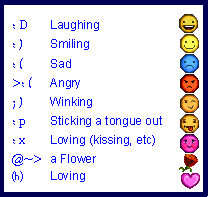
Of the seven case studies collected for
this data corpus I have found the highest incidence of abbreviations (30%) and emoticons
(6%) in the Britney Spears chatroom (see appendix for a statistical comparison
of the seven chatrooms). The dominance of abbreviation use on this site
suggests an especially tight community focus: a consensus not merely of style,
pressuring all participants to adapt similar forms, but of familiarity and so
frequency of concourse. These are complex, multi-layered linguistic constructs.
While they are continuous with those used elsewhere in IRC, and more recently
on SMS texting on mobile phones, and while these forms also show influences
from the semiotic packing used in advertising logos and slogans (see for
instance Williamson, 1978, and Wernick, 1991) their heavy use on the Britney
site contains particular elements affiliating individual chat participants to
Britney culture. A teenage girl will see hunting boyfriends and beautifying as
a norm; it is argued indeed that these are transcribed as their sole purposes
in life (Davies, 2001). As these lines below show, the participants in the
Britney Spears chatroom are concerned with relationships.
|
11. <IM_2_MUCH_4U> well heather he going to end it i just
know it |
|
16. <Mickey_P_IsMine> But i think hes got a gf so i dont
miss him that muc but well see what tomrrow bringslol |
|
26. <MADDY_CICCONE>Sis i want Justin to get here! |
|
29. <Mickey_P_IsMine> wel I duno Mickey lol I juss think hes
hottie so i cant really miss him |
|
32. <Luvable_gurl15> i am going to cry if i dont see my baby
soon |
The assumed age group in this chatroom places this group within the youth
market: a demographic focused on identity formation, marked by heavy levels of
over-lexicalised self-expressiveness. At the same time, the energetic
communicative ethos drives a primary push for shortened messages, as well as
for “in-group/out-group” affiliative techniques. Abbreviations and emoticons intensify the
group codes at the pace required of a group which sees itself as dynamic,
mobile and trend-leading (Wrolstad, 2002; Ocock, 2002). The
table below reveals the affiliative urge of such youth groups, attracted to
each new generation of communicative technologies, maintaining fashion-status
and social cohesiveness in the one focus.
|
High Interest
in Applications of 3G |
|||
|
|
|
|
|
|
Total |
22% |
26% |
25% |
|
Under 25 |
37% |
30% |
45% |
|
25 to 34 |
27% |
26% |
26% |
|
35 to 49 |
19% |
25% |
27% |
|
50 and over |
9% |
24% |
10% |
|
(“High Interest” based upon a six-point
interest scale, where ratings of 5 and 6 indicate high interest.) |
|||
Youth Market percentage of 3G http://www.cellular.co.za/news_2002/060102-3g-market-research.htm
Read purely as signifiers at the level of communicative
technique, abbreviations thus carry with them a semiotic loading which endorses
membership of such trend-seeking/trend setting youth culture groups. This is,
in Barthes’ terms (1972), a “second order” signification, to be read not as the
specifics of the Britney style-culture claims seen in actual indent tags,
above, but as the more generalized “myth” construction which constructs around
IRC and SMS an entire culture of newness, group-exclusivity, and urgent
self-expressiveness.
Alongside the abbreviation mode, and indeed often
compounded into it, is the emoticon – whether individually keyboarded or software-encoded.
Many web analysts have considered the emoticon to be a “symbolic” form of
communication (Herring, 2002; Roberts-Young, 1998; Reid, 1991), presumably in
recognition of its distinctly graphic or visual form, as opposed to
textual-alphabetic codes. But strictly defined, a symbol is a sign that has a
non-arbitrary relationship to what it means. Its meaning is established within
a particular cultural consensus, even if any logical origins for the connection
between the representation and the represented (in semiotic terms, the “signifier”
and the “signified”), may be lost in history.
To use an emoticon, however, is to assign a meaning,
usually to a feeling, through one or more existing keyboard characters. Emoticons
may be “conventional”, in the sense of being available and consensually
established within a given community of users – up to and including all web
users, even across language groups (Churchill and Bly, 2000; North, 1994) – but
they can also be “improvised” or created new, by the act of creative
recombination or re-application to new circumstances. The keyboard thus becomes
a way of adding expressiveness to the words typed into the dialogue box,
restoring some elements of the expressiveness of vocalisation, facial
expression, body gesture, or even handwriting fluency or emphasis, lost in the
standardization of keyboarding and the remoteness and physical distantiation of
the chat relation.
Because of the conscious choices from the available
repertoire of expressively recombinant keystrokes that the emoticon culture
offers, all presentational selections in dialogue box text entry become
“significant” in semiotic terms: laden with potential expressive meaning,
beyond that of the semantic load of the words themselves. Nor is this semiotic
“loading” always an extension or intensification of the semantic intention.
Such elements as case selection, word - “fracturing”, deliberate mis-spelling,
can act alone or in combination with emoticon elements, to create inversions,
ironic effects, deliberate ambiguities, and entire sets of witty effects,
calculated in their own right to influence their reader(s) – interlocutor(s).
In other words, even the presentational elements of chat are pragmatically and
semantically “significant” – although it takes a semiotic analysis to unearth
the techniques in play: to tease out what is being “signified” by this, or
that, selection or creation.
It has for instance long been established in chat communities
of all kinds that using capitals for every turn-taking is considered “rude” –
the equivalent of shouting (Reid, 1991; Rheingold, 1991, 1994). When an
otherwise apparently experienced chatroom participant uses this form of
“speech” it is worth seeking an explanation. In the Britney extract below, at
turns 50, 53 and 57 <Luvable_gurl15> uses capitals - but there is no
immediate indication as to why. She (or
he) has only four contributions in this chat sequence: the first in lower case with the following
three in capitals.
|
50. <Luvable_gurl15> HEY PAUL IT IS ME
HANNAH |
|
53.
<Luvable_gurl15> NAD I WILL.....LMAO |
|
57.
<Luvable_gurl15> WAAAAA |
<Luvable_gurl15> is the only contributor in this
“captured” chat sequence to use capitals. This suggests that
<Luvable_gurl15> does not see herself as part of the general discourse
format of the chatroom, but has taken it upon herself to claim a stronger
presence in this room, than that signified by the conventional smaller letters.
Remember that in Case Study Two, examining an Instant Messenger room, one
person had used capitals in all of his turn takings. That contributor always
uses capitals in all his on-line writing, whether in a usergroup or in a
chatroom or in e-mail, because he professes to be a spiritual guru, and claims
it as a sign of spiritual authority to use capitals (perhaps a reflection of
the formal grammatical convention of the capitalisation of terms for God; Our
Lord, the Saviour, etc). Without similar access to knowledge of the motivations
of <Luvable_gurl15> it is difficult to argue a similar case, or to propose
that the person uses capitals in this chatroom because of her sense of
self-importance. It is however possible to analyse the functions of each
contribution, and to reconstruct the communicative intentions of the
lexical-semantic as well as semiotic-expressive selections the participant has
made. In this example it appears for instance that in turn 50 the use of upper
case is equivalent to shouting across a crowded room to get someone’s
attention. <Luvable_gurl15> says <HEY PAUL IT IS ME HANNAH>. Her
naming of her addressee, Paul; her indication of a past relationship which will
lead him to recognize her without identification (“it’s me”), her addition of
her own name (“Hannah”) and even her informal and colloquial demand for
attention (“hey!”) all operate to mark her contribution out as having been made
by a special participant. The capitalisation thus, in this case, operates as an
intensifier.
In a chatroom everyone is in the same room, operating in a
mixed-conversational medium, in which individual contributions – especially
from those just joining an existing set of threads - can easily be
overlooked. The conversation is no
different in this respect from how it would be if the participants were in a
physical room together, in which noise levels were high. The graphic equivalent
of shouting becomes a necessary strategy – and one underpinned by all of the
other elements of the speech behaviour in <Luvable-gurl15>’s
contribution.
She subsequently, at line 53, displays a fluent use of
chatroom ellipsis: <NAD I WILL.....LMAO> (“laughing my ass off”),
building her turns with complex acronyms. At line 57 she creates a
paralinguistic expressive utterance: <WAAAAA> in response to not being
recognized by her friend. Despite the
seeming lapse into juvenile expressions of temperament, this displays her as an
experienced, even advanced chatter, asserting her sense of a superior right to
expression and response in a crowded chat space. But it is the dual
signification she adopts: the representational load of her words and of her
keyboarding, which produces her as this extra-assertive, extra-competent
contributor.
This suggests that language within the chatroom is already
establishing a set of behaviours and techniques distinctively different from
conventional talk, at least in their capacity to add further levels of
communicative “signification” through the keyboard’s graphic-expressive
potential. Can this be adequately explained, within the existing conventions of
semiotic theory? It is interesting to
attempt to represent the practices of a chatroom modelled on the American
philosopher Charles S. Pierce’s semiotic triangle, which consists of sign,
concept and object as shown below.
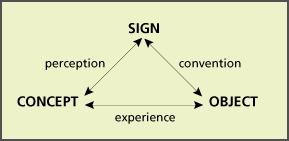
Pierce was attempting to capture a meaning relation
between physical or embodied experience, and the symbolic equivalent in
language or in conventions of graphic signage, by showing how the material
object encountered by the physical senses, and its symbolic coding within
thought, are reunited in the use of the SIGN, whether as word or as image. His
efforts are salient as we struggle to explain meaning-making practices behind
those words or images used on websites, our newest forms of distantiated or alienated
communication. But what the chatroom experience has added evolved from a very
rapid layering of countless numbers of user contributions and creations and
recognitions of “meaningfulness” or “signifiance”, (the potential to signify)
is the desire to render within this electronic equivalent of everyday
interpersonal chat the immediate and creative expressiveness of actual speech.
In a chatroom
the sign has duel significance. The emoticon and its associated expressive
techniques (for instance abbreviations or avatars) are dually-significant, as
they double the semiotic load of the chat, which now carries a semantic and an
intentional-expressive load. Even at the simple level of the username or
graphic identity symbol, the selections carry multiple messages. Is
<Pretty_Jennifer> pretty? Is <AnGeL_GlRL> a girl? Is
<Luvable_gurl15> really 15? No matter.
They wish to represent themselves as this “other”. No surprise then that
the keyboarding of subsequent chat turns is enriched by the use of expressive
forms such as the emoticon, which represents a shortcut of expressed intent. Emoticons
are useful in chatroom discourse
because of the hurriedness of chat “speech”: the sheer text-entry-pace
required to maintain a seemingly natural conversational exchange, without
losing the complex interplays of spontaneous word projection and response. It
is much quicker to relay feelings with one or two presses[127]
of the keyboard than it is to explain whether one is sad or happy. The use of username and avatars or ikons as
symbols of the chatter provides similar sorts of double signification, hinting
to other chatters at the interpretive and relational positions to be taken up
in interactions with the speaker.
CS 3.3.1.2 3D virtual chats and ikons
Unexpectedly, there were no avatars used in
the Case Study with Britney Spears – a surprising discovery in a chatspace dedicated
to a media ikon popular as much for her youthful appearance as for her musical
talent (indeed, some would argue, more).
While avatars and graphic representations of self or ikons are primarily
used for role-playing sites such as MUDs and MOOs and Habitats, many chatrooms
also let the “speakers” signify themselves through the use of an avatar. In 3D
or virtual chats[128],
avatars (author as sign/symbol) are added to usernames, to provide the
individual signature of the chatter. The screen shot on the following page (see
CS 3.3.1.2..3D virtual chats and ikons) shows a virtual chatroom using avatars.
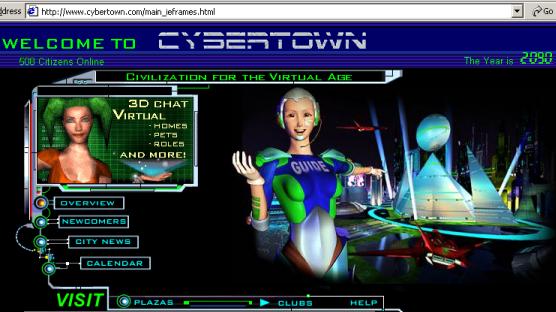
CS
3.3.1.2.3
3D Virtual Chat screen http://www.cybertown.com/
Many newer chatrooms (those designed after
2001) do not use text. Instead the chatter speaks into a microphone to create
dialogue, instead of writing text onto the screen. However, even there the
author/speaker’s identifier coding is an important factor within the ensuing conversation.
The selection of the iconic representation of what chat participants “are”,
sometimes changing at any specific moment, influences the response relation
within the conversational exchanges, in the same ways as in the text-talk
discussed above. There is a deliberate
and purposive link between the avatar and the intended “reading” (or audio
reception) of the conversation. If voice is now present, full physical cues are
not. Some compensation still appears to be necessary.
A feature of person-to-person off-line
(p2p-off) conversational analysis that makes it different from person-to-person
on-line (p2p-on) analysis is that the people who appear in p2p-on conversation
are not necessarily the same as their physical originators. Whether it is
through the username: <Pretty_Jennifer>, or an avatar, identity is
disguised. In the Britney Spears Chatroom users’ gender can only be guessed at.
Of fifteen users names in the data sample, seven are possibly female, one is
possibly male and seven are possibly either:
|
Possible male |
Possible female |
Either |
|
Paul665 |
JeRz-BaByGurL |
Mickey_P_IsMine |
|
|
Pretty_Jennifer |
guest-Wild-cust |
|
|
baby_britney1 |
IM_2_MUCH_4U |
|
|
AnGeL_GlRL |
msbbyblu12 |
|
|
MADDY_CICCONE |
Joypeters |
|
|
Luvable_gurl15 |
TYTAN-guest |
|
|
guest-hotgirlz |
buttercup20031 |
Three-dimensional chat with iconic (avatar)
representation characterizes what the chatter identifies with and in turn,
wishes or hopes others will see him or her as. An icon or picture of a female
warrior, with a username of <lady-warrior>, may belong to an elderly
male, but others in the chatroom, and maybe the author of the utterances, may
believe that the author is a young woman. How we are affected by these pictures
determines how we interpret the utterances and how we respond – but these
interpretations are culturally – and subculturally – located. Users predict the reception outcomes of their
choices, and work strategically to evoke preferred responses.
For example, below several representative graphics of “the
author” in chatrooms show the liberty some chatters take in identifying
themselves.
|
|
|
|



Just as in the Britney chat above, where the possible
reference to a popular movie text “coloured” the talk relation, here it is
clearly possible to see media identifications used to convey or annex preferred
“identity” to garner hoped-for responses.
To communicate such identity claims to others the chatter
needs to do little to create a complicated virtual utterance. In the chatroom
screen shown below, in the dropdown box on the left the chatter can choose an
expression to modify what he or she is saying. Coupled with an emoticon such as
a smiley face only a couple of words need be entered into the chat. Once again,
the semiotic layer of such communication intensifies the semantic and
pragmatic, allowing it to abbreviate to meet the entry-speed demands of the
chat format. Many sites even let the user choose from a list of avatars,
speeding up the image-selection process as well – and also incidentally
accentuating the already observable tendency to identify through affiliation
with widely known and popular media identities.
But the self-made avatar gives originality to the user, adding to the
sorts of creativity and expressiveness detected above, in compound
abbreviations and text-punctuation-emoticon clusters.
The avatar or icon appears before the text whenever the person “speaks” in written text, for example;
...||Xian-Shin||...

Xian-Shin Icon avatar
As a result it pre-colours the posting, both threading the
postings for coherent interactive sequencing, and contributing to the responses
each participant aims to evoke from others – and often selected and preferred
others, to whom a posting may be individually addressed, even in the midst of
the multilogue. Recognising this makes it possible to appreciate the split
focus chat participants are enacting. Not only are they conveying rich layers
of identity presentation in their postings, whether through texted styling or
avatar or both, but they are also positioning their postings to respond to and
in turn evoke responses from interlocutors. It is at this point that the
semiotic focus of analysis shifts, to consider how chat is calculating not just
its representations, but its responses. And this demands a move back into
linguistic analysis: specifically, into pragmatics.
CS 3.3.2 Pragmatics
Pragmatics looks at what the “speakers” or writers are
doing conversationally in a chatroom. At this point, a pragmatic study of
chatrooms can show which features of keyboard character-manipulation (emoticons, letters, numbers) are being used
to “switch” dialogue by double-loading its semiotic values, to position
reception of the semantic load or subject matter the user is dealing with.
Pragmatics is
the study of actual language use in specific situations. By looking at the
factors that govern our choice of language in social interaction and the
effects of our choices on others (Levinson, 1983; Nofsinger, 1991) we can
calculate the speaker’s intentions from the utterances they produce. In
studying chatroom practice, such consideration of the intended outcomes within
reception of utterances must therefore include description and analysis of this
double semiotic load: the semi-graphical components of the keyboarding, which
similarly “position” addressees to “take up” and respond to utterances in
certain preferred ways.
Here I have represented the chat turns as they might
appear in ordinary talk: that is, without the source attributions which appear
on the scrolling chatroom dialogue box. This is of course how the “speaker”
enters them – so it is a means of capturing the “response” mode of interactive
chat as its intentions are coded in – even if each addressee does have the
advantage of receiving the contribution in a name attributed format (along with
all of the non-addressees receiving the contribution in the mixed sequence
scrolling in the open dialogue box). The removal of the name identifiers does
however achieve the function of “remixing” the chat into physical
talk-conventional turns, so indicating how far the respondent role (reader
rather than writer) is crucial for continuity and reciprocity in this chat
mode. Without the named attribution, the talk flows become incomprehensible and
unmanageable.
|
WAAAAA |
|
Ok.. its cool. now
your turn =p |
|
gurl 15 hannah?? |
|
asl? |
|
not cool jenn...criez
|
|
huh |
|
kev are you there |
|
which i duno how im
failin science |
|
What? |
By consulting the table with the user names included, it
becomes possible to see the response interactions – and so to see them as
meaningful. These speech exchanges are
heavily invested with the types of additional semiotic loading outlined above,
because, unpinned from the direct exchange-cues of real life conversation,
their semantic load alone conveys too little for us to reconstruct logical response-pairings,
and so find the “threads” of conversation. While for instance the single
interrogative <what?> could well be a response to the line above – a
comment which cannot logically be made to engage any of the prior utterances;
that <what> proves to be a response to the comment <not cool jenn…criez>,
and thus becomes not a shocked exclamation (“What!”) but instead a semi-denial
response inviting elaboration of an accusation: (“What are you (unfairly?)
accusing me of?”)
While pragmatics can help us to reconstruct responses from
the positioning work of their original proposition utterances, it can also help
us to find if users are switching codes, or shifting the positioning elements
of their utterances, according to the interactive and reactive development of
their speech relation. Code-switching introduces socio-cultural information in
context, which is retrievable through conversational inference (Gumperz 1982;
Alvarez-Cáccamo 1990). As can be seen in the conversation below the dialogue is
dependant on knowing what the other participants are saying.
|
57. <Luvable_gurl15> WAAAAA |
|
58. <Pretty_Jennifer>Ok.. its
cool. now your turn =p |
|
59. <Paul665>gurl 15 hannah?? |
|
60. <Pretty_Jennifer> asl? |
|
61. <AnGeL_GlRL> not cool
jenn...criez |
|
62. <Paul665>huh |
|
63. <buttercup20031> kev are you
there |
|
64. <Mickey_P_IsMine> which i
duno how im failin science |
|
65. <Pretty_Jennifer> What? |
The above table includes nine turns from seven different
“usernames”. Unlike person-to-person talk off-line (p2p-off) where the direction
of the conversation can be followed by seeing who is speaking to whom, in
person-to-person on-line dialogue (p2p-on) it is difficult to establish streams
of interactivity. The features of p2p
chat on-line create a new set of rules for interactivity. The degree to which
participants spend time “housekeeping” their engagement with a particular
respondent is clear from this 9-turn extract, where Paul (lines 59 and 62) tries
to establish whether Luvable-gurl 15 (line 57) really is the “Hannah” she claims
to be – a surprised questioning achieved with the double question mark and the
paralinguistic “huh”, rather than in clearly established semantic loadings.
Meanwhile <Pretty Jennifer> at lines 58, 60 and 65
tries to establish contact with an unidentified “newby”; someone of whom she
asks the very basic information which operates in chatrooms as “so tell us all
about yourself”: <asl>, or “age-sex-location please…” Presumably in line
58 she is reassuring this new contributor that she can go ahead: “OK…it’s
cool”, advising her on what to do next: “now your turn…” But to get to this
reconstruction of an exchange and so establish its relational and intentional
load (helpfulness and reciprocity) and positioning of an expected response, we have had to make a decision about a quite
complex “code switch”, where <Pretty_Jennifer> has moved into helpful
instructional modality (<now your turn…”>), and into very basic keyboard
acronym coding (<asl>) and away from the presumably less patient forms
which have produced <AnGel-GIRL>’s comment at turn 61: <not cool
jenn…criez>. Here the reproof, plus the familiar abbreviation of the name,
and the representation of her own responsive feeling – along with its
youth-culture “z” terminal, builds a complex mix of socio-moral evaluation in
the content, and “mitigated” form in the address. This contribution thus says
something like “Pretty Jennifer we know each other well enough for me to tell
you that what you have just done is unacceptable – but I still like you enough
to call you by your pet diminutive name, use youth-in-group terms which cement
our shared sub-cultural bonding, and enact a mock-emotional response which I
know you will laugh at yet still use as a warning”. With 21 keystrokes,
including the space bar hits, she has achieved all that. Pragmatic loading must
be accompanied by semiotic overload, to carry these degrees of significance.
William James, who wrote on the analysis of the structures
of the stream of consciousness accompanying thinking, envisaged pragmatism as
“…a method of settling metaphysical disputes that otherwise might be
interminable” (James, 1907). James’s notion of streams of consciousness linking
thought to thought captures much the same seemingly random and discontinuous
flow as chatroom “talk”. Chatroom “talk”
can appear as random keyboard character entries, often difficult to follow as
purposeful conversation. In turns six and nine in this chatsite sampling,
<guest-Wild-Just> uses only emoticons or alphabetic symbols to
communicate, and in 15 <guest-Wild-Just> adds a single proper noun,
<mickey>. It is not clear who <guest-Wild-Just> is speaking to
within this short “capture” of conversation. It is as if the reader-listener
had walked in on a conversation. What is being said with the emoticons and alphabetic
symbols is not universally known, and indeed no one responds to it. In turn 9
it would be assumed that the x and the o would signify hugs and kisses. Because
entry 9 follows <Pretty_Jennifer> and <baby_britney1> it is
possible that <guest-Wild-Just> is flirting with them. This is an example of how chat flows are
economical because of their capacity to fulfill the relational/reciprocal
“positioning” roles covered in pragmatics, by using the signification processes
of graphical/alphabetic recombinant “expressiveness”.
|
6. <guest-Wild-Just>
.?¯S¯?.?°¯Y¯°?.?·D·?. |
|
9. <guest-Wild-Just> xoxoxox |
|
15. <guest-Wild-Just> hmmm mickey |
Analytical tools developed in pragmatics have found
frequent application in discourse analysis. Much of Pragmatics grew out of
Natural Language Philosophy with the work of Wittgenstein’s concepts of
“meaning as use” and “language games” (Shawver, 1996, Still, 2001). The
chatroom as an arena of entertainment and its dependence on interactive
conversational exchange genres turns its activity into a sustained and
dynamically evolving language game[129]. It
is this playfulness and interactive responsiveness which is producing complex
and multi-layered significance within what otherwise might appear as little
more than a seemingly random bantering.
In a chatroom discussion, finding how meaning is being “read” can only be reconstructed with any degree of certainty through following individual chatters and how they respond to an earlier utterance. Right from the start though there is the problem of the ongoing dialogue and not knowing when it begins or ends. In the example below <IM_2_MUCH_4U> makes his or her first statement at turn number 11 of my chat sample:
|
11. <IM_2_MUCH_4U> well heather
he going to end it i just know it |
|
31.
<IM_2_MUCH_4U> s dead=( |
|
45. <IM_2_MUCH_4U> brb going to
see if he e-mailed me at yahoo |
In the previous ten turns there is no one
with the name “Heather”, and further more no one else is speaking about a
particular person, to provide any positive identification of this “he” in
question. When <IM_2_MUCH_4U>’s next two postings, 31 and 45, are read
there can be meaning applied. It could be assumed that <IM_2_MUCH_4U> is
missing someone, and at turn 45 is saying he or she is checking e-mail to see
if there has been any correspondence. These three lines between turns 11 and 45
seem to indicate that <IM_2_MUCH_4U>
is concerned that someone is going to end a relationship with him or her. There is also the possibility, given the
presence of this exchange on a media-celebrity site, that the “Heather” alluded
to is being used to position the exchange within the subculture of girltalk
over boyfriends: an elliptical allusion to the teen flick “The four Heathers”
(1989), coding its address to a confidante so that she can instantly slip into
“Heather talk” and so post back <s dead:(> as an appropriately “in
character” reply. Without these
references back into (subcultural) context the response relation becomes too
hard for at least the outsider to read – and in some cases, even for the
insider, as the high levels of interpretive and relational repair talk in these
chat exchanges demonstrate.
Pragmatics is the study of linguistic communication; of
actual language use in specific situations (Prince, 1981; Levinson, 1983;
Clark, 1973) as a cooperative/collaborative process, so that referring
backwards and forwards in talk threads “ties” stray meanings back into
meaningfulness. Pragmatic accounts of “co-reference”, where different names
refer to the
same individual, are apparent in this case study. Instead of writing out
<Mickey_P_Is Mine>, <guest-Wild-Just> addresses the user as
<…mickey> just as <Mickey_P_Is Mine> responds to
<Pretty_Jennifer>, <Ok Jenn lol>, perhaps not wanting to add the
“Pretty” part of the user’s name. Once again, pragmatics plus semiotics shows
how a particular communicative ethos is under development. Not only do these
participants interact, threading backwards and forwards across postings, but
they abbreviate tags: they indicate familiarity and group acceptance by
shortening the complex tag names – at the same time “outing” the most “real”
elements of the name strategies: “Jen”, “Mickey”, and so on.
The factors that govern our choice of language are
important in social interaction and in examining the effects of this choice on
others (Levinson, 1983; Nofsinger, 1991). In theory, we can say anything we
wish, within our linguistically regulated repertoire. However, in practice, we follow a large
number of social rules as well as grammatical rules (many of them just as
unconsciously observed) that constrain the way we speak (Crystal, 1987, p.
120-122). In linguistic enquiry, several main areas overlap. Pragmatics and
semantics both take into account such notions as the intentions of the speaker,
the effects of an utterance on listeners, the implications that follow from
expressing something in a certain way, and the knowledge, beliefs, and
presuppositions about the world upon which speakers and listeners rely when
they interact. Pragmatics also overlaps with stylistics and sociolinguistics,
and psycholinguistics, as well as discourse analysis (see Case Study Five).
Each in its way foregrounds a particular focus, and it is worth examining what
each can offer to examination of chatroom communication. A pragmatic analysis
can capture a range of seemingly “individual” communicative actions
(stylistics), and enable comment on their social applications
(sociolinguistics) – including their role in identity formation and assertion
(psycholinguistics) – as well as contributing to the socially and politically
engaged analysis of discourse (Fairclough, 1995; Singh, 1996). In this case study, where the roles of the
chatters are identified by their names, as shown in table Table 4 CS 3: 1
above, how they perceive themselves often is illustrated through the name. <
Luvable_gurl15> wants others in the room to believe this is a
fifteen-year-old girl who is luvable. This is her preferred character. Even if
she is he, 55-years-old and hates the world, what matters is that at this
particular time she identifies as 15, lovable, and a techno-trendy female: not
just a girl, but a “gurl”. Social
conventions make all of “her” statements reasonable: from the adolescent excess
of <i am going to cry if i dont see my baby soon> to “her” childlike
expression at not seeing the one “she” wants to see in the room: <
WAAAAA>. Like the three icon representations shown previously, these texted
expressions are cues which reveal real people principally as characters who want
others to see them as they are depicted. Once again, the semiotic overload onto
the conversational pragmatic carries the main message of the posting.
The distinction between pragmatics and semantics is easier
to apply than to explain. One reason for introducing the pragmatics-semantics
distinction in this chatroom is to show how seemingly confusing it is when a
chatter is thought to be attempting only to convey meaning: to be acting
instrumentally, in a transmission mode of communication. Ambiguity, vagueness,
non-literalness are not a “fault” of the on-line speaker, but the style in
which communication is carried on. The semantic load of words is not enough,
once postings are unthreaded, compressed into the interactive speeds of on-line
IRC posting, and confined to screened text. While Semantics as an analytical
practice attempts to provide a complete account of meaning for a language,
recursively specifying the truth conditions of the sentences of the language,
pragmatics provides an account of how sentences are used in utterances to
convey information in context (Kempson, 1988 p. 139). Until the work of
pragmatics has captured and assessed how actual examples of on-line
communication “work” in chat, the types of semantic variation already clear
from data in this and other studies will not be able to be consolidated into
the sorts of systems which the rapidity and creativity of on-line chat
production suggests as already under construction. And further, such a task
appears likely, at least from this preliminary sampling, to demand recognition
of communicative techniques – such as the semiotic loadings used to intensify
on-line expressivity – as part of the new CMC repertoire.
Semantics deals with the relation of signs to objects
which they may or do denote: it accepts that communication operates within a
relatively settled, established repertoire. Pragmatics concerns the relation of
signs to their interpreters (see C. Morris, 1971, pp. 35, 43; Crystal, 1985;
Leech, 1983; Lyons, 1981; Levinson, 1983) – it allows for the sorts of active
and interactive communicative relations revealed in the data for this study But
semiotics adds to this “global-local” set of vertical and horizontal
meaning-making connections, the capacity to read new techniques – especially the
semi-graphical techniques of emoticons and split-lexical character use – which
IRC and its related formats have developed to compensate the loss of oral and
other physical communicative cues. Britney-speak, with its high demand for
expressiveness and a pacey delivery, reveals an especially strong degree of
creative semiotic loading – perhaps to be expected in a space dedicated to
style culture and adolescent identity-formation. In Peirce’s terms, the
“object” under signification - Britney – is already also a “concept”: itself a
semiotically laden entity, carrying values which entice chatters into this
space, and not another. That the behaviours, representations, interactions, and
texting strategies all prove to be “signed” with these values is thus no surprise.
The degree of complexity encountered: the skill in posting, in de-threading
complex entry sequences, and in creating new signifying categories, does
however indicate communicative repertoires brought to great heights of
sophistication - levels which demand new configurations of combined analytical
techniques to surface their operations.
The
next case study therefore moves to consideration of how on-line chat might be
understood as instrumentally communicative: less as identity-expressive and
playfully creative; more as directed to the enactment of information exchange
directed to identified and consensual ends. I explore what a “speech act” is
when it is conducted on-line, in writing: an altogether different coding from
that understood inside traditions of “speech act theory”. What are the social
acts performed when participators engage in on-line chat? Are there
recognizable techniques and systems, carried over from real life speech and
analyzable within existing linguistic frames, or, once again, is on-line chat
observably developing new and recombinant modes?
Case Study Four
CS
4.0 Introduction
|
75) <jijirika> *):) at da room |
|
76) <AquarianBlue>** lol@dingo |
|
77) <safetynet10> ** OMG |
Examples of chat in this Case Study are from the “astrochat”
chatroom, unless otherwise indicated (see appendix a4). As analysis moves into
this highly specialised space, the above three turns are provided to show the
difficulty of knowing what any particular chat is about, when only a few turns
are revealed. The experience is similar to a conversation overheard or entered
without knowing what the topic is, or without sharing knowledge of the
specialist subcultural codes or “registers” However, as shown throughout all of
these Case Studies, there can also be several conversations going on at any one
time, making it difficult to ascertain the topic(s), or to contextualise the
various postings into a continuous and comprehensible exchange.
In the table above for example these are three voices,
which may not have any conversational connection at all, as they may each be in
response to other chat-streams of talk. Yet once again, even with unconnected
streams of chat, users are able to begin some degree of interpretive engagement
with a site and its talk, once they know the chatroom title, and can begin to
interpret the referents behind the texted-talk. The chatroom used on this case
study is titled astrochat, one of thousands available through
TalkCity.com. I refer to this chatroom as
“user defined”, in contrast to a chatroom where the topic is open so that the
conversation can weave and wander; from sex to religion to baseball to the
price of tea in
|
1) <gina2b> everyones a know it
all! |
|
2) <dingo42> nicole wahts your
sign ?? |
|
3) <AquarianBlue> yeah white told
me to meet her tonight |
Turn number two from <dingo42> asks <nicole wahts your sign ??>,
while the third speaker has the user name <AquarianBlue>. The
interpretive cues are in place, and the “newby” can expect to rapidly have them
confirmed.
In a “user defined” chatroom a user operates within the
subject limits of the chat discussion indicated in the title of the chatroom.
Chatrooms entitled “astrochat”, “jesuschat”, “bondagechat” or
“54-year-old-white-adelaide-single-hetero-chat” attract users who are
specifically interested in those topics.
However, as most chatrooms are open for anyone to enter at anytime[130],
the occupants of a chatroom are not necessarily only those who are interested
in the topic of the chatroom title. It is common enough for instance as we have
already seen, to encounter “lurkers” who enter rooms without participating in
the talk, and who may or may not be interested in the topic. It is also not
unknown for users to attempt to derail topic-specific chat – especially in
attempts to encounter new cyber-sexual partners (see for instance Hamman, 1998,
1999; Albright, 1995; Gilbert, 2000). But for the most part, designated
topic-specific chatroom participants stay on topic, building their
talk-relations – and it can be assumed, their on-line social relations – around
the topic. It then becomes possible to ask: What are the distinctions between
those two activities? How far is this “specialist” talk focused around the
pursuit of knowledge or information and how far around social relational
activity more generally? With both encapsulated under the not altogether
appropriate term “chat”, what are the talk-text cues and behaviours signalling
to possible site entrants that this is for “serious informational talk”, and
not for “light-weight bantering chit-chat”?
To this extent, the “astrochat” site can be anticipated to
offer an intermediate space between the identity-formational zone of Britney-speak
participants, with their heavily self-expressive modalities, and the more
constrained and formal registers of professional “BBS” styled rooms, where
identity is suppressed beneath the demands of expert information exchange. At
this stage, what my analysis seeks is the revelation of what is being enacted
in these conversations. Inside a specialist chat founded on a field of inquiry
halfway between scientific knowledge and psychological or spiritual
interpretation, should we anticipate objective information provision, or the
sorts of identity work outlined in Case Study Three – the Britney site? Will
postings display in their talk texting the creative compounding and semiotic
layering of self-expressive chat, or a more formal and direct “plainstyle” syntactic
structuring? What, in talk terms, is being enacted here – and what can it tell
us of the specifics of on-line chat practice?
CS 4.0.1 Questions
In speaking any language, through no matter which format,
we are performing speech acts, making statements, giving commands, asking
questions, making promises, and so on (Searle, 1965). Such “speech acts” however vary in their
concentrations and occurrences, as we shift from zone to zone, task to task,
social group to social group, within our language culture. Each set of speech
contexts develops its specialised sets of techniques: from the questioning
repertoires of teachers or doctors – interestingly not at all the same
repertoires – to the bald assertions of courtroom witnesses, or the distorted
but still comprehensible orders of parade-ground sergeants or short-order
chefs, to the heavy enactive burdens of such ritual phrases as “I take thee to
be my lawful wedded wife”, or “I sentence you to seven years penal servitude”.
But what might the analytical repertoires of Speech Act Theory reveal about the
activities of astrochat? In particular, is such chat formed most distinctively
around its ostensible topic: astrology, or around the tendencies encountered
elsewhere in on-line chat behaviours – that is, should we anticipate astrology,
or chat?
And can we use Speech Act Theory in old or new ways, to
describe what the language in a chatroom is doing?
In the first place, can difference be observed between
speech on-line and speech face-to-face, if the topic matter is the same?
Would an on-line astrological discussion differ from a
face-to-face astrological conversation? And if it does, can Speech Act Theory
help us to isolate what those differences might be?
CS 4.0.2 Why I chose this
chatroom
I selected an astrology chatroom, partly because I have a
background in the field, and can therefore anticipate recognising many of the
“typical” speech behaviours of this speech community. At the same time, as a
specialised knowledge arising largely outside formally recognised accrediting
agencies, such as Universities, a relatively unregulated field such as
astrology can be expected to have a broader than usual range of variant or
“localised”, even informal, usages. My selection therefore anticipated both
familiar, and unfamiliar, communicative strategies. But how might the
conversation in an astrological chatroom be different from that in a real room,
full of astrologers, discussing the upcoming Saturn opposite Pluto aspect[131]?
I had in fact expected that this chatroom would be more
technical and advanced in its discussions of astrology than it was. There are
astrological sites where one would need to have studied astrology for many
years, not only to carry on a conversation, but also to understand what anyone
else was saying[132]. The astrochat site was far from advanced[133]
in terms of its astrological expertise, yet still displayed significant
differences from talk practices in the other chatrooms under examination. Superficially at least, it appeared that it
was indeed the on-line chat status of the discussion, and not the topic, which
was most in ascendance in relation to the specifics of the communicative
practices – yet that there was also something worthy of analysis in relation to
the influence of the topic selection in the development of those communicative
practices. How then, might those practices be described?
Speech Act Theory considers communication as a form of
human action: the texture of intention and interactive persuasion and control.
To examine that texture in a specific chatroom such as this one, I looked for
words, including chat-specific forms such as abbreviations and emoticons, which
revealed a capacity to produce interactive responses between chat participants.
In the example below for instance, it is clear that <dingo42> is asking
for a response from <Nicole528> with his direct question: <nicole
wahts your sign??> and <Nicole528> responds equally directly: <im a
gemini with tauras moon and scorpio rising>.
Traditional grammar recognises three classes of speech
act, distinguishable in many languages, on the basis of their form as
statements or declaratives, questions or interrogatives, or commands or
imperatives. Asking a question is performing a speech act: one that demands a
response, and a response of a particular type. Question responses address the
issues of the given question, on its own terms. If they do not, the talk breaks
down – either from incapacity, or unwillingness, to respond. But in the
astrochat sequences, there is clear and immediate evidence of the capacity of
all participants to respond in kind. The following turn-taking sequence shows
what any user might have expected to find in a chatroom about astrology, and at
a level which suggests that most ordinary, non-expert participants could respond.
|
2) <dingo42>
nicole wahts your sign ?? |
|
11) <Nicole528> im a Gemini |
|
31) <Nicole528> whats your sign dingo? |
|
47) <dingo42> im a libra..much scorpio with
it...astrlogist after al;l |
|
60) <Nicole528> im a gemini with tauras moon and
scorpio rising |
Here, <dingo42> has simply asked what sign
<Nicole528> is. The querist does not ask to know any more than that.
<Nicole528> replies equally simply with <im a Gemini> - an
assertion which is however full of significance on an astrological site.
<dingo42>, claiming to be an astrologer, <...astrlogist after
al;l>, provides more information, addressing both the respondents’
information exchange and the field of knowledge, to show how much he or she
knows about the topic of astrology. This identifies him or her in two ways.
Firstly <dingo42> knows that astrologers are interested in more than
one’s sun sign. Secondly, <dingo42> indicates that all participants on
the site are likely to know that this particular astrological configuration is
common among astrologers themselves: that it is a favourable aspect for
astrological talent. In other words, <dingo42>’s has the outcome of
deepening the information and the relational intensity, at the same time. By
passing two additional pieces of information, the statement builds “in group”
rapport with the interlocutors. Yet this is an indirect speech act. There is –
as with the semiotic loadings in the previous case study - a sense of too much
information being provided, as the participant moves from simple question-answer
exchange, into a more multi-levelled and multi-acting contribution. Two
questions can be asked here. Firstly, why and when do we give more information
than is asked for, when telling about ourselves? And secondly, does the initial
speech act, initiated by <dingo42> as the original querist, configured as
a simple question and answer exchange, in itself invite this sort of
elaboration – or is it the chat zone and its curious mix of
identity-distantiation and identity foregrounding, which invites this more complex
move? If for example <dingo42> has
given more information in order to have <Nicole528> divulge in turn what
her or his signs are, then it is important to examine whether the initial, very
basic questioning ritual is just the “astrochat” version of IRC’s “a/s/l” cue,
or an initiating gambit in all astrological conversation.
CS 4.1 Methodology
CS 4.1.1
Transcription
Once again, the collection protocol used in this chatroom
is the same as that in the other case studies. I will however look more closely
at the actual word sequences written in this chatroom, to discover how a
sometimes seemingly incoherent conversation is able to continue. This is a
smaller sampling than in other Case Studies, 16 speakers taking 85 turns, where
for instance Case Study One had 48 speakers using 275 turns. This chatroom used
more abbreviations and emoticons than Case Study One but fewer than Case Study
Three. Because there was no emergency involved as in the first chatroom, the
talk is less immediately focused. The
speakers seem more playful, constructing more linguistically-focused responses,
and paying more attention to their performance as they communicate. They are however less expressive than those
in Case Study Three, marking the intermediacy of the topic focus: by no means
open conversation, yet not altogether disconnected from self-expressive
“identity work” of the Case 3 type.
CS 4.1.2 Speech Act Theory
The method of analysis for this case study is
based on Speech-Act Theory, a theory of language use based on J. L. Austin's How to Do Things with Words (second
edition, 1975), the major premise of which is that language is as much, if not
more, a mode of action as it is a means of conveying information (Henderson,
Greig and Brown, Christopher, 1997). Speech Act Theory was developed to explain
how we use language to accomplish the goals of speech acts. Many utterances are
equivalent to actions. When someone says: “I name this ship” or “I now
pronounce you man and wife”, the utterance creates a new social or psychological
reality (
Speech
acts in a chatroom are not exactly in talk mode, as discussed earlier in this
study – and yet both forms are clearly interactive real-time communications.
The “speech act” when it is conducted as written text has an altogether
different coding from the coding of speech acts in person-to-person
conversation. Firstly, whether the chat occurs in a chatroom where people are
using voice or typing, what are missing are the physical cues so important in
other communications. As my study has been based on text only chatrooms the
taking away of voice[134] makes it difficult to identify the speaker
through tone, gender or age. Using Austin’s identifying of speech coding into
locutionary acts, illocutionary acts and perlocutionary acts such as
performatives it has however still been possible to look at a particular
chatroom to try and discover how meaning is exchanged using only a few
characters on the screen. Locutionary acts for instance, which define the
intentions of speakers while speaking, are dominant in the early exchanges in
the astrochat site, discussed above. But, as we have also seen already, these
relatively basic statement structures move quite quickly into more complex
forms – and it is this transformation, which demands some attention.
CS
4.2 Discussion
My focus in this chatroom is thus initially on the
“speech-act”, at its simplest terms. Even at this most reduced of levels, it is
important to test whether the contributions made produce an “unhappy” response
or a “happy” response - to use the terms of
|
<AquarianBlue> |
|
12) /\9 hehe |
|
29) /\26 sniff sniff |
|
34) /\32 hmmmmmmm |
|
42) /\40 ** wb jiji |
|
76) /\61 ** lol@dingo |
Here, in speech terms, the communication appears reduced
to the paralinguistic, including sniffs, murmurs, and laugh markers. But in
chat terms, there is also complex abbreviation work; some of it conventional –
such as “lol”; some compounding convention and originality – lol@dingo - and
some seemingly entirely original. The exchanges thus work at a level beneath
speech act activity – perhaps as holding devices to register attention without
any active contribution, rather in the manner of linguistic “continuers” such
as “yeah” or “aha”. But at the same
time, given their appropriation of chat conventions, they also make clearly
interpretable speech act contributions, stating, albeit in abbreviated form,
such responses as “you make me laugh”; “you make me weep” – or perhaps “cry
with laughter”; “I am bemused by what’s going on”, and “I am laughing out loud
at Dingo”. They are declaratives, with the added expressive load and
affiliative-relational codes typical of on-line chat.
At first sight then the status of chatroom talk in general
seems obvious and unproblematic. Surely the chatroom is a speech act community.
There are speech exchanges and even continuous conversations. Yet this is a most unusual conversational milieu,
which has never before appeared in any society. Chatrooms can after all produce
a never-ending conversation. They are quantitatively different. There are
thousands of chatrooms available on the Internet with no set hours of
operation. Moderated chatrooms may have a set time, and people can meet an
authority on a topic or a famous person and talk to them, but in other
chatrooms one could spend days without leaving, and carry on continuous
conversation. Even though people come and go, and potentially the same person
could be in a chatroom with several usernames[135]
chatting as different identities, there is continuous interactive dialogue,
just as there would be in a real-life setting where everyone knows one another.
But at the same time they also appear to be qualitatively different. Their talk
texting seems to fulfil and yet not fulfil the definitions for speech acts: to
be both inside and outside its registers. So is this perhaps a new set of
speech act forms? And how far is it the situation in which this speech occurs,
which is driving such changes?
CS 4.2.1 Speech situations as speech
events
The choice of the term “speech event” to describe
text-based chatroom exchanges may be seen to endorse the view that such
exchanges are a form of speech, i.e. a conversation. A number of researchers
have examined this question (Shank, 1993; Veselinova & Dry, 1995; Maynor,
1994) and the general consensus is that of Shank (1993):
Is Net communication like conversation?
Quite a bit. Messages on the Net tend to be informal, to be phrased in
conversational form, and can engender a great deal of direct and dyadic
interchange. Is Net communication like writing? Absolutely. Messages are
written instead of spoken.
“Speech situations” (chatroom situations) are composed of
“speech events” (chatroom events) (Hymes, 1974) and these activities have rules
governing the use of speech within particular circumstances - e.g.
getting-to-know-you conversations - (Gudykunst and Kim 1997 p. 328). Often
though, the whole chat, or the entire chatroom event, is little more than a
“getting-to-know-you” conversation. I have found from my research on many chat
sites that most statements are of the greeting type:
|
32) <Night-Goddess_> anyone cool in here? |
At this level at least, Speech Act Theory helps us to
understand the preponderance of this sort of entry on “open” chat sites, where
general conversational rules must be deployed in the absence of clear
topic-focus guidelines. But to understand Speech Act Theory more thoroughly and
what it offers for chatroom analysis, we must first look more closely at the
vocabulary of speech act theorists.
Speech Act Theory as with most schools of thought has its
own sets of terms. There is a specialist language to explain the language of
speech acts. Most of these terms and ideas originated with
John Austin’s original classification of speech acts
separates acts which are locutionary, illocutionary, and perlocutionary, including
acts which are informative, performative,
expressive, directive, commissive, declarative, and representative, each
seeking to operate within those “felicity conditions” which will produce an
appropriate speech act in response. Such utterances can in the first instance
be analysed using the basic threefold distinction: locutionary, illocutionary
and perlocutionary acts.
CS
4.2.1.1 Locutionary
A locutionary act is simply the speech act which has taken
place, regardless of its intentional or enactive role. In a text-based chatroom
locutions are the typed symbols that signify talk, including even for example
the paralinguistic elements noted above, such as <hehe> <sniff
sniff>. While we may also – as above
– attribute more complex intentional and enactive loads to these entries, at
this level they are simply registered as speech acts.
|
14) <Nicole528> 5-28<--- hehe |
|
29) <AquarianBlue> sniff sniff |
CS 4.2.1.2 Illocutionary
An illocutionary act is a complete speech act, made in an
utterance which typically consists of the delivery of some propositional
content within the utterance, and connected to it a particular illocutionary
force, whereby the speaker asserts, demands, vows, names, promises, apologizes,
congratulates or suggests. Illocutionary acts refer to real actions which will
eventuate from the messages performed by the utterance, where saying equals
doing.
At the illocutionary level the chatter in effect provides
interpretation of the sentences as they enact the speech. For example,
<Night-Goddess_> utters <bye> in line 59. There is not only this
word typed into the chatroom, but <Night-Goddess_> actually leaves the
room.
An illocutionary act also therefore has an effect on the
hearer.
CS
4.2.1.3 Perlocutionary
The perlocutionary act is the effect of an utterance.
“This means that every utterance can be analysed as the realization of the
speaker's intent to achieve a particular purpose” (Eggins & Slade 1997, p.
40). Perlocutionary acts include persuading, intimidating and incriminating.
Perlocutionary and illocutionary speech acts are both found in this chatroom.
Yet sometimes the medium used is so reduced that the speech act may not be
immediately obvious.
|
1) <gina2b> everyones a know it all! |
|
25) <gina2b>
coocoocoocoo |
|
56) <gina2b> /\47 coolfool |
Perlocutionary and illocutionary chat acts
A perlocutionary act is present here, despite the extreme
reduction of the formatting. <gina2b> begins the session – or at least
the section which I recorded - with a statement intended to indicate her
evaluation of others in the chatroom, by responding to an earlier
utterance. (Its actual content is
unknown as the previous utterance has not been a “captured” statement). There
was it appears a response from others and a discussion concerning who was
“cool” in this chatroom, which led <gina2b> into making one final
summarising statement in my recorded session: “coolfool”, in turn 56.
Here, none of <gina2b>’s statements can easily be
given clear attribution as this or as that speech act. While both posting 25
and 56 can be regarded as perlocutionary acts, because they assert, or at least
suggest, an evaluative summary of another participant and their behaviour, both
the reduced form – again, almost paralinguistic – and the wordplay: the
assonance and compounding of “coolfool” and the onomatapoeic pigeon-cooing of
“coocoocoocoo”, add so much to the impact of a simple act of assertion, as to
shift its significance as a speech act.
As a perlocutionary act is a speech act that produces an effect,
intended or not, achieved in an addressee by a speaker's utterance,
<gina2b>’s utterance must be
interpreted as an insult – and yet one designed to impress others in the chat
group, and to elicit supportive agreement alongside the stringent criticism.
The complexity of the
speech situation here however raises the question of whether, in Speech Act
Theory terms, chat spaces provide “felicity conditions”
for the deployment of such perlocutionary ventures.
A speech act is felicitous when it is uttered by the
appropriate speaker, directed toward the appropriate hearer, and uttered at the
appropriate time and place. If one or more of the above are not satisfied, the
act is infelicitous.
A speech act thus has to be appropriate in both immediate
context, and within social conventions more generally. Here <gina2b>’s
contributions are clearly felicitous within the closed context of the chat
forum, as she enacts the quick-response but heavily meaning-laden summary forms
of chat communication, to indicate to a set of preferred participants, her views
of the behaviour of another. As appears typical of chat participants,
especially in expert or semi-expert groups, who share sufficient social capital
to assume common values, <gina2b> is confident that her postings will
enjoy felicity conditions – so much so, that she can code them in subtle,
indirect ways, where the “appropriate hearers” can enjoy the wit, and be relied
upon to interpret the correct message for themselves.
CS 4.2.1.4 Performatives
According to John Austin (1962), there is quite often more
going on than the actual definitions or semantic loadings of words that we
share in person-to-person conversation.
Verbs in Virtual Communities such as chatrooms often have
a specially allocated perfomative function. In virtual environments, verbs such
as “open”, “close”, “lift”, “move”, are specialised performatives, in that they
they perform actions to open another screen on the computer (see Cicognani,
1996, 1997, 2000). For example in a chatroom that has private rooms one can
click on the “open” button and the screen will change to where only the person
selected to speak with is present.
In a chatroom, performatives thus include words, emoticons,
acronyms and abbreviations; elements that can “do” instead of merely
“describing”. For a speech act to perform and be successful, two qualities must
be present. Firstly, the speaker and addressee must share a common
language. If a chat participant
instructs another to “move”, it must be understood that this is used within the
conventions of chat space, and not those of the physical realm. Even at this
most basic of levels, it is thus obvious that chat has its own set of felicity
conditions, which experienced participants will deploy as the preferred usage,
at least while in the chat space. This however, I suggest, cues chat users to
extend specialised usages and in turn anticipate them in other users, so that
the sorts of multi-loaded wordplay we saw in <gina2b>’s postings, or in
the more general use of emoticons or abbreviations, become common and readily
comprehensible. Chatroom users must
then come to allocate the same meanings for abbreviations and emoticons. Only
then can participants work to create within these known repertoires – as
<gina2b> does, with her “coocoocoocoo” play on the term “cool”.
Secondly, within these new codings, the speaker must work
to make an utterance understandable. A creative posting – one which uses new or
original abbreviations or wordplay forms – must still be sufficiently within
the felicity conditions of the chat coterie to be received and to activate its
intended meaning(s). And it is, I suggest, a function of the specialist topic
within focused chatrooms to guarantee this. <gina2b>’s postings work in
this space, because here she has an interlocutory group sufficiently consensual
in its values, to be able to discriminate and exclude. And part of that
consensus is established not in established semantic loading, but in
performance – as it is with her message of judgement. One participant is being
summarily dismissed not just by being described as “foolish because attempting
to appear cool”, but as a “coolfool” – a speech act which is presented for the
subculturally defined pleasure of the “ingroup” interlocutors, as much as to
enact the dismissal of the miscreant who has occasioned the judgement.
A performative utterance includes its own successful
performance. Saying it, and saying it this way, makes it so. This constitutes
the conditions that a performative
must meet if it is to be appropriate or successful. According to
There are constant instances of postings which at first
sight appear to be simple performative statements, but which also display this
dual sense of “chat activating” verbs, and of the doubled “chat cultural”
loading. Performative verbs are used to perform the acts they name. In the
sentence “I promise not to lie”, the verb “promise” is performative, because it
carries out the action it describes.
Such verbs are in other words self-referential, in that they describe
their own actions and execute them at the same time. When < tazzytaz1o1> in line 64 says
<is Outta here! > he or she is leaving - and in saying so both describes the
content of the promise (to leave) and makes it so. Yet once again, the form in
which this is done doubles what the term signifies. Not only does this enact in
chat technology terms the activation of “enter” and “exit”, but it does so with
a colloquial and youth-cultural coding: “outa here!” not just as an escape, but
with the implication of “better action
elsewhere: your loss…” In typically reduced form, the posting carries both a
(dual) performative and an evaluative load.
Are there then other speech act types which can help
explain this multi-loading tendency in chat postings – and especially in those
within culturally consensual or topic-focused spaces? One possibility is the
use of the constative act. A constative utterance is used to describe a state of affairs. It has the
property of being true or false. Constatives can be concurring, insisting,
affirming, disputing, claiming, identifying, conjecturing, informing,
predicting, disagreeing, alleging, ranking, announcing, answering, stating,
attributing, classifying, confirming, denying, disclosing, reporting or
stipulating. The performance utterance, by contrast, can never be either true
or false: it has its own special job; it is used to perform an action. What a performative says, it
also does.
It is surely significant that, within the astrochat site,
constatives outnumber performatives – and that even in the more relational acts
of affirming, disputing, disclosing, and so on, utterances are “mitigated”; coloured
by consensual codings, typical of although not exclusive to chatrooms, which
endorse consensus and act to confirm membership of a specialist speech
community. Constatives move closer to this central chat agenda, since their
purpose cannot be checked by simply looking at the actual utterance, on its own
terms. Context, not activational power in the semantic loading, creates
constative utterances as meaningful. There need to be other words, (or
abbreviations or emoticons) to mark the reception conditions of the utterance.
One needs for instance in chat to know what particular abbreviations and emoticons
represent. For example, <AquarianBlue> on the astrochat site states
<wb jiji>. If one entered this conversation at this point one would have
no idea, without seeing previous utterances, what this means or refers to.
However, knowing only the previous two turns, it is clear that <jijirika>
has returned to the room, and the abbreviation “wb jiji” can be interpreted as
<AquarianBlue> saying “welcome back to jijirika”. To this extent at least
the speech act is responsive to context: it reacts, rather than enacts – and
this degree of inter-relational sensitivity appears crucial within chatsite
talk. Add to it the familiarity implied in the use of the intensified
diminutive (“jiji”, not “jijirika”), the warmth of welcome even after temporary
absence, and the deployment of abbreviation, anticipating a chat-form expertise
from the group, and <AquarianBlue>’s posting is working more to affirm,
claim, classify, and confirm the affective and relational elements of a
communicative exchange, than to produce actions. Chat talk, distantiated from
physicality in its relational space, appears to refocus away from actions and
into transactions.
When action-dependant statements do occur in “astrochat”,
they are often marked by reference to activities “off-site”, in the real or
physical world. Two types of performatives, contractual (I will) and
declaratory (I do), help illustrate the point.
In the example below <AquarianBlue> is reporting
that he/she has already planned to meet “white” in this chatroom. The character “white” does not appear in the
chatroom selections for this data corpus, however only fifteen minutes of the
conversation were collected. There is no
contractual statement present, since <white> does not appear to negotiate
the agreement with <AquarianBlue>. Instead, <AquarianBlue> works
constatively, to report the arranged meeting to others:
|
3) <AquarianBlue> yeah white told me to meet her
tonight |
In fact there is an entire chat thread about this person.
Two others, <judythejedi> and <IroquoisPrncess>, are also looking
forward to meeting “white”, not only in this chatroom, but physically. Here the
speech acts not only move closer to those of real world chat: constatives,
binding the group through references to planned, agreed, negotiated, promised
ACTIONS – the sorts of things which can only happen in real life – but the
utterances ease away from the sorts of “chat styling” we are coming to see as a
principal on-line mode. Here there are few abbreviations, no emoticons, and
little wordplay of any sort. The playful “colouring” which loads onto language
when its activating component becomes limited is here far less necessary as a
community binding technique. Real communing is planned, looked forward to, and
talked about. There is a referent act under discussion, which focuses the talk
and demands far less creative or affective compensatory texting.
In part this “over-loading” of chat utterances with relational
or constative work responds then to the conditions of on-line chat technologies.
For a performative utterance to be successful several conditions are necessary
– and these are often either absent, or rendered difficult, in chatrooms.
In the first instance the words, including emoticons or
abbreviations, need to be appropriate to the circumstances. But in a chatroom
there can be much confusion in locating appropriate responses. The thread that the response is part of needs
to be identified, most often under pressure from competing and interrupting
postings. Secondly, the response must be appropriate and intelligible, not only
as it is entered, but also as it arrives in the chat sequence. For example,
|
84) <Nicole528> yea |
does not provide a successful response in any way unless
it is referring to turn 82,
|
82) <dingo42> just VERY passionated |
Only two turns prior to the “yea”, this assertion invites
a response, in particular with its capitalised intensifier – and
<Nicole528>’s ready agreement provides consent – even more powerfully,
because <Nicole528> and <dingo42> have been carrying on an
interchangeable thread. However, <Nicole528> could be answering other
speakers. Her utterance is too broadly applicable to link with certainty to
<dingo42>’s opinion.
As in real life
conversation, where someone just acknowledges an utterance or offers a
continuer by saying “OK”, or “yea” when someone announces they are present, or
asks a generalized question, the affirmative as
response has many possible uses.
|
65) <tazdevil144> so hows every one to day |
One might expect that <tazdevil144> who has just
entered the chatroom is going to receive a response from others as one would if
entering any group of people. We would expect a response such as “we are fine” or “I am a bit sad today” or
some such returned speech, but in this chat there was not any response to
<tazdevil144>’s question. This not answering a question or responding to
what one has said is not unusual in chatroom dialogue. What then is the speech
act role of such questions?
Greetings in a chatroom are one of the most often used
speech acts. Most often someone will announce his or her arrival in a room by
making some form of greeting. Although in turn 64 <tazdevil144> says
<so hows every one to day>, as this is his or her first utterance it is
less a question than a marker of the beginning of their interaction with the
others in the room. In some chatrooms when a person logs on a message will
appear with that person’s log on name. For example, the
|
***jagat (202.141.24) |
|
***rahul (202.9.172) has left location |
|
***Preet assi vi vadiya ncg |
|
*** neuage (198.175.242) |
Log on message
In the astrochat chatroom this does not occur.
<tazdevil144>’s utterance <so hows every one to day> is thus a
generalised welcome greeting, undirected to any particular participant, and as
yet not engaged into any conversational thread. In chat, we must therefore read
through the lens of the communicative technology – here enabling us to see that
what in speech act terms is a question, in chat terms is the equivalent of an
impersonal and technically generated welcome cue. That <tazdevil 144> produces
his greeting in standard speech form, and not in the wordplay colourings of the
astrochat group, may contribute to his slow acceptance into the speech
community – another feature which invites critical scruntiny of just how far
chat utterances depart from those of real life communication.
Speech Act Theory, depending on whose definition is being
followed, refers to greetings as “expressives” (Searle, 1965, 1969),
“behabitives” (
CS 4.2.2
Searle
Philosopher John Searle[136]
classified speech acts into five categories: Commissives, Expressives,
Declarations, Directives and Representatives.
CS 4.2.2.1 Commissives
Commissives involve agreeing, guaranteeing, inviting,
offering, promising, swearing and volunteering. Once again, given the
distancing of chat space from the capacity to directly enact through language,
commissives are rare.
With commissives, speakers commit themselves to a future
course of action, as <judythejedi> does below:
|
26) <judythejedi> /\24 she'll stop in west palm ,
then i'll take her to |
|
4) <Seoni>
** brb littletaker beak lol |
Commissives
Here the action is very clearly promised for the real
world, in named places. In chat space those few actions which can be undertaken
– most often still relating to real world activity – are frequently coded into
conventional abbreviations, so that when <Seoni> leave the site for a
moment, presumably to undertake some real life demand, she signals with
“brb” - “I’ll be right back”.
This tendency to reduction of performative utterances adds
to the rebalancing that is going on inside chat, from performatives to
expressives. Since real life enactability intrudes on chat, it is among the
reduced elements of the talk.
CS 4.2.2.2 Expressives
The expressive function of language is to tell others our
attitudes, feelings, and emotions, including the speech activities of
apologizing, welcoming, or sympathizing. Expressives are those kinds of speech
acts that state what the speaker feels. They express psychological states and
can be statements of pleasure, pain, like, dislike, joy, or sorrow, such as
saying “I’m so happy!” or “It depressed me”.
Even in these more relational elements of language on-line
chat tends to use reductive and coded forms. In these two examples we have
“sniff sniff” as in the sounds of one crying to express how
<AquarianBlue> is feeling about a situation, while <Seoni>
expresses anger about a personal matter. In turn 81 <Seoni> lets others
know how he or she feels about the electric company. Here, where the real world
referents might mean that we anticipate the full-form texting we have seen
elsewhere, since <Seoni> is actually more intent on expressive utterance
for her chat colleagues than on activating talk to redress her problems in the
real world, the chat is rich in abbreviations and codes. <Seoni> uses
abbreviations to emphasize the hurriedness of the situation. <brb> - be
right back – is used twice in this utterance, while in <cll> the vowel
“a” is left out, and the electric company is shortened to <elc>. Only
when <Seoni> reaches the level of graphic curse (“they can kiss my white
ass”) does she move fully into complete formal language, asserting rejection of
an assumed responsibility (paying a bill) by transforming the “payment” it into
an obscene action, with herself as the recipient.
|
29) <AquarianBlue> /\26 sniff sniff |
|
81) <Seoni> **is confused brb gotta cll the elc
company i dont owe them they can kiss my white ass brb |
While the conventions of the curse mean that it could operate in the rather more figurative and non-literal talk of the chat space, here its intention to express anger intensifies its physicality, and so makes it appropriate to the real world intrusion. How then is rejection of this sort handled inside a chat room?
CS 4.2.2.3 Declarations
Searle uses
In this case study there is various forms of performatives
used as enacting markers when users are coming and leaving the chatroom:
|
48) <Seoni>
**brb littletaker beak lol |
|
59)
<Night-Goddess_>bye |
|
64) <
tazzytaz1o1> is Outta here! |
Performatives
|
40)
<jijirika>is back |
|
62) <jijirika>climbs back up the tree |
|
72)
<jijirika> toodles taz |
|
75)
<jijirika> *) :) at da room |
|
80)
<jijirika> as she quietly drinks her water |
In these captured turns <jijirika> uses only the
available commands. Her postings are thus a curious form of commentary on her
actions: a teasing notation of her use of inserted activators. More than any
other single element of chat practice, this indicates the shift between real
life and chat speech. In chat, declarations seldom change an external or
non-linguistic situation. Chatrooms are virtual spaces, and unless there is a
real person-to-person resultant contact following the chatroom exchange, declarations
are not a classification which can be used. The limitations on action equate to
limitations on speech acts.
CS 4.2.2.4 Directives
Directives are speech acts that include advising,
admonishing, asking, begging, dismissing, excusing, forbidding, instructing,
ordering, permitting, requesting, requiring, suggesting, urging and warning.
With directives, the speaker wants the listener to do
something. But since this “something” can be verbal rather than physical,
directives are possible speech acts in chat spaces. This is in fact one of the
most common speech acts in a chatroom. Below, the chatter <dingo42> wants
the listener, Nicole, to state her sign.
|
2) <dingo42> nicole wahts your sign ?? |
The invitation is typical of chat utterances, in that it
attends to the conditions of multilogue, naming the required respondent, as it
opens space for reciprocal exchange. It is an indirect directive, inviting
rather than commanding response – and as such once again helps to build the
reciprocity and communal ethos of such expert chatspaces as astrochat.
What happens then once this communal consensus is in
place? Does a chatroom reach complete agreement on its rules of
communicability? Is it clearly expressing its social values, and is that one of
its peak goals, given the diminished capacity for performative or enacting
talk?
CS 4.2.2.5 Representatives
Representatives are speech acts which convey belief about
the truth of a proposition, as for instance in asserting, or hypothesizing
(Crystal, 1992, p121). They are speech acts which state what the speaker believes
to be the case or not; for example, “The earth is flat”.
In using a representative, a speaker makes words fit his
or her world (or at least, his or her world of belief). Such representatives
occur relatively often in chat spaces.
|
35) <judythejedi> /\32 everyone is cool here |
|
73) <safetynet10> EVERYONE WANTS THE TRUTH BUT NO
ONE GETS IT |
Representatives and truth statements
<judythejedi> responds to earlier thread
contributions, discussing the behaviours of a participant over-keen to appear
“cool”. She is in effect mitigating the impacts of that participant’s claims to
a superior “coolness”, by representing a consoling belief in the shared “cool”
of her community. Because her contribution is doubly contextualised: acting
within both the conversational thread and the community of chatters, she is
able to “represent” safely and without demur. Her speech act is – at least
tacitly – accepted, and needs no reply. But <safetynet10>, with no one
previously having made any comments about truth, has decided to make a
representative utterance to the chatroom concerning “truth”. This is a big
claim – perhaps reflected in its capitalization. There may indeed be truth in
the proposition that “EVERYONE WANTS THE TRUTH BUT NO ONE GETS IT”, but not
only is there no proof for the truth of a statement which refers to “everyone”,
but no one responds to this statement in the next twelve turns (all that is
recorded for the data corpus). Here tacit agreement of the type acceded to
<judythejedi>’s posting seems less likely. Perhaps participants need time
to digest the referents: a universal (off site) “everyone” or a direct
accusation directed at participants on this site (“you are all concealing the
truth from one another, even while seeking it for yourselves”). In either case,
the posting is not pursued – an indication of the need for contextualised
posting, especially when assuming the task of representative statements.
Reading the conversational contexts is however a complex
and multi-levelled task – and one which, as we have seen, defies the skills of
some participants. Even with those chatroom users immersed in the abbreviated
forms which enable fast texting, the chat technology often limits attribution,
and so reply. For instance, when <tazdevil144> produces this isolated
ripost:
|
83) <tazdevil144> ** lol |
<tazdevil144>’s utterance could have been in
response to many other utterances in the chatroom, including any of the three
previous contributions:
|
80) <jijirika>
as she quietly drinks her water |
|
<Seoni> **is confused brb gotta cll the elc company
i dont owe them 157 they can kiss my white ass brb |
|
82)
<dingo42> just VERY passionated |
In a prior turn at 78 <tazdevil144> had invited a
participant to take up a particular speech act:
|
<tazdevil144> in turn 78) <tazdevil144> do be
so rude |
To a general reader none of the following turns in 80, 81
and 82 seem to fulfill this request, however, to <tazdevil144> one of the
answers does enough to give the response (lol).
One difference between chatrooms and person-to-person
conversation is thus the relative indeterminacy of chatroom exchanges. Because
no observable actions result, an “unlinking” occurs within the speech act
sequencing. Overall, this produces a refocus on and intensification of those
elements of speech which construct consensus and community. Even those speech
events which do relate to activation – for instance those planning meetings or
activities outside the chatroom and in the real world – focus around qualities
rather than activities; values rather than actions.
|
13) <judythejedi> /\6 i can't wait to meet her in
person |
|
17) <AquarianBlue> /\13 your meeting her judy?
when? |
While this is planning talk directed towards the act of
meeting socially in the physical world – talk with outcomes – it still forms
around emotional states such as the pleasures of anticipation.
When
<AquarianBlue> in turn /\6 evaluates a non-present participant, his
comment at first sight seems inappropriate to the physicality of the posting
which preceded it:
|
6) <AquarianBlue> /\5 shes a sweetheart |
|
5) <judythejedi> she almost had me peeing my pants
i was laughing so hard |
Here though <judythejedi>’s description is mitigated
by “almost”. With one addition she shifts focus from the physicality of her own
response, to the figurative and expressive. She “almost” peed her pants, and so
intensifies the humour and the trust of her relation with both
<AquarianBlue> and the unnamed and non-present site participant. At
the same time, she shifts the talk firmly back into the chat tendency of
relational community-building. There was “almost”, but not in fact, any action
here.
How far is this produced by the technologising of on-line
chat; the rapidly developing tendencies to the establishment of “consensual” or
“communal” talk strategies, compensating the non-physicality of the
communicative experience with saturating expressivity and relational
techniques?
The features that I have highlighted in this chatroom are
features of all chatrooms. The first is the disruption of the dialogue, caused
by the technologisation of the “threading” onto the chat participant’s
screen. There are several ways in which
this occurs. Firstly, there are the threads which break away from initial
dialogue exchange to begin another one. Unlike a printed story which has a
single or at least a dominant message, a chatroom has many messages, and even
many threads from the same author. A new thread can be from a person already in
dialogue with others, but who wants to begin discussing something else, or it
can be from a new arrival in the room. Continuing with the chat above,
turn-taking 33 shows an example of a new thread from someone who has not yet
produced an utterance in this room, which cuts into two quite separate dialogues:
|
31)
<judythejedi> i don't think so..she's bringing amtrack down
maybe |
|
32) <Nicole528> whats your sign dingo? |
|
33) <Night-Goddess_> anyone cool in here? |
Following <Night-Goddess_>’s opening utterance
[anyone cool in here?] a new thread develops:
|
33) A/ /\32 5i. <judythejedi>
hi night |
|
34) D/ /\32 3h. <AquarianBlue> hmmmmmmm |
|
35) D/ /\32 5j. <judythejedi>everyone is cool
here |
|
36) D/ /\32 6h. <Nicole528> is cool lol |
|
37) A/ /\35 11a. <poopaloo> 10ty judy |
|
38) D/ /\32 6i. <Nicole528> is cold too |
|
39) ? 12a. * sara4u I LOVE YOU TO MUCH.......ACARD |
|
40) B/ 13a. <jijirika>is back |
|
41) D/ /\32 15a. <tazdevil144> cool |
For this series of speech acts to be completed within the
performative mode there needs to be an understanding of what is actually being
said by <Night-Goddess_>.
<Nicole528> for instance plays across the ambiguity in the term
“cool”, reading it as both “trendy” and climatically “cold”.
<AquarianBlue> and <judythejedi> and even <poopaloo> however
consider how to respond to the issue of trendiness, <poopaloo> scoring
<judythejedi> a “10” for asserting group cohesion around the proposition
that some might be more “cool” than others – while <tazdevil144> endorses
the solidarity among the group, and its resistance to hierarchical evaluations,
by commenting that it is equally “cool” that <jijirika> has announced a
return to the room. Overall then, we can
see in this thread extremely high levels of affiliative or “group” talk,
resistant to suggestions that some might be more worthwhile (“cool”) as chat
participants than others: “everyone is cool here”. And yet, whatever the work
undertaken to reinforce group cohesion and repair solidarity, there is a
disruption to the original narrative about a person travelling to
CS
4.2.3 Speech Act Disruptions (SADs)
Besides complex crossovers in threads in a chatroom discussion there are other disruptions that are particular to chat. On many chatsites there are advertisements from the chatroom provider. After every so many lines of text, which differs from server to server, there will be an ad to purchase something available from the server. This disrupts the conversational flow. However, after observing this in hundreds of chatrooms I have never seen anyone refer to the advertisement. Instead, participants continue what they were discussing or begin a new topic or thread of conversation. Disruptions then are frequently an ignored speech act – whether auto-cued as advertising, or posted by new or new-thread-initiating chat participants. In other words, no matter the intention of a thread-initiating speech act, it may or may not activate its purpose – and indeed, such activation seems especially difficult within the expressive-consensual talk of chatrooms. In these spaces it seems that the unlinking, or at least the over-extended distantiation, between the utterance and what it might enact, works to de-emphasise and weaken the traditional performative, instead refocusing on the consensual-expressive.
CS 4.3 Conclusion
Using Speech Act Theory as a means to identify how chat
participants communicate and find meaning in a chatroom suffers from the marked
indeterminacy of the “response” mode in on-line chat
technologisation. Speech acts are difficult to code, and Speech Act
Theory difficult to use as a conversational analysis method in chatrooms. It is
equally difficult too to know how much of the intentional load
might be carried by para-linguistic elements such as emoticons or
abbreviations, elements which can only be semi-coded into this system of
analysis, thus even further distantiating the enactment potential of
utterances.
The question to be answered in this chatroom at the
beginning of this case study was, in Speech Act terms,
“Are ‘felicity conditions’ being met in this chatroom?”
Before the question can be answered, it is necessary to
raise other matters. What is a successful speech act in a chatroom? And do the
special codings: the abbreviated forms and expressive techniques particular to
on-line chat, add to or detract from successful speech acts? Only then can the
sorts of performative repertoires evolving in chat be assessed. And once again,
a complex and variable set of communicative behaviours appears to be under way
on-line.
Some final examples of particularly “chat represented”
speech acts might help resolve these issues.
Remember that in the chat sequence outlined above,
<AquarianBlue> offered a paralinguistic continuer when directly
questioned, along with others, over the degress of “coolness” in the room.
|
34) <AquarianBlue> /\32 hmmmmmmm |
It is not easy to determine the intention of this
utterance. Austin and Searle claim that the speech act is the basic unit of
meaning and force, or the most basic linguistic entity, with both a constative
and a performative dimension. They both accept that there are illocutionary
acts and perlocutionary acts, and that these can combine. Here then, “hmmmmmm” can be interpreted to
offer a vision of <AquarianBlue> pondering on either
<NightGodess>’s question, “anyone cool in here”, or <judythejedi>’s
revelation that (someone) is taking the Amtrak train. And since these are
somewhat different propositions, the act performed by “hmmmmm” becomes as
indeterminate as the very suspension it induces within <AquarianBlue>’s
contributions.
In other words, the technologisations of on-line chat
interfere with what Lanow has called “wreadings” – writerly interpretations –
of the utterances, and defuse their certain attribution as speech acts. There
are many such instances in this data corpus. When <safetynet10> comments
on truth:
|
73) <safetynet10> EVERYONE WANTS THE TRUTH BUT NO
ONE GETS IT |
We at first assume that <safetynet10> is shouting at
the others – perhaps accusing them of suppressing their real opinions. However,
other utterances of <safetynet10> (appendix 2 table 15) reveal that all
their text is in capitals, meaning that
<safetynet10> either has the capital key locked on, or wishes to claim
status over other participants. Once again, it is difficult to determine
exactly what is either intended, or produced.
Even misspelt words can provide “wreaderly” meaning
on-line, although usually the most likely meaning is that the writer is typing
quickly or is not overly concerned with spelling conventions. However, what it
does show is that the writer has decided that the addressee is comfortable with
having to interpret what is being said.
In other words the speaker is more intent on presenting text than
grammar, and is consensually open to (mis)interpretation.
Unless a person is being directly addressed, meaning is
often unknowable in a chatroom.
|
21) <dingo42>
ok nicole its in the air |
With this posting, even careful contextual analysis leaves
the meaning unresolvable to an outsider – and maybe to insiders. Sometimes we
can anticipate a seemingly obvious response:
|
17)
<AquarianBlue> your meeting her judy? when? |
But in each case, describing what is going on in a text-based
chatroom using Speech Act Theory has limited use, and often produces
indeterminate outcomes, working more to illustrate the differences between
on-line and off-line talk, than to resolve the role of each posting. What
appears to be needed is a system which can read “speech acts plus” the “uses”
of a posting-statement, plus its performative and expressive loadings, and the
particular contextual forms evident within the posting and its surrounding
talk-texts. Accordingly, in the next case study I use Discourse Analysis to
analysis “language beyond the utterance”, or within linguistic studies, “beyond
the sentence”.
Case Study Five
CS 5.0 Introduction
In this case study I proceed to examine a general or non-topic-specific
chatroom. A general chatroom is not
listed under any specific category and topics of discussion or chat have no
prescribed direction or purpose, unless the participants decide, seemingly at
random, to follow a topic thread together.
I took the dialogue I am primarily concerned with in this
case study from a Talkcity[137] chat
one afternoon. It consists of some
89-turns and has eleven “speakers”. My
purpose in using this particular chat was to examine a chatroom with a short
turn-taking series, to discover if, even in a passing and apparently casual
conversation, there was enough time to establish a communicative community
amongst the chatters present: to sense the operations of either a site-specific
discourse under formation, or a generalised “chat” discourse, controlling all
chat. The whole chat I saved lasted only
twelve minutes. If this chat were
recorded over a twenty-four hour period, there would have been approximately
10,500 turns; and if there had been a continuation at this rate, 75,000 turns
per week. Across such an intense volume of talk, something of social and
cultural significance must surely be operating, or at least under construction.
This case study sets out to locate at least some elements and features of what
that might be.
Talkcity has thousands of chatrooms, and together with the
tens of thousands of other chatrooms on-line, several million lines of e-talk
are being exchanged between people at any given moment; few of them known to
anyone else in the chatroom. It is only when a major event happens that an
individual chatroom takes on added significance. The New York City Chatroom
whose chat log I have used for analysis often had no one in it. Only at certain times do certain chatrooms
become intensely active, when for example, there is a major event to discuss.
But what occurs at other times? How do chat threads establish themselves? How
do individuals persuade others into pursuing certain topics? And what is
actually happening when, as appears often to be the case, no particular topic
gains enough attention to structure a sustained discussion?
CS 5.0.1 Question
Is there a discourse purpose in non-purpose centred
chatrooms?
The research questions which guide the exploration of this
case study centre on intent: “Does a chatter have a discursive purpose when he
or she enters a chatroom?” I ask this question because of a peculiar utterance
that is found throughout this chatroom by one speaker,
<B_witched_2002-guest>, who repeatedly utters the single comment: <0HI> (see http://www.geocities.com/picture_poems/thesis/a5.html).
Since this comment seems to be proffered regardless of the context, I became
interested in what might be motivating it - and in how chat “wreaders” might be
interpreting it. Is it just an endlessly entered offer to chat: “Oh, hi!” If
so, why does it fail to evoke a response? How might a successful entry to
conversation be achieved in an unthemed and topic-free space? And if, as we have
seen in analysis of previous themed chatroom conversations, much of the
communicative activity is directed towards coding utterances within either
general or topic-culture specific styles and cues, can that be achieved in an “open”
chat space? Whose utterances succeed in this space, and what characterises
them?
This chapter sets out to examine how on-line conversation
is structured when no pre-established markers or pre-existing
chat-relationships appear present.
CS 5.1 Methods
CS 5.1.1
Transcriptions
In the
transcription in this case study, I have highlighted each speaker by a
different colour as a means by which to quickly identify the different
speakers, for example,
tab_002
Leesa39
. jenniferv
Ashamo416
“Welcome to
This additional coding works to compensate the relative
“crowding” in the chat threads, where many participants are operating, most
often without a single topic focus. As with any chatroom dialogue my data
sample is an example of “jumping into talk”. What precedes this exchange has
not been “captured”. Therefore, this is a random snippet of talk from a random
chatroom. This particular “frozen”
moment in time is from room #50 (picked at random) on the Talkcity (http: www.talkcity.com) channel taken on
Many of the larger chat servers now are set up so that
they are impossible to copy and save.
Even Talkcity, from which I took this chat, is now impossible to save,
as it is in an “applet window” (see glossary). The primary difficulty then for
the researcher is in future attempts to gather data for comparative analysis.
Replication of this research is already impossible, as the chat logs from
Takcity.com are no longer available. However, since I am not engaging in
statistical research, looking at, for example, the number of times a particular
person or category of user visits a chatroom (see further research topics in
the conclusion of this thesis) replication is not important for establishing
validity. Here I am focusing on analysis of the actual linguistic strategies
deployed by users at a particular moment in time: work which is already
receding from easy research accessibility, and which in part at least seeks to
establish how chat-specific communicative techniques have become established in
just such spaces as these. While at a micro level my work is empirical and
descriptive, at another level it is about the historical development of social
and cultural pressures operating on and through the new CMC technologies. While
the numbers of people engaging in such unstructured or “casual” talk as on-line
chat continue to increase, our capacity to understand how that talk works – and
thus why it is so popular – actually declines.
We are very rapidly losing the necessary access and archival capacities
which such research requires. And at the same time, the potential to uncover
significant recurrent patterns of language-in-use is denied. For this reason, I
consider it important to examine these seemingly “random” talk-sessions while
they are still available, using a broad analysis method, which will at the same
time allow me to examine whether there are socially “active” outcomes within
the talk of non-topic-specific chatrooms: the least directed of the samples I
have collected. Discourse analysis – and especially the “Critical Discourse
Analysis” developed by sociolinguists working in a Foucauldian context (see
especially Fairclough, 1989, 1992, 1995) – enables such analysis.
CS 5.1.2
Discourse Analysis
I am using discourse analysis[138] in this
fifth case study, as it combines oral and written language analysis in an
interdisciplinary approach, which can show how language is structured and used
in a chatroom context. Discourse Analysis incorporates many fields of research
such as linguistics, cultural studies, rhetoric, and literary studies (Propp,
1968; Greimas, 1990). Theorists who write on Discourse Analysis come from
various disciplines, such as sociolinguistics, conversational analysis (which I
discuss in Case Study Six) as well as from within the two theories already
discussed in the previous case studies, “Reading Theory” and “Speech Act
Theory”.
In its simplest form, Discourse Analysis is the analysis
of language beyond the utterance, or within linguistic studies “beyond the
sentence”. Not all discourse analysts look at the individual utterance, but
instead consider the larger discourse context in order to understand how it
affects the meaning of the sentence. Charles Fillmore (1976) points out for
instance that two sentences taken together as a single discourse unit can have
meanings different from each one taken separately (Tannen, 1989). In a rapidly
scrolling textual-chatroom taking lines seemingly out of context often leaves
an utterance uninterpretable, or opens it to what in context is revealed as a
misinterpretation. Even an individual
who is in the midst of writing may push the enter key before finishing writing
what they had to say, or they may push “enter” as an afterthought, cutting their
texts into incomplete and unresolvable discourse entries. For example in the
previous case study, <AquarianBlue> enters <sniff sniff> in turn
number 29. That on its own has no reference, until we look at the line prior to
it. In line number 28 <AquarianBlue> says, <she wont be in
Discourse Analysis maintains the unity of language as both
structure and event, operating within pre-established language systems as it
processes actual topics and speech situations. It handles both knowledge and
action; activates both a system and a process, and exists both as communicative
potential and as actual communication (see Firth, 1957, 1964; Halliday, 1978;
Pike, 1983). This dual operation allows us to “read back” one level from
another: to see the system behind the conversation; the knowledge deducible from
the communicative activities. Discourse Analysis, while seen as a subdiscipline
of linguistics, having grown out of both philosophy and the descriptive study
of language, deals in broader cultural issues, and allows for analysis of deep
patterns of communicative practice, which engage social organisational and
cultural preferential modes of thinking and acting. While, as Fairclough
acknowledges, it has a relatively underdeveloped methodological repertoire in
its own right, it is able to harness techniques drawn from other
linguistic-analytical methods - some of which I have already highlighted in
this study, including Speech Act Theory and Pragmatics. With Discourse Analysis
- and especially Faircloughian Critical Discourse Analysis with its direct program
or social engagement, this study can extend its focus to the outcomes of
chatroom conversation, and their possible influence on sociality, cultural
consensus, and the insertion of CMC into everyday living.
With on-line talk-texted chat, discourse analysis allows
the rigorous investigation of the structuring powers of language beyond the
keyed in words, abbreviations and emoticons used to exchange messages with
meaning[139].
It sees through the language selections, to their social and even cultural
contexts. The term “discourse” thus contrasts with a more “linguistic”
analysis, which sections the language selections into their constituent parts
and categories, including the study of the smaller elements of language, such
as sounds (phonetics and phonology); of parts of words (morphology) or the
order of words in sentences (syntax). All of this fine-detailed linguistic
inquiry is directed not to what a given deployment of language might achieve,
or why it arises as it does – but to seeing the regulatory systems behind
language itself, controlling its sense-making systems (Tannen, 1989; Stubbs,
1998[140]).
Discourse analysis on the other hand involves the study of larger chunks of
language, such as several turn takings, taken together, as they flow into a
meaningful “discussion”. Even in this seemingly “topic-free” chatroom I will
examine the grouped utterances of participants as just such meaning making
activity, seeking not to discover how an utterance “works” in its own right,
but how it works as an act of communication: why it is admitted into social
relational action, and how it can be seen to be formed by, and in turn to
inform, consequent utterances from others.
There are many theorists from a variety of disciplinary
backgrounds who have researched discourse (see Van Dijk’s four-volume
collection of the range of theories and practices available within Discourse
Analysis, 1986; as well as Comber, Cook and Kamler, 1998, and Lee and Poynton,
2000, for those commonly used in Australian research). In many cases even central
terms used in Discourse Analytical studies are disputed – including the term
“discourse” itself. “Discourse”, “dialogue” and “utterances” may seem
interchangeable, or they may have entirely different referents. However,
“discourses” in this case study, will be seen as the sum total of the
utterances (the individual words in a turn taking) and the dialogue (the
interchange between speakers): a meaningful construction directed beyond the
mere activity of language exchange, and into the social and cultural worlds of
the participants.
There are many kinds of “specialist” discourse used in the
many social roles undertaken in everyday talk; author, listener, eavesdropper,
interpreter, political rhetorician, calligrapher, mediator, teacher and poet.
Each can be examined, and the special features which declare its specific
purposes and applications can be defined. We distinguish readily within daily
talk behaviours the special discursive features of such communicative activities
as spoken and written jokes, stories, ABC wire news items,
What however signals the “given social and political
context” of a topic-undirected chatroom? How do participants make decisions
which enable them to operate in this relatively uncued space for encountering
strangers? One interesting issue which signals an extreme degree of such
problems is the case of “cut utterances”.
In chat, because practitioners may press the “enter” key
at any moment - intentionally or otherwise - and especially because some
participants do so habitually, to maintain their “place” in a thread, chat sequences
occur in odd and discordant patterns. The relational element is often difficult
to attribute, and can produce some surprising juxtapositions. Discourse
Relation Theory can provide a formal description of the possible relationships
between events in a text, and so allow an analysis of cut utterances. Cut
utterances are frequent in chat-talk, for several reasons. Chatroom utterances are determined by the particular discourse
situation, which includes the rapidly
moving text and the hurriedness of the communicational act. A “speaker”
could have mistakenly hit the enter key, or may want to emphasize a point, or
just to take up space. In the example below <soldier_boyedo835> makes
three immediately consecutive utterances to describe his or her present state:
|
85) <soldier_boyedo835> good tab |
|
86) <soldier_boyedo835> thanks |
|
87) <soldier_boyedo835> I'm
grrrrrrrrrrreat |
The relation between the same speaker entering three
utterances and what evokes the three-part response,
|
79) <tab_002> good soldier how bouts you? |
is further related to an earlier cut text,
|
76) <soldier_boyedo835>how the hell is
everyone tonight? |
<tab_002> answers even though the question was not
necessarily or exclusively directed to him or her.
This “voluntary” relational interchange shows the
consensual cultural coding of speech utterances in chat, that occurs either
because the participants already know one another from previous times in this
chatroom, or because everyone feels so comfortable in a public chatroom that,
even unknown to each other, everyone is a “friend”. <tab_002> is thus
able to shorten <soldier_boyedo835>’s name to just “soldier”, showing
social familiarity. This is much like when someone, even unknown to the other
person, will shorten a person’s name to the familiar diminutive form: Robert to
Bob or Terrell to Terry.
Asher & Lascarrides (1995) have isolated nine
discourse relations or categories: narration, elaboration, continuation,
explanation, background, result, contrast, evidence and commentary; all of
which can be useful in isolating how discourse in a chatroom makes sense, or
does not make sense, to other participants, as “co-speakers” interpret and
“identify” different relational strategies within the on-line flows of chat. In
the above examples the relationships are shown as elaboration, continuation and
explanation. Despite the problems of cut utterances and complex threading
sequences the chat participants are able to work significance into their
continuing talk, selecting particular discourse relations which build
consensual relations into even broken and discontinuous sequences. Within this
formation, both the intimate abbreviations of tag names, and the informality
and colloquialism of the lexical selections (“how bouts you?”) work as
reinforcement. There is evidence therefore that even in this undirected
chatroom, there is a preference for discourse forms which support communication
itself: which work to set up and maintain speech relations, rather than to
“speak something”.
CS 5.2 Findings
CS 5.2.1 Discourse and
Frames
In discourse analysis, framing is an important aspect for
the performance of both task-oriented talk and that supporting interaction
(Cassell, 1999). “Small talk” is one form of talk framing, especially important
when meeting someone anew. Within a sales environment for instance it is
considered important for the sales person to build rapport with the buyer
before entering the actual sales topic. When meeting with any new person,
“small talk”, such as commenting on the weather or on a feature of the person,
such as an article of clothing, is used to establish a communicative relation,
before more important topics are launched. Such initial framing in a chatroom
is most often the greeting frame, which includes the “hellos” and “anyone want
to chat?” forms. A farewell frame is similarly activated once a person is seen
to be signalling an intention of leaving.
|
1) <tab_002> HI nice to see you too
Jennv :))))))) |
|
3) <jenniferv> SCUD |
|
4) <Ashamo416> hi |
|
26) <jenniferv> buh bye scud ;) |
In the examples above in turn 3) <jenniferv> simply
says <SCUD>, yet this is
activating a greeting frame, as it introduces the speaker <jenniferv> to
<SCUD> and <SCUD> responds seven turns later.
|
10) <scud4> hiya jenn hugz and kotc S"S" |
The importance of these ritualistic exchanges - marked by
their constant recurrence, and by the creativity of the use of emoticons,
demonstrates once again the relational or “communicative” focus in chat
practices. These work to bind chat participants into collaborative relations:
talk forms which are reinforced not only in the lexical selections - and
enhancements - but in the close attention to building and maintaining
comprehensibility across the chat exchanges.
Discourse Analysis uses the category of “reframing”, or
checking and correcting initial understandings - and the practice can
illuminate several recurrent practices in chatroom talk. “Reframing” in DA terms is the act of going
back and re-interpreting the meaning of the first utterance of a dialogue
between speakers to bring meaning to a subsequent utterance, asking “What
activity are speakers engaged in when they say this?” (Tannen, 1998), and
uncovering a direct orientation towards review of earlier utterances. This
activity is common when we hear or read something that at first does not make
sense to us. We go back and re-read or
listen again. In chatroom talk, chat participants, as in natural speech, will
ask whether something is in fact referring to this or to that subject. For example, in Case Study One in turn 104 <SWMPTHNG> asks <YOU AINT
TALKING ABOUT MEX ROOFERS ARE YOU?>.
Chatrooms however do not lend themselves easily to
reframing. If a participant misses an utterance or misinterprets one, they will
usually move on and talk about something else. I have never in fact seen anyone
in a chatroom attempt to reframe formally in this way – to say something like:
“but you said in line 666 that you were from the moon, now you’re from Mars?”
or in any way citing or quoting directly
what had been said earlier - even though the scrolling function does permit
this. Presumably the ongoing flow of talk makes the time taken to scroll back
and review too difficult to undertake. Yet chat participants do use reframing
strategies on-line, to check, to reinforce, and to move forward and develop
existing or already offered utterance sequences: in effect, to build a space
for themselves within a topic thread. This is, of course, especially important
in open or non-topic specific chatrooms, and invites a more careful
consideration of the concept of discourse framing.
Frame analysis is a type of discourse analysis that asks,
“What activity are speakers engaged in when they say this?” “What do they think
they are doing by talking in this way
at this time?” Erving Goffman introduces the idea of framing in his work, Frame Analysis. An Essay on the Organisation
of Experience (1974), and introduces categories of “natural frames” and
“social frames”, to distinguish between different levels of activity. Goffman
uses the idea of frames to describe and analyse interaction in face-to-face
communication. Goffman writes that:
anytime human beings experience anything, we “frame”
the experience in frame categories of the natural frame, which one does
“automatically”. Those frames are not easily changed or shifted” (p. 46).
These framing devices are what makes the way the person
constructs his or her reality seem “natural” to them - and to reciprocating
others. To this extent, Goffman's “frames” are discourses: selective language
patterns which work to control and constrain not only symbolic activities:
thinking, knowing, communicating, representing, but actions as well, as they
are in turn selected from within the predominant discursive patternings, and
used to justify and motivate “appropriate” behaviours. On-line, framing has
been used as a metaphor by Bays (2000) to explain how presence is negotiated in
virtual communities. Chat groups will for instance, as we have seen, greet new
comers in the room, or work together to organise against someone in the room.
Since these “actions” can be carried out only at the level of language, and
since the social relations which work to include and exclude individuals are
also established only within (texted) talk, “natural frames”, or in DA terms
selective discursive formations, must be in place. But how are these frames
established, or carried over from the most probably variant social locations
from which individual chat participants enter the chat space?
One answer, drawn from Goffman's work, is the heavy use of
“social framing”. In this Case Study, as we have already seen. Chatters greet one another and ask how they
are:
|
41) <MtnBiker99> Hello everyone |
This is a social framing, letting the others know that
<MtnBiker99> is “present” in this community, and sees the others as
worthy of greeting.
Social frames result from our past experiences, resultant
predispositions, and worldviews. Because the rituals and behaviours which are
established in our speech repertoires thus reflect our social and cultural
values, they can be used, as shown above, to code consensus - or its converse -
into speech relations. The otherwise unmeaningful greeting exchanges of chat
thus become crucial.
Once this is recognised, some interesting questions can be
raised about speech behaviours in this chatroom. Can a single person control
the frame of the speech experience, once a close social frame has been built -
as is so often the case? If so, how does
this happen in a chatroom, as opposed to real-life conversation? If one person does gain control of a
discourse thread or topic, what is the response of others in the chatroom?
I attempted to examine discourse coherence between the
chatters in this topic-free room. Discourse coherency[141] is
difficult to define in real life and even more difficult to define in a
chatroom. By coherency we generally mean, does the discourse flow? Is there a
central logic or sense? Without such a sense, can we respond? For example, with
greetings, a primary activity in most chatrooms, we look for adjacent pairs:
comment and response. One says “hi”, another responds. This discourse relation
is known to us: pre-established as a “social frame”. Below we find several
people recognizing this discourse relation: saying “hi” to <scud4> as he
enters the chat space.
CS5.2.1.1 scud4>
|
<scud4>
|
|
3) 3a.
<jenniferv> SCUD |
|
12) /\10 2c.
<Leesa39> heyyyyyy scud |
|
18) /\15 1b.
<tab_002> hiya scud |
<scud4>, I would speculate, based on the greetings
above, has already made an utterance in the period before I began capturing the
conversation, though from the beginning of my “capture” of this dialogue, he or
she does not have a recorded entry until turn 10;
|
10) /\3
<scud4> hiya jenn hugz and kotc S"S" |
<scud4> has replied to one of the three who greeted
him or her with [hugz and kotc S"S] or what I would translate as being
“hugs and kisses”. It is not revealed
exactly what “kotc” represents, but it could be “Kisses On The Cheek”, to
reframe the greeting into a more passionate expression. It could also be
someone's initials or another combination of words: “Keepers of the culture”,
“king of the cage” or “knights of the court”. Abbreviations can be a language
known only to those who are part of the group. We are however able to
understand this discourse without fully recognising the utterance itself, since
it is a conventional speech act: a greeting. However, if we examine the social
frame, we can see how it is that respondents know which responses can be
logically made. Not only does each respondent in this case make the conventional
assessment that <scud4> is operating within the discourse relation of the
greeting, but each is able to respond in a variant way, which indicates in
itself a particular and even personalized socio-cultural relation:
<jenniferv> with the capitalized enthusiasm and delight of recognition:
<“SCUD”>; <Leesa39> with the street-wise gestural emphasis of
<heyyyyyy scud>, and <tab002> with the rather more restrained and
conventional <hiya>. And <scud>’s own subsequent response to
<jenniferv> endorses the view that we – and the on-line participants –
can and do read “difference” into each of these greetings, since <scud>‘s
delivery of not only an intensive emotionalism, but an expert on-line control
of abbreviated formulae: <hugz and kotc S”S”> – indicates an ongoing
relation with fellow chatters, plus the capacity to distinguish among them
discursively, and respond in kind.
To a person entering a chatroom who joins an already
established chat, the frame may appear to be closed. And yet what appears on any reader’s screen
is the totality of what is said.[142] In
most chatrooms there appears not to be a lot of “in depth” correspondence
between chatters when viewed from “outside” the chatroom. Someone outside the usual participant group
in a chatroom, if indeed there were usual participants, would not necessarily
be aware of the dynamics of the speakers' interactions.
|
54) <tab_002>so how you been jenn? |
Yet while chat exchanges may be brief, they are obviously
still significant. It appears in this exchange above that <tab_002> knows
<jenniferv> well enough to shorten the name to jenn - or at least claims
the equivalent of that status, in on-line acquaintance.
Even in a very brief contribution, emotion can be
displayed. In example three below, <scud4> uses no emoticons or
abbreviations, just a command. This is one time where leaving out the emoticon
can heighten the annoyance. If there had been a smiley face, :) or J
following the utterance, <bwitched stop scrollin in here>, we would
assume that <scud4>, who earlier
was saying <hugz and kotc S “S”> was fine with what was occurring - or
was at least giving advice, without being particularly upset. Emoticons and abbreviated forms can be used
to “mitigate” utterances - and often are, in chat communication. Here the fact that <scud4> has not only
made two attempts to leave this room, discussed below, but that he or she has
had little to say in this room, suggests that a “social” discourse frame
settled around <scud4> in the
greeting rituals has not achieved total group cohesion in this instance.
|
47) C/ /\46
6e. <scud4> bwitched stop scrollin in here |
Where are the framing devices here? This utterance by
<scud4> makes sense in the context of the 89 turns “captured” in this
chatroom, when we realize that
<B_witched_2002-guest> has entered the same utterance 37 times
with no variation. It seems that <B_witched_2002-guest> is doing nothing
more than cutting and pasting the same letters over and over.
|
5) <B_witched_2002guest> 0HI |
The others in this chatroom are left to their own
interpretation of this utterance. Is <B_witched_2002-guest> attempting to
annoy everyone? Is < B_witched_2002-guest> in fact even a person or
merely a bot, planted in the room to say the same thing repeatedly?
It is difficult to follow <scud4> for more
discourses markers in these few turns as he or she has only two other utterance
during this time;
|
10) /\3
<scud4> hiya jenn hugz and kotc S“S” |
|
29) <scud4> thanx leesa
“S” |
These are both within the greeting and social etiquette
frame. In a chatroom the same linguistic conventions are applied as in
face-to-face talk – although they are arguably more significant, since without
them other contribution seems socially unlicensed. While physical presence can
be registered with a nod or a glance, chat entry must be marked by an arrival
ritual, configured, at least in these early “social frames” of chat, around the
discourse relation of greetings. Not
“knowing” whether any of these chatters know one another is not a limitation in
this analysis. We are even able to read the distinguishing discursive markers
of degrees of familiarity, and even different forms of affiliation, from the
form of each utterance. The concern with discourse is thus with what is
happening “beyond” the utterance: with elements still “contained” within the
language, and yet directed towards elements other than language – such as
social relations, degrees of familiarity, levels of friendship, social cohesion
– possibly even gender category maintenance, in which “hugz and kotc S’SS’” is
appropriate between “scud” and “jennferv”, when it might not be between someone
called “scud” and someone called “rambo”. What is being accomplished here is
recognition of the existence of other, earlier, chat events, which are being
used by participants to complete the dialogue coherency.
When we go beyond the utterance in a chatroom in this way,
we can begin to see that there are, as in real life, other, non-speech acts
that can become parts of speech acts. In this data sample there are many such
examples. In many chatrooms one can even
click on a hotkey on the screen that will send an image, sound or generic
pre-written text[143], to
help within the conversation. In a discourse analysis of a chatroom these too
become important. They are another dimension beyond the abbreviation, mark,
emoticon and mis-spelt words, which define the discourse. They are part of the
speaker’s repertoire of communicative tools, and are often deployed in
especially interesting ways. For example, <scud4> has two other entries
in this chat event,
|
21) <scud4> <----on his way to the
main room 36) <scud4> <----is now door
testing |
There are no utterances here as Scud4 activates an
auto-text by leaving the room, but there is intent of discourse. In real life
when one ends an utterance, one of the actions can be to leave the room. Here
<scud4> has clicked on a link to another room, the main room. He or she
does not in fact leave the room, but in turn 36 is still showing intent by
clicking a link to a door to another room. Yet still he or she does not leave,
instead making an utterance further down in turn 47. By turn 85 at the end of
the dialogue I have captured, <scud4> still has not left. However, in a
chatroom others see who is present. There is recognition of <scud4> from
the dialogue that was going on before I entered the chatroom and it is
apparent that <scud4> had
previously been engaged in conversation
with one or more of the people present, as seen in the two examples above. So
<scud4>, while not taking an active part in the dialogue remains an
active presence – in fact, is able by asserting his near-non-presence, to make
significant contributions to the chat.
Discourse analysis studies just such aspects of a
“complete” text (both written and spoken), giving attention to textual form, structure
and organization at all levels; phonological, grammatical, and lexical elements
of language structuring, as well as to higher levels of textual organization in
terms of exchange systems, structures of argumentation, and generic structures
– each of which is then seen to signify as broader social, political and
institutional practices (Fairclough, 1982, 1989, 1995). Its analysis then extends out to its social
and cultural context – and yet all of this is contained within a meaningful
utterance that one responds to, in a turn-taking sequence, in the chatroom
convention of abbreviated but multiply-loaded short postings.
CS 5.2.2 Language system
As I go beyond the structure of the words in the chatroom
and look more at the context within which the individual utterances occur, it
becomes necessary to examine a few of the many theories regarding language
development. These theories have emerged from social and cultural disciplines
such as linguistics, philosophy and psychology, each of which influences the
specific focus and so outcomes of a particular language acquisition theory. But
in order to examine how chat might be evolving as a new discursive form, within
a certain set of social relations, and having implications for broader cultural
activity, it is important to examine current views on how language development
occurs: both in the sense of how an individual enters a language system and acquires
its repertoire of features, and in relation to how a given language system can
change its favoured repertoires over time. Put simply: how do chat room
speakers learn the codes? How do they “read” the codes of a particular space,
and so come to use them? And how is it that the sorts of chat-room-specific
“utterances” and special codings have developed so rapidly?
Discourse analysis allows us to examine examples of
socially-embedded language, working over a recorded text, within a given
language system. What should happen then is that we should find generic
conventions and expectations within the chatrooms we are examining here. Thus
we approach the study expecting participants to understand and use certain
conventions of dialogue. As I have shown in previous case studies in this
thesis, there is clearly a body of accepted linguistic, lexical, syntactic and
semantic resources used in chatrooms.
These conventions are conveyed even in the special semiosis of the
abbreviations and the emoticons, as well as in the acceptance of poor grammar
and misspelt words used so often.
We accept these conventions of hurried utterances because
the chatroom dialogue passes by so quickly.
For example, I was able to copy and paste a chat in a chatroom (http://www.geocities.com/picture_poems/thesis/afgan.htm)
that in less than five minutes had more than two hundred and fifty
turn-takings. So in acting within these
pressured limits, how have chatroom speakers selected the techniques we now
see?
Language acquisition occurs gradually through interaction
with people and the environment. Whether
it is a new language, the first utterances of childhood, or learning how to
communicate in a chatroom, the process is the same. There is a trial-and-error learning
progression involved. To have meaning in
exchange understandable there has to have been prior experience at
communicating. For example, in this
exchange we have turn-taking that would not have been learnt in traditional
education, or in any way, except through these participants having spoken to
each other previously, in a chatroom:
|
3) 3a. <jenniferv> SCUD |
|
10) /\3 6a.
<scud4> hiya jenn hugz and kotc S"S" |
|
12) /\10 2c. <Leesa39> heyyyyyy scud |
|
14) /\10 3c. <jenniferv> heheh scud |
|
15) /\12 6b. <scud4> leesa ltns hugz and kotc S"S" |
|
18) /\15 1b. <tab_002> hiya scud |
|
23) /\15 2d. <Leesa39> same to ya scud |
|
29) /\23 6c.
<scud4> thanx leesa
"S" |
What can we make of <scud4>’s popularity in these exchanges? <Leesa39>, <tab_002>, and <jenniferv>
each seem familiar enough with <scud4> to carry on what would be considered a
conversation. The concept of an
anti-language is a useful way of understanding the social basis of the form of
this exchange. Michael Halliday has
written extensively on the topic of anti-language, referring to it as slang
developed by members of “anti-societies” such as criminals and prisoners. My
Honours degree from
CS 5.2.2.1 Anti-language
There are many differences between on-line and natural
conversation and person-to-person spoken conversation. In natural conversation there are discourse
markers or conversation markers. Words such as “oh” and “well” can be called
discourse markers or conversation markers. Likewise, some words and
constructions are likely to occur only in spoken English. Words like “thingamajig”, “dohickey” and
“whatchamecallit”, and phrases like “bla bla bla” or “yada yada yada” are
unlikely in written text - unless it is reflecting spoken forms
deliberately. Natural conversation can
also have simpler constructions and fillers, such as “um”, “uh” and “er”.
Nixon: “But they were told to uh”
Haldeman: “uh and refused uh”
Nixon: [Expletive
deleted.]
--Excerpt from the Nixon Tape Transcripts (Lardner
1997)
In a chatroom the user can use symbols and abbreviations
or just a series of letters as discourse markers in the conversation.
|
2) <Leesa39> ooooo my sweetie jake is angry |
Here <Leesa39> uses a series of letters
<ooooo> to express reaction, just as one may in a person-to-person
conversation, to emphasize his or her sense of sympathy - or perhaps
mock-sympathy..
Eckert and McConnell-Ginet (1995) advance the concept of
the “community of practice” as a useful alternative to the “speech community”,
the traditional unit of sociolinguistic and linguistic-anthropological analysis
(see Raith, 1987 and
Romaine, 1982b). According to this method the speech community proposes
language, in one aspect or another, as the basis of community definition. The
community-of-practice model however considers language as one among many social
practices in which community members engage, with different community members
participating to different degrees. This is another interpretation of Halliday
and the antilanguage theorists – and it allows in the sorts of consideration of
language as operating within inequitable power distributions, common to
critical discourse analysis (CDA).
In a chatroom the speech community, in order to construct
itself first as a speech community, and then as a specifically “chatting” or
on-line community of practice, must have an understanding of what is being
said, written, uttered or read - all four blending together as one “speech
event”. To display at the same time a chat-specific repertoire of discursive
markers: social framings, and beyond them, the “natural framings” of full
discourse orders of belief and practice - appears however to require more than
simple transfer of natural utterance forms into texted-talk. As we have seen,
code-intensifiers, by their constant presence, seem to indicate their necessity
in establishing, and maintaining, both social and natural discourse frames.
Yet another
“Community of practice” element in chatrooms that is different from
person-to-person or natural conversation is thus the way abbreviations and emoticons
are used. There are no “utterance” equivalents to emoticons in person-to-person
or natural conversation. While at one level these can thought be of as
compensating the loss of physical speech cues for expression, gesture,
relational elements such as eye contact or body orientation, and auditory
markers such as volume, intonation or accent, in chat practice they are
directly linked into utterances, appearing in the same registers, and generated
from the same keyboard pool of symbols, and appearing on the same screen boxes
as the texted “utterance”. As we have seen, there is thus a further
compensation in chat practice, as consensus is established in both general and
specific chat groups as to how, and when, and to what purposes these elements
of utterances can be applied. Yet there also appears to be a belief that these
forms are directly translatable across language groups. Some chatrooms are for
instance using machine
translation which provides on-the-fly translation into several languages -
everything users in the chatroom say is instantly translated into the
appropriate language for the other people in the chat room. MultiCity.com has
chat interfaces that can be translated into 17 different languages as the
person is “speaking”. Though translation software translates words that are in
a dictionary base, they cannot translate abbreviations and misspelled words
that are understood by others in a chatroom.
Yet in Internet speak the same use of emoticons demonstrates a belief in
a commonality between chatroom practices in all languages. The examples below show for instance a
Japanese language site that uses ikons with the English words (“welcome” and
“post”) - while the next extracts show emoticons applied into other examples of
non-English emoticon usage.


|
En attendant je fais du gros boudin |
 pour pas dire
d'autres choses moins polies
pour pas dire
d'autres choses moins polies 

|
<ÇÞæáå> ããßä ÈäÊ ãä ÇáÞØíÝ Êßáãäí ÇÐÇ ããßä ¿¿ (^_^) |
Does such trans-language application of keystroke symbols
imply the development of an ideographic system - akin for instance to Chinese
notation, where the phonic element of a word may vary completely, without
disturbance of the semantic load? Or is even that claim a misapprehension,
missing the cultural immersion of all meaning making? Are “visual” codings such
as emoticons language specific - and even anti-language specific – and to be
compared with abbreviations and colloquialisms?
What we do already know is that for chatters to
graphically express emotions and simulate speech-phonology (through phonetic
spelling) provides the potential for gesturally and linguistically created
social cohesion to exist. Chatrooms thus present at first entry a “community of
practice” operating as a Hallidayan “anti-language”. Anti-language, without
immediately appearing political, is what a particular, usually non-dominant
culture, creates as a communicative system to distinguish it from mainstream
behaviours, and to bind its users into a sub-culture (Halliday, 1978). The most
characteristic antilanguage of chatrooms is in the use of acronyms. Chatters
keep key-strokes to an absolute minimum. Usually, an acronym will be used to
replace a common real-life phrase such as “be right back” (BRB) or “by the way”
(BTW). Chatters capitalise on the ability of others in the chatroom to predict
much of an everyday conversation from the context, or decode it from the
initial letters of the words.
There are certainly observable elements of behaviour which
are extending the limits of linguistic convention well beyond comprehension
from within a mainstream “community of practice”. This single-phrase chatter
discussed above - and ejected from the chatroom community - offers what may be
an appropriate utterance within the confines of an anti-language of chat
practice, but one which bears little semantic loading for a mainstream speech
community. What is the intent of the
discourse? What communicative purpose is being served?
CS 5.2.2.2 <B_witched_2002-guest>
0HI
|
<B_witched_2002-guest>
0HI |
In interpreting this single utterance [0HI] by
<B_witched_2002-guest> one needs to suspend any notion about the meaning
of words. Why is this [OHI] repeated 37
times in 89 turns by <B_witched_2002-guest> when no response is offered?
And does the lack of response make this a nonsensical speech gambit from
B_witched, or is it meaningful but unacceptable/uninteresting to other
participants?
|
1. tab_002 9 |
|
2. Leesa39 12 |
|
3. jenniferv 8 |
|
4. Ashamo416 1 |
|
5. B_witched_2002-guest 37
[‘OHI’] |
|
6. scud4 5 |
|
7.
MtnBiker99 3 |
|
8.
SiReNz_A 1 |
|
9. Hooligan3 1 |
|
10.
soldier_boyedo835 7 |
|
11. MCXRAY 5 |
If <B_witched> was hoping for a specific response it
is difficult to know if it occurred. There are only three responses. The first
captured instance of [OHI] is turn 5: followed by turns 9, 11, 13, 16, 17, 19,
20, 22, 24, 25, 27, 28, 30, 32-35, 37, 38, 40, 43, 44 and turn 46 before anyone
in the room comments. Then we have <skud4>’s response in turn 47 (see
example 3, above) instructing someone (B_witched?) to “quit scrolling”.
However, undeterred, <B_witched> continues the same [OHI] for turns 50,
52, 55, 56, 58-60, 62-65, 67 and turn 68. <Leesa39> finally responds,
“B_witched we see ya”. There is one more
[OHI] from <B_witched> in turn 69 before <tab_002>says in turn 70,
<hi bwitch>. Then there are no more interactions between
<B_witched> and the others in the room. What appears to have happened is
that until this moment, the other seven chatters have not had any positive,
“conversational” interest in <B_witched>. If, as is likely,
<B-witched> has used a scroll key and an abbreviated greeting (“Oh – hi”)
to force entry to the chat, then their attempt at entering this “chatter”
discourse has failed. If, however,
<B_witched> was attempting to disrupt the conversation of others or to
irritate them, then <B_witched> had some, but very limited success. Again
<B_witched>’s efforts could be considered to have failed. Other
participants, however, have had greater success in communicating.
<Jenniferv> for instance manages to enter the conversation with a
similarly reduced formula using the abbreviation “rofl” (rolling on the floor laughing):
CS 5.2.2.3 <jenniferv> ** rofl
Chatroom dialogue centres on the assumption that someone
else within the room is able to interpret the words – or the codes of the
“anti-language”. However, chatrooms of
this type at least, do not appear to provide an opportunity to elaborate the
context of all one has to say in a holistic manner. There is seldom even a coherent chain of
speak-events. For example, in the
following, <jenniferv>, whom we have noted as a successful entrant to
this community of practice, has made eight entrances or utterances in a space
of seventy-eight-turns (turns 3 – 81).
Below are the eight turns. If
<jenniferv> had a point to make about anything other than contact with
the other chatters then I have missed it.
|
3) 3a. <jenniferv>
SCUD |
|
6) 3b. <jenniferv> *) nice to see you to tab ;) |
|
14) /\10 3c. <jenniferv> heheh scud |
|
26) /\213d. <jenniferv> *) buh bye scud ;) |
|
39) 3e. <jenniferv> ** LOL |
|
57) /\54 3f.
<jenniferv> good tab and you? |
|
73) 3g. <jenniferv> ** rofl |
|
81) 2j. <jenniferv> hiya ray |
As can be seen there is no elaborative content in the
sum-total of <jenniferv>’s conversation, beyond the relational and the
greeting functions. Even if we take the previous turns, the ones we assume
<jenniferv> is responding to, will it make <jenniferv>’s
conversation into a more sustained and coherent contribution?
|
3) 3a. <jenniferv> SCUD |
|
1) 1a. <tab_002> *) HI nice to see you too Jennv J)))))) |
|
6) 3b. <jenniferv> *) nice to see you to tab ;) |
|
10) /\3 6a. <scud4>hiya jenn hugz and kotc”S”S" |
|
14) /\10 3c. <jenniferv> heheh scud |
|
26) /\21 3d.
<jenniferv> *) buh bye scud ;) |
|
39) 3e. <jenniferv> LOL |
|
54) /\39 1d. <tab_002> so how you been jenn? |
|
57) /\54 3f.
<jenniferv> good tab and you? |
|
It is not even clear who the below ‘rofl’ is addressed
to. |
|
73) 3g. <jenniferv> rofl |
Nor is it clear who the utterance below is addressed to,
as no one in the chatroom had the name “ray”. Of course Jennferv may know
better than we do here…
|
81) 2j. <jenniferv> hiya ray |
With dialogue such as the above we are often left to
ponder what exactly is going on with communication in a chatroom. As has been shown in the previous chatroom
dialogues and is obvious in any other chatroom presented in this study, there
seldom is a clear conversational “topic” when exchanging turns in a chatroom,
beyond the relational “management” utterances.
For an act of speaking (locution) in a face-to-face conversation to be
valid as a locution, an utterance must be at least to some degree grammatical,
and draw on a recognisable lexicon. In this reading, a given locution must have
meaning independently of the context in which it is used. Using the utterance
in context then amounts to lending it a particular force (illocution). However,
what do we make of <B_witched_2002-guest>’s “0HI” utterance in this
chatroom? Is there a recognisable lexical element involved? This “OHI” occurs 37 times in the 89
turn-takings recorded, so comprises 42 % of the utterances involved. We surely
do not have lexical cohesion in this case – and yet a great deal of expressive
energy is directed into producing and placing this repeated utterance.
Continuity may be established in a text by the choice
of words. This may take the form of word
repetition; or the choice of a word that is related in some way to a previous
one (Halliday, 1994, p. 310).
The difficulty with this particular form of repetition is
that it appears to be - as indicated by <scud>'s irritated comment -
produced not as “socially framed” relational talk, but as an auto-function
within the technologisation of chat. Its impact then appears to defy rather
than to consolidate the community of practice - even at the level of
antilanguage. While many statements are
ambiguous in isolation but clear in context - or at least amenable to logical
analysis – “Ohi” appears to have little acceptable application in this context
- even though <jenniferv> does ultimately accept and respond to it as a
greeting cue.
If there are then some utterances which appear
inappropriately coded for some chat groups, there are also frequently used
social framings which are lifted from seemingly inappropriate contexts, to take
on entirely acceptable applications. Although there are for instance scores of
meanings of “see”, someone who speaks of “seeing”
someone on-line is
not likely to be using the word in the sense of “seeing
you” physically,
although that is possible and may in some circumstances be so.
|
1) 1a.
<tab_002> HI nice to see you too Jennv :))))))) |
|
6)
<jenniferv> nice to see you to tab ;) |
In this chatroom no one is actually being “seen”,
but <tab_002> and <jenniferv> see
one another, using the extended chatroom anti-language meaning of “recognize
you as having entered this chat space with your usual logon name”.
In yet another
twist, <tab_002> also “sees” others, but the “see ya” has different
meaning in these two contexts. In example 12, <tab_002> is using the “see
ya” as a salutation as skud4 is leaving the chatroom.
CS 5.2.2.4 Example 12 see ya
|
31) /\29
1c. <tab_002> see ya scud |
In chat context
we know, since this is a chatroom that does not boast web-cameras (this was a
couple of years before their general popularity) that “seeing” someone may mean
registering their speech act within the
chatroom. For example, when
<B_witched_2002-guest> says the same thing over and over, <Leesa39>
finally responds to this annoyance by saying:
|
68) /\67 2g.
<Leesa39> B_witched we see ya |
Her comment has a double load: the final somewhat
irritated recognition that someone otherwise studiously ignored has actually
logged on, and at the same time, a hint that the consensual “we” that Leesa39
feels enabled to claim as HER “community”, but not B_witched’s, is “keeping an
eye” on B-witched, and doesn’t much like the behaviour they see. As with so
many other aspects of this curiously “empty” or phatic chat discourse, more can
be conveyed than may at first appear. Here, it seems that the repeated
contribution of B_witched may indeed be evoked by a community refusal to
acknowledge them: an act which turns even auto-generated NON-speech into
entirely meaningful communicative activity.
CS 5.3 Conclusion
My purpose in using this particular chat was to examine a
chatroom with a markedly short turn-taking
series, to discover if even in a rapidly passing conversation, there was enough
time to establish a communication community amongst the chatters present.
I asked in particular, “Does a chatter have a
communicative intent when he or she enters a chatroom?” It seems that, no
matter how reduced or “closed” the discourse; there is indeed a community of
practice operating. The seemingly empty exchanges of greetings and the rituals
of recognition are here deployed in much the same ways as those identified for
any speech community – and may arguably be extended into “communities of
practice”, in which a sociality of who is “in” and who is not is central to the
functioning of the group.
Internet textual chats are one of many genres in
communication, which help one express, clarify, see and think about the
world. I have chosen the chatroom in
Talkcity which is not associated with any “topic interest” group or community[145] in
order to examine what I would call passing chat or by analogy, bus-stop-chat.
What this study has shown is that on-line chat communities do take on social
agendas as much as they would in person-to-person meetings. Communities of
practice can be communities marked by acceptable and non-acceptable behaviours
registered at the level of the “doubled speech” of chat, with its semiotic
loadings of meaning and familiarity. In Case Study One it was apparent that
there was an easy familiarity established among the speakers, enabling them for
instance to discuss Mexican roofers in the midst of a discussion of a national
emergency. In Case Study Seven the baseball chatroom has a clearly established
community of practice where the participants are comfortable with their talk.
In this case study the participants have not even developed an in-depth
discussion centred on a particular topic, but there are the same practices of
social and even natural discourse framing.
Why then do chat participants enter and use on-line
communities? Early research (see Turkle, 1995; Rheingold,
1991; Reid, 1991; Hamman, 1996) suggested that cyberspace communities would be
“other” to their off-line, real-life parallels: that they could and did avoid
issues of inequitable power relations, allowing those who were suppressed or
minority “voices” in physical communities to achieve a new freedom of
expression and to realise ideals of active democratic participation and
citizenship. Certainly, by examining discourse in a range of chatrooms we have
been able to establish that in on-line chat one may affect not only their own
world-views, but also those of others. This is accomplished through exchange in
an environment that is widely considered to be “safe”[146] by
users – “safe” in the sense of providing a “values free” space for
communication. Yet in every instance to date, we have found much the same
instances of communicative consensus and control occurring - indeed, in most
instances we have found enhanced and intensified relational or “social framing”
activities in play. So are chatrooms in fact the “free” spaces we have been led
to believe?
The freedom of expression in a chatroom is increasingly
being questioned on legal[147],
social, philosophical and political grounds[148].
Research has yet to establish exactly what on-line communication is and how it
does or does not relate to its off-line equivalents - or indeed to which
off-line equivalents it would be compared.
A federal court
ruling last week could make it much more difficult for companies to
successfully sue chat-room posters for expressing their opinions.
A
The ruling on
the case -- Global Telemedia International vs. Does -- found that the chat-room
banter posted by the defendants were statements of opinion, not fact.
Electronic privacy experts say that distinction sets an important legal
precedent.
There are a growing number of business and private
Internet sites that display the anti-censorship campaign logo:

“The ruling is
significant,” said David Sobel, an attorney for the Electronic Privacy and
Most material posted to chatsites differs greatly from the
considered and deliberate comments of such formats as message board
communication, in its relative restriction to social-relational talk - however,
rulings such as these do appear to recognise on-line talk and texting as linked
to pre-existent talk forms, and as therefore operating within known modes -
here for instance open to legal interpretation. As legal problems demand
examinations of what Net chat “is”, in order to decide upon its acceptability
as “private” or “public” communication, inquiry into actual on-line practices
will become more rigorous. It will use richer and more extensive samples than
those possible here, to investigate how on-line chat practices annexe and alter
existing off-line talk behaviours – and which discursive formations they most
resemble and duplicate. Regardless of outcomes, they seem very likely to
discover that early claims for on-line communication as marked by “freedoms”
not apparent in off-line talk are less than accurate: that on-line chat may be
evolving new repertoires, but that all of these are built upon existing,
off-line linguistic and especially social-relational discourse practices.
It is in recognition of these added loads
of social-relational “work” that this study now moves to focus on even finer
details of how chat operates on-line. In the next case study I use
Conversational Analysis to focus right in onto the details of communicative
exchanges; to assess whether chat displays new forms or practices of relational
communicative activity, and where such a communicative form might be leading
us.
Case Study Six
CS 6.0 Introduction
Dialogue can be studied through its grammar (as I do in
Case Study Seven) as well as through examining its preferred discursive
patterns (Eggins & Slade, 1997, p.178), as I have shown in Case Study Five.
Grammar provides the “nodes” of speech; in the case of dialogue, the
constituent “mood” structures of conversational clauses. With physical,
live-interacting conversation, linguistic investigation techniques particularly
as used in ethnomethodology provides a system for analysing the assertion of
rights and privileges stemming from the inequitable social roles in culture
(see Bourdieu, 1989). Words very much
define the speaker, and provide both him/her and the co-locuters with a settled
repertoire of what can and can’t be said, and how it can and can’t be cast. And
this, in turn, establishes and regulates elements which we read back as social
power or status. However, in electronic
“talk” it is especially clear that words do not so immediately define social
roles. First, they must construct a continuum of speech practice, which can
evolve into a conversation, as participants begin to “read” the cues for social
positioning. This processing will, over a course of many turn-taking sequences,
define enough about a speaker to allow others to have some awareness of their
places within social structures: elements such as their social or cultural beliefs,
and sometimes nationality, culture and standing. I have explored this notion of
trying to “know” more about a speaker from the words they use in individual
case studies, suggesting that the relative lack of socio-cultural cues in chat
is being compensated by the semiotic loading of abbreviation and
emoticon-graphic codings. In this section I want to examine what can be learned
from how the “turn-taking” rules are operated within an on-line conversation.
Do the same regulatory systems apply as those found in live conversation, or
are there once again restrictions, and compensations?
Text-based chatrooms at first sight appear to offer an
open, empty space. However, within previous sections of analysis of chat
practice, I have been able to demonstrate that this is not quite the case. For
chat-entrants such as B-witched in Case Study Five, the chat space was not at
all “open”. For all his/her persistence, this chatter was “closed out” by other
participants. And, as I have indicated earlier, it is true for chat as for all
linguistic performances, that no participant enters an “empty” system. Chatrooms
depend not only on language conventions drawn from broader speech communities
and communities of practice, but have rapidly established their own complex
codes of both locution and interactive behaviours. And finally, the technology
of chat hardware and software: the screen and keyboard and modem speeds, and
the limitations of the dialogue-box and line structure, all act upon “chat” as
a communicative act.
Within conversation turn-taking is central. Without turn-taking, the chatroom is static.
But does the system of turn-taking within chat follow that of non-electronic
conversation, which in this thesis I refer to as “natural conversation”, or do
the constraints of the chat space act upon this, as upon other areas of this
particular communicative practice? In the case studies thus far it has been
shown that electronic conversation is dependent on the vehicle for the speech –
the computer. Conversational analysis or sequential analysis to date has
involved noting “natural” conversation and understanding such conversations as
regulated, to provide an orderly sequence of entrance spaces for participating
members. A chatroom too is thoroughly bound by orderliness, with its protocols,
rules and structure. It is only within this order that sequential conversation
can be carried on.
Electronic communication has received much analytical
research. In my literature review in the section on on-line literature most of
the material reviewed brings a sociological or psychological perspective to
electronic chat. Meaning development in chatrooms can be shown to be dependent
upon conceptualisation, as well as upon social formation (see Tannen, 1984,
1998, 1995; Turkle, 1995, 1996). What I have done in this case however is to go
beyond the “why” we communicate, into “how” we exchange utterances. In this case I am using the most systematic
and “fined tuned” of the linguistic investigation techniques, Conversational
Analysis, within the Sacks tradition. Conversational analysis focuses on the
sequential organization of talk, and the overlaps in various places in the
transcript, focusing in particular on how participants contest and maintain
“powerful” speaking positions, which enable them to lead and steer
conversations (ten Have, 1999).
CS 6.0.1 Sacks
Conversational analysis (CA) is an outcome of an
ethnomethodological tradition of social inquiry. Ethnomethodology is a sociological
perspective, founded by the American sociologist Harold Garfinkel
in the early 1960s, to explain and understand meaning systems and
procedures between people and how they make sense of their social world. CA was developed
collaboratively by Sacks, Schegloff and
I started to work with tape-recorded
conversations. Such materials had a single virtue, that I could replay
them. . . . I could study it again and again, and also, consequentially,
because others could look at what I had studied and make of it what they could,
if, for example, they wanted to disagree with me (Sacks, 1974, p. 715).
Due to most tape recordings being accomplished with the
knowing of the participants they may not be as free as natural conversation
would be without the presence of a recording device. Chatrooms provide an
enthnomethodological object in which the researcher is able to lurk without the
participants knowing.
The researcher is on exactly the same epistemological
grounds as the room’s other members. The researcher is looking at the screen,
just as the others. All parties have exactly the same information, and all
receive it simultaneously. If the
researcher were to be able to record the chat room from the physical
perspectives of all the room’s other members, he or she would gather no data
that could not be gathered by recording some other computer screen somewhere
else in the world. In this way the study
of chat rooms avoids the epistemological difficulties that may arise in
studying FTF interactions (Parrish,
2000).
CS 6.0.2 Case Study chatroom
This case study is of a site dedicated to discussion of
Web 3D graphics. It is a highly developed and supervised site, with its own
help files, as well as clearly defined rules and assistance and a “Quick
reference guide”. The headline for the chatroom states:
“Come and chat about Web3D and VRML and all things 3D,
every Wednesday at
Because this is a topic specific site, on the development
and/or use of computer graphics, the purpose of the moderator in this chatroom
is more one of leadership, than of keeping users from either going into other
topics or abusing others[151]. To
this extent, the site is inviting a use closer to that of the listserv, or of
the older BBS services, in which professionals with a given interest met
regularly for the purposes of common-interest debate and information exchange.
The booking of a common “meeting” time on this site suggests serious purpose,
rather than the more spontaneous development of conversation with strangers,
expected in a non-topic-defined chatroom. For this reason, I anticipate a more
overt and analysable display of “regulated” conversational exchange.
CS 6.0.3 Questions
A question that I explore throughout this
thesis is “Are non-moderated chatrooms closer to casual conversation than
moderated chatrooms, where there may be a perception of censorship, and
attempts to steer the talk?”
My second question asks whether having fewer participants
in a chatroom makes for a better and easier to follow discourse. Unlike the
other chatrooms that I have used so far which had more users present, Chat 3D
had only eight participators (see CS 6 data on the CD). The chat logged for
this study is available on-line[152] and
permission to use this chat was obtained by the chatroom owner on
My first question is also concerned with whether a moderated
chatroom provides a setting for “natural” chatting. At this time there are not
any bots (Internet robots simulating Artificial Intelligence) that are able to
reproduce the flow of “natural language” (see Barr, Cohen, and Feigenbaum, 1989). Natural language involves the processing of
written text or spoken language, using lexical, syntactic, and semantic
knowledge of that language, as well as any required information about phonology
or scripts, as well as enough additional experience to handle the further
ambiguities that arise in communicative acts. The theories that are used to
discuss the different case studies in this thesis are steps in the process of
natural language understanding. To have a natural chat in a chatroom one might
for instance expect to be required to produce “conversation”, such as that in
person-to-person conversation, that would include turn-taking, sentence
structures, waiting for the completion of a sentence before responding to a
previous speaker, and a continuation of the topic. In this case study there is
evidence of many of these features, such as for instance a continuity of topic.
As this is a moderated chatroom, someone in fact keeps the speakers on the
topic. Yet in Case Study One the participators kept the chatroom on the topic
of the storm, as they also do in Case Study Seven, when the topic is about
baseball. How then can communication in a moderated chatroom be seen to differ
from that in spaces generally considered less regulated? Is it perhaps possible
to see all chat as “moderated” – at least in the sense of conforming at some
level to the requirements of natural conversational order?
My assumption before analysing this room had been that
moderation equals censorship. Knowing someone will correct or change or even
suppress what we wish to say could alter the forms used in chatting. After
visiting many moderated chatrooms at Talkcity.com and at Microsoft’s chat
server I realised for instance that few people are concerned with conventional
spelling or grammar, even in a moderated chatroom (see the afghan chatroom
example below). “Moderation” therefore does not appear to alter levels of
formality, at least in so far as this relates to text conventions of “correct”
usage. There is, however, quite clear concern about content, and whether it
fits the room’s topic or themes.
In an unexpected way, content proves important to
maintaining turn-taking in a moderated chatroom, as will be shown in the
discussion below. Unmoderated chatrooms, as we have seen, can spontaneously generate
forms of moderation, if people in the chatroom attack or attempt to control
others. In unmoderated chatsites the area of grammar and spelling is,
curiously, one area where a participant can make an attack on another chatter –
and yet I have not found an example of anyone in a moderated chatroom being
concerned with spelling or grammar. I discuss grammar more formally in Case
Study Seven.
|
51) <Pauline> hello there.... |
|
52) < web3dADM> hey pauline! |
|
53) <Pauline> hiya sandy ! how
are things going ? |
|
54) <Leonard> blaxxun and Shout
have browsers based on their proposals, but no ones proposals were adopted in totality |
|
55) <Leonard> Hi Pauline |
|
56)
<Pauline> hi leonard ! |
|
57) <brian> what do u refer to
when u say x3d then? |
|
58) <brian> network lagged
today!! |
|
59) <Leonard> Think of X3D as
redoing the infrastructure of VRML. It is not a change |
|
60) <Leonard> in functionality,
but a change in the language. |
|
61) <brian> i thought it was a
subset of vrml? |
|
62) <web3dADM> x3d is VRML with
an XML syntax |
|
63) <Leonard> Of course, Core X3D
is MUCH smaller than VRML - about ½ the nodes |
|
64) <brian> to allow small client
downloads |
|
65)
<pauline> are
there any add-ons compare vrml with x3d ?? |
In this case study
when a new person arrives there is the usual chatroom greeting, and shortly
thereafter the other participators, along with a new user, such as for instance
<Pauline>, continue their conversation – in this case, on web 3D
animation. <Pauline>
joins in at turn 51 and is immediately greeted by <web3dADM>,
whom <Pauline> apparently knows, as <Pauline> says <hiya
sandy> in response to the moderator of the chatroom, <web3dADM>.
<Leonard> also greets <Pauline> and after one line of greeting
there is once again the continuation of the topic, with <Pauline> in line
65 going straight to topic, saying <are there any add-ons compare vrml with
x3d ??>.
This sequence, with its strong topic focus, is similar to
the baseball chat in Case Study Seven, where there are 13 greetings with the
other “captured” 142 lines being on the topic of baseball. After the greeting
there is the immediate continuation of the baseball topic. It is also
interesting to note that the baseball chat shown below, the majority of the
greetings were from the speaker <NMMprod>. <NMMprod> has taken on
the role of greeting people as they enter the chatroom. As this was not a
moderated chatroom it is not the “official” role of <NMMprod> to greet
people. Voluntary operation within such a role – and the acceptance of that act
from others – seems to indicate the refocus by most chat participants from the
saturating greeting rituals and social framing work of open or non-topic
directed chatrooms, to the topic focus of specialist rooms and moderated expert
communities.
|
36. |
/ |
/\ |
<NMMprod> |
2e. |
hellotrix |
|
37.
|
/ |
/\ |
<CathyTrix-guest>
|
6c. |
hiya |
|
47. |
/ |
/\ |
<MLB-LADY> |
3f. |
h cathy |
|
50. |
/ |
/\ |
<NMMprod> |
2g. |
hey trix |
|
75. |
/ |
/\ |
<NMMprod> |
2k. |
hellotrix |
|
82. |
/ |
/\ |
<<NMMprod>
|
2m. |
Hi Molly! |
|
90. |
/ |
/\ |
<Chris_Pooh> |
10b. |
Hey Mike |
|
115. / |
/\ |
|
<Chris_Pooh> |
10c. |
Howdy MLB |
|
119. / |
/\ |
|
<Chris_Pooh> |
10d. |
Cathy? you new here |
|
125. |
/ |
/\ |
<MLB-LADY> |
3j. |
howdy pizza man |
|
127. |
/ |
/\ |
<MLB-LADY> |
3k. |
hi chris |
|
141. / |
/\ |
|
<KnobbyChic-11> |
11a. |
Chris!!!!! |
|
147. |
/ |
/\ |
<Neeca-Neeca>
|
13a. |
hey Chris! |
In the chat3D chatroom the moderator <web3dADM>
continues greetings and small-talk until turn 10, even indicating an off-line
or at least out-of-room engagement with the work of the chat community:
|
10) <web3dADM>
just got the Cult3D folks to agree to show up on March 3 |
The remainder of the chat is concerned almost exclusively
with the topic of discussion: three-dimensional software. Yet by beginning with
small talk and greetings this chatroom is shown to be based in casual
conversational ordering techniques, even though it is about a specific topic.
The administrator, <web3dADM> even states this policy of casualness to
<Justin>:
|
4) <Justin>
my first visit here; what's
normal? |
|
8) <web3dADM>
|
In the non-topic specific chatroom in Case Study Five
there was no prior focus of conversation. There the participants concentrated
on greetings and relational talk: elements which <web3daDM> emphasizes
here, with his emoticons at least, as he cues Justin for entry to the group.
But even in this mode, his posting is marked by relatively formal grammar and
complete sentence structure – as well as by what amounts to metatetxtual
reference, as <web3> reacts to <justin>’s expectations of “normal”
behaviours, and queries the term with caps emphasis and emoticon mitigators.
This move “beyond” formal language and into chat techniques is significant,
given the shift it enacts in the discursive frame, from topic-orientation and
expert discussion, to the “social framing” of the establishment of group
“norms” in a chat space.
Other examples of such metatextual, self-aware comment on
language use within chat tend to occur only at what CDA theorist and
practitioner Fairclough (1989) calls moments of “crisis” – instances when the
talk relation is strained or broken. In the example below (see http://www.geocities.com/picture_poems/thesis/afgan.htm)
there actually are personal attacks enacted through issues of spelling. The
unmoderated users here comment on each other’s spelling, using it as so often
occurs in unmoderated chat, as part of the establishment of the “ground rules”
for the chat: the constant readjustment of relational talk which dominates
non-topic-specific talk, and bleeds over into topic-specific but unmoderated
sites at moments of “crisis” in a given talk relation.
|
[ZtingRay] what a dumb ass |
|
[fRANKIE] excuse me i meant to say butch bitch |
|
[ZtingRay] cant spell |
|
[ZtingRay] butch |
|
[fRANKIE] asshole ztingray (who can't spell himself |
Here an abusive exchange focuses around the capacity to
wordplay across terms, simply through orthographic shifts – or even by implying
that they should occur – as in the critique of <ztingray> with a “z”
instead of an “s”. With little else available for building critique, the
textual elements alone are made to serve. Even on the “expert discussion” site,
where a consensual community is already in place around a topic, there are
occasional moments of rupture and repair around spelling:
|
1) <Leonard>
Sort night for me tonight... Gotta take my oldest to scouts |
|
2) <web3dADM>
sort night? ahhhh |
|
6) <Leonard>
Sort == new term for Short |
Two very different types of chatrooms, saved side-by-side
at http://www.geocities.com/picture_poems/thesis/bondage.htm
show that topics or themes may be as important as the actual conversation in a
chatroom, in controlling the forms of talk. Not merely the topic, but the
formality of exchanges varies between these two spaces:
|
<Tape>:
true,but would like to see what the nipples look like under latex |
|
<MrMikl>:
as long as dag is tied to a spoke? |
|
<Cupid's
Sister> |
Dolly.....Nowhere that's just how I am.....I
prayed hard to God for my father to recover....but God took him and now my
father is in heaven |
|
<Ann>
|
I'm singing that same tune Cupid's Sister.
Still we have the love of Christ |
Each of these exchanges achieves a marked consensual flow,
but there is in the second a greater concern for grammatical exactness –
including for instance the capitalisation convention for God and Christ – while
in the first a much freer form of sentence structure is present. Coates (1998)
has shown in many studies that such a distinction between formal and non-formal
language use in natural conversation rests on an interesting intersection
between class and gender – and here there is at least some suggestion that
gender may be in play, with <Dolly> and <Ann> and <Cupid’s
Sister> preserving the conversational niceties, as Coates suggests. But in
earlier analyses we have seen (at least ostensibly) female participants using
the abbreviation/emoticon formulae of chat which breech formal speech rules –
see for instance <Jenniferv> in Case Study Five, above. I do not wish to
embark here upon a gender based study of chat, which might, if Coates is
correct, either enable expert analysts to detect gender in chat even when
on-line gender disguise is in play, or perhaps even indicate that all
participants already do such detection work, remaining alert to the subtleties
of a gender regulated talk, learned from natural conversation. Instead, I am
interested in whether the sorts of “ungrammatical” behaviours common in
non-topic-specific chat, where the focus is on relational talk, are actually
instead new forms of grammatical regulatory behaviour: the sorts of
“anti-language” which I argued in Case Study Five could be used for
establishing and maintaining a specific “in-group” culture, against the broader
mainstream behaviours of “intruders”.
CS 6.1 Methodology
I use a conversation analysis[154] (CA)
approach in this chatroom as CA investigates the machinery and the structure of
social action in language. The primary concern of conversation analysis is
sequential organization, or the ways in which speakers organize their talk
turn-by-turn (Neuliep, 1996).
Conversation Analysis (CA) grew out of the research tradition of
ethnomethodology[155].
Ethnomethodology refers to understanding the meaning systems and procedures
people use in everyday transactions – in whatever cultural field they find
themselves. Where Functionalists[156],
Symbolic Interactionists (see Blumer, 1969), and Marxists understand the social
world as orderly instead of chaotic and haphazard, ethnomethodologists assume
that social order is illusory (much as it appears at first glance in
chatrooms). The task in everyday life, as “we do what we do”, is thus to forge
a means of ordering a particular task, to achieve common understandings among
consensual groups – even if temporary –
which enable us to carry out daily life processes. Applied to language-in-use
by ethnomethodologist Harvey Sacks, this totally empirical and descriptive
approach requires minute examination of the exchanges of talk, seeking the
emergence of regularly recurring and reciprocal patterns of practice, which
then act as structuring rules for talk. The CA or Conversation Analysis which
Sacks and his fellow investigators produced (see for instance the work of
Sacks, in collaborations with Schegloff, and Jefferson, 1974) has outlined a
number of ruling structures around which talk exchanges are constructed, and
which can be used to assess how conversations are formed, as well as who among
a group of talkers performs which roles, and why.
CA thus becomes a way of researching chatrooms as just
such a (temporary) consensual group. This may lead to an understanding of the
way in which words are produced and meaning is ascribed in these new spaces for
talk. There is the sense in the literature to date that social interaction
based on the turn-taking conversation in a chatroom is a hit and miss affair -
even chaotic (see for example, Reid, 1993 and Vronay, Smith and Drucker,
2001). CA assists in the making sense of
these otherwise seemingly random or perverse acts of speech acts.
Conversational analysis looks at who is “leading” in the
conversation. Finding who is leading may appear impossible in an unmoderated
text-based chatroom where turn-taking appears random and where, unless the
chatroom has a specific time frame - for example the chatroom is open only for
one-hour a day - there is a never ending conversation. Who is leading can
change at any given time whilst the chatroom is open. CA however is able to
“read” the relational ploys of speakers at any moment of a conversation,
extending over any number of “turns”, from two to infinity – and is expert at
detecting those moments when the conversational lead does indeed shift between
participants.
CA has studied the social organization of conversational
turn-taking in the past by a detailed inspection of transcriptions made from
audio tape recordings. With the advent of computers to log text-based chat
conversations researchers are able to inspect huge amounts of data.
Chatrooms are thus a useful source for CA study of casual
conversation. There is even already in
place the notion that on-line communication is nothing more than casual
conversation (Murphy and Collins, 1997, 1999) and open to what is termed
sequential analysis. Criteria for Sequential Analysis includes that conversational data must be
directly observable - which in chatrooms it is - and can be saved for future
research. Next, all principles and rules of how conversation is structured in
terms of exchanges-in-sequence must be developed inductively, based on
observable data. An analysis of any particular conversational event when
replicated by others should look essentially the same.
Because of the technologisation of chat, chatroom
turn-taking at this point in time always looks the same; there is a username
followed by the utterances. Some chatrooms have additions to this provision,
such as the ability by participants to change the font or colour of the chat text
or to include a sound, but ultimately all postings all have an auto-sequential
nature – they do not appear side by side on the computer screen, but are
followed one after another, line by line. Once the enter button is pressed
there is no taking back what was said. If the chat can be saved, either by saving
the screen shot of the chat, or by copying and pasting or reading the chat
logs, the dialogue can be “captured” for future reference. What the technologisation does do however in
CA terms is to prevent any analysis of the sorts of simultaneous talk occurring
in such configurations as “overtalking”, or interruption. Because the “enter”
button sends statements which log according to the speeds of modems and the
packet-switching used in on-line transfer, CMC technology and not the
reciprocal talk relations of chatters sets some of the turn-taking rules.
Enough features remain evident however for CA to operate on chat data.
Conversational analysis is one of three central themes
that are the focus of ethnomethodology, the other two being “mundane reasoning”
or the structuring of logical order within everyday thinking, and “membership
categorization”, or the ways we regulate social order through techniques of
inclusion and exclusion. Sociologists typically examine talk or conversation as
a resource to learn something of people's attitudes, the ways people's lives
are structured, and how people differ from each other in their values and
assumptions. The ethnomethodologist, on the other hand, treats chat as a topic
to learn how members of a community (in this case the on-line chat community)
use properties of talk (e.g.: its sequential properties) in order to do things
with words, such as to have an interaction in a chatroom. CA research for this
case study helps investigate the structure of social action in on-line
language, to reveal how meaning is negotiated – and this is especially appropriate
to a topic-focused chatroom, intent on professional knowledge exchange.
Conversational analysis first seeks to make an analysis of
the data by studying the overall structure of interaction and sequence
organization within casual conversation. Secondly, CA investigates the dominant
sequential patterns of speech, systematically analysing talk-texts to discover
which properties govern the way in which a conversation proceeds. The approach
emphasizes the need for empirical, inductive work, and in this it is sometimes
contrasted with “discourse analysis”, which has often been more concerned with
formal methods of analysis, such as the nature of the rules governing the
structure of texts (Eggins & Slade, 1997, p.56). My “capturing” of “natural
conversation” within chatrooms is through the saving of conversations into a
word document, by-passing the need for transcription – although the many
debates within CA on the interpretive colourings introduced by the selection of
a transcription protocol (see Agar, 1983; Berelson, 1952; Moerman, 1988) are
mimicked even in my cut-and-paste technique, by the varying ways the extracts
used in subsequent analysis can be represented (see Chapter 3,
methodology).
CS 6.2 Discussion
My purpose in this case study then is to describe in
detail the conversational relation displayed in topic-specific chat by
isolating and measuring its primary components. Conversation processing is rich
in a variety of small behavioural elements, which are readily recognised and
recorded. These elements combine and recombine in certain well-ordered rhythms
of action and expression. In the live, two-person confrontation there results a
more or less integrated web of communication, which is the foundation of all
social relations (Guy & Allen, 1974, p. 48-51). Chatrooms use many of these
small behavioural elements, even evolving as we have seen new techniques such
as emoticons, abbreviations and pre-recorded sounds provided by the chatroom,
including whistles, horns, or laughter. The full web of on-line communicative
exchange however remains unmapped at this time. Analysts are not yet even
agreed on which elements should be mapped for analysis.
What is important in conventional, live-talk enacted CA is firstly the degree to which talk breaks into “turns” – sometimes reciprocally agreed, sometimes hotly contested among participants. Within chatroom conversation however, fragmented conversation is the norm. Rarely are full sentences made, or contiguous and related sentences exchanged, although it is arguable that complete thoughts are being formed and understood. But within chatroom dialogue breaks in the utterance exchange pattern are especially clearly established, because the ENTER key is pushed on the keyboard, even if a participant is actually only part way through the utterance. For example, below, poster Gordon carries his comments through several contributions:
|
197) <Gordon> the
funny thing is |
|
198) <brian> sgi
visual workstatio demos by sam chen are
great
|
|
199) <web3dADM> yeah
the new |
|
200) <Gordon> that
when I try to view those SGI vrml, or any VRML with .gz extension to it |
|
201) <web3dADM> yeah |
|
202) <Gordon> Winzip take over |
Because of the enter key there is a primary difference
between person-to-person conversation or natural talk and its on-line
equivalent. It is as if one interrupts oneself. It can happen quite
accidentally when someone is typing, and hits the enter key,
dividing their own conversation as <Gordon> does above. At the same
time, many chat participants habitually break their postings in this way, as
if, in CA terms, claiming “the floor” for their ideas, by keeping interlocutors
waiting for a completed thought.
During the event-pause the person who is “speaking” is
likely to be writing the continuation of his or her own text, whilst others are
inserting their utterances into the chat. When we look at a larger selection,
such as the six turns above, we can see that there was a complete thought by
Gordon, who is expressing a frustration with the computer code in his or her
program. Furthermore, these breaks in speech in the chatroom do in themselves function
as an element in the verbal stream, similar to those Allen and Guy (1974)
mention in their discussion of person-to-person talk. This introduces a
“mechanics” of speech as a signifying act which includes a wide variety of
meaningful techniques - in contrast to the behaviourists’ view that language
and thought are identical. Here even activities enabled by the CMC vehicle
through which communication occurs can be rendered significant communicative
acts. To behaviourists, there is no “non-verbal thought”: all thought is seen
as determined only by the language used (Watson 1930, Sapir 1929 and Whorf,
1940, 1956). But CA – and now CA within the new conversational forms of the
chatroom – is able to locate “meaningful” communicative acts in such calculated
actions as pressing or not pressing the “enter” button; interrupting or not;
“shouting” in caps or not; “texting” chat talk in abbreviations or emoticons,
or in carefully regulated formal grammar and spell-checked entries. These ways
of communicating are therefore forms of “language”, even if not qualitatively
the same as language in person-to-person conversation. Since these on-line
activities contribute to the ways participants position their postings for
interlocutors, they can at least to some extent have their impact calculated
through the existing rules of CA – a language investigative tool which examines
how talk is performed, to establish what it is actually saying. So to what
extent might established CA rules from natural conversation help in analysis of
on-line chat – and to what extent are on-line chat evolving new rules and
techniques of its own?
CS 6.2.1 Adjacency Pairs and Turn-taking
Conversation analysis recognizes the existence of
turn-taking procedures, and especially the impact of what are called adjacency
pairs, or direct interactive responses, within conversations. In chat
rooms however, one turn can be presented amongst multiple utterances, with
intervening but totally unrelated statements. The conversation does not stop to
wait for one person to finish a turn that he or she did not conclude in one
utterance. So does on-line chat inherently breach CA rules – and will some sets
of CA description need to be reworked for IRC research?
Adjacency pairs while a useful structure for both conversational
formation and its analysis; describe one method by which people structure
conversation. When one asks a question, one expects an answer. And
the structure, and its attendant expectation, does in fact occur on-line. In
turn 47 below <brian> says <still confused about x3d> and
<web3dADM> sympathizes, <so are most people brian> - yet ten-turns
later <brian> is still without a comment on his or her confusion:
<what do u refer to when u say x3d then?>. Only then does the topic shift
to discussing x3d directly - for the next thirty-five turns.
|
47)
<brian> still confused about x3d |
|
48)
<web3dADM> so are most people brian |
|
49)
<brian> r u talking about blaxxun and shout3d
implimentations or something else |
|
50)
<Leonard> They are still debating some wrapping issues |
|
pauline
joined............. |
|
51)
<pauline> hello there.... |
|
52)
<web3dADM> hey pauline! |
|
53)
<pauline> hiya sandy ! how are things going ? |
|
54)
<Leonard> blaxxun and Shout have browsers based on their proposals, but
no ones proposals were adopted in totality |
|
55)
<Leonard> Hi Pauline |
|
56)
<pauline>hi leonard ! |
|
57)
<brian> what do u refer to when u say x3d then? |
The turns above were interrupted by a new person entering
the chatroom and others giving greetings. Interruption by people entering or
leaving the conversation, or shifting focus to speak with someone else is not
the only splitting of conversations to occur in a chat-flow.
Due to the accidental hitting of the entry key an
utterance can be split even before it is completed:
|
40) <Leonard> I will be offereing it on-line
through |
|
41) <brian> can't make it |
|
42) <Leonard>spring |
Speakers can thus actually create adjacency pairs within
their own turn-takings. In the following turns <Leonard> posts two different
utterances in a row, one a question and the next a statement. Both turns are
taken before anyone responds. <web3dADM> answers the first question, even
though not personally addressed, and then responds to <Leonard>’s
statement.
|
21) <Leonard> Anyone used Xeena? |
|
22) <Leonard> 3D just arrived today |
|
23) <web3dADM> no it's on my list |
|
24) <web3dADM> ahhh great Len |
In CA terms, chat participants must learn to re-thread
turns, eliminating some postings, without coding them as intended interruptions,
and instead working towards reconstruction of consecutive threads. But how has
this technique been acquired – and are there experiences inside natural or face
to face conversation which pre-dispose us to towards interpretation of on-line
non-sequential threads?
Two different and conflicting linguistic theories concern
the relationship between language and thought: “mould theories” and “cloak
theories”. Mould theories represent language as “a mould in terms of which
thought categories are cast” (Bruner et al., 1956, p.11). An example of mould
theory is the Sapir-Whorf hypothesis. Cloak theories represent the view that
“language is a cloak conforming to the customary categories of thought of its
speakers” (ibid.)[157].
In sum, this debate asks, is language bigger than and
outside of its social use, or does social use in itself form and reform
language?
The American linguist Benjamin Whorf believed that speech
is culture bound. He points out that words used are uniquely determined by
specific cultures, so that it is impossible to fully equate the thought
processes of two persons from different cultures, even though they appear to be
saying the same thing (Whorf 1956, 221). Extending on the work of Edward Sapir
(1929), Whorf developed the “Sapir-Whorf hypothesis”. This hypothesis combines
two principles. The first is linguistic determinism, which states that language
determines the way we think. The second is linguistic relativity, which states
that the distinctions encoded in one language are not found in any other
language (Whorf 1956). The Sapir-Whorf hypothesis states that:
We dissect nature along lines laid down by our native
languages. The categories and types that we isolate from the world of phenomena
we do not find there. On the contrary, the world is presented in a
kaleidoscopic flux of impressions which has to be organized by our minds and
this means largely by the linguistic systems in our mind (Whorf, 1952, p.5).
Language thus becomes a “determining”; or at least a
structuring, set of regulatory practices. As such, its systems must be
observable in action, in order for it to operate consensually within given
culture. Elements of the system can be deduced from any given speech exchange
(including in the case of my study, those of CMC “talk”). Many such elements
have been analysed. For instance, “sequence probability” (Allen & Guy, p.
79) refers to the likelihood that any given verbal act will not be followed by
just any other verbal act. An assertion for instance usually follows another
assertion and not a question (Allen & Guy, p. 189).
When discussing language determination we need however to
ask whether and how an individual's analysis of their world links to their
particular acquisition of their language's vocabulary and structuring systems,
and whether people in different cultures analyse the world in different ways,
linked to differences in the vocabulary and structuring systems of their
language. The answers to such questions have important consequences for
investigation of chatroom talk, where new formations appear to have evolved, or
are still in the process of evolving. Is there already evidence that such new
configurations of language might be impacting on world-view – or at least on
social-relational and concept-formational activities, which would reflect the
emergence of new world views? If a finely-honed, detailed analytical technique
such as CA is able to find complex patterns of social-relational formation
inside natural conversation, and – with modifications – different patterns in
use in on-line chat; might we not be looking at communicative behaviours with
at least some capacity to reflect new patterns of social interaction – and
perhaps even new meanings?
In chatroom conversation the chat “voices” have to be
separated by participant speakers in order to follow the sequencing and turn
taking. A difficulty arises when a speaker responds across the board, to
different speakers, instead of staying with one particular voice. We always
know who is speaking in a chatroom because the username prefixes the talk.
However, we do not always know to whom the speaker is responding, unless they
use the usernames in their postings, or there is a clear theme being responded
to. Below it is clear for instance that <Justin> is commenting to
<web3dADM> without any name being used. In this case it is especially
clear because the response is in the very next line.
|
10) <web3dADM> just got the Cult3D folks to agree
to show up on March 3 |
|
11) <Justin> what's cult3d |
Dialogue about Cult3D continues until turn 21 between only
three participants, <brian>, <web3dADM> and <Justin>, until
<Leonard> introduces a new topic - however the overall topic is still
about computer animation.
|
21) <Leonard> Anyone used Xeena? |
Though in the following it is not clear who is being referred
to, it would be assumed the speaker is addressing the whole room; the on-line
convention being that greetings are universally addressed, demanding response
if not from everyone, then at least from a representative sample of those
present:
|
51) <Pauline> hello there.... |
Despite the potential for disruption from Leonard and
Pauline, the conversation is able to continue. The regulatory systems are
placed under increased pressure to keep the participants and their postings on
topic. After returned greetings by two of the five, <web3dADM> in
turn 52 and <Leonard> in turn 55, the conversation continues with the
animation topic:
|
59) <Leonard> Think of X3D as redoing the
infrastructure of VRML. It is not a change |
In such spaces it is typical that only a few of the
chatters will respond to someone new in the group. This is unlike
person-to-person conversation, where a new person entering a room will usually
be acknowledged by all of the others in the same space – dependent on the size
of the group. It seems then that the greeting function, shown in earlier chat
analyses as a dominant practice in non-topic-specific spaces, can recede in
importance, until it is only a ritual mode, which can adequately be handled by
only a few participants in any one instance. Certainly this shift between not
only natural conversation and on-line chat, but non-topic led chat and
topic-focused types, indicates that chatrooms have already established quite
different repertoires of practice for different contexts.
This study seeks however to establish whether such
pressures as interruption and the necessity to re-thread simply increase
participants’ competence in speech exchange relations, or actually alter the
regulatory systems. The evidence suggests that the language system
is in fact altered as speakers contrive ways for their “talk” to proceed in a
chatroom. There have not been any studies to date which examine whether chat
behaviour, were it to extend beyond the relatively brief technological “shelf-life”
I have suggested it is likely to enjoy, could permanently alter face-to-face
talk – although there is conjectural discussion in the media in relation to
chat and SMS format and its arrival inside the language repertoire in school
classrooms. On-line conversation however
has many generic features that cannot be replicated in person-to-person
conversation. When within individual chatrooms, language systems change from
word usage to emoticons or abbreviations, as soon as one user begins, others
often follow. This capacity to play creatively across the keyboard repertoire
appears especially attractive to on-line chat participants. Here a group
rapidly picks up the challenge to express opinions through numeral characters
alone – and they spin the joke through several transformations:
|
98. |
<NMMprod> |
if you like the yanks press 3 |
|
99. |
<dhch96> |
1111111111 |
|
100. |
<BLUERHINO11> |
got it |
|
101. |
<dhch96> |
1111111 |
|
102. |
<smith-eric> |
5555555 |
|
103. |
<dhch96> |
11111111 |
|
104. |
<dhch96> |
111111 |
|
105. |
<CathyTrix-guest> |
2I hate the Yankees |
|
106. |
<smith-eric> |
don't have a 3 |
|
107. |
<Pizza2man> |
12456789 |
The sophistication and speed of this reciprocity is
marked, but the tendency to reply in kind is common. Chat participants
frequently reply using the same coded forms as the speaker before:
|
165) <Pauline> lol, hopefullly is a family site,
sandy ! ;-) |
|
166) < web3dADM> lol think so! |
And in Case Study 3,
|
1. <SluGGie-> lol |
|
2. <Mickey_P_IsMine> LoL |
In face-to-face
communication there are many layers of signals to decipher before meaning can
be ascribed, including gestures, facial expressions, body posture, intonation,
inflexion, colloquialism, and so on. In electronic “talk” we have
eliminated all but the actual typed symbols in providing added signification. Within a chatroom conversation it is
therefore impossible to construct nuances of talk in precisely the same ways as
those developed in person-to-person conversation. Developed layers of meaning
need more than one utterance, or else an established communicative community –
or the safe expectation that one will exist – in order that a participant can
colour their posting in the chat-codes which have evolved to carry these
additional meanings. But in the final analysis, what is this additional
loading about? How necessary is it to the act of communication? Is it central,
or optional? Are those chat participants who perform creatively inside the
repertoires, “better communicators” – more influential in their chat groups?
Are they, in CA terms, “powerful” conversationalists?
Conversational analysis focuses on actual communicative
performance as it is realized in the social context. Language overall for CA
theory however ultimately provides and acts as the communicative means behind a
social goal, holding human social systems and cultures together (e.g., Sacks
1992). Does this lift the seeming inconsequence of non-topic chat
into something meaningful and socially important? Are the many seemingly
trivial exchanges of on-line chat actually the very aspects upon which an
on-line CA should be focused?
CS
6.2.2 Moderated/Unmoderated
Before addressing such key questions, it is important to
consider the issue of power specifically within the chatroom milieu, and its
special communicative technologisation. Here, power is most obviously invested
in one particular role, and it is crucial to examine this role, and how it
operates, before proceeding.
Chatrooms can be moderated or unmoderated. The case studies
I have looked at so far have been unmoderated, so that people can come and go
and say what they please at anytime. But there are also two types of
moderated chatrooms. The first is the one I discuss here, where a moderator
maintains the topic discussion, either by making those not appropriately
contributing leave the chatroom, or by bringing the discussion back
to the original topic. The other moderated chatroom is for an expert or a known
person, such as an actor or sports person, to answer questions. This I refer to
as edited-moderated chatroom – although in Australian use this is more often
referred to as a “web forum”; see for instance many examples at ABC.net.au,
used to allow audiences to discuss news and documentary content with expert
guests and journalists, following radio or TV broadcasts. In these chatrooms the
user sends their message to a moderator, who selects and posts messages for the
person the chat is based around to answer.
In any type of moderated chatroom there is thus some
practice of relatively direct censorship acting over postings – so is “casual”
chat actually possible in an area which is moderated? One way to check this is
to compare its interactions with those of unmoderated chat.
Most unmoderated chatrooms are open to the public.
Usually no one is in charge, and what transpires between the participants
is built around the “conversational” turn-taking that I am investigating. Some
chatrooms, however, may have someone who overlooks the interaction, or a method
to silence someone who may be a threat to the community sense of the chatroom.
For example, some chatrooms have warnings:
“If you witness any obscene or rude behaviour, please
e-mail me at…” Or a notification is posted on the chatroom site stating that
any of the following will not be tolerated: “Abusive language; Disrespect of
others; Causing a disturbance; Purposely annoying others”.
A moderated chatroom can have different levels of
moderation. At its most extreme in controlling content is the chatroom where
participants write in their “talk” and a designated person reviews what they say
and either allows it to become visible for the other chatters or deletes it so
no one else can see it. This makes a chatroom very topic specific, and helps to
keep the interchange between speakers on one subject, or to keep out unwanted
material, such as sexual or political information, which is not suitable
for the general public, and a distraction to an expert or[158]
topic-specific group. It is also a method used by chatrooms which have a “guest
speaker” who currently has a high profile.
The formality introduced by such restrictions and the
sense of being under surveillance not only maintain topic, but also tend to
produce a more conventional formality in language and presentation: even a
certain “literariness” to postings, which often arrive as extended paragraphs,
with levels of grammatical and lexical correctness which suggest a visit to the
spell checker en route. More interesting is the topic-specific site with less
formal moderation, where, as in the case I am examining here, the
moderator sets up the time and date and stands back for contributions – or
jumps in him/herself to the debate, relating to content rather than to
regulatory concerns. Here I am more easily able to compare the “expert chat”
which I can anticipate will still be content lead, with the more “relational”
chat of non-topic-specific sites, and so examine what it is which is producing
different language forms in the talk of the two types of site.
CS 6.2.3 Bound by
orderliness
The problem of measurement anchored in a complex
phenomenon is that it can contain thousands of discreet elements within a short
time span. Allen and Guy have identified some twenty types of basic elements in
the action matrix of “live” two-person conversation. Many of these elements
however are not available to current chatroom speech, as they rely on physical
cues for interpretation. In addition, social relations which can impose limits
on conversation are not useful in chatroom analysis. In face-to-face
conversation for instance participants must be concerned about the impressions
which they make on the others (Goffman, 1959, p.33). Prior to electronic
communication conversation has been considered a “reciprocal and rhythmic
interchange of verbal emissions” (Allen & Guy, 1974, p. 11). It is
enacted down regulated and recurrent pathways, its variations built around and
used to maintain social relational patterns of importance in social living.
However with synchronous
on-line interaction conversation can no longer be considered a merely verbal
phenomenon, and all definitions need to be re-evaluated for their coverage of
on-line practice. The performance in electronic talk of such
regulatory features as Goffmann’s recognition of the need to preserve face is marked
for instance by the emergence of the practice of “flaming”, or intense
escalations of abusive exchange (Lea, O'Shea, Fung and Spears, 1992; Mabry,
2000; Turkle, 1996). Numerous early studies of on-line communication have noted
this tendency towards aggression and rapidly escalating abuse sequences –
perhaps one of the motivators producing the careful attention to social
relational formulae in consensual communicative sites, observed in Case Studies
above.
CS 6.2.4 Flaming
Not every chatroom has flaming, just as every conversation
does not have insults as part of the dialogue. Flaming is another communicative
tool, and needs to be analysed less as a problem, than as a communicative
relation, whose use should indicate something about the talk relations at a
particular moment and in a particular conversational context. Most chat
rooms in fact have rules disallowing flaming within the room, yet abuse can
still reach peaks of intensity usually possible only in selective communities –
such as men’s locker rooms or other hyper-masculine locations (see for instance
Kuiper, 1998). In this case it may be just <fRANKIE> who is intent on
applying his on-line expressive creativity into an abuse mode:
|
113. <fRANKIE> you are so low you have to have an
umbrella to keep the ants |
|
81. <fRANKIE> because you and texas asshole rose
eat fried donkey dicks- (excuse me... pig dicks) on rye bread.... together |
In the seeming chaos of non-linear communication there are
protocols and netiquette controls – especially important in
spaces without a chatroom moderator. The more usual open-topic rooms are
largely self-regulated environments, so that abuse, entering the mixed thread
conditions of relatively loosely interconnected turn-taking, can cause serious
disruption. Aside from the social rules to adhere to the same standards
of behavior on-line that one follows in real life, and so to maintain the sorts
of speech behaviours displayed in the context one enters – as we have seen
above - there are unwritten on-line rules relating to respecting other people's
time and bandwidth, as well as their privacy. Most important though is
being in the right chatroom with the right utterances at the right time. If a
room is unmoderated others in the room may insist that an offending party
change their talk or else change their room. In the present case study I have
saved 500 turn takings and every turn is on the topic of 3D animation, unless
it is a greeting to a person coming into or leaving the chatroom. And yet no
one censored this talk. Even when there is disagreement as below (for the full
text see moderated_unmoderated.doc on the CD), it is usually the theme or topic
of the chatroom which provides a sense of orderliness.
|
[fRANKIE] fuck you texas rose. you need to be sent back to |
|
[ZtingRay] If those bastard terrorists would stay in their own
damn country... .that would be great |
Even when someone has a different tone it is still about
the same topic,
|
[AmericanExpress.] WHAT |
|
[ZtingRay] GOD BLESS THE |
In the following series of turn-takings the moments when
the participants self-regulate are noted, as well as moments of leading;
moments of contesting, and moments of adding to the discussion.
|
Participator |
What is happening in this conversation |
|
111) <brian> so did len say x3d not finalised yet? |
adding to the discussion |
|
112) <web3dADM> x3d is not finalized yet...yes true
i think the final spec is due by siggraph time this summer but a lot should
happen at the web3d conference too |
adding to the discussion |
|
113) <brian>is a lot of business done there? |
adding to the discussion |
|
114) <web3dADM> yeah quite a bit i suppose....most
of the working groups meet |
adding to the discussion |
|
115) <brian> there's not a lot of info about the
BUSINESS of web3d |
adding to the discussion |
|
116) <web3dADM> ahhh you mean money business? |
adding to the discussion |
|
117) <brian> maybe someone should write a regular
column i'm interested in what makes some of these companies tick! |
Leading – introducing new information for the topic |
|
118) <brian> eg. blaxxun, shout etc |
This is a continuation of 117 but due to the enter button
being hit it shows as another turn |
|
119) <pauline> am back... |
Formal greeting |
|
120) <web3dADM> hi there |
greeting |
|
121) <pauline> hi again. ;-) |
greeting |
|
122) <web3dADM> well I'm writing lots ;-) |
Response to 118, expressing disappointment at not
having work recognized, but with emoticon as mitigator |
|
123) <brian> yeh, you're the info hub! |
Acknowledges that work does exist |
|
124) <web3dADM> seriously...get the new "3D
Magazine" issue on web3d |
Leading – introducing new information for the topic |
|
125) <brian> ok we'll probably get it here
in oz in a few months! :( |
adding to the discussion; also mirroring emoticon
expressives: amounts to an apology |
|
126) <web3dADM> ecommerce is certainly a good
app...should help |
adding to the discussion |
|
127) <web3dADM> it may be up on there web site soon
www.3dgate.com |
adding to the discussion |
|
128) <brian> thanks |
adding to the discussion |
|
129) <pauline> are there a lot of e-commerce sites
doing vrml or 3d ?? |
Leading – introducing new information for the topic |
|
130) <web3dADM> definitly growing |
adding to the discussion |
|
131) <brian> seems to have taken of (relatively)
over the last 6 onths |
adding to the discussion |
|
132) <web3dADM> ahhhh! www.3dgate.com has the new
issue! |
adding to the discussion – also indicates moderator has
checked a website while on-line: leading group as well as conversation |
The topic of the chatroom is not breached, except for a
few greetings. There is only one incidence of self-regulation, in turn 123 –
and this is a particularly mild reversal, acknowledging both error in assuming
that no work yet existed on an issue, when the interlocutor had in fact
produced such work – and at the same time reading and responding to the
mitigator attached to the rebuff, in the form of an emoticon.
In Case Study One, a largely consensual discussion of the
urgent topic of Hurricane Floyd, there is only one attempt at regulation, in
turn 125 when <Zardiw> reacts to <SWMPTHNG> saying
<smptthing................go back to your SWAMP> in reaction to
<SWMPTHNG>’s turn: <i SAW A BUS LOAD HEADING ACROSS THE GEORGIA STATE
LINE THIS MORNING>, in line 117. In that chatroom this directive technique
works, with <SWMPTHNG> making just one last comment on
Mexican roofers: <WHAT AABOUT THE CONTRACTORS WHO HIRE THEM?? THEY OUGHT TO
BE TRIED FOR TREASON DURING A NATIONAL EMERGENCY LIKE THIS> in turn 133. The
next turn from <SWMPTHNG> is back to discussing where Hurricane Floyd is,
<WHERE IS THE BLASTED DEVIL AT RIGHT NOW> - surrendering his political
comments to the topic at hand. Notice though that once again, even when the
reproof from <Zardiw> is quite direct, it still takes time to pun on
<SWMPTHNG>’s name. As with the moderator’s emoticon attachment above,
this formulation of rebuttal inside the special registers of chat appears to
provide recognition that, even in the moment of critique, an errant group
member is still included within the communicative community.
CS 6.3
Conclusion
Conversation analysis holds that talk is an orderly
affair. It is “organized by use of machinery deployed in and adapted to
local contingencies of interaction across an immense variety of social settings
and participants” (Zimmerman & Boden, 1991, p. 8). Conversation Analysis is
an especially useful analytical tool for understanding busy chatrooms where
actual dialogue is buried beneath the “noise” of IRC technology; systems that
show for instance everyone that signs onto the chat server. Has this convention
then become “bracketed out” of CA transactions by most on-line
participants? In the IRC chat below
there are only two actual utterances in thirty-six turns; the remainder showing
merely someone joining or leaving, or an action such as kicking a user out of
the room:
|
1. *** asim has joined #beginner |
|
2. *** A-SirD-Bot has left #beginner |
|
3. *** A-SirD-Bot has joined #beginner |
|
4. *** nybbler905 sets mode: +b
*!*@200-184-112-212.intelignet.com.br |
|
5. *** nybbler905 sets mode: +b
*!*@203.135.47.1 |
|
6. *** we2 was kicked by ^BeginBot^
(banned from channel) |
|
7. *** asim was kicked by ^BeginBot^
(banned from channel) |
|
8. *** young-male has joined #beginner |
|
9. *** BARNITYA has joined #Beginner |
|
10.*** CRONOS405 has quit IRC ( |
|
11.<primz1> dont know much about it |
|
12.*** Guest39262 has joined #beginner |
|
13.*** DjNItin has quit IRC ( |
|
14.*** nybbler905 sets mode: -b *!*@203.135.47.1 |
|
15.*** AlertMe has left #Beginner |
|
16.*** sweety49 has joined #beginner |
|
17.*** `Peer_Away` sets mode: -b *!*@202.151.228.95 |
|
18.*** ET is now known as Guest10473 |
|
19.*** kitty-mews sets mode: -b
*!*joaoa@*.intelignet.com.br |
|
20.*** nybbler905 sets mode: -b
*!*@200-184-112-212.intelignet.com.br |
|
21.*** erin22 has joined #Beginner |
|
22.*** jooe has joined #Beginner |
|
23.*** Neo has joined #beginner |
|
24.*** nybbler905 sets mode: +b
*!*@ppp06-iligan.mozcom.com |
|
25.*** Guest39262 was kicked by nybbler905 ( Clone
Removal of *!*@ppp06-iligan.mozcom.com) |
|
26.*** Neo was kicked by nybbler905 ( Clone Removal of
*!*@ppp06-iligan.mozcom.com) |
|
27.*** ci-be-rawit has quit IRC ( |
|
28.*** adam has joined #Beginner |
|
29.*** jooe has left #Beginner |
|
30.*** jabin has quit IRC (Quit: ) |
|
31.*** sand`and`scents is now known as depths |
|
32.*** dbztoolkit has joined #Beginner |
|
33.*** guitarguy18 has joined #beginner |
|
34.*** Guest49543 has joined #beginner |
|
35.*** Elaijah has joined #Beginner |
|
36.<dbztoolkit> whats going on in here |
An
IRC chatroom on http://www.irc.org/
Curiously, had the two actual dialogue postings been
reversed in order, they could be read as interactants – in effect, as question
and answer. But with the intrusion of so many technical entries, this
space appears too chaotic to interpret – and certainly as it stands it displays
no evidence for CA transactionality. According to conversation analysis,
turn-taking is integral to the formation of any interpersonal exchange – and
here, turns cannot effectively be established. In The Business of Talk:
Organizations in Action, Deidre Boden (1994, p. 66) compiles a list of
the “essential features of turn-taking”:
·
one speaker speaks at a time
·
number and order of speakers vary freely
·
turn size varies
·
turns are not allocated in advance but also vary
·
turn transition is frequent and quick
There are few gaps and few overlaps in turn transition in
such a listing. Boden’s definitions do hold good for on-line chat, although in
the IRC chat above the actual “speakers” need to be separated from the
noise of the participants coming and going.
Other than in the act of lurking, participants in
chatrooms demonstrate their knowledge of the chatsite they are visiting in
order to be accepted or rejected by others in the chatroom – both as regards
topic focus, and in relation to how to “format” their postings or utterances to
the styles used by others on the board. The signalling of one’s status as an
insider or not is important in establishing communicative membership – and in
cases where a participant resists or attempts to overturn prevailing norms,
they will be censured, ignored, and even ejected. In this chatroom on computer animation it is
clear for instance that <web3dADM> is the leader or moderator, not only
because of the abbreviation for administrator (ADM) behind the web3d part of
the username, but because of the number of leader entries posted; the expertise
displayed in answering questions; the familiar greetings to arriving
participants, and especially the interaction with those seeking information on
the chatroom itself:
|
4) <Justin> my first visit here; what's normal? |
|
8) <web3dADM> |
<web3dADM> is also known by a first name, “sandy”,
showing the community that develops in a chatroom:
|
52) <web3dADM> hey pauline! |
|
53) <Pauline> hiya sandy ! how are things going ? |
Not just the
topic expertise, but the sense of communal engagement, focuses this chat.
Turn-taking is not only strongly reciprocal in such circumstances, but is
strongly adjacent in its construction and patterning – showing how far classic
tropes of CA can be demonstrated on IRC sites. What is of more interest however
is any occasion upon which the regulatory norms are breached: where either CMC
technologisation or IRC conversational practices move away from patterns
established in live conversation. To capture such moments is to move beyond CA
description, and to examine other influences organizing the processing of
words. In the next and last case study I discuss the grammar of chatroom talk,
focusing on word order, and asking whether there are already differences
showing up in on-line utterance structures – differences relating to how chat
is composed, which can reflect back on how it might be reciprocated.
Case Study Seven
CS 7.0 Introduction
This is the last of my case studies of text-based
chatrooms. A discussion of the grammar of on-line text-based chat seems
especially suited to the talk-texting behaviours of sports fans: a group
heavily immersed in a pre-established expertise and strongly demarked
specialist lexis. Link the sorts of linguistic adaptations already made within
the language of sports culture, and especially of dominant sports forms such as
baseball within the
It is of course obvious from the lost casual scan of
on-line chat that chatroom participation does not demand use of formal grammar
– or even grammatical practices used in the often relaxed and idiomatic levels
of everyday conversation. Standard spelling in particular, because of the rapid
rate of scrolling text, seems to be an unimportant aspect of on-line
communication. Abbreviations on the other hand do become important – part of
the “anti-language” established for an “in-group” of expert and rapid
key-boarding on-line communicators. It is much quicker to write BTW than to
write “by the way”. The abbreviation also however functions as a way of signalling
chatroom-use experience. So is the same
true of some of other new regulatory features of grammatical practice on-line?
Are the common patterns of grammatical adaptation under formation? Are these
predictable, variable across sites, part of individual on-line creativity, or
markers of on-line social-relational consensus? Which features can be observed,
and why might these, rather than other options, be in play?
There are many ways in which chatroom talk could be
considered simply as an informal, efficient use of language. Will we for
instance stop using prepositions altogether, after extensive chatroom experience?
If we learn that these small markers of relations can be inferred by users,
will we bother to learn to use them at all? Yet at another level it is possible
to see not a “relaxation” of grammatical rules, but the establishment of a new
set. This chapter will examine chatroom practices, to see whether particular
usages are becoming sufficiently widespread and recurrent to constitute a new
“on-line grammar”.
In selecting chat on the topic of the sport of baseball, I
am following up on Case Study Three’s chatroom analysis, focused on “Britney
Spears” Chat. That site displayed few utterances on the topic of the person on
whom the chatroom was based. My findings there showed such high levels of
inter-social or relational talk (greetings and group-behavioural “maintenance”
work), that I was able to suggest that the topic worked more to select a
delimited social category of participants: a “style tribe” of taste – and
probably of age and gender – than to afford the opportunity for topic-based
discussion.
In the other topic specific case studies, “Storm”, Case
Study One, and Case Study Six on “3D animation”, there was more dialogue in the
chatrooms on the topic headings for the chatrooms, with evidence for
group-maintenance behaviours being used to militate against excessive off-topic
postings. But to date I have not considered whether particular repertoires of
grammatical usage emerge to mark performance within given chatrooms. In this case study, “Baseball Chat”, which
combines an expert population with informal and colloquial speech behaviours, I
will apply several linguistic models for examining the grammatical functions
most often evident – and ask whether these are general across all sites
examined so far, or whether some forms and behaviours are specific to this
site.
Researchers and linguistic historians, who study various
aspects of on-line language, communication, cognition, socio-culture,
psychology and other facets of cognitive and communicative behaviour, may find
the discussion of grammar and structure a useful modelling forum for
researching on-line communication. If certain behaviours are coalescing around
IRC, the formats in which they are configured must in and of themselves be
relevant to the analysis. Indeed, recent re-theorisation within conversation
analysis in particular and socio linguistics more generally, suggests that it
is the preferred techniques in which cultural dispositions are being expressed
which constructs identity (see especially Holmes, 2000, and Bergvall and Bing,
1996). Rather than language “expressing” pre- established identities, it
becomes a stage upon which selves are enacted; a surface on which identity is
inscribed. Within such a theorization, the sorts of language selections
dominant in a given context are indicative of more than communicative intent.
In particular, the site and the cultural positioning of a speech context are
likely to be impacting on both individual decisions to access such a site, and
on subsequent behaviours within the site. A baseball chatroom thus becomes an
important site: one likely to display gendered and classed language selections,
yet within the casual or “conversationalised” range, while mixing expertise and
sociability. Baseball, as a widely popular male-dominated spectator sport,
centres a great deal of general male social communicative activity – and thus
becomes an ideal forum for the examination of distinctive communicative
patterns in on-line use[159].
CS 7.0.1 Why this chatroom?
I chose baseball as a topic-specific chatroom to balance
the probable gender-balance of the Britney Spears site, and to provide for a
broader social range of users than in the specialist 3d animation room. Sports
spectatorship is a broad-based social activity, which improves the chances of
locating not a class or educationally-based grammatical usage, but one arising
within the chat practices; established across a more socially-inclusive group.
Baseball in the
|
4. |
/\-- |
<BLUERHINO11> |
1a. |
sox beat the tribe |
|
5. |
/\4? |
<NMMprod> |
2a. |
Nop |
|
6. |
/\4 |
<MLB-LADY> |
3a. |
no clev fan but
like wright |
In the above three turn-takings, which are the first three
turns I captured in this chatroom, it is clear that the ongoing topic is
baseball. The first speaker, <BLUERHINO11> says <sox beat the
tribe>. The user name could be in part a name of the professional Major
League baseball team in
CS 7.0.2 Questions
Which functions of grammar dominate in
baseball chatroom language? To ask that question is to seek
out the participants’ roles within their on-line activities: to examine their
desires and motivations in on-line chat. What is it they want to do? Why are
they “here”, and how do they want the site’s communications to function? In this
case study I will examine theories of grammar, and seek out techniques of
analysis which will help us to look at the recurrent grammatical patterning of
the language used in this case study.
CS 7.0.3 Transcriptions
For the sake of continuity and familiarity the
transcription method is the same as used in previous chatrooms. However, in
order to discover how conversation flows within the chatroom between particular
speakers, I have arranged two different sequencing orders within the
transcripts. In the first and most familiar instance I have put each user’s
utterance into chronological “posting” sequence, as it arrives on participants’
screens. But I also re-arrange these, to
show the more conventionally threaded interactional utterances between the participants,
as if in one-on-one relations. I aim to test how far grammatical adaptations
relate to reciprocal communicative work: does one grammatical selection evoke
response in kind?
Also, I suggest in this case that removing usernames from
postings may not make much difference to the conversation. In a text-based
chatroom where people may not know each other, each entrance to “speech” is
separated by the presentational software - so that a reader knows the beginning
and end of an utterance. For example:
|
62. |
<Nickatnite13> |
How will Finley do for the Indians this year? |
|
63. |
<NMMprod> |
hellolady |
|
64. |
<dhch96> |
reds and red sox |
|
65. |
<smith-eric> |
he'll do ok |
|
66. |
<Pizza2man> |
fifteen wins...hell of a lot more than gooden |
With the usernames not inserted the conversation,
apart from the <hellolady> utterance, is as readable as it is with the
usernames present – and shows both immediate and delayed responses far more
easily.
|
62.
How will Finley do for the Indians this year? |
|
63. hellolady |
|
64. reds and red sox |
|
65. he'll do ok |
|
66. fifteen wins...hell of a lot more than gooden |
While usernames as we have seen elsewhere are a major
element of on-line greetings once past that with a conversation developed or
developing, it is the subject matter and the verbal forms of postings that
become important. Therefore I am suggesting that the user names are NOT the
sole or even the major codes chatters use to achieve de-threading. The primary cues for that exercise can exist
elsewhere. To this degree at least, the grammatical patternings of the language
are significant, since it is these which help users determine response modes
from new threads.
CS 7.1 Theories
Linguistics is the scientific study of human language
(Fromkin, 1998). Trying to find an umbrella for all the theories available in
linguistic dialogue is difficult. There
are overlaps and even overlaps of overlaps. Often there seem to be very few
differences between Speech Act Theory, Discourse Analysis, Conversational
Analysis and many other linguistic mazes.
The term Basic Linguistic Theory has recently come into
use for the fundamental theoretical concepts that underlie all work in language
description and change... (Dixon, 1997, p. 128).
Others use this term in a similar way. For
example, “Basic Linguistic Theory refers to the theoretical framework that is
most widely employed in language description, particularly grammatical
descriptions of entire languages” (Dryer, 1995). Therefore, for a language
describer, Basic Linguistic Theory can be used to describe all of the
“structuring” features which regulate communicative utterances, and make them
consensually meaningful. In this case study
I will examine chat using such “Basic Linguistic” grammatical descriptions, its
terms and concepts applying across many theoretical frames.
From the outset it is clear that without regulated grammar
there would be no communication. This may not be the formal grammar of educated
written communication. Yet while any given grammar-in-use may be closer to the
relative informality of everyday conversational speech, it is always going to
be different from that as well, dependant upon its context, its user group, and
its topic focus. Chatroom grammar therefore is likely to be a form that
incorporates many traditional forms of grammar formation, since it must be
accessible to a broad – indeed in theory at least, entirely open – public of
potential users. How then might such a
traditional grammar be described, while at the same time open to indications of
different, specifically on-line, practices? Will established descriptive terms
and concepts suffice, or does on-line grammar define itself in new ways?
Several of the discourse theories and linguistic schools
of thought focus on the exploration of grammar in conversation and the
construction of meaning, including the Prague School of Linguistics (see
Vachek, 1966; Jakobson, 1980), Paris School Semiotics (see Parret, 1989; Perron
and Collins, 1988), Tagmemic Discourse Theory (see Edwards, 1979; Pike 1983)
and Systemic Linguistics and Optimality
Theory (see Archangeli and Langendoen, 1997). There are many Grammar Theories: Categorial Grammar (Wood,
1993; Morrill, 1994), Word Grammar (Hudson, 1995), Dependency Grammar (Bauer,
1979; Fraser, 1994), Construction Grammar (Goldberg, 1995), Relational Grammar
(Blake, 1990), Montague Grammar (Partee, 1980), Transformational Grammar (Roberts,
1992; Chomsky, 1957), Cognitive Grammar (Huttar, 1996), Generalized-Phrase
Structure Grammar (Gazdar, Klein, Pullum, and Sag, 1985), Lexical_Functional
Grammar (Bresnan, 2001), and yet as of December 2001 there were no publications regarding an On-line Grammar,
which might use parts of some of these
other grammar theories.
Grammar is at core the system of structural
rules that describe how words combine with each other to form sentences. On the
Internet in chatrooms speakers of English already have an instinctive knowledge
of its grammar and it is this knowledge that enables us to distinguish a
well-formed English sentence from one which is clearly ill-formed – even in the
grammatically-variable realms of natural person-to-person conversation. For
example, native speakers of English would know that the following sentence is
well formed and “grammatical”:
“I am not a
Native speakers can produce and understand
a sentence like this without ever thinking consciously about its grammar.
Conversely, in either a face-to-face or letter writing communication, no native
English speaker would say <no clev fan but like wright>.
|
6. |
<MLB-LADY> |
no clev fan but
like wright |
But in a chatroom not only would saying “I
am not a Cleveland fan but I like their pitcher Wright”, look out of place in the steady stream of
quick chat, but there would not be the time to write it. Hence the version: <no clev fan but like wright> - a
grammatical elision which fits the technologisation of on-line communication.
Immersed in the stream of other such postings pre-existing this one, it signals
the chatter’s capacity to perform speech acts suited to this on-line
context. We can then begin to deduce the
grammatical demands on chat participants: demands for abbreviation of noun
forms (“clev” no
The main dimension of the linguistic systems to be explored below
involves the distinction between linguistic resources (which describe the potential for forming well-formed utterances
within a given language system’s repertoires) and linguistic processes (which
describe how the resources can be used) [160]. For
example, Saussurean structuralists observe that, syntactically,
“Terrell” and “Narda” are the same, as are “cat” and “rat”. It is not the
meaning of a word that provides one with a total meaning, but only the way it
relates to other words. All of these examples are nouns, and can be used as
nouns. The first two are proper nouns and can be used differently from the
others – in that, for instance, while all can stand as noun subjects or objects
in relation to sentence formation and their relation to verbs, only the first
two may stand without definite or indefinite articles – since only the first
two can convey identity outside a general category. The “rules” outlined here pay no heed
whatsoever to the meaning of these words – only to how they may, or may not, be
placed in relation to other words. One
is thus able to define a word grammatically, only in a relation to the roles it
plays with other words.
To further complicate things, in chat turn taking, we
often have to go beyond the turn to know what a word “means”, even in the
limited grammatical sense of establishing what role it is playing in the stream
of communication. In the example below,
|
17. / /\ 16 <dhch96> 5 b. big baby |
<big baby> is not a description unless we put it
into context. Who is a big baby? What is a big baby? Are we speaking of a woman
just giving birth to a large baby, or a big baby elephant, or someone who
complains a lot? The two words big and baby can have opposite meanings, just as in “small” and “tall”. We
need the earlier utterances in the chatroom to clarify what this means: which
roles these terms are playing. So from the outset chat conversation relies on
two layers of context: the words to which each word relates within an
utterance, and those to which it relates in other preceding utterances. While
grammar can be seen to be regulated from within the systems of its home
language, with some modifications in varying speech communities, on-line chat
appears to have an extremely specialized speech community of usage, and a
regulatory system built around four different levels of communicative
selection:
·
The possibilities of English as a communication
system
·
The conventions of selection used in standard spoken
conversation; talk, not text
·
The specialized vocabulary and usage of “topic
indicated” speech communities
·
The special on-line needs of “de-threading”
interpretation and its related cues.
With the rapidly evolving modes of communication
electronically, from SMS messages to Palm Computers and the computer text-based
chats of the late 1990s and early 21st century, with which this
study is concerned, the grammatical structures of a new language-use system
appear to be evolving. This new language already has established new rules
based on graphic-expressive symbols (emoticons), heavy use of consensual
systems of abbreviation, and admits significant levels of creative wordplay and
neologism, as well as such partial cues and “gestalt” forms as misspelt words and
reduced sentence structures.
Already however such a selection contains paradoxes.
Abbreviations for instance are peculiar to the chatter’s native language, and
even to their sub-cultural specialist groups -as are most examples of creative
wordplay - but emoticons are becoming language-universal, deployed in many
on-line language communities which work with the necessary keyboard elements.
To witness this is to recognize the technological intervention acting upon
chat: software systems contributing new communicative elements, which are taken
up variously in different language and user groups. Are these then linguistic
or extra-linguistic elements? And can
existing linguistic theories describe the regulatory processes under
development with such elements?
CS 7.1.1 Prague School
A central aspect of the Prague School of Linguistics’[161]
approach is the belief that linguistic theory should go beyond the mere
description of linguistic structure to explain the functions fulfilled by
linguistic forms - and this is important to the study of chatroom conversation.
The Formalists who were the members of the
The simultaneous coexistence of competing discourses or
systems of usage provided a dialogue between “voices” that anticipated then
answered one another. Even when, as shown below, the speaker carries a
monologue, the speech is built over pre-established texts, and re-enacts in
varying ways their techniques. Bakhtin referred to this multitude of voices as
a heteroglossia: different voices speaking together to form a complexly layered
dialogue. In a chatroom every voice is then already a mosaic of voices, picking
up and reapplying the textual and communicative forms of earlier postings and
earlier chat experiences, in order to maximize comprehensibility. Yet, at the
same time, inside the scrolling lines of chat’s technologisation, a different
form of heteroglossia is compiled, with many simultaneous voices competing with
one another to be heard and answered.
In turn 84 of this baseball chatroom for instance,
<smith-eric> states: <cinni has already changed rules for jr.>
(Cincinnati Reds’ outfielder Ken Griffey Jr.). There is no earlier indication
of a thread discussing this player, or references which can help decipher which
“rules” are being discussed. The only
other response to this utterance is in the next turn, where <Pizza2man>
says <he'll hit sixty in cincy...maybe sixty five>. This is referring to
how many home-runs Ken Griffey Jr. may hit. In 1997 and 1998 he hit 57 home
runs for
|
84. |
<smith-eric> |
cinni has already
changed rules for jr. |
|
85. |
<Pizza2man> |
he'll hit sixty in
cincy...maybe sixty five |
|
86. |
<BLUERHINO11>
|
u |
|
87. |
<dhch96> |
|
|
88. |
<Pizza2man> |
with casey and
vaughn around him...he'll see a ton of good piches to hit mwillie1 ! |
|
90. |
<Chris_Pooh> |
Hey Mike |
|
91. |
<BLUERHINO11>
|
asl dhch96 |
|
92. |
<mwillie1> |
hey chris |
|
93. |
<BLUERHINO11>
|
wuts th nic mean |
|
94. |
<dhch96> |
24 m bos |
|
95. |
<smith-eric> |
jr. will sell the
tickets!!!!!! |
|
96. |
<dhch96> |
me and wifes name
and ann. |
|
97. |
<Pizza2man> |
already has! |
Only by reconnecting grammatical
connections here can we discover which turns relate to others. Turn 86 with its
single character entry can be seen to be a question, once turn 87 “answers”,
with the location cue, “
Both intertextuality and dialogism are therefore central
to chatroom conversation – yet even at the most basic of linguistic levels,
Because the phonic elements of language are absent in
print text, “voicings” cannot cue us as to who speaks which utterance. We
re-learn a cue technique as readers, discovering for instance how to unravel
even unattributed dialogues, relating comments to possible speakers. We become
expert at using context to distinguish between those elements distinctive in
meaning, but similar in phonetic composition. To some extent within text spelling
conventions cue us to decisions which might be harder in spoken language: for
instance, dispelling any problem between “cue” and “queue”. But in chatroom
conventions, where abbreviation rules, both of these are likely to be rendered
as “Q”. Perversely, even at the level of
phonology which might seem almost irrelevant in texted chat, we are confronted
by the need to actively interpret which phonic elements refer to which semantic
elements, by referring not to the aural binaries which regulate language at the
phonological level, but to the much broader social and cultural context which
we call discourse.
|
148. / /\ <Pizza2man> still has a 4 era |
Read aloud, especially at random; for example when a
person just arrives in the chatroom setting and sees a phrase such as,
<still has a 4 era>, this
posting is most likely to be construed as “four era”. Then the question could
be asked, “what is a four era?” An era could be a time period, such as in the
Internet era. It could mean many things.
Google Search Engine gives a result of 13,300,000 entries for the
letters “era” (for example, Equal Rights Amendment, Electronics Representatives
Association, European Regions Airline). This would
mean that “era” in this utterance could potentially have any of thirteen million
referents. But in this utterance there is a shared knowledge of meaning: a
specialist discourse. In baseball slang, “era” is the Earned Run Average, and
is important for a pitcher, as he or she wants to keep the era at a low number,
usually fewer than three. A pitcher with a “four era” is allowing four runs per
nine-inning game, which is not considered good. Once the referent is in place,
not only does the ambiguous element become meaningful, but its communicative
load may be immense – as in this case. The feature of post 148 which suggests
this reading however is the grammatical construction. The suppression of the
subject (“he”) is so common in chatroom usage as to signal through its absence
– and if the implied “he” is signified in this way as agent of the verb, and as
doubled by the term “still”, then we are cued to locate a possible subject
within a pre-existing prior utterance, to which this will act as a reply.
Scroll far enough back, and we will find a requisite “he” – one who we can
expect to have been praised, since the logic here is that he carries a handicap
(the era of 4) which may disqualify him as a successful player – signalled by
the insertion of “still”: an argumentative indicator suggesting something which
must yet be taken into account.
The capacity for interpreting and responding to this
reduced and recoded on-line grammar is clearly present. It includes for
instance grammatical roles for emoticons, which act as we have so often seen
above, as intensifiers or mitigators – effectively, in terms of traditional
grammar, as adverbs, heightening or softening the intended speech acts of chat
participants. When a chatroom user sees
:) or “I say this smilingly”, there is no phonological referent. Even when the
emoticon suggests weeping, or an abbreviation phrase refers to a physical
response (for instance, “LOL”, or “laughing out loud”), there is no evidence
that the action or emoting actually occur.
What we come to then, as this thesis argues often, is that what is said
in a chatroom is translatable by those who know the on-line “chat acts” of that
room: who are thus conversant in its additional grammatical features,
constituting a new expressive range.
This grammar has already evolved to a stage where it is strongly
rendered in communicative elements which are outside the repertoires of
live-enacted, face-to-face, “natural conversation”, and yet which also defy the
formal grammatical conventions and narrative techniques of texted prose
genres.
Does this imply a “chat universal” repertoire however, or
are there grammatical conventions which are chatroom or at least chat-topic
specific? It is difficult to tease out such possible specialist repertoires
from their natural conversational and even popular media texted equivalents. In
some special chat communities for instance vocabulary alone appears to signal
the discursive frame. Anyone unfamiliar with baseball for instance may have
difficulty understanding the sequence of utterances in this baseball chatroom.
|
31. <CathyTrix-guest> anyone have predictions for
who will take the west? |
|
32. <BLUERHINO11> yans, sox, orioles, jays,
rays.......indians....mariners
rangers a's,
angels.........final standings |
<CathyTrix-guest> is referring to the Western
Division of the American league, or so <BLUERHINO11> must believe, or he
or she would not have responded with the team names. <BLUERHINO11> shows
not only a knowledge of the requisite baseball teams, but has enough time in
between turns (either he or she is a very fast typist or there is a long enough
pause in between turns to provide the utterance) to list not only several teams
in the Western Division <indians....mariners
rangers a's, angels.........>
[The Seattle Mariners, Texas Rangers, Oakland Athletics and the Anaheim Angels]
but also the Eastern Division Teams <yans, sox, orioles, jays,
rays.......>. [The
Here then at least three forms of grammatical work are
under way. Firstly, <Bluerhino11> annexes the colloquial nominatives,
which emerge from sports chat inside natural conversation in real world settings,
to list a predicted set of winners. By adding to this claim on familiar
expertise the sorts of abbreviation behaviours which act in everyday speech,
and especially in everyday male speech, a breezy disregard for formality and a
set of “in group” conventions for indicating consensual usage,
<Bluerhino11> enacts a powerful speech format which endorses a right to
express opinion, and to be listened to. But at the same time this utterance
slides its grammatical features across into the very similar grammatical
formulae of on-line chat. There too abbreviation acts to license and even
privilege authority and the right to utter, as we have so often seen in earlier
case studies. And finally, <Bluerhino11> uses keyboard functions
exclusive to on-line chat – in this case, the points of suspension – to segment
the categories listed, and so reinforce the expertise and knowledge of the
regional League structure which underlies the posting. There is then in this
one posting an indication that on-line grammatical codes are both co-extensive
with, and differentiated from, specialist codings in natural conversation – and
especially so in topic-specific zones, such as baseball chat.
It could be argued
then that the style of utterance in a chatroom is a form of dialect.
…speakers of one dialect may be set off from speakers
of a different dialect by the use of certain pronunciations, words, and
grammatical forms (Roger W. Shuy, 1998, p. 292).
In a spoken dialect, phonological cues are especially
important in identifying what someone means. “Accent”, read back as preferred
pronunciation of some phonetic elements, is absent from texted chatroom talk.
So are those conventional arrangements of intonation, pitch and pace, which we
learn to relate to regional or classed or gendered communication preferences.
But the selection of some lexical items and grammatical constructions,
especially when recurrently used, and the texted indication of certain phonic
behaviours and grammatical elisions (“gonna”, “gotta”, “ain’t”) are all continuous
with dialectical forms. Since the use of certain words or grammatical forms in
speech marks a person's membership within the communicative forms of that
dialect, it should be anticipated that chatrooms are also segregated according
to the “accent” of their text. In this baseball chatroom, having a shared
subcultural knowledge (the beginning of the baseball season) is important for a
successful chat speech event to be accomplished. But so is knowing what the
shared language is, and being able to perform within that discursive order.
|
126. / /\ <dhch96> 5w. sox are gonna get radke |
Sox would be understood by others in the chatroom to be
the Boston Red Sox baseball team, while Brad Radke, at the time of this chat,
was a second base player for the Minnesota Twins. Within this specialist
discursive frame then, the selection of “gonna get” becomes “accented” by
elements of the class, masculinity and contestational aggression associated
with talk about competitive sports. Once again, interpretations must be
established from within context – this time, the “local” context of surrounding
postings in this thread. Two interpretations of what <dhch96> means could
be firstly, “Radke will be recruited into the Red Sox team” – which would give
the utterance a tone of positive affirmation – or “the Red Sox players will
completely outplay Radke and leave him looking foolish” – which colours the
comment altogether differently. In either case, even in the absence of direct
intoning of the words, “accent” is present.
If we assumed that what is meant is that Radke would be
recruited into the Red Sox team history would have proved us wrong. Radke did not go to the
Already it is becoming apparent that the apparently
simplest of chat utterances requires multiple layers of linguistic analysis to
tease out its complete communicative activity.
No one linguistic school of theory can accommodate all of the necessary
interpretive elements.
To extend the sorts of basic grammar analysis used above
to examine the complex relations between on-line and natural talk forms, it is
necessary to look at how the total structure of an on-line dialogue can be
described and interpreted. The theory of Functional Sentence Perspective (FSP) is concerned
with the distribution of information as determined by all meaningful elements,
from intonation (or on-line, emoticons and abbreviations) to context.
CS
7.1.2 Functional Sentence Perspective
Functional
Sentence Perspective (FSP) was developed in the early 1960s by J. Firbas[163] and
others in the tradition of the pre-war
Theme and rheme are
the parts of an utterance alluding in
the first instance to already given information, communication which is
considered the lowest level of
communicative dynamism (or CD), and in the second instance to new information. These latter elements have
the highest degree of communicative dynamism, and form the rheme. Parts which
have an intermediate degree are sometimes said to form a transition between
theme and rheme.
CS
7.1.2.1 Rheme and Theme
The term “Theme” is used to refer to the elements of an
utterance which serve as the point of departure of the message. The remainder of the message, the part in
which the Theme is developed, is the Rheme (Halliday, 1994, p. 37).
Rheme is the part of a sentence, which adds most to the
advancing process of communication; it has the highest degree of communicative
dynamism as it expresses the largest amount of extra meaning, in addition to
what has already been communicated. Below, consider the posting: <How will
Finley do for the Indians this year?> adding <for the Indians this
year?> provides extra meaning in this chatroom. Given the fact that in a
chatroom the common approach to dialogue is to disburse only a few words at a
time, adding a complex Rheme to an utterance is unusual. Within FSP therefore,
we are able to see that chat communication may often carry comparatively low
levels of dynamism: more theme than rheme.
Theme carries the lowest degree of communicative dynamism.
The theme is the part of any sentence which adds least to the advancing process
of communication. It expresses relatively little (or no) extra meaning, in
addition to what has already been communicated. When <Nickatnite13> asks
<How will Finley do for the Indians this year?> and in reply,
<smith-eric> says <he’ll do ok>, his contribution remains focused
on theme. His own rheme element is minimal - “ok” – and he fails to pick up
anything offered by Nickatnite’s rheme extension: “for the Indians this year”.
Replies which could have developed discussion on the Indians, or on this
season’s play, or on the Indian’s record this year as opposed to previous
years, all fail. The minimalism of chat appears to favour theme over rheme.
|
23<Nickatnite13> How will Finley do for the Indians this
year? |
|
26. <smith-eric>. he'll do ok |
What
this suggests is that there may be dynamism inhibitors inside the technologisation
of on-line chat – including for instance both the requirement for brevity
arising in the technical limitations on space and pace of entry, and the
socio-cultural demand for adjustment of speech act styling into the semiotic
modes of abbreviations and emoticons as expressives and relational markers.
These both enforce significant amounts of “theme” over “rheme”, building large
amounts of conservatism into the chat text, and requiring all participants to
attend to the stylistic demands of a given chat location before uttering. In
terms of the reader response theories which began these case studies, chat then
becomes a markedly “readerly” communicative form. How then might we describe
the grammatical demands of this act of reading a chatsite and its transactions?
Is there a linguistic theory and method of inquiry which can help us to examine
the processing activities as they unfold?
CS 7.1.2.2 Meaning-Text Theory (MTT)
Meaning-Text Theory (MTT), first developed by Zholkovskij
& Mel'chuk (1965), operates on the principle that language consists of a
mapping from the content or meaning (semantics) of an utterance to its form or
text. In a chatroom, MTT is useful for detecting how a chatter is able to map
content quickly enough to respond – and for assessing differences in the
mapping repertoire, as chat develops its own distinctive communicative forms.
The baseball chatroom for this Case Study offers extreme
challenges to MTT analysis. How can
chatters know, without reading and remembering turns taken earlier, what the
semantics reveal?
In turns 99 – 111 every utterance, with six chatters
involved, is linked to what was said before turn 99.
|
98. |
/ |
/\ |
<NMMprod> |
2n. |
if you like the yanks press 3 |
|
99. |
/ |
/\ |
<dhch96> |
5p. |
1111111111 |
|
100. |
/ |
/\ |
<BLUERHINO11> |
1l. |
got it |
|
101. |
/ |
/\ |
<dhch96> |
5q. |
1111111 |
|
102. |
/ |
/\ |
<smith-eric> |
8j. |
5555555 |
|
103. |
/ |
/\ |
<dhch96> |
5r. |
11111111 |
|
104. |
/ |
/\ |
<dhch96> |
5s. |
111111 |
|
105. |
/ |
/\ |
<CathyTrix-guest> |
6g. |
2I hate the Yankees |
|
106. |
/ |
/\ |
<smith-eric> |
8k. |
don't have a 3 |
|
107. |
/ |
/\ |
<Pizza2man> |
7o. |
12456789 |
|
108. |
/ |
/\ |
<CathyTrix-guest> |
6h. |
2blech |
|
109. |
/ |
/\ |
<NMMprod> |
2o. |
hahahahahaha |
|
110. |
/ |
/\ |
<dhch96> |
5t. |
yankees s-ck |
|
111. |
/ |
/\ |
<BLUERHINO11> |
1m. |
im removing that # now |
A person who enters at turn 99 has no clue what the
dialogue is about. For the content of this dialogue to be mapped one needs more
than the immediate content. Even to follow the speech events which ensue means
a quick reading of the participants’ expertise with their keyboards: the knowledge
for instance that # is the keyshift for 3. The degree to which the postings
switch from direct contribution to the “like or hate the Yankees”
challenge to competitive play within the
repertoires of chatroom keyboard codings – and recognition of clever
contributions – indicates yet again the predominant focus on the formalities of
chat communicative activity itself. Even in topic-selected chatrooms
participants appear to raise their participation levels highest at such moments
of play across the chat repertoire. Here “rheme” is achieved by creative use of
a limited keyboard – all in response to a single “themic” element. Attention is
thus focused on patrolling the “chat community” as expert at two levels: that
of the chat topic, but also in regard to chat skill. This is a double focus, as
signalled in post 100, where <BLUERHINO11> indicates that the joke-code
has been broken. But by post 102 chatters have begun playing within the new
repertoire – including the cleverness of posts 107 and 111, which act within
the repertoire of keyboard entry, to deny the act of homage to the Yankees. All
chatters – even those working only at the simple repetitive insistence of
<dhch96> - display immediate capacity to read the degree to which
<NMMprod> has coded semantic load inside on-line chat format. Across this
dialogue-stream responses interact, not only referring back to the themic cue
of <NMMprod>’s original challenge, but to individual “rhemes” as they add
to the repertoire. When <smith-eric> at post 106 denies his capacity to
praise the Yankees (“don’t have a 3” – a good joke for its obvious untruth -)
<Pizza2man> picks up the omission technique, and intensifies the wit by
omitting the 3 in his listing – evoking <dhch96>’s subsequent suppression
of alphabetic markers at post 110. In other words, participants prove able to
map semantic and formal loads both back to the initiating moment, and from
moment to moment – and all at the pace of chat posting, and within its
preferred repertoires. So does such an exchange, seemingly enjoyed by all as a
peak moment of on-line communications, indicate the emergence of a new, reduced
and double-coded, on-line grammar? Which other elements of traditional or
formal texted or spoken grammar are absent, or transformed, in on-line usage?
And is this a steady, replicable, and universal on-line re-processing, or do
individual on-line chat communities – and even individual chatters – enact an
on-line grammar differentially?
CS 7.1.2.3 The loss of formal or
traditional text Grammar
Once chatters learn the language, it appears that they then can speak
like a native, displaying a sometimes formidable command of on-line codes. But
they can never become in effect an on-line native speaker (ONS). Speech behaviours are established first off-line, and
are then modified for on-line use – most notably by the current technology
which at least demands that texted formats intervene in the “chat” processing.
Yet the logic of this developmental trajectory suggests that on-line chat,
mediated through writing, would have become more formal than natural speech –
not, as we have seen, markedly less so.
On-line chat is already in its short history notable for
its flouting of at least some of the rules for formal written-text grammar.
Most immediately obvious is perhaps the loss of rigorous capitalization rules:
[Not capitalizing “I”] is fairly typical and seems to
be a direct result of the immediacy of the computer mediated communications
environment. This...is probably due to a sense of urgency that is not usually
present in a writing mode coupled with a medium that takes much longer to
compose a message in. Capitalization is something he just does not want to
bother with - it takes too much time and destroys the flow of his “speech”. The
same is true of spelling errors and other typographical blunders. The written
word on the net is built for speed, not for show. If, in the opinion of the
writer, the meaning is more or less clear there is no social need to go back
and correct such blunders (Giese, 1998).
To many people grammar refers only to the basis for
“proper” communication[164].
Presentation of our language to others signals many things: for example, our
command of language, our social position, our educational level and much about
ourselves. “Improper” grammar is thus often associated socially with laziness,
low self-esteem or being a “foreigner”. However, the focus in Internet chat is
on constructing effective or meaningful messages quickly. Traditional rules of
grammar are replaced with a new set of emerging grammar protocols – and the
meaning of “grammar” for analysis of this shift must move to that of formal
linguistics, where grammar is examined first as a system of regulation of word
order, established consensually within given languages, and again within their
social sub-sections, to optimize communication.
In other words, to make the sorts of “inclusive or exclusive” social
regulatory decisions based on grammatical “correctness” which dominate the
popular understanding of the term “grammar”, we must first be able to undertake
the purely “descriptive” work of the formal linguist, in identifying which
elements in a given language or “dialect” are considered standard or variant.
In today’s on-line environment we can
rarely form a definite social opinion about another person based on their
ability to write on-line. For example, my physician types painfully slowly,
with one finger at a time; however, she has been through university and medical
school. Meeting her in a chatroom may at this level be the same as
corresponding with a child. She has told me that she has never used a chatroom
because her typing skills were too poor. If she was communicating in a chatroom
with many speakers and the text was scrolling by at a rapid rate her utterances
would quickly be lost in the shuffle. However, if instead of being careful and
typing slowly to be accurate with grammar and spelling, she typed quickly and
disregarded the forms of speech she was using, others in the chatroom might not
take her professional qualifications seriously. In a chatroom then we assume
authority not from externally recognized credentials, but from the internally
obvious cues of high levels of chat “literacy” – the capacity to process and
enter texted-talk rapidly, and with creativity, inside the keyboarding repertoires
of on-line grammar. When <BLUERHINO11> is able to list the baseball teams
above, properly segmented in the quick notation of chat, keeping the colloquial
nominatives, and reducing grammatical sequences to the bare minimum, we treat
him or her with respect, for both the baseball expertise and the chat literacy
displayed.Traditional grammatical exactness as required in high-social status
speech and formal written texts has been replaced by systems of reductive
syntax and compensatory keyboarded creativity, built from within the very
limits placed on CMC by its technologisation. So is there yet in existence a
linguistic theory and associated analytical method with terms to describe this
reduction-compensation on-line grammar?
CS 7.1.2.3.1 Systemic-Functional Linguistics –
the functions of on-line chat
The function of language is central (what it does, and how
it does it) within the field of Systemic-Functional Linguistics[165] (SFL).
In place of the more structural approaches, such as the Prague School
mentioned above, which place the elements of language and their combinations as
central, SFL begins with social context, and looks at how language both acts
upon, and is constrained by the social context.
The social context in a chatroom is the chatroom milieu
itself. The social context of an on-line community is a self created and
constantly changing group. Without a moderator as discussed in Case Study Five,
the group goes from one topic to another with no set direction. As was shown
above, “Tangent Topic Thread” (TTT) usually lasts only a few turn-takings
before another topic-thread is started and the group joins that. Even within
topic-selected chatrooms, as we saw above, the talk often turns to the
relational or to the skills of chat entry. Chat is “theme” directed, rather
than dynamically skewed to “rheme” construction. SFL can help us to finally
assess the “sociality” of chat, by locating the major social “functions” to
which it is oriented.
The social function of communication, as theorized within
SFL, can range from entertainment, to learning, to communicating news and
information. “The value of a theory”, Halliday wrote, “lies in the use that can
be made of it, and I have always considered a theory of language to be
essentially consumer oriented” (1985a, p. 7).
A theory of on-line linguistics, the social “what-is-said”, as with any
communication, will always have changing values and redeveloped theories. Grammar is thus by definition
flexible rather than unchanging, and with such a fluid communicative form as
that found in chatrooms, grammar both embodies and discourages traditional
rules.
Central to SFL is the concept of “stratification”.
Linguistic function is divided for the purposes of analysis into its social
context, its semantic loading, its deployment of a lexico-grammatical
selection, and its phonological-graphological choices. In chat terms this
relates to the specifics of a given chat community, the topic focus – or
relative lack of one, the terms and structures used from posting to posting to
build threads, and the on-line chat codings recurrently itemized above:
abbreviations, emoticons, creative use of the keyboarding repertoire.
CS 7.1.2.3.2 Stratification grammar
Stratification grammar views language as a system of related
layers (strata) of structure. Stratification grammar[166] has
two meanings:
1.
the act or process of stratifying or the state of being
stratified or
2.
a stratified formation.
The first of these allows us to assess the formational
processing carried on in chat.
Stratification firstly allows language to be examined for its relation to context, introducing consideration of what is called Tenor and Mode.
Context concerns the Field across which the talk plays
(“what is going on?”), while Tenor considers the social roles and relationships
between the participants (“who are these people?”), and Mode reviews the ways
in which the talk is conveyed, considering aspects of the channel of
communication, such as whether it is monologic or dialogic, spoken or written,
+/- visual-contact, and so on (Halliday, 1985).
CS 7.1.2.3.2.1.1 Field
In
“On-line on Time: The Language of Internet Relay Chat”, Juliet Mar (2001)
includes within “Field” the entire context of an on-line conversation:
the activity, the topic, and language choice. In her view “what is going on?”
is answered not by the topic advertised for instance in a Talk service listing,
such as those for Talkcity, but instead by what an arriving participant
witnesses as they log on and enter a given chatroom.
Her system would therefore
produce an understanding of chat “field” as experienced in the following
strata:
1. The “Field” as topic title:
|
*** Welcome to |
2. The “Field” as activity:
|
sox beat the tribe |
|
no clev fan but
like wright |
|
I sure hope wright gets out of his funk this
year |
|
hes a headcase |
3. The “Field” as language choice:
|
fifteen wins...hell
of a lot more than gooden |
|
With the run
support I say 20 |
|
won't be coked up
like gooden either |
|
2anyone have predictions
for who will take the west? |
|
sox, orioles, jays,
rays mariners, rangers, a's,
angels... final standings |
Having
indicated the field across which talk is proceeding, has the chat “wreader”
entering a site exhausted the possible information being offered? Within SFL,
tenor is also considered, an element concerned with processing and indicating
the social relationships among the participants, including their
relative power or status.
CS 7.1.2.3.2.1.2 Tenor
Usernames alone can be seen to work to form the social
roles between chatters. These are the first-encountered signals as to a
participant’s intended relation to others in the chatroom. But usernames alone
are no guarantee that what is promised will be and can be delivered – for
“tenor” is established in a broad range of chat activities:
Tenor is concerned with the social
relationships among the participants. Power (or status), contact, and affective
involvement are three important dimensions of Tenor. Power is the operator (an
individual that monitors, guides, and polices the room), an individual that
seems to be an “expert” on the topic at the time, or one that has a more
aggressive style in the conversation. Contact comes in various forms, both
intimate and frequent. This contact can lead to affective involvement. Since
contact is usually not outside the chat environment, affective involvement is
usually low (Juliet Mar, 2001).
It is the usernames that first work to
establish the social relationship between chatters:
|
BLUERHINO11 |
|
NMMprod |
|
MLB-LADY |
|
MollyChristine |
|
dhch96 |
|
CathyTrix-gues |
|
Pizza2man |
|
smith-eric |
|
Nickatnite13 |
|
Chris_Pooh |
|
KnobbyChic-11 |
|
mwillie1 |
|
Neeca-Neeca |
Except for the user <MLB-LADY> (Major League
Baseball) none of these users can be identified by their name as anything to do
with baseball. In fact, other than the probable pizza lover <Pizza2man>
and the Nickolodeon cable TV fan <Nickatnite>, these names create not
only no baseball-expertise claims, but no cultural referents in the field of
popular leisure pastimes (with the possible exception of recreational sex!).
However, the fact that there are no socially unacceptable names; nothing that
would stand out as confrontational, as one would find in a sex chatsite,
indicates some degree of intentional neutrality. In sexchat users are quite
clearly identified in relation to how they want to be regarded by others:
|
:)Skipped school |
|
Ali Kat (asian fem) |
|
Black Love [M]uscle |
|
Drew(wifes at school) |
|
FuckBuddy(m)Pa |
|
I(M)pressive Proportions |
|
Lisa-PornAddict |
|
Older is Better (M) |
|
Prison Guard |
|
Slut Trainer |
|
|
|
cousin lover (F) |
|
justforfun(m) |
|
paolo |
In this case the tenor for ensuing exchanges is set by the
names alone, in effect operating as invitations to the establishment of
specialist threads within a general discussion. Compare the relatively neutral
and non-informative baseball chat names, where initiating postings must be
produced to evoke discussion threads:
|
98. <NMMprod>
if you like the yanks press 3 |
In this case <NMMprod> began a thread that continued
for another fifty-two turns, whilst <SWMPTHNG>’s comment in Case Study 1
began a thread that continued for fifty-five turns – albeit many of the
responses evoked proving antagonistic and combative:
|
75. <SWMPTHNG> THERE'LL BE PLENTY OF MEXICAN ROOFERS IN |
Within chat spaces tenor thus appears, as Julie
Mars suggests, a combined and flexible element, constructed not only from a
combination of communicative features, but varying between chatroom types. The
same could perhaps be true of other SFL categories.
CS 7.1.2.3.2.1.3 Mode
Mode in SFL terms refers to the special circumstances
marking a particular communications channel – in the case of chat the symbolic
(emoticons and other typed representations) and rhetorical techniques
distinctively present, and the role which language plays in the situation
(Halliday and Hasan, 1985, p.12). The mode is formed by the type of electronic
communication fostered within the varying Internet modes already established,
such as e-mail, discussion groups or chatrooms. Mode in chatrooms can be further
broken down into that found in text–based chatrooms, visual chatrooms (with web
camera) and multimedia chatrooms. These chat–modes in turn include Instant
Messenger (IM) forms with two participants or larger chatrooms with many
participants. And each has already-established particular speech relations
(tenor).
Using the text–based modes of chatting mutes the visual
and aural ranges of physical activities that off-line users use to communicate.
A large part of the power of new technologies to accommodate these intersecting
and overlapping layers of reality lies in their power to simultaneously expand
and constrain interactants’ mutual monitoring possibilities, giving the
participants greater control over developing how the situation is enacted
(Sannicolas, 1997). Because there are no physical objects, spaces or barriers
participants are often thought to negotiate physical alignments and levels of
involvement at will. The mode then becomes the framework that is chosen by
chatters seeking to interact within certain forms of relation. Perversely, a
large chatroom with dozens of participants and the chat moving at a rapid rate
provides an arena of the highest safety for a chatter to be non–committed in a
discussion. The aura of invisibility is heightened and it is easier to be a
lurker hiding amongst many voices than it would be in a chatroom of only a few
speakers. The least safe arena to be in and not participate would be in an
Instant Messenger chatroom, where the one-on-one mode invites a social relation
of intimacy, demanding active participation and an expectation of disclosure.
A chatter entering the baseball chatroom centring this
case study confronts a medium-activity chat flow, with multiple threads already
established, a topic clearly designated, and chat-expert formulae on display.
The tenor and mode thus align, cueing the new entrant to the functions of this
chat, and to the systems within which it operates. While not necessarily
knowing exactly who “jr.” is in the following extract, the Baseball Chatroom
entrant is unlikely to assume a general discussion about someone selling
tickets to the baseball game, perhaps even a young person, as the letters jr.
often denote “junior”. But in this case the person referred to is Ken Griffey
jr., the baseball player discussed above. And that he will sell tickets based
on his popularity, as people will want to come and see him play, is a given of
baseball lore.
|
95. |
<smith-eric> |
jr. will sell the
tickets!!!!!! |
Even in the absence of experience of preceding threads, a
new chat entrant is likely to review their previous out-of-chat experience of
baseball players and the tag “jr”, to establish the referent. Topic, acting to
establish field, stands in for the missing data – and so the chat still
functions.
CS 7.2 Findings
CS 7.2.1 Altered language
Each of the linguistic approaches to grammar surveyed
during analysis of this baseball chatroom has proven able to contribute to our
understanding of how chat functions, specifically at the level of its
structuring. Yet none can totally answer the question asked at the start of
this case study; what is the function of
grammar in chatroom language?
Instead, what we have discovered is the insight offered by
SFL: that grammar, rather than establishing an unchanging repertoire of
structuring rules for composition of chat utterances, is a flexible and
shifting system – or set of sub-systems, each established in and providing the
basis for a specific communicative space. Language forms in any chatroom, as we
have seen, are constantly altered - both deliberately, in the search for
creative expression, and by mistake, arising in the pressures of the CMC
technologisation. Mis-spellings and changes to language witnessed on the
Internet may not be altogether deliberate. Typing can lead to accidental
changes in spelling and punctuation. On the other hand the grammar of
chatrooms, when enacted intentionally, can display a highly sophisticated form
of new texted-talk processing that is semantically innovative and daring.
Below, <CathyTrix-guest> in turn 108 of the baseball
chat site says <2blech>, an utterance which has no conventional
linguistic place inside any grammar. Is this a noun? A verb? If a verb, is it a
command? A request? An insult? What is implied by its combination of numerals
and alphabetic characters? Within the
“new grammar” of IRC, specifically within this chatroom, and in particular
within the response patterns of this thread, the utterance is keyed within an appropriate grammar. The “2” refers to an
earlier request for chatters to press the “3” key if they liked the New York
Yankees. <CathyTrix-guest> emphases his or her dislike of the Yankees by
pressing a lower key to “3” and confirming her representation of disdain with a
“blech”. This is not a recognized semantic element, but has the same letters as
“belch”, and is a fairly conventional onomatopoeic or phonetic vomiting
representation. In this turn there is therefore deliberative linguistic
response – even while the riposte perverts the intention or request of the
original posting.
In turn 77 <MLB-LADY> asks “dd any see the atanta
score”? with two spelling errors. Assuming the correct wording is, “did any see
the
|
108. |
<CathyTrix-guest> |
2blech |
|
77. |
<MLB-LADY> |
nmm whats new? dd any see the atanta score they played u. of |
|
126. / |
<dhch96> |
sox are gonna get radke |
|
127. |
<MLB-LADY> |
hi chris |
|
128. |
<BLUERHINO11> |
i hope so d |
As well as leaving out letters, single digits are
conventionally used in place of whole words: u – you, 4 – for, r –are, c – see,
2 – to; and in 128 below <BLUERHINO11> refers to <dhch96>by using
the single initial letter “d”. Within SFL this allows us to see not only a
flexible and indeed constantly developing grammatical repertoire actually under
construction and re-application, but because of the stratified processing, we
can also recognize that such moves as <BLUERHINO>’s use of the single
letter “d” construct a particular social relation, as well as a new grammatical
coding for his interlocutor. Here “d” is admitted to the colloquial
“nicknaming” techniques of diminutives, which indicate familiarity, informality
and friendship.
In chatrooms, grammar is thus a developing protocol.
Common practice of grammar may be applied differently in chatrooms – and in
different chatrooms, and sometimes even differently within a given chatroom. In
everyday social interactions, we use grammar to judge people in terms of social
status and education. In chatrooms the rules have changed. A person may be
judged by how efficiently he or she types, by their expertise in deliberately
miss-spelling words by leaving out vowels to indicate the pace of their
utterances and their familiarity with chat modes, as I have demonstrated.
Unlike in face-to face formal or professional conversation, or high-status text
genres, one does not seek to impress others in chatrooms by the “correct” use
of spelling and grammar. What is “correct” in chat spaces has already clearly
moved on, to suit its own communicative conditions, and to permit variability
into the increasing range of on-line modes.
5. DISCUSSION
Overall, work
in this new area of study postulates two major features of the on-line
communication milieu:
1. That new ways of
thinking about conversation will emerge with growing widespread use of
computers as a form of communication (Ess, 1996; Stubbs, 1996).
2. That
chatrooms involve exchange more hastily done than in any other form of
electronic talk-texting, and so therefore more likely to respond to and reflect
back the particular pressures and influences of on-line communication (Spender,
1995).
The findings of the seven case studies used to research
chatroom conversation provide an inductive base for elaborating on a
preliminary view of the nature of on-line talk-texting “chat” as a specific
mode of communication. Together, these case studies demonstrate features
peculiar to on-line chat which make it different from face-to-face chat, and
from any forms of text-based communication. Questions raised at the beginning
of this study may now be re-examined, and – in some cases at least –
answered. Assumptions made about on-line
chat by many researchers and users – including those stated in my proposal[167] for
this research – can now be shown to have been supported or unsupported in my
research data and analyses.
Each of the seven linguistic techniques used within this
study has been able to some extent to show that on-line communication in a
chatroom has unique features as a communication form.
This study was undertaken during a specific period of
Internet history, from 1998 to 2001. The Internet had its start in September
1969, when two computers were hooked up, and the first computer-to-computer
chat took place at the
In using a broad
selection of linguistic and text analysis theories to examine chatroom talk, I
was seeking to maximise the range of investigative tools able to capture and describe
the systems of conversational exchange arising in IRC.
5.1 Findings of Case Studies 1 - 7
In the first instance my task within each
research frame was to examine what each particular methodology could capture
and describe within the talk-text as data. Only then could I begin to detect
directions within these accumulating sets of features, and so to hypothesise
that on-line chat had recurrent or characteristic behaviours and selective
techniques, which, while varying across the types of chat sites examined,
tended towards the establishment of recognizable “on-line chat” linguistic
strategies. By summarizing the most explicit findings in each study, I can now
move to compare the seven studies, adding where appropriate observations from
five supplementary chatroom studies[170], to
show features common to all text-based chat, and generalisable as the “core”
discursive modes of Internet chat.
Despite their often incommensurable focus,
the range of the theoretical methods used for analysis revealed particular
communication features common to all chatrooms. Most of these features are not
part of person-to-person off-line talk, and many appear unique to text-based
electronic dialogue - although there is evidence that some of these behaviours
occur in related CMC-delivery formats, such as SMS.
Returning to the five assumptions, drawn from
the CMC literature and from personal experience of IRC, posed at the beginning
of the methodology section (3.2), it is now possible to test the Case Study
findings against these, and so to construct a series of propositions on the
nature of on-line chat:
·
That language used in
chat rooms is more deliberate and calculated than the predominantly “informal”
styles might suggest.
·
That conversation
within Chatrooms demands a highly sensitized “reading” of texted-talk gambits
from participants.
·
That “chat” does not
differ from natural conversation in certain key aspects, but does so in others.
·
That observational
study of chatroom conversation can capture adaptations to conversational
behaviours.
·
That such work gives a better
understanding of how, and why, chatrooms are an important area in which to
extend current conversational research theory.
Each case study had three components useful
in bringing about such conclusions for chatroom analysis.
Firstly, the linguistic theory and its
associated methodology identified key aspects relating to how each text-based
set of chat data “worked”.
Secondly, each case study identified features
of conversation that were unique to both text-based chatrooms, and to the
varying types and functions of such spaces.
Thirdly each case study allowed for the
analysis of recurring or “typical” chatroom behaviours, demonstrating elements
of communicative activity specific to the theory driving that particular case
study. In other words, both general and specialised features were pursued in
each case study.
The
primary discoveries in each case study together provided a map of IRC, in both
general and specific terms, across a broad spectrum of exemplar behaviours, at
least during the sample period, and most likely beyond.
5.1.1 Case Study 1
Case Study One based its analysis on Reader-response theory
to show that in on-line chat, both the person writing and the one (or many)
reading are co-language-meaning creators. Chatrooms were revealed as an active
reading environment where the “reader is left with everything to do…” (Sartre,
1949, p. 176). In order to engage in
conversation the “speaker-writer” first needs to be a “listener-reader”. Yet,
as with all Reader-Response research, chat-texts captured for this study
illustrated ongoing tensions for users, in relation to the issue of “closure”,
or certainty in interpretation. What is left open in chatrooms – more so than
in person-to-person conversation - is what later Reader-Response commentators
called “preferred readings”: techniques whereby texts are arranged to position
readers to receive and interpret them in certain ways which optimize selected
understandings and suppress others. Such texts
may construct within themselves “an inscribed reader”, or such a figure and its
attendant roles may emerge in “interpretative communities” (
Using Reader-Response theory to examine chat
in a community of users checking progress of an extreme weather-alert
emergency, I found that there are two moments of “reading” that a chat
participant carries out in seeking to understand meaning within a chatroom,
even before beginning to read the actual utterances of the other chatters. In
person-to-person conversation early “readings” of an interlocutor, taken even
before we listen to what he or she says, involve viewing the person, their
appearance, their posture, body language and the environment (see Richmond and McCroskey, 1995; Ong, 1993;
Goffman, 1981). Similar work is clearly
undertaken in on-line chat.
In chatrooms, firstly, the title of the
chatroom is read. Case Study One showed that chatters carried on conversations
reflective of the chatroom title, Hurricane Floyd. In other Case Studies with
clearly designated topic-related titles I found the same reading techniques
used. Speakers tended to converse about
the topic established by the chatroom title. In chatrooms the reader’s response
fits the chatroom milieu. A new
utterance may begin a new thread, but there too the response is dependent on
the reading. For example in Case Study One turn 107, <SWMPTHNG> inquires
<YOU AINT TALKING ABOUT MEX ROOFERS ARE YOU?> in assumed response to turn
99 <EMT-Calvin>: <folks need
to be careful for con artest after the storm>. This reading is however still
on the same topic of the storm as a thread alongside, which talks about the
storm itself – it merely illustrates a different “reading” of the topic There
are indeed very few threads during this conversation that are not directly
on Hurricane Floyd. The chart below shows that 254 of the utterances in
this chatroom are directly on the storm, while 14 turns are about whether
Mexican roofers will become involved with rebuilding after the storm, seven;
are interpersonal (for example, <your
last name wouldn't be Graham would it>); and a small number “drifted” from
the storm topic onto comments not immediately about the storm, although
arguably bearing on the participant’s semi-panicked reaction to it, as well as
to their performance within the chat exchange: <VIAGRA AND PRUNE
JUICE....DON'T KNOW IF I'M COMING OR GOING.....>, or <ankash> stating <I gotta go get
some Xanax.>. Such lines are not uncommon during even focused and
topic-specific chat, and reveal from their “theming” to both topic and
interchange relations, the varied “reading” work of participants.
|
Thread |
Example |
Number of turns in thread |
|
Storm thread |
Turn4 <TIFFTIFF18> DO U MOW IF ITS GONNA HIE |
254 |
|
Mexican thread |
Turn77 <SWMPTHNG> THERE'LL BE PLENTY OF MEXICAN ROOFERS IN N
CAROLINA NEXT WEEK |
14 |
|
Personal thread |
Turn189 <guest-Beau> Calvin, your last name wouldn't be
Graham would it |
7 |
|
Chocolate thread |
Turn15 <mahmoo> brb.......gotta go get me some chocolate |
6 |
|
Other |
Turn215 <guest-Capt> VIAGRA AND PRUNE JUICE....DON'T KNOW IF
I'M COMING OR GOING..... |
6 |
|
|
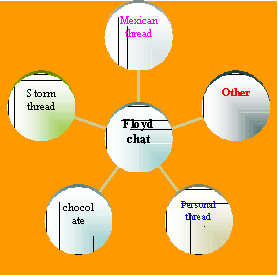
The illustration on the left shows the
threads branching out from the primary thread. The primary thread concerns all
that relates directly to Hurricane Floyd (Mexican thread, Storm thread) while
the secondary threads diversify into related topics. A secondary thread becomes
a primary thread only when most of the participants in the chatroom move to
contribute only to that thread.
While it is possible for strong secondary
threads to entirely de-rail primary threads and take over their central
function, it is less likely in named chat spaces such as this one, where topic
establishes context.
Reader-response theory takes us further
however than just the recognition that topic controls dominant conversational
thread-construction. Here, I found that the “writerly-writer” or actively
constructing text-talker who initiates a conversational thread, and the
“writerly-reader” who responds, are able to move the chat into new avenues, not
simply responding in topic-compliant ways to developing conversations, but
demonstrating especially “open” and “active” strategies of initiating text and
responding to it. The talk remains topic centred, yet works to focus and
refocus threads around certain aspects or themes of a topic. This is not just
information provision, but creative exchange build around information exchange.
At times this exchange is built around direct
question and answer. In the example
below for instance, <TIFFTIFF18>, in captured-turn 4, enquires whether
the hurricane is going to hit
From the outset, a large enough sample of
turn takings needs to be logged from any chatroom, in order to be sure of what
is being said. If for instance an entrant to the Hurricane Floyd chatroom
entered after <TIFFTIFF>’s question, they could well read <RUSSL1>’s response, stating that the
storm was overhead, as meaning that it was indeed going to hit New Jersey. Yet <RUSSL1>
was replying to an earlier posting, asking where the storm was. All chat
interpretation or reception is therefore only as current as it is when the
chatroom is entered. What is said before is unknowable, unless a log of the
prior utterances is available, and new entrants take the time to read it –
which mostly they do not, and indeed, cannot, given both the ongoing nature of
most chat sites, and the pace at which talk continues to scroll. Chat entrants then anticipate certain content
and behaviours, focused around the chatroom title – but also display tendencies
towards adapting rapidly as topic focus shifts and new threads develop, and even
a capacity to shift off topic, especially into personalized referential chat.
One of the features of reader-response theory as I am using it in chatrooms is
thus that it shows how a reader brings certain assumptions to a text, based on
the interpretive strategies he/she has brought to a particular community, from
other social-cultural contexts (see Gass, Neu, and Joyce, 1995; Blum-Kulka,
Kasper, Gabriele, 1989; Rheingold, 1994; Turkle, 1995). The racial tone in Case
Study One, displayed toward Mexican roofers, is an example of this.
Reader-Response analysis thus reveals inside chat the sort of active,
meaning-generating participants considered central in postmodern consumer
culture (Lury, 1996; Castells, 1997, 2000). Even where the topic-shifts and socio-cultural
attitudes may be directed to conservative or reactionary positions, the claims
on reflexive use of communicative technologies and transformational
interventions on communicative texts demonstrate Castells’ hypothesis, that the
new communicative technologies are key to the “project identity” strategies of
the postmodern condition. IRC becomes not a trivial pastime, but a key location
for social and cultural formation.
Increasingly, such socio-cultural contextual
experience formation, and therefore capacity for critical interpretation,
involves on-line communities. Technological features of the virtual environment
combine with self-selected membership to create a community with a strong
shared sense of values (Bruckman, 1992). This is especially so with chatrooms
in culture and country specific sites, such as Middle Eastern sites (Gudykunst,
2001), in which talk about the US war against Iraq is supported by pro-American websites and
opposed by pro-Mid East sites. Often pro-American chatters will enter
pro-Iranian or Iraqi sites and speak negatively about the country in question. For example see chatrooms at http://www.iraq4u.com and http://persepolis.com/chat/ChatPage.htm. But
even within more benign examples – such as the weather alert site used in Case
Study One – a community of values emerges, with chat participants responding in
aligned and non-aligned ways with one participant’s new thread on Mexican roofers.
And within this, chat behaviours in themselves are being defined, maintained
and even patrolled, as chatters self-correct and comment on technical or
presentational aspects of the entries of others. To this extent then, chat
behaviours are “readerly”, working to detect and accept chat conditions as
illustrated in pre-existing strands – yet also “writerly”, playing with chat
forms, actively interpreting and re- and even mis-interpreting postings, and
re-positioning both topics and techniques.
Working from a Reader-Response analytical
frame, I set out to examine the complex relations between readers and writers
of texted-talk, posing the multi-directed question:
Is the reader in fact the writer, who is
writing the reader? In other words, is a posting on a chatsite read as its
writer may have intended – or is it reconstructed and reformed into the
understandings of whoever encounters it?
On-line, a writer produces his or her
utterance, based on previously having taking on the role of the reader; and therefore
the reader’s “response”, immediately activated as a chat reply, is very much
the response the original writer seeks – and works to provoke. If there is no
response the written utterance becomes lost in the scrolling text and there is
no thread or content to build upon. Both moments of intensive reciprocal
posting, and those irruptions into disagreement, therefore indicate strong
tendencies towards consensual exchange – and at the same time a markedly
“writerly” texting, constantly reviewing its positioning, and working to
accommodate postings to act within and upon those of the chatroom. At the same
time however, as shown in Case Study One, the fact that the “author” of any
chat posting is ultimately unknown “opens” the reading of the text. The author
becomes an imagined author – possibly male or female, young or old, rich or
poor, Muslim or Christian or any other identity. Meaning is created in a
chatroom only as much as the reader finds it to be meaningful – so that the
“author” of any posting must work hard on their text if they wish to control
its possible readings. The multiple text structures of chatrooms can provide
for different interpretations of the same utterance (see Reid, 1996; Kolstrup,
2000). As a result of the limited information about authorial identity or
context within a chat channel, it is difficult to argue for a single or
consensual set of text practices in chatrooms. Previous research on
conventional text production and reception has not had to explain issues such
turn taking, backchannels, and co-presence in on-line environments (Cherny,
1995). How a print-text reader assesses meaning cannot accurately or totally be
applied to real time written “utterances” in a medium such as a chatroom or SMS
messages on a mobile (cell) phone. Where the “flow” of words suits the
already-established contexts of both the chat session itself, and the
“chatters” in their broader social settings, a consensual flow of “developing
responses” occurs – yet this is a more fluid and immediately reciprocal relation
than that of the time-and-space distantiated world of print text. The flow of
the chat in Case Study One is evoked by the storm – itself a shifting and
changing topic, so that it is the flow that establishes the context of the
chatroom. Everything said in this space clearly concerns the storm; even,
arguably, two isolated statements: turn 215 where <guest-Capt> states
<VIAGRA AND PRUNE JUICE....DON'T KNOW IF I'M COMING OR GOING.....> and <ankash> in turn 24: <I gotta go get some Xanax> (an anti-anxiety agent). If these comments
can be seen as reflecting affect: introducing “real world” demands of the storm
topic, so too may the three threads[171]
about chocolate (turns 15, 23, 25, 163, 171 and 177)[172]. Turn 215 could be uttered in frustration over
the chaos of the storm conditions (<VIAGRA AND PRUNE JUICE....DON'T KNOW IF
I'M COMING OR GOING.....>). Needing
Xanax – and even the “comfort food” chocolate - could therefore be related to
being anxious about the storm. The ostensible shift in topic is still resolvable,
in terms of the growing relation of trust and recognition of concern among the
group, as individuals feel more able to indicate their emotional response to
the situation, rather than simply information seeking. What is being “written”
therefore builds on what is being “read” – yet those texts are read back as
inviting and allowing the introduction of affect: a notably active “reading”,
already halfway to an act of innovation within a subsequent “writing”. In chat,
even when quite tightly topic–focused, the reader and the writer create meaning
together, to produce threads of conversation. The writer and the reader are
co-creators or co-authors in the communicative act.
How important is the particular chatroom
context for the reader-writer interpretive relation?
It is the title of the chatroom that I
suggest lures a participant to a particular chatroom. In Case Study One it was
the topic of Hurricane Floyd. In Case Study Seven it is baseball and in Case
Study Three the title of the chatroom indicates that chat will focus around the
pop idol Britney Spears – although in this case, as the analysis suggests, talk
focused more into a Britney Spears form of style culture than into direct
discussion of the ostensible topic. It
appears then that despite the title as indicator, the chatter has to deal with
multiple frames of interpretation, assessing the motivations and attitudes of
others in the room. When in turn 105 of
Case Study One <SWMPTHNG> asks <YOU AINT TALKING ABOUT MEX ROOFERS ARE
YOU?> the question indicates a moment of direct consensus- checking.
<SWMPTHNG> picks up a hint in an earlier posting that there may be an
opportunity to redevelop a current thread, and intervenes to “take the floor”
in CA terms, in a powerful bid to redirect conversation. Here “context” is both
shifting – from hurricane alert information, to discussion of ethnic tension –
and not shifting, since <SWMPTHNG> in making this move is assuming that
he or she is culturally contextualised: conversing with a group of like-minded
non-Hispanic Americans, who will share his or her views on “Mex roofers”. The
“ain’t”, with its appeal to a colloquial repertoire, helps establish that
cultural context, and indicates not only a chat entry which has “read” a
cultural framing in earlier postings, but which re-inserts its interpretation
of that framing, hoping to evoke response in kind.
The chatroom as context appears then to
pre-dispose – in Bourdieu’s terms – its users towards certain expected
behaviours, values and topics. But since this appears to be only partially
established through the title and topic selections, chatters also display
complex techniques for both signalling and reading back rather less directly
expressed aspects of the social and cultural framings brought to the chat. Context
is generated in both chat space and real space – and these may or may not
align. To this extent it becomes necessary to assess the contribution of the
technologisation of chat to its cultural contextual framings, and to take up
the findings of Case Study 2.
5.1.2 Case Study 2
Case Study Two examines on-line chat as a
form of Computer-Mediated Communication (CMC), with all the special features
and characteristics this implies. Computers do not replace but supplement
communication. Despite the many obvious influences of the technologisation of
on-line talk, communication remains dependant on both the sender of the message
and the receiver. Even bots: those elements of on-line practice pre-generated
as software and used to automate some on-line messaging functions, are scripted
inside the communicative conventions of their language community – and
sometimes even of their specialised chatspace.
The many tools available for CMC research
conventionally divide the research objects into either asynchronous CMC
(e-mails; mailbases; network groups; annotatable webpages; databases and
discussion boards) or synchronous CMC (chatrooms and computer-conferencing) – although
future studies might well address this division from the perspectives
established in studies such as this. While the “liveness” of synchronous chat
enables application of such analytical methods as CA, the use of script in
“chat” still places interesting limits around the act of communication, and
links even the immediacy of IRC to the more stable and enduring CMC forms.
Since Computer-Mediated Communication (CMC) is used in business, non-profit
organizations, education, and entertainment as well as for personal use, better
understandings of how each format works as a communicative act, and of how each
suits its wide range of uses, might assist in future selections and development
of the various formats, for specialist use. However, as this study has
suggested, CMC at this stage still lacks established and specific methodologies
to analyse chatroom talk. While this thesis has used several conversational
analytical theories, such as Speech Act Theory and Conversational Analysis, as
a lens to examine the data in CMC, it has also uncovered in a preliminary way
many limitations for analysis, as techniques developed for real-world talk are
transferred into electronic forms of communication. Until CMC research moves
beyond its current emphasis on pragmatic and developmental studies of user
applications, and begins to examine instead the practices of those users in
observational, descriptive and analytical ways, “how to” introductions to CMC
formats will remain largely at the level of technical glossaries. The most
common use of CMC research currently is surveying students and instructors (see
Romiszowsk, 1996; Harasim, Hiltz, Teles, & Turoff, 1995; Mason, 1992; Rice,
1990) and tracking e-business supported work coordination (Bowers
and Churcher, 1988). CMC is however beginning to be used as a method, as well
as a tool, for researching on-line conversation (see Cicognani, 1996, 1997,
1998, 2000; Parrish, 2000; Rheingold, 1993, 1994, 2000; Vallis, 1999, 2001;
Turkle, 1982, 1984, 1995, 1996) – but such studies to date work within broad
sociological or social-psychological modes.
To some
extent the impacts of CMC on Internet chat are obvious to every user.
Synchronous CMC has its own particular set of
difficulties, as I have shown in Case Study Two. Multiple threads of discussion
become difficult to follow. Slow Internet connection can mean that the speed of
reading and responding cannot be maintained. This results in discussion losing
its focus and side discussions (threads) developing. Sometimes participants may
simply be slow typists. The result is that what is written is often a response
to something written many turns earlier.
Three terms, “gap”, “lapse” and “pause” are
used to refer to silences in CA[173]. In
chatrooms however, there will never be silences in the proper sense of the
word, let alone with the specificity and distinguishability of CA
analysis. If there are silences in real
time, the text will simply scroll together to cover these spaces. The CMC
technologisation masks what is, in CA terms, significant rupture in
“talk”. Because of the threaded nature
of the arrival of chat postings, chat users learn to bridge and to braid: to
cross between postings, to reconstruct postings into reciprocal turns. As yet,
there is no means of assessing how extended, or how complex, such bridgings and
braidings might become – or of registering or measuring their impact on
subsequent “replies”.
In the example below I have looked at the
space between a person’s turn, and the next time the same person has a turn. I
have called the distance between the two turns a “lag”. A “lag” in this segment
is the distance between speech events of a speaker in a chat situation; a pause
between one utterance and another.
For example in Case Study One <EMT-Calvin> has the following number
of turns in between his or her utterances:
|
turn |
|
# of turns in between |
|
1 |
hahahaha lol |
|
|
14 |
That weather building in
cherryt point says it s 126 degrees in cherry point |
13 |
|
35 |
well folks im signing off here |
21 |
|
42 |
i need some sleep |
7 |
|
63 |
i like being self employed |
21 |
|
69 |
dont have to worry about
someone telling me to |
6 |
|
70 |
report to worl |
|
|
82 |
and those folks will be sent
back to |
12 |
|
85 |
The locals will be the ones to
get jobs |
3 |
|
97 |
folks need to be careful for
con artest after the storm |
12 |
|
112 |
i aint worried our new 99 home
is under warrentyu |
15 |
|
118 |
morehead guess how many tie
downs are on here |
6 |
|
121 |
68 tie downs |
3 |
|
153 |
folks my God is able |
32 |
With CMC the conversational lags are
self-created. There is no one physically urging an answer, as there would be in
face-to-face communication. <EMT-Calvin>
even appears to “answer” his or her own utterances, signing off in turn 35, and
stating seven turns later <i need some sleep>. There is a varying conversational lag between
utterances throughout <EMT-Calvin>’s contribution to this chat. Looking
at all 282 turns in this sequence <EMT-Calvin> has the following lags
between utterances 13>21>7>21>6>12>3>12>15>6>3>32>5>5>1>
9>6>9>5>7>14>8>9>7>14>7>3>.
In other words, there are 13 turns from <EMT-Calvin>’s first turn to his next,
then 21 turns separate his second turn from his third, and so on. I have shown
this graphically in column three. The
upright line represents all 282 turns in the chat segment. The short horizontal
lines represent <EMT-Calvin>’s turns, giving a visual image of the spaces
between <EMT-Calvin>’s turns – and so, breaking open the CMC
technologisation, providing an opportunity to consider whether the time-lags in
entry are significant.
The largest frame is the 32 conversational
lags between turns 121 and 153 (shown in the third column above) between the
utterance: <68
tie downs> and
<folks my God is able>. The turns
between were utterances concerning the storm, for example:
<I know the anxiety you must be feeling~I was in two
typhoons in
<Winds are picking up but not tropical yet>,
<The
news says the eye should hit us in the early AM hours.>”.
What
these case studies have shown is that there is a strong “writerly” form of
“reading” in between such frames (see CS 1.2). In face-to-face conversation a conversational
lapse or pause can be equated to a listening phase of conversation (see Sacks,
1992). In chat rooms this is a reading phase; interpretive, reconstructive, and
wholly significant in the chat process. Without consideration of the lag times,
as well as of the intervening utterances, it is impossible to see how much
interpretive work is occurring. In de-threaded sequence <EMT-Calvin>’s
postings seem in fact incommensurable. Several unconnected themes develop – and
only by consideration of both the time <EMTCalvin> takes in achieving
these changed frames, and in shifting focus as new threads intersect and gain
attention, can we make sense of the whole contribution. A CA methodology
therefore, with its primary focus on relatively immediate conversational
responses, even within multilogue circumstances, will need adaptation when
dealing with IRC conditions.
This
newly revealed “active presence” within lags also reminds us of the IRC
convention of “lurking”, or being present but not posting in a chatroom. In
chatrooms that do not indicate when a user is entering or leaving there is no
way of knowing whether the chatter is lurking or has indeed logged off. In column B below <Kiera>
makes no utterances between entering and leaving. Given a presence of just under one minute in the
space, Kiera must be understood as having scanned the conversational threads
under discussion, and found none of interest. The speed with which this is achieved
is in itself interesting.
|
B. on the
CD 911_Chat.doc |
|
|
( |
8. 14:57:20 ||||||||| Kiera just entered this channel |
|
( |
9. 14:57:43 ||||||||| novyk just entered this channel |
|
( |
10. 14:57:35 Sascha: no from |
|
( |
11. 14:57:50 oscar: ok hello! |
|
( |
12. 14:57:56 MissMaca: is anyone from NY? |
|
( |
13. 14:58:01 ||||||||| dolly just entered this channel |
|
( |
14. 14:58:04 ||||||||| Will just entered this channel |
|
( |
15. |
|
( |
16. 14:58:09 damaged: im a fread what will happen next |
|
( |
17. 14:58:14 mike: that was an organized terror act. what do you
people think. |
|
|
18. 14:58:14 Sascha: i watch it in tv it is unbelieveble |
|
19. 14:58:15 novyk: what's happened there ??? |
|
|
20. 14:58:17 ||||||||| Kiera just logged off. |
Conversely,
in chatrooms that auto-record every instance of keyboard usage, including
entry, leaving, changing names, and using pre-set text, there can be moments of
extreme difficulty in following conversation (see for instance the
example in Case Study Six where
there were only two actual utterances in thirty-six turns). And yet this is not to suggest that
immediately reciprocal conversational flows are any less complex. Indeed, it
may well be that it is the sophistication of our learned capacities to manage
the threads of even dialogic conversational posting sequences which enables us
to override such problems within the technologisation of chat. In examination
of an Instant Messenger chatroom that had two people, this study found just as
many threads happening as there would be with multiple speakers. Measurement of
thread rates alone cannot indicate fully what is happening in terms of
communication.
It is important then to locate techniques
which will allow analysis of the differences in communicative responses between
various Internet communication devices. In discussion groups and e-mails people
observably take more time and care with what they write, and are therefore not
as immediate in their communication as in Instant Messenger (IM) or chatroom
conversations. Users of discussion groups and e-mail may use a spell/grammar
check, and plan more consciously before posting their text. There is for
instance a more textual format with discussion groups. But while Instant
Messenger and chatrooms appear at first sight to be less disciplined and more
varied, with the relative spontaneity of casual interchange ignoring many more
formal communicative conventions, analysis has shown complex patterns of
interpretive and pre-dispositional structuring under way. In the example below
the message from the Hurricane Floyd Messages Board appears more developed
textually than the chatroom utterance – but is this an absolute, or a relative
judgement? While IRC postings are far less grammatically formal, they remain as
communicatively active and complex.
|
Hurricane Floyd Messages board |
|
By <wpapas> |
Significant safety concerns for family, friends,
and property on Sincerely. Wp |
|
Floyd chatroom |
|
<ankash> |
Tornadoes in Pender Count |
With
the above examples it is of course possible to postulate that, in the absence
of directly reciprocating co-locutors, postings must address an unknown and
general audience, in their quest for the specific addressee – and thus the more
formalized and “public” mode of expression. In an Instant Messenger chatroom,
the contrary is true. Interlocutors – most often established acquaintances, or
at least those who are able to establish cultural commonality within the
immediate communicative context – form responsive exchanges through their
readings of informal, yet nevertheless complex and sophisticated – talk-texting
repertoires. The demands for some degree of security within
|
|
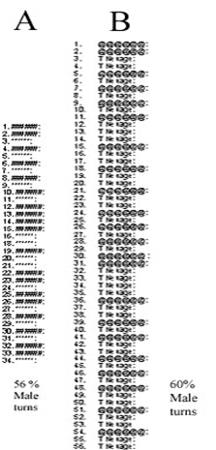
an
expressive consensus can be clearly seen in those cases in which utterances
accumulate from a single chat participant, before responses appear. In both
cases below there are repeated entries by the same IM chatter before the other
chatter “speaks”. The example to the left in column “A” shows the male speaker,
coded as <######:>, making another entry in advance of any answer,
giving five multi-utterances and seven single utterances. I am not showing
individual turns in this chart and instead I have minimized the chat to
highlight just the male turns. Between the female’s turn at 11 and her next
turn at 16 there are four male utterances. Interestingly, especially for work
on male-female “power” relations in talk, this shows in at least these two chat
examples that the male utterances outnumber the utterances of the female (see Tannen,
1995; Morgan, 2000, on conversational
maintenance by men and women in both CMC and face-to-face discussions).
The posting frequency alone
suggests an imbalance in the power relations of the speech – but when the
thread sequences are assembled, more can be read from the “lag” durations. The
degree to which threads either change direction, or alter their intensity,
“inside” the lag frame, is in itself of communicative significance, and
suggests that serious study is needed into how “silence” works inside various
chat forms.
From
this example it is evident that the male’s posts are the initiating threads and
the female is maintaining them[174]. In the next example, the male has initiated the
thread on past lives and the female has commented on it.
|
1. ######: WE WERE TOGETHER IN
THE HAREMS OF CHINAS THRONE, THE GOOD OLDL DAYS |
|
2. ######: MINE |
|
3. ******: ah...one of those
past life miracles |
In Case Study Four the speakers who dominate
the conversation by contrast are female usernames[175].
<Nicole528> has taken 24 turns and <judythejedi> has taken 22
turns. Below <judythejedi> is marked as  and <Nicole528> is marked as
  so that they can
be easily seen as the dominating influence in this chatroom[176]. By colour coding the speakers I could easily
identify who was speaking the most.
so that they can
be easily seen as the dominating influence in this chatroom[176]. By colour coding the speakers I could easily
identify who was speaking the most.
|
|
|
http://jan.ucc.nau.edu/~ipct-j/1999/n1-2/stewart.html viewed
|
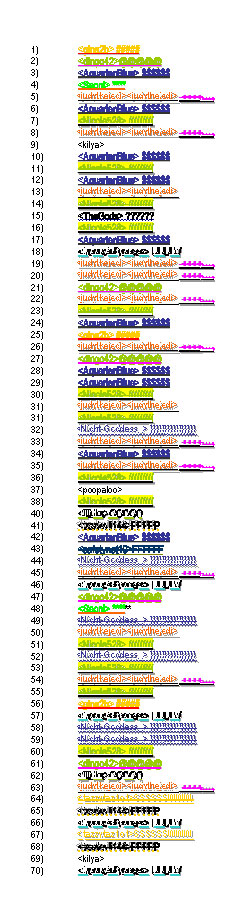
I approached this case study with two
questions related to Computer-mediated communication: “Do computers change
conversation” and “Are Instant Messenger chatrooms closer to
off-line-person-to-person conversation than dialogue in a multivoiced chatroom?” It has certainly become obvious that
computers do change conversation, and especially in relation to the suppression
of paralinguistic cues, direct address carried by gaze or gesture, tonal
emphasis … all of those techniques used in “live” communication to manage the
conversational relation. While we have found many emerging CMC techniques being
used to replace these physical features, and noted the extraordinary creativity
and pace of application in many cases, the informality of the new repertoire:
its constitution within practice and its lack of a tailored analytical method,
mean that CMC has not yet delivered all of its secrets. Nor can we anticipate
that users will cease their creative transformations of the mixed-mode of
“texted-talk” into these new communicative forms. Already it has become obvious
that while CMC has produced and still produces new talk techniques, there is no
monolithic regulatory influence being exerted. Practices differ – between chat
spaces, between chat participants – even at different moments within a
particular chat sequence, as talk-topics shift emphasis, and behaviours adapt.
CMC itself has already spun into many different formats, and the talk-texting
and speech relations within each have also differentiated. Some patterns appear
to cross between CMC technologising practices in different formats. For
instance, as with the chat in Case Study One where multithreads (five) branch
out from the primary topic of the storm, multiple chat-focus threads were also
present in the Instant Messenger conversation analysed (in this case, three).
The overall topic stems from the fact that the two people in the conversation
appear to know one another (confirmed later in my research). The threads in
this “talk” are about past lives, current relationships and sexual relations.
The new threads were each initiated by the male speaker.
past lives - <######:> <WE WERE
TOGETHER IN THE HAREMS OF CHINAS THRONE, THE GOOD OLDL DAYS>
current relationship <######:> <YES, I GET TO CALL HER IN
ABOUT 2 HOURS
sex talk
<######:> <THE WOMAN HAS FOUR ORGASIMS, A LEAST ONE VERY BIG
TWO MEDIUM AND ONE OR MORE SMALL THE MAN HAS ONE BIG AND MAYBE A FEW SMALL ONES>
|
|
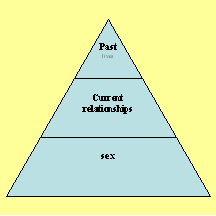
The conversations begin with talk about past
lives, then branch into a current relationship (the male’s current
relationship), and the male initiated topic of sex - and the conversation ends
there.
Instant Messenger or two-only chats are more
intimate than multi-chats. In a public multi-chat room where it is not known
who are present, utterances are viewable by all who are present. In the maze of
scrolling texts threads, an individual participant can be found and lost by
both the reader and the writer. In IM there are only the two viewers, who
choose to respond or not to respond. Instant Messenger is thus similar to
face-to-face conversation in that responses must be made if there is to be a
conversation. In a multi-person chatroom by contrast, if there is no response
by one person then someone else may respond to carry a thread forward. As I
have shown in Case Study Two and in the other case studies, multi-voiced
text-based chat confuses talk-relations to the point that not only is dialogue
difficult to follow, but it is difficult to know who is dialoguing. One-to-one
on-line discourse is interpersonal, uninterrupted, and in this sense closer to
“normal” off-line conversation.
What is changed – and markedly so within
chatroom technologisations - is how we do
conversation – the waiting for a direct response, dependent on the person with
whom we are communicating and the speed at which they type and the speed of
their computer connection. The speed of turn-talking and of understanding what
is being said is dependent on the number of people in the chatroom. The more
voices there are to sort through to carry on a personal conversation, the more
a one-on-one conversation can be prevented from developing. If there are more
than 40 people in the same chat, all typing and entering text at the same time,
there can be a lapse between what we write and its appearance in the order of
chat. For example in the chat below that occurred during the World Trade Centre
collapses, there were sixteen entrances with eleven participants in the minute
between 3.07 PM and 3.08 PM. Turns 123
and 124 are both recorded at
|
|
||||||||| sascha just entered
this channel |
|
|
1Bone!!: Ich bin deutsch |
|
|
Spain_17: Here in |
|
|
novyk: yo alucino, what's
happened in |
|
|
damaged: morons, there weher 2
attacks again, one in pittburg |
|
|
Hello: news: may be Osmat
behind this attack |
|
|
mike: where are you from,
damaged? because you d'like to escape to mars. |
|
|
Spain_17: Anybody from the
N.Y?? |
|
|
oscar: yo de menorca! que
pasada no? |
|
|
1Bone!!: koischer chat hier |
|
|
Hello: I just heard from news |
|
|
oscar: que pasada no? |
|
|
captain_insaneo: in |
|
|
Spain_17: Oscar? |
|
|
MissMaca: what's happened in |
|
|
||||||||| tach just entered
this channel |
Not only is it difficult to follow
conversation at this pace but one has to quickly respond to a very specific
utterance in order to be read and responded to. The speed that communication
occurs at with computers, and the inability to access the source of the
information and the context that it is in, present the biggest problems of
finding meaning in multi-person text-based chatrooms. In Instant Messenger or
any two-person-only chatroom there is more opportunity for an organized and
familiar turn-taking within communication, and therefore a more immediately
meaningful exchange, than in a multi-person chatroom. So how then might the
multi-person communicative repertoires of IRC be examined, to assess how
participants “manage” the complexities of their flows of talk? Which tools can
be used to assess techniques in use by IRC users, to overcome problems posed by
CMC technologisation?
5.1.3 Case Study 3
In Case Study Three, using semiotic and
pragmatic analysis as my tools of investigation of on-line chat, I particularly
wanted to uncover not just how “talk” is accomplished in a chatroom, but how
far chatroom “talk” generally may be said to include a broader than usual
repertoire of representation, working to “manage” talk relation problems as
outlined above, and to compensate the loss of off-line conversational cues. Mihai Nadin (1977) claims that the
computer is in itself a semiotic machine, as it is at core a machine that can
be programmed to manipulate symbols. Using computers themselves as
semiotic generators has an aesthetic appeal to users, because semiotic codes change
over time and provide new meanings to old ideas. This seems interestingly close
to the sorts of marked creativity the IRC and IM users in particular display in
the case studies for this research – although the continuity of these creative
“solutions” to communicational problems on-line, with strategies and
talk/texting techniques evolved in off-line conversation and reading-writing
practices, reduces the implied suggestions that it is the CMC technologisation,
and not human communicative ingenuity, which drives these changes. While users take up and work with some of the
special codes and even coding styles CMC systems provide, both the machines and
the users develop inside a broader social and cultural context, and source
their various communicative pre-dispositions there.
In this case study I focused on the most
obvious of the CMC elements of creativity, exploring how the use of non-word
representation: emoticons and abbreviations, as well as the “identity”
sign-tags or the usernames of the chatters, influenced the turn-takings of the
chat-talk (see Crystal 2001; Rivera 2002).
I chose a chatroom named after a
celebrity to firstly discover whether usernames, their “identity” sign-tags,
would be reflective of the title of the chatroom. In this case
study on “Britney Spears Chat” one chatter did indeed identify as a Britney
fan: <baby_britney1>. This identification with the chat-title is
consistent with what I have found in the other chatrooms in this thesis, such
as in Case Study One, Hurricane Floyd, where there was the username
<IMFLOYD>. In Case Study Four on astrology participants used the names
“astrochat”, <AquarianBlue>, <TheGods> and <Night-Goddess_>;
in Case Study Six, “web 3d animation” there were <web3dADM> and < Web3DCEO)> and
in Case Study Seven, “baseball chat” <MLB-LADY> (major league baseball).
Therefore it is evident that usernames can be directly associated with the
name-directed topic of the chatroom. When the dialogue is read from the
postings of these specific users it is clear that each chatter is indeed
interested in the topic of the chatroom:
<AquarianBlue>
in Case Study Four;
|
10). <AquarianBlue> Nicole 528 is gemini |
<web3dADM> in Case Study Six;
|
10) <web3dADM> just got the Cult3D folks to agree to show up
on March 3 |
<MLBLADY> in Case Study Seven;
|
6. <MLBLADY> no
clev fan but like wright |
<IMFLOYD> and in Case Study One;
|
55 <guest-Sundance>
Has it flooded very bad on the island, heard they haad a tornado in emerald Isle |
But in
each of these chatrooms there are also participants, as we saw in each study,
identifying against or outside the title-topic convention; contributing
postings off-topic; playing with textual form rather than following content
threads – even resisting efforts to bring them back on topic. And both within
and off topic, we have seen intense moments of creative communicative play,
frequently directed more towards the maintenance of communicative relations
than to focused engagement with talk topics.
Case
Study Two, let us note, centred on inquiry into whether the “playfulness” of
on-line chat is a CMC specific impulse. In face-to-face conversation it is
clear that people also use an array of semiotic communicative cues: intonation,
physical gestures, facial expressions - but with CMC communication semiotic
play is restricted to lines of text on a screen as an expressive marker (Stone, 1995a, p.93) as well as such
“characterising” elements as semantically-layered usernames, expressive emoticons
or colour selections, and added sound. Semiotic analysis thus enables this
study to move beyond a purely linguistic base into examination of the graphical
and expressive modes used to compensate, and maybe beyond that, to create
meaning in new ways, within the new “conversational” spaces of the chatroom -
and particularly so in a chatroom of saturating expressiveness within identity
work, as is the case with Britney chat.
In Case
Study Three to fully explore this drive to identity performance and
exploration, to find out how users extend the actual communicative range of the
“language” or coding system used, it was first necessary to examine which
communicative functions were actually in use in the Britney Spears chatroom,
and to reveal which are dominant and recurrent.
Firstly,
it was obvious in this chatroom that chatters employed usernames as signs to
give others clues about their identity – or at least about their “preferred
identity”, or particular identification with a Britney community. In
person-to-person conversation the clues that are given as aspects of identity
are personal – indeed, physical. On-line, these are replaced by the sorts of
identity markers which demark off-line social or cultural status: one’s employment or educational level for
instance.
Here, in
keeping with the Britney world, user tags are about image and “claiming”, or
the image that one wishes to have represent one’s status within the particular
social context of the Britney chat group. Each asserts either a relational
claim, or one’s desirability as a relational being: <Mickey_P_IsMine>, <JeRz-BaByGurL>, <Pretty_Jennifer>, <baby_britney1>, <IM_2_MUCH_4U>, <AnGeL_GlRL>, <Luvable_gurl15>, <buttercup20031> and <guest-hotgirlz>. These
usernames suggest that the chatters, if not actually young girls, are at least
identified with a popular teen culture of physicality and cuteness. In
real-life <Luvable_gurl15> could be a 58 year old male, but if so he is
entirely conversant with the codes and values of the Britney culture – even
down to the assertiveness of the orthography: the post-feminist/netchick “gurl”
replacing the conventional – and less powerful – “girl”.
Secondly,
the title of the chatroom identifies the chatters as interested in the
celebrity icon, Britney Spears. The chatroom title alone can provide
information on the identity of a participant; for example, in a chatroom such
as “Iraq4u”. An adolescent chatroom such as this one is likely to focus
discussion on aspects of personal self, as users construct identity around the
image and stylized behaviours represented in their idol. As I show in the
comparison table with a computer software discussion chat below, this can be
seen to be true in the Britney Spears room. And yet there are distinguishing
features beyond the level of topic as well.
Abbreviations were used more extensively; suggesting that adolescent
play over identity is also enacted within talk-texting strategies.
|
|
Emoticons too serve a purpose beyond just the
saving of time. They are also a marker of informality, and so an
“antilanguage”, in Halliday’s sense, indicating a special subcultural group
identity, and used to show who is familiar or “up-to-date” with the latest
language being used. Of the seven case studies, I have found the highest
incidence of abbreviations (30%) and emoticons (6%) in the Britney Spears chatroom
(see http://www.geocities.com/picture_poems/thesis/tables.htm for
a statistical comparison of the seven chatrooms). In fact the abbreviation for
laughing-out-loud “lol” was used fifteen times. In this chatroom frequency
counts of specific language forms are indeed revelatory. There were 294 words
used within the collected data corpus, with the personal pronoun “I” used the
most frequently, (18 times) and “lol” used the next most frequently (15 times).
In the sequence shown below “lol” is used nine times in 20 turns, which is more
frequent than in any other chatroom examined in this study. Another form of laughing-out-loud “LMAO” (Laughing my ass off) was used five
times.
Firstly then, chatroom semiotics show the
specialist communicative skill-level of the participator and whether he or she
is in the right communicative arena to continue to be an accepted part of the
chat community. Yet identity work of this kind in the Britney Spears chatroom
is limited to the user name and the textual input of the chatter. By contrast,
in face-to-face conversation, forms of identification are much more extensive
and include cues which can reveal personal identity, national identity,
occupational identity, corporate identity, gender identity and even religious
identity (see Berger, 1998). So the talk-texting and linguistic creativity of
these young chatters must achieve high levels of sophistication in order to
convey all of the information needed to assert a “Britney” self, and yet remain
a distinctive and desirable co-locutor in the “flattened” yet still competitive
space of the chatroom. One dimension of chat which seems to become suppressed
in these conditions is that of extended reciprocal conversation – those longer
threads of debate, information exchange or narrative, which appear in some
other chat spaces and cultures. Here, while such narratives of experience for
example do exist, they are constantly interrupted by the “social recognition”
postings of greetings and farewells, and reactive-expressive turns, working
less to cement sociality than to maintain affective role within the chat
relation.
The only thread of a conversation “captured”
in the Britney Spears chat sequence shown below is about the wish to see a
particular person on-line. This somewhat casual and intermittent chat contrasts
with that in the 3D Chatroom, where there was a more developed discussion of
computer software.
|
1. well heather he going to end it i just know it 2. No Syd damn it meee 3. No hes not ter 4. Lol 5. hmmm mickey 6. But i think hes got a gf so i dont miss him that muc but well
see what tomrrow bringslol 7. Ok Jenn lol 8. Yayay lol! 9. Lol justin 10. lol 11. iz lost 12. will find ya lol 13. do any guys wanna chat? 14. afk 15. Jenn Am i talking to a brick wall??? 16. Sis i want Justin to get here! 17. need to fix my hair.. 18. hello 19. wel I duno Mickey lol I juss think hes hottie so i cant really
miss him 20. lol s dead=( i am going to cry if i dont see my baby soon |
1. What VRML options work within AOL? 2. dunno 3. ahhh an ausse...a bunch of good vrml folks there 4. I don't believe AOL supports VRML at all 5. Will X3D work better there because it's Java-based? which
really sucks...but i'm not completely sure 6. X3D is not necessarity Java based that is just 1 implementation
option 7. I'm sure there will be stand alone and plugin versions of X3D viewers
8. so did len say x3d not finalised yet? 9. x3d is not finalized yet...yes true i think the final spec is due by siggraph
time this summer but a lot should happen at the web3d conference too 10. is a lot of business done there? 11. yeah quite a bit i suppose....most of the working groups meet |
Here for instance we can see in posting 2 an
interesting expressive embellishment, as a chatter who is entirely capable of
entering the term “damn” with its correct spelling, renders an extended “meee”
to assert both presence and the sort of “self” focus typical of the chat group.
Alongside this focus on various forms of “I”, the recurrent laugh-cue “lol”
creates a terrain of good humour and reciprocal sympathy, even in the midst of
small narratives of loss: “I am going to cry…”; “he going to end it…”; “s dead
=(…” The heavy layers of expressive play suggest a dramatized rather than an
experienced reality: an enactment of how one should appear in a Britney world
(relationship obsessed); concerned over the appearance or not of one’s “justin”
or one’s “hottie”, rather than how one is: hanging out in cyberspace with one’s
“gf”s who care, and who respond in kind.
Having established such high degrees of
symbolic or creative-linguistic play, it becomes important with this chat
culture to examine more carefully how this specific talk-texting repertoire
works. Pragmatics as a lens of
conversational analysis in chatrooms (Ayer, 1968; Pierce, 1980) can reveal a
socially embedded reading of chat “talk”. Pragmatics helps to focus on how the
various communicative items in chatrooms; emoticons, abbreviations and
misspelled words as well as chat utterance sentence structures (CUSS) are used
within an on-line linguistic society. Pragmatics in chatrooms starts from the
observation that people use on-line language to accomplish certain kinds of
acts, broadly known as speech acts (Speech Act Theory is discussed in Case
Study Four). Studies by Simeon J. Yates (1996) have shown that the language
used in interactive speech in chatrooms more closely resembles spoken than
written language, especially in the interpersonal respect (including use of
personal pronouns). As I have shown, in Britney Spears chat, Table 8 - http://www.geocities.com/picture_poems/thesis/table8.htm
(also on the CD) “I” has been used 18 times in the chat, the most used word in
the whole chat.
Writing (or text-talking) back to a previous
utterance in a synchronous conversational situation in chatrooms leads to a
pragmatic re-contextualization of the use of the sorts of double-loaded
semiotic expression discussed in Case Study Three. It is how the signs are read
which provides meaning, and entices, or provokes, other participants to either
continue building an utterance into a thread, or begin a new thread – including
responses to its graphic or creative-abbreviation load. In Case Study Three there are several
utterances that do not become threads, as they evoke no comment on them. For
example neither of the following utterances have a response.
|
23. <baby_britney1> do any guys wanna chat? |
|
27.<SluGGie> need to fix my hair.. |
Despite the direct question/invitation in
posting 23, and the focus on a Britney-culture preoccupation with physical
appearance in posting 27, neither turn is answered. The sorts of creative play
with chat-semiotic loadings which we have seen above appear more likely to
evoke reciprocal posting, when otherwise powerful conversational and
communicative strategies such as direct invitation or topic and contextual
focus, do not. Even those postings which access and reproduce the contextual
“antilanguage” or specialist codes, with the conventional attitudinal and
behavioural signifiers in place, do not always succeed in chat. In these next
two turns <Mickey_P_IsMine> similarly receives no response - but responds
to him or her self in turn 64.
|
56. <Mickey_P_IsMine> Ahh i got a retest tomrrow mi failin
math lol..and i think science |
|
64. <Mickey_P_IsMine>
which i duno how im failin science |
The casual texting, including colloquialism
(“dunno”), spelling lapses “tomrrow “, and “mi” for “im” = “I’M”) – even the
“lol” abbreviation – code into the established styles of group talk – yet
seemingly without sufficient creativity to gain notice. While responding to
abbreviations and emoticons and colloquial forms and specialized lexical terms
shows a commonality of understanding amongst those who are chatting, this
appears not enough in itself to command a reply. Commonality is clearly indicated when <Paul665> in turn 44 asks <Jen>
to give details on his or her self, and it is evident that to evoke a
response <Paul665> must assume
that Jen knows the abbreviation “asl”.
|
44. <Paul665> Ok Jenn asl |
<Pretty_Jennifer> responds:
|
51. <Pretty_Jennifer> 15/f/fl u? |
But while we can clearly see that here the
codes are exchanged in perfect reciprocity, what we cannot do is calculate with
certainty why this exchange succeeds, while others fail. The gambit is not as
directive as in <baby_britney1>’s direct question in posting 23, so that
we are left with an interesting possibility that the direct question works less
effectively in this chat context than the coded-abbreviated “asl” convention:
perhaps a signal of <Paul665>’s chat-credentials and comparative “cool” –
while <baby-britney1> may be showing too much real-world social
desperation and push. But it is impossible to be certain. Maybe chatters were
attending to other surrounding threads as posting 23 arrived. It is at such
points that textual analysis, no matter how multi-layered, begins to fail, and
only ethnographic or observational work can succeed.
How then can we assume that w/readers respond
in certain ways to certain language selections within chat postings – and
especially to the sorts of chat-codes and conventions which seem most often to
evoke interested responses? I use semantics, (Korzybski, 1958; Chierchia, 1995;
Chierchia and McConnell-Ginet, 1990) to investigate the “meaning” of a
linguistic item, considered as part of a specific syntactic system, in terms of
how the item, (in this case, an on-line abbreviation) carries meaning out of
and back into its culturally specific context. Yet even the most recurrent
items can fail to connect with certainty, even to established referents. For
example, the on-line abbreviation “lol” can have different interpretations,
such as “laughing-out-loud” (the meaning I would ascribe in this case study);
“lots-of-love” [177],
“learning-on-line”[178];
|
16.<Mickey_P_IsMine> But
i think hes got a gf so i dont miss him that muc but well see what tomrrow
bringslol |
|
17. <Mickey_P_IsMine> Ok
Jenn lol |
|
18. <Pretty_Jennifer>
Yayay lol! |
|
19. <Mickey_P_IsMine> Lol
justin |
|
20. <SluGGie-> lol |
|
22. <Pretty_Jennifer>
will find ya lol |
While “laughing out loud” is the most likely
coding here, at least in postings 17, 18 and 19 “lots of luck” and “lots of
love” are also possible. Only when the threads are carefully teased apart can
more certainty be added – and the process remains, even then, teasingly open.
To establish an analysis of on-line dialogue thus requires both semantic
representation (content of what the different “speakers” in a chatroom are
saying) and pragmatic information, to evaluate the kinds of speech acts
chatters are performing, such as asking a question, answering a question that
has been asked, or just announcing their presence. Case Study Three found that
in this particular chatroom conversation continued in a seemingly casual and
colloquial manner, with abbreviations such as “lol” fulfilling a user’s turn,
acting as a “continuer”, even in the absence of certain application to a given
referent. It appears than that semantic loading can weaken, as long as
pragmatic potential remains intact – but that this “openness” or
undecideability in the speech relation requires a compensatory layer of
cultural-contextual work – and that it is the on-line chat techniques
themselves: the abbreviations, the emoticons – which provide this, and not the
direct relational work of fully formed questions, or the “style-culture” topics
of behaviours of the “world of Britney” which we might otherwise anticipate as
the goal for the entire communicative project.
The first question I posed in this chatroom
was whether a popular person’s name as title of a chatroom creates a difference
in dialogue in a chatroom. In this chatroom, surprisingly, there was only one
mention of Britney Spears, even though the chatroom bears her name. There would need to be study of many
celebrity chatrooms before an answer could be definitively given as to whether
celebrity establishes not a fan-celebratory space, but a looser
social-relational peer group or “style tribe”, in Maffesoli’s terms. There are
chat-events when a celebrity is present, and questions are addressed to them,
in an on-line talk-genre closer to the practices of a web-forum. In this case however, while the chatroom was
named after a celebrity there was no indication that it was an “official” site
for Britney Spears[182] and
I did not find more than a few users at any one time during the research
sampling, suggesting that the myriad of Britney fans do not see such sites as
this as part of fan activity[183]. It
is then entirely feasible that an entirely otherwise-directed communicative
purpose is evolving within such spaces.
The second question asked in this
chatroom-study was whether emoticons and abbreviations are used more frequently
in youth orientated chatrooms than elsewhere.[184] Findings from this chatroom suggest that this
is so, and I show this in 5.1.1 Table 1. This chatroom had 30 percent of turns
with an emoticon or abbreviation used, compared to the next highest room, Case
Study Six, which had .06 of turns with emoticon usage. With Case Study Three based on a teen pop
star and Case Study Six on computer 3D animation participants in the latter are
likely to be older – and certainly appeared so (many made some mention of
family during the conversation). A Pew Internet Project report (see http://www.pewinternet.org) in
August 2002 found that 17 million young people aged from 12 to
17 use the Internet. That represents 73% of those in this age bracket. Fifty-five
percent said they used chatrooms and close to 13 million teenagers, representing 74% of
on-line teens, use instant messaging. In comparison, 44% of on-line adults have
used IM. A further finding by the Pew Internet
Project found that 24% of teens who
have used IMs and e-mail or have been to chat rooms have pretended to be a
different person when they were communicating on-line. I have therefore felt it
statistically safe to assume that the majority of those in this case study were
indeed teenagers, and suggest that the
high ratios of expressive talk, social-relational and affliative talk, and
on-line coding use, are typical among such groups.
5.1.4 Case Study 4
Since Case Study Three therefore raises the
question of whether the conversation in each chatroom varies in its focus in
relation to talk techniques, and not just in topic focus, this study moves to
consider which talk forms are evident in chat, and whether variability in given
chat spaces can be detected – and perhaps even predicted, from the “chat
community” present. Case Study Four used Speech Act Theory to identify dominant
types of speech activity in a single chat space. While IRC chat makes
application of Speech Act Theory difficult, because of the indeterminacy of the
“response”, it is still possible to categorise postings within the speech act
repertoire, and, where threaded exchanges are evident, to evaluate the success
or “felicity conditions” of an utterance. It remains difficult to assess how much of the intentional load of a chat
utterance is carried by para-linguistic elements such as emoticons or
abbreviations, codings shown as of immense communicative significance in
previous case studies. Given the frequency of use and rapid assimilation of
these elements into on-line communication in various media, it is important to
attempt at least a preliminary investigation of their “speech act” role.
In chat there are clear examples of direct
speech acts being deployed, and in quite conventional ways:
|
Speech Act |
Sentence |
Function |
Examples |
|
Assertion |
Declarative. |
conveys information; is true or false |
(Case Study Four) 11)
<Nicole528> im a Gemini (Case Study One) 10)
<guest-MoreheadCityNC> NO she's near 10th & (Case Study One) 77) <SWMPTHNG>
THERE'LL BE PLENTY OF MEXICAN ROOFERS IN N CAROLINA NEXT WEEK |
|
Question |
Interrogative |
elicits information |
(Case Study Four) 2) dingo42 nicole
wahts your sign ?? (Case Study Four) 17)
<AquarianBlue> your meeting her judy? when? (Case Study Four) 32)
<Night-Goddess_> anyone cool in here? (Case Study - 911) 182) Brazilian report:
some one know any new about the manhattan situation ??? |
|
Orders and Requests |
Imperative |
causes others to behave in certain ways |
(Case Study Five) 47) <scud4> bwitched
stop scrollin in here (Case Study One) 123) <Zardiw>
smptthing................go back to your SWAMP |
Direct speech acts that use
performative verbs to accomplish their ends expand the three basic types shown:
statements, requests and commands (as shown below).
Statements
(Case Study One turn 37)
<EMT-Calvin> well folks im signing off here
Questions
(Case Study Six turn 49)
<Brian> r u talking about blaxxun and shout3d implimentations or
something else
Orders and Requests
(See the CD 911.doc - turn 296) <MissMaca> Brazillian Report:
Iknow it was a building %&#%head. Give up on the %&#%ing nuke's ok!!!>.
Indirect forms in chat are dominated by a
generalized activation formation, which masquerades as a question addressed to
the entire chat community:
(Case Study One
turn 74) <guest-Tom> does anyone know where floyd
isnow>.
(Case Study One
turn 125) <guest-kodiak> does anyone
know why UNCC has not closed>.
(Case Study One
turn 162) <guest-EZGuest367> Anyone
know if I should worry about daughter in west NC?>.
The form has even evolved its own
abbreviation:
(Appendix 911 turn 370) <
The first four postings are clearly in
the form of questions, but equally clearly are not inquiries about issues the
chatter can anticipate will be answered by an expert “knower”. Thus the speech
act is in itself indirect, as we can see by examining possible answers. Most of
the time, the answer “yes, I do” to any of these four questions would be an
uncooperative response. The normal answers we would expect in real life talk
would be “Yes, the Weather Channel tells us that Hurricane Floyd is passing
over North Carolina now”; <UNCC is closed because of the storm>; <if
your daughter is in the eye of the storm you should be worried>; <another
active New York chatroom is at http://www.superglobe.com/chat/>.
Because of the anonymity of the chat situation, each response depends upon what
could be called a “validation” format: the use of an indirect statement or
reported speech from another context: “The weather channel tells us that…” A
simple “yes” answer that responded to the literal meaning would usually be
taken for an uncooperative answer in actual social life. For example “Yes, I
do”, would be heard as “Yes, I do, but I'm not necessarily going to tell you
where the storm is, why UNCC is closed or the location of other active
chatrooms in NY”. So the five examples above function as indirect questions,
more accurately coded as “I want you to tell me where the storm is now”, “I
would like to know whether UCC is closed yet”, or “Please tell me of some other
New York chatrooms so that I can move to them” and the chatroom participants
are clearly able to interpret this function, and respond appropriately. In
other words, despite the added indirection of chat speech act formation, chat
continues. But this means that very complex speech act relations are concealed
beneath the quick-form exchanges of IRC – across a range of chat communities –
and that indirect speech acts appear to be in heavy use.
The key question for this Case
Study and this chatroom:
“What is a successful speech act in a
chatroom?” thus appears to require consideration of the more than usual
loadings of indirect speech acts inside a non-physical and multilogue talk
community.
Austin and Searle claim that the speech
act is the basic unit of meaning and force, or the most basic linguistic
entity, with both a constative and a performative dimension. They both accept
that there are illocutionary acts and perlocutionary acts, using Speech Act
Theory as their theoretical foundation and analysing the data by message
length, distribution, message links, and interaction. Speech Act Theory is
based on the notion that what people say is consistent with what they do
(Howell-Richardson; Mellar, 1996). Such a definition indicates that we should
examine those zones in which chat “unravels” some of the regulatory functions
hypothesized in speech act theory. Distribution roles, or those aspects of
speech working to direct talk relations and to control its performative
dimensions, are problematic within the generalized speech relations of chat:
one explanation of the sorts of indirect strategies outlined above – and maybe
of the retreat into saturating expressives and relational work.
In part this indeterminacy which bedevils
speech act analysis in chat rests in the technologisation and “de-threading” of
the format. It is not determinable for instance whether <hmmmmmmm> in the
utterance below is a truth statement (agreeing with a previous utterance) or an
answer to the previous utterance from <Night-Goddess_> (anyone
cool in here?) – or even <AquarianBlue>
expressing a response to some off-line pleasure. For these reasons alone Speech
Act Theory cannot categorise all utterances in a chatroom, with certainty – and
it may be that the confusion and chaos that new users so frequently report of
the chat experience relates to this indeterminacy, in relation to off-line
talk. Yet at the same time regular chat users do manage their talk
successfully.
|
34)
<AquarianBlue> hmmmmmmm |
In this chatroom Speech Act Theory shows
that it can be used to examine features common to all chatrooms. In particular it can help establish
interconnections within the threads of conversation. Unlike face-to-face conversation,
where a person appears to respond to the most recent statement in a
conversation, in a chatroom the utterance can be a continuation of someone
else’s utterance - or it can be on a new topic, with the hope that someone else
may join in. The example below shows three unrelated utterances, but all are
either continuations of a thread or the initiation of a new thread:
|
30) <judythejedi> i
don't think so..she's bringing amtrack down maybe |
|
31) <Nicole528> whats your sign dingo? |
|
32) <Night-Goddess_> anyone cool in here? |
Because of the technologisation of chat there
are no markers to segregate or “direct” this conversational traffic. Chat
participants must then de-code the speech acts, and re-connect threads into
logically sequential strands. Since posting 30 relates to an earlier posting,
only those participants already threaded into that particular chat will respond
– unless of course a new chatter asks directly “You don’t think what? She who?
Amtrak down to where? Why only ‘maybe’”?
Since such a response would be an interruption of an implied co-locutor
relation, it is unlikely to occur. Posting 31 creates a similar “directedness”,
signing it with the user name “dingo” – the sole participant invited to reply.
So it is no surprise that of these three consecutive postings, it is 32, the
generalized and indirect question/invitation form, which succeeds. Following
<Night-Goddess_>’s utterance <anyone cool in here?> a thread
develops that plays across the issue of
whether anyone is “cool” in this room – and incidentally provides a
possible answer to the role of posting 34 from <AquarianBlue>.
|
32)
<Night-Goddess_> anyone cool in here? |
|
33)<judythejedi> hi night |
|
34)/\32 <AquarianBlue> hmmmmmmm |
|
35)/\32 <judythejedi>everyone is cool here |
|
36)/\32 <Nicole528> is cool lol |
|
37)<poopaloo> 10ty judy |
|
38)/\32 <Nicole528> is cold too |
|
39)<sara4u> I LOVE YOU TO MUCH.......ACARD |
|
40)<jijirika>is back |
|
41) <tazdevil144> cool |
For this speech act to be completed there
needs to be an understanding of what <Night-Goddess_> means by “being
cool”. The speech community within the room choose in interesting ways to
respond by playing across the semantics of the term “cool” – yet in doing so,
indicate their understanding of the indirectness of her speech act strategy. As
<Nicole528> and <poopaloo> evaluate and reward the claim from
<judythejedi> that all the chatters in this space are cool, and
<tazdevil> extends the game by using the term to express pleasure that
<jijirika> has rejoined the chat, each understands not only the “surface”
codes, or display techniques which sign “cool” chat expertise: “lol”, and “10
ty”, but also the indirection of <Night-Goddess>’s speech act. This is
not a directed question. As its “anyone” address formula shows, it is an
invitation to talk. But specifically, in its address to not only a chat
community, but to a known and familiar group (note <judythejedi>’s
diminutive tag-name response: “night”) it creates a speech act which is less a
general question than an assertion of communality. In effect, it says something
like: “Hello to all my old friends: I’m ready to be as active in chat as usual”
– and those chat friends react entirely appropriately. Responses demonstrate “cool”, in chat terms,
with a mix of community affirmation:
<judythejedi> everyone is cool here>,
appreciation of the communality>,
<Nicole528> is cool lol>,
and the sort of metatextual play across chat
conventions which establishes the cachet of cool on-line:
<Nicole528> is cold too>.
No
surprise then that the thread is continued for several more turns before a new
thread is begun. The original utterance serves not to elicit specific answers,
but to evoke the sorts of talk which on-line chat promotes, and which is
distinctive to its form: reflexive, linguistically aware, communally directed,
generalized and inclusive/exclusive, fast-paced, and multi-threaded:
|
49) \32 10c.
<Night-Goddess_> I is not cool |
|
50) \49 5l. <judythejedi>
yup |
|
51) \49 6j. <Nicole528>
really |
|
52) \4910d.
<Night-Goddess_> I is awsome |
|
53) \496k. <Nicole528>
yes your cool |
|
54) \465m. <judythejedi>
lol..i know prncess |
|
55) \476l. <Nicole528>
cool dingo |
|
56) \521c. <gina2b>
coolfool |
Is there then sufficient evidence to
assert that in its Speech Acts, on-line chat is predominantly relational –
working more on its communal elements through generalization of its modalities,
than on its performative or illocutionary acts? To test this requires
assessment of chat in a strongly topic-directed chatroom – one in which we
might anticipate task and topic oriented talk. Case Study 5 takes up the
analysis of chat in an Astrology chatroom, in which many chatters appear to
already know one another – therefore appearing less reliant on self-assertion
or community formation.
5.1.5 Case Study 5
If
there is a preponderance of relational talk-texting in chat rooms, by examining
a chatroom with a predominance of markedly short turn-taking sequences, it may
be possible to discover if even in the rapidly scrolling conversation of
on-line chat, there is enough time and enough “speech act” work to establish a
communication community amongst the chatters present.
Talk in text-based chat is as fleeting as its
off-line equivalent. Text disappears as it scrolls by. The participant gets one
opportunity to read the text, after which time it cannot be retrieved – at
least not without time out for scrolling – during which period postings
continue to amass. This capacity I have called “fleeting text”. On-line fleeting text affects discursive
connectiveness. There is a counter-intuitive distinction here between talk and
text. Conventional spoken language is also dynamic, fleeting, and irreversible
communication, but printed language breaks the strictures of time and leads to
permanence. The two together in an on-line environment contain elements of both
– what has been said can be “revisited”, as long as the chatroom is showing
previous turn takings. My data cannot show evidence that users do check back to
re-establish threads, but the co-presence of postings onscreen, even while
fleeting and constantly mobile, does encourage longer consideration than is
possible in talk.
Thread-framing is in itself a major
phenomenon in chatrooms. A posting appears to “begin” and “end” because it
arrives on the receivers’ screen inside an individual text-box. These framed pieces of conversation are of
course not necessarily sequential. Threads twist around, stop and start, and
several may arrive at one time, in a seemingly chaotic fashion. What then is
the relationship between the seeming coherence of a single chat utterance, and
its equally contained surrounding utterances?
We have already seen that the apparent
commensurability of utterances, each framed in the same spatial convention, is
an illusion. Immediately consecutive utterances are often unrelated, or at
least out of sequence – and many remain so. Further, because this form of
visual framing is the only contribution to the communicative regulation of
texted-talk by its technologisation, users themselves must work instead at the
level of language alone – including of course both verbal and visual elements –
to construct meaningful communication.
At the linguistic level the “threading” which
constructs meaningful conversational exchanges across and between these
individual and flattening visual frames also must read back possibilities for
response. It is this form of “framing” which gives a starting and finishing
point to a thread, and turns it from an artificial sequence of random
utterances to a meaningful conversation. Since there are no visual codings
contributed by the CMC technologisation to mark a new or ending thread, that
decision too must be made by the chat participants; read back from the speech
act possibilities. Curiously, in many cases the originator of a thread is also
the last “voice” seen in that particular thread. In the example below,
<Night-Goddess_> begins a new thread by asking whether there is
<anyone cool in here?>. The topic
is also ended by <Night-Goddess_>
20 turns later, with the comment: <I is awesome>.
|
32) <Night-Goddess_> anyone cool in here? |
|
49) <Night-Goddess_> I is
not cool |
|
52) <Night-Goddess_> I is awsome |
Because this topic had centred so clearly
upon the word “cool”, this transformation – “cool” becomes “awesome” – ends the
potential for wordplay, and so terminates the frame. But to sense this
termination chat participants must be able to “read” and respond beyond the
level of conversational turn-taking exchange – the CA level. By reading speech
act intent in utterances, and seeing <Night-Goddess> “switch off” the
topic cue at this point, collocutors can indeed note a frame termination – and
they move on accordingly.
The initial framing of a thread can thus
determine – or at least work towards determining – its success and
duration. But in the case above, as
already noted there is a particularly consensual group in communication. This
community of astrology followers appears to be regular collocutors on-line, and
know one another’s behaviours. How far then is this, the cooperative
communication of a friendship group, as opposed to a specific communicative
behaviour of on-line communities generally: a feature of “chat”, rather than of
this example of “astrochat”?
One way to examine this is to check for
deliberate interventions: “policing” of chat posts. If there is hostility shown
in a chatroom, or as shown in Case Study One, an attitude such as racism, (in
this case towards Mexican roofers) will other speakers contribute to the thread
in like manner, supportively, as in the astrochat sequence? Here there is clear
evidence that such threads can be very deliberately de-railed, and comments
such as <SWMPTHNG>’s stopped by others.
A different speaker can and will end a thread, indicating a
multi-chatter frame (see Tannen, 1998; Bays 2000). Since to do so they must
however also “read” the frame – understand the intent of the utterance – the
termination/transformation intervention still acts as evidence for the power of
talk-text framing. So clear is the framing intent (or re-framing intent) of
some postings to some collocutors, that they move to end a posting – or at
least, to re-direct it. And indeed, without such framing a thread could continue indefinitely.
Framing is what completes the thought in chatroom discourse.
5.1.6 Case Study 6
Using conversation analysis (CA) in chatrooms
helped me discover how communication on-line regulates its exchanges. While the
“capturing” of data is different in chatrooms from that used to research
face-to-face conversation there are similarities in the analysis process.
Traditionally, CA researchers audio record a session and discuss from a printed
readout “what happened” in the conversational exchanges. In the example below
from such a taped session[185] the
time between turns and the pauses in the conversation are noted – not an
element that can be considered in on-line chat, or at least not in those
chatrooms which do not mark the time of arrival of each utterance – and even
then, given the packet-switching technology, this does not reflect the times of
entry for a given posting. Some aspects conventionally of communicative import
in CA are therefore not available for analysis in chat. In CA for instance most
work is done with two or three people speaking. In the example below two people
are having a phone conversation. This one-on-one speech relation, or its close
approximation within a small group, has contributed many of the techniques and
features of CA method. To an extent, the features identified by CA in
small-group or dyadic talk relations can also describe chatroom interactions.
Conversational analysis of chatroom talk shows for instance examples of
adjacency pairs and turn-taking conventions common in CA-analyses of natural
talk. But both the capacity for multilogue and the technologisation of the
talk, through text and through CMC, create new complexities inside the talk
relations. One primary difference as this case study and others have shown is
the interjection of conversation before a thought is complete, due to the
tendency to use the enter button “mid utterance”, combined with the often lengthy
periods between utterances that are filled with other streams of talk. In
examples A and B below we see clear indications of turn-taking, and the
development of a conversation. In A however there are interruptions (for
example in turn 45), impossible in chatroom turn-taking.
|
A CA transcription from tape recording
|
B Web 3D Chat on CD at 6a.doc
|
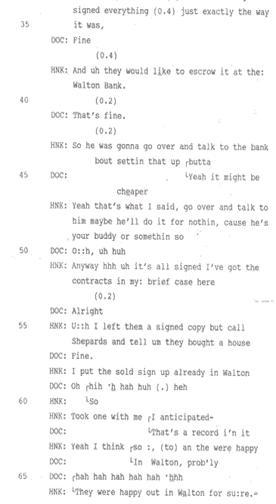
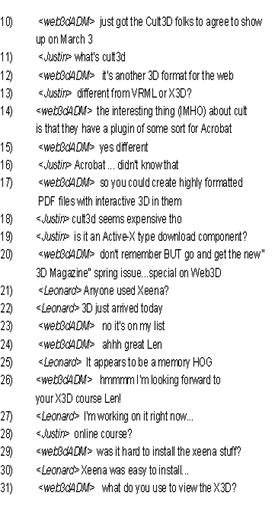
Utterances are mostly complete turns in
chatrooms, with the only breakage in a particular utterance being made by the
user at the time of the utterance – for only if they press the enter button
does the utterance become broken. In turns 21-24 below (column B) <Leonard>
makes two utterances that are
different thoughts, but because they are entered sequentially without anyone
making an utterance between the two thoughts <web3dADM> is
left to answer them both, as different thoughts, sequentially after <Leonard>’s
entrances.
|
21) <Leonard> Anyone used Xeena? |
|
22) <Leonard>
3D just arrived today |
|
23) <web3dADM> no it's on my list |
|
24) <web3dADM> ahhh great Len |
In a face-to-face conversation one would
assume that <web3dADM> would respond to <Leonard> saying <Anyone used
Xeena?> with the utterance <no it's on my list> and to <Leonard>’s
<3D just arrived today> with <ahhh great Len>, ordering the
conversation differently:
|
21) <Leonard> Anyone used Xeena? |
|
23) <web3dADM> no it's on my list |
|
22) <Leonard>
3D just arrived today |
|
24) <web3dADM> ahhh great Len |
If in fact utterances 21 and 22 had been
offered in sequence in a natural conversation, it is also likely that
<web3dADM> would reverse the response sequence, offering his expressive
and evaluative response before his explanation
– in effect replying to 22 before 21:
|
21) <Leonard> Anyone used Xeena? |
|
22) <Leonard> 3D just arrived today |
|
24) <web3dADM> ahhh great Len |
|
23) <web3dADM> [no] it's on my list [too] |
In fact <web3dADM> could have
been typing in <no it's on my list> at the same time as <Leonard>
was typing in <3D just arrived today> - or even before, since we do not
know the relative distances travelled through the system, or the traffic-flow
conditions encountered by the packet-switching .[186]
According to conversation analysis,
turn-taking is integral to the formation of any interpersonal exchange. Unless
lurking, the participants in chatrooms demonstrate their knowledge of the
particular chat conventions of the chat-site they are visiting in order to be
accepted or rejected by others in the chatroom. The signalling of one’s status
as an insider is especially important in establishing dominance. In the
chatroom I used for this case study the topic was computer animation, and it is
clear that <web3dADM> is the leader or moderator in this case study, not
only because of the abbreviation for administrator (ADM) behind the <web3d>
part of the username, but because <web3dADM> provides answers to
questions people ask in the chatroom regarding the chatroom itself. The status
of this participant is thus marked in various ways, but key among them is this
specificity of interrelational role – a feature of turn-taking as identified in
CA.
The underpinnings of CA, sequential
organization, turn-taking and repair, and how they can depict interactional
competence, are therefore useful in reading chatroom talk. However, the
circumstances of chatroom technologisation demand adaptations to CA protocols,
to enable analysis of conversational relations occurring in de-threaded
sequences. Unlike face-to-face conversation the sequential organization of a
given chat exchange needs to be separated from what else is being enacted in
the chatroom. The isolating of pairs in the chat is difficult if there are many
people chatting and the text is scrolling at a rapid rate. In finding adjacent pairs in Case Study One
the conversation had to be re-threaded.
What is revealed below for instance is that there is a turn-taking
strategy present between <lookout4110>
and <Werblessed>,
but each utterance has several turns in between.
|
Turn |
Between Utterances |
Speaker |
utterance |
|
60. |
|
<lookout4110> |
Who is in Wilm. right now? |
|
64. |
4 |
<Werblessed> |
Im 50 Miles west of Wilm. |
|
73. |
9/13 |
<lookout4110> |
How ya holding up Werblessed? |
|
83. |
10/19 |
<Werblessed> |
So far just strong wind gusts
and lots of rain.. Over 8 inches so far.. |
|
89. |
6/16 |
<lookout4110> |
Have the winds been strong? |
|
98. |
9/15 |
<Werblessed> |
Gusts up to 60-65 so far its
starting to pick up a bit.. Only gonna get stronger Between now and midnite |
The first number in the “between utterances”
column is the number of turns since the previous utterance was addressed and
the second number is the number of turns since the last utterance by the same
speaker. The complexity of the posting relation is apparent. After these three
sets of turn-takings <lookout4110>
and <Werblessed>
no longer interact directly. <lookout4110>
contributes more utterances, concluding at turn 164, and <Werblessed>’s final utterance in this
segment is at turn 180. In other words, given the multiple threads available
for response in on-line chat, threads form and reform, as participants shift
focus. But the degree to which such shifts are driven by the complexities of
the multilogue are hard to evaluate – another feature which CA is unable to
address, and which may require a more ethnographic inquiry to assess.
CA is however able to consider some aspects
of conversational breakdown – for instance, repair, a standard part of normal
conversation. Natural conversation is rich in examples of breakdown – a feature
which CA analysts often find disruptive to other programs of their analysis:
When we consider spontaneous speech (particularly
conversation) any clear and obvious division into intonational-groups is not so
apparent because of the broken nature of much spontaneous speech, including as
it does hesitation, repetitions, false starts, incomplete sentences, and
sentences involving a grammatical caesura in their middle (Cruttenden, 1986,
pg. 36).
In chatrooms, where utterances are mostly
posted complete, this experience of breakdown at first sight seems less of a
problem. But chat-repairs do come about, due to two primary causes. The first
is shown in column A below and the second in column B. The first is introduced
when a word is typed incorrectly - <IroquoisPrncess> says <hey Judy
did a get my car in the link thingy>. While “car” is a proper word, it is
wrongly entered, and confuses the meaning, since interlocutor <judythejedi> does not associate the
word with the utterance-topic, leaving <IroquoisPrncess> to correct the
error. Here the error is text and CMC related: clearly a typing error, and a
feature which in natural conversation would be corrected in much the same way,
although enacted as a mispronunciation, or a mishearing – probably cued by a
quizzical glance or facial frown. Here
the interlocutor, <judythe jedi>, directly addresses the need for repair.
The second repair error however is less techno-conversational than CMC
technological. Owing to pressing the enter key early, dividing his utterance,
<Leonard> leaves a curious suspension in his exchange with <brian>.
Has <brian> pre-empted a reply in advance of all the information, because
the utterance object introduced by “this” must be “spring”? Does
<Leonard> enter “spring” while <brian> is entering his own
utterance, or because he thinks if <brian> has all the information he may
change his response? Because we have no information available on the timing of
the utterances we are unable to analyse the interaction further – an
interesting example of chat’s technologisation defying CA principles on repair.
|
From Case Study Four |
From Case Study Six |
|
57) <IroquoisPrncess> hey Judy did a get my car inthe link
thingy 63) <judythejedi> car in the link? 66) <IroquoisPrncess> card |
40) <Leonard> I will be offereing it on-line through 41) <brian> can't make it 42) <Leonard> spring |
Are there then instances of chat which
require more than the sorts of extended CA repertoires discussed here, for
examination of the full range of utterance behaviours and conversational
techniques? Are the chat participants examined above displaying both interesting
instances of the language-use pressures of chat, and conscious attempts to
redress these? Are there other techniques of talk or text analysis which can
help both identify and explain some of these communicative behaviours? One
issue raised in CA work on chat is the need for a more finely-focused
examination of word-selection and word-ordering in utterances – and especially
in such self-conscious moments as those occurring around instances of repair.
In a final pass over the chat-room communicative experience, this study used
current approaches to grammatical analysis, to assess how far chat uses and/or
departs from standard text or talk grammar conventions.
5.1.7 Case Study 7
This case study examined baseball chat, a
talk-community anticipated to use high degrees of informality in grammatical
formations, to assess whether the functioning of grammar in chatroom
communication could be shown to be the same as, or different to, that evident
in text or talk. Do common grammatical conventions – such as word order,
sentence structure, question formation, hold up in on-line chat? Do
baseball-chatters on-line use the same specialist formations as their off-line
brethren? Are there any new constructions evident?
Language in a chatroom certainly proved to be
altered by its users, both deliberately and by mistake. Formal sentence
structure conventions become less evident, as abbreviation and graphic elements
arise to meet the speed-entry demands of the chat technology and its new
communicative ethos. Compound forms arise,
with the informality of spoken language, but enacted in the sorts of textual
play and creativity otherwise seen in communicative genres such as poetry, or
advertising. The grammar of chatrooms, if it is done intentionally, is
developing a highly sophisticated form of prose that is semantically and
semiotically innovative and daring.
Below, <CathyTrix-guest> in turn 108
creates the utterance <2blech>. Such combinations of numerals and letters
have no place or “utterability” in spoken conversation – yet in this chatroom,
at this moment, inside this thread, the utterance communicates. The “2” refers to an earlier request for
chatters to press the “3” key if they like the New York Yankees baseball team.
<CathyTrix-guest> emphases his or her dislike of the Yankees by pressing
a different key from the “3” suggested, confirming it with the comment: “blech”
- not conventionally a meaningful word, but one used colloquially as an
onomatopoeic representation of the act of vomiting. The turn thus communicates something like “I
don’t like the Yankees, they make me sick, I would only score them at a rate of
2”. The economy, the creativity and the expressiveness of the utterance
overturn the conventions of a more formal sentence construction, without losing
communicative power. But at the same time, they demonstrate a linguistic and
grammatical formatting not available or possible in speaking about baseball.
|
98. |
<NMMprod> |
2n. |
if you like the yanks press 3 |
|
99. |
<dhch96> |
5p. |
1111111111 |
|
100. |
<BLUERHINO11> |
1l. |
got it |
|
101. |
<dhch96> |
5q. |
1111111 |
|
102. |
<smith-eric> |
8j. |
5555555 |
|
103. |
<dhch96> |
5r. |
11111111 |
|
104. |
<dhch96> |
5s. |
111111 |
|
105. |
<CathyTrix-guest> |
6g. |
2I hate the Yankees |
|
106. |
<smith-eric> |
8k. |
don't have a 3 |
|
107. |
<Pizza2man> |
7o. |
12456789 |
|
108. |
<CathyTrix-guest> |
6h. |
2blech |
|
109. |
<NMMprod> |
2o. |
hahahahahaha |
|
110. |
<dhch96> |
5t. |
yankees s-ck |
|
111. |
<BLUERHINO11> |
1m. |
im removing that # now |
|
112. |
<NMMprod> |
2p. |
you wish |
Similar concision in chat utterances operates
as both efficiency forced by the required typing speeds, and a stylistic marker
of on-line competency. In turn 77 <MLB-LADY> enters a question: “dd any
see the atanta score”. A formally grammatical rendering would produce the form:
“did anyone see the
Similar effects are achieved by the use of
single letters or numerals in place of whole words: u – you, 4 – for, r –are, c
– see, 2 – to. In posting 128 of Case
Study Seven <BLUERHINO11> refers to <dhch96>by using the letter “d”
– an abbreviation of a user-tag which works as both familiarity (“may I call
you “d”, <dhch96>?) and as on-line efficiency.
In chatrooms, grammar is thus a developing
protocol, reacting to both the demands of the rapid scrolling of the
conversational threads, and to the creative demands of establishing on-line
communicative competence. Common grammatical principles and practices are applied
differently in chatrooms. In society generally, we use grammar to judge people
in terms of social status, regional origins, and educational level. In
chatrooms the rules have to some extent already changed. A person may be judged
by how efficiently he or she types, and by the familiarity they are able to
display with on-line chat conventions, such as abbreviations, graphics
integration, and the capacity to respond to creative utterances in kind – to
continue the stylistic directions of a thread, as well as its content or
semantic load – and that may well mean “reading” and writing back the sorts of
grammatical adjustments outlined in Case Study Seven. There does indeed appear
to be evidence that on-line chat is activating new elements in the
communicative repertoire.
5.2 Unique features of chatrooms
Overall, the case study sites have then been
able to display not only communicative complexity inside the chat utterances,
but complexity resolving into specific on-line chat techniques. Electronic chat
is no longer only one small communication exercise among many, sharing most of
the communicative styles of natural conversation or equivalent text forms (such
as for instance the memo), but an important and distinctive form of
communication, establishing its own regulatory systems and practices. Internet
text-based chat is already changing as a technology, with the increasing use of
webcams, multimedia and 3D Graphics-based chat communities[187] and
the ability to use voice instead of only text. New applications of text-based
chat are appearing with the availability of wearable
computers[188],
including miniature PCs, personal digital assistants (PDAs),
cellular phone watches, cognitive-radios[189], and electronic performance
support systems (EPSS)[190]. Such
devices will enable people to access information via networks anytime, even
while out walking. But as this occurs, it will in turn force adaptations to the
sorts of on-line communicative practices revealed in this study, and others.
From the discussion of the seven primary chatrooms in the case studies and
several secondary chatrooms I have found that there are common, “core”
elements, present on all web-based chat sites, as well as specialist elements
on specialist sites – and further, that these elements are not limited to a
special lexis, as might be expected in such relatively new communication
contexts, but extend to the full range of communicative behaviours.
This study has shown too that chatrooms place
particular limitations on communication, producing unique communicative strategies
which not only mark them as communicative locations and cultures, but are
consciously deployed by users to demonstrate competence and status within
on-line community. In summary, moving
from Case Study to Case Study, the following communicative features already
mark on-line chat:
Author as reader, reader as
author (Case Study One)
On-line, as talk text generates, the
“reader” and the “author” can be the same person at the same time. The listening and response phases of
face-to-face conversation are less separable on-line, where the formulation of
a reply is dependent upon a high-demand interpretation or “reading” of prior
postings – including their formatting, recognition of which is required for
reciprocal expression, which lifts a participant’s status within the chatroom.
Without this capacity to process postings at speed, and to reply creatively and
in like mode, chat participants become less successful in on-line communication.
To be a powerful on-line “author” is also to be a competent on-line “reader”.
Chatroom titles and
communicative-community controls: the power of chat communities to re-direct
the role of on-line communication (Case Study 1)
The title of a given chatroom
often fails to indicate what is actually discussed. On-line communities, like
casual conversationalists in the off-line world, very often redirect their
communicative focus – and sometimes permanently, with consensual groups setting
up regular meetings in spaces no longer very relevant to their topics. This “drift” in topic direction demonstrates
once again the focus produced within on-line chat on communicative technique,
with chat very often more directed towards features of its own communicative
repertoires than to pre-determined topics.
Multiple-Authorship in
different chatrooms (Case Study 2)
It is difficult in face-to-face
conversation to carry on two or more conversations at the same time, but in
chat communication it is possible to open two or more screens on one’s monitor,
in order to chat in several chatrooms at the same time. This can be expanded to
having conversations in different locations at the same time, for example
speaking with someone in
Avatars (Case Study 3)
Avatars are graphic or textual
representatives of the speaker, based on how the chatter identifies him or
herself. The avatar could be an animal, cartoon, celebrity or any object. An
avatar is the chatter at the time of textual engagement. Again, its created
character both distantiates and characterizes a chat participant, acting to
position them in the larger chat community in a preferred way. The persona thus
also becomes a part of the communicative intent, adding to the complexity of
chat techniques.
Emoticons (Case Study 3)
Using a series of keyed characters to
indicate an emotion, such as pleasure [:-) J]
or sadness [:-( L] chatters are able to
communicate beyond the “word”, giving faster communication. Some emoticons are
becoming universal – even carrying the same meaning in different
languages. The first and most used
emoticon is the smiley[191]. Emoticons re-deploy the
keyboard repertoire, adding expression to a communicative form denied the
expressive techniques of gesture, facial expression or vocalization. Once again
however they have already established themselves as a layer of communicative
competence, used not only to add nuance (acting for instance as mitigators or
intensifiers) but to demonstrate creativity and “wit” in interchanges.
Threads and Discontinuity
(Case Study 4)
Because conversational threads disconnect
in on-line chat, as the posting sequences react to the technologisation of the
IRC software and not to interpersonal turn-relations, all chat participants
must both accept and learn to negotiate discontinuities in their postings and
those of others. The ability to focus on topic and to build even multilogue discussion
under these circumstances has already established itself across many types of
chatroom – so much so that common elements of practice are already evident from
chatroom to chatroom. Often even very extended sequences of intervening text do
not appear to deter thread focus, while chatters are also able to respond to
sequences which “de-thread” as postings arrive in inappropriate order; i.e.
sequences dictated more by typing speeds or transport efficiency than by the
logic of the topic development. This particular form of “repair” work appears
to pose few problems for chatters.
Discontinuity, i.e. popup ads
or ads amongst the turn-takings (Case Study 4)
One form of stop in the flow of
conversation in chatrooms is caused by advertisements that are auto-inserted at
regular places amongst turn-takings. Different chatrooms will have varying
spaces for their ads, some having an ad appear every five turns, others
displaying ads that appear to randomly pop-up in the midst of the chat. These
interruptions also appear to be no problem to chat participants, who remain
focused on their threads. It appears that intervening postings of this kind are
dealt with not as chat, but as otherwise-framed text, which does not
“interrupt” the texts of talk.
Chatroom graffiti (Case Study 5)
The messages conveyed through the work of
graffiti artists are often highly political and deliberately aggressive,
positioned in public spaces most likely to attract notice and force response.
Some on-line participants go from chatroom to chatroom, leaving messages but
not participating in chatroom conversation: I refer to this as chatroom
graffiti. Perhaps because their postings appear to chatters as utterance rather
than as “otherwise-framed” text, these postings are more likely to evoke negative
response – especially if repeated.
Fleeting text (Case Study 5)
Chat, being a synchronous
communication form, lacks the permanency of an asynchronous form. Thus, despite
its texted format, it shares more features with talk than with prose – among
them the tendency to “patrol” or work positively and negatively to maintain the
specific features of the communicative forms and relations present in a given
chatroom. This drive to include and exclude utterance forms, utterances and
utterers is evident in different degrees and different ways in different spaces
and chat modes, but does mark a communal sense of control over chat, and a
regulation of what is and is not acceptable or preferred behaviour.
Lurking (Case Study 6)
Lurking is one behaviour which may not be
welcomed in chatrooms. Some chatrooms do not show the chatters in the room and
therefore the lurker is even more hidden from view. A lurker is able to read
and observe behaviour in a chatroom without making any contribution – but since
chat is by definition a participatory activity, lurking defies all aspects of
the communicative act, with even the “reading” which we might anticipate as
being carried out by a lurker being inactive by virtue of its failure to
connect with the “w/reading” of texted chat which is signaled in properly
configured response postings. Since chat status is judged by the relevance and
creativity and format-matching of one’s postings, lurking is so low status as
to attract derision and censure – or at the very least, nervousness.
Collaborated-Selves (Case
Study 6)
MUDs and MOOs are collaborative, networked
environments where the MOO and MUD consists of a number of connected rooms.
Chatters create a “combined self”, partly fictionalized but partly built on his
or her own chat capacities and skills, in order to create a space or story or
thread in the chatroom. It is the MUD and MOO experience which signals most
clearly the continuity-separation aspect of chat identity on-line, where the
skills required to chat with authority and efficacy – elements continuous with
our off-line expectations of a “present” or authorizing self from which
“expression” can flow – can be shown to be fictionally deployed, in the service
of an on-line character role. This insight drives a further wedge between
identity and chat-skills: that is, it establishes the distance that exists
on-line between whatever roles and statuses a chat participant may be accorded
in real life, and those established through their skills at on-line chat. It is
here that the special chat codings enter the scene, providing a repertoire of
possibility across which chat experts can play, to establish their on-line
credibility.
Spelling, Abbreviations and
Grammatical errors as on-line “norms” (Case Study 7).
Abbreviations and grammatical errors are
not only accepted but also dominant in on-line chat, for two primary reasons.
Firstly the speed of “speech” in a chatroom does not provide time for writing
out what can be abbreviated, leading to forms such as “btw” for “by the way”.
Once this is established as commonplace however, it becomes a marker of
expertise. High-statused chatters – those whose postings gain attention –
display creative innovation and application of such compounds, abbreviations
and grammatico-orthographical reformations.
Moments of reciprocation between chatters all displaying command of
these new conventions become peak moments of on-line chat, showing the degree
to which chat conventions themselves are a major element of on-line community
identity, and have become central to chat as a communicative form.
Long gaps between asking and
answering in turn-takings, with other turn-takings in between – equivalent to
the listening phase in a conversation (Case Study Two)
If chat-community is established in the
formal conventions of chat “style”, “w/readers” or entrants to a chat space who
seek to participate must work to establish the repertoires in play; the level
of skills required to intervene, and the likely acceptability of their own
postings, in terms not just of ideas and opinions – semantic issues – but of
their capacity to reciprocate in kind at the formal level. But other elements
of chat skill are also demanded. The length of gap between turns, and the
ability to locate and follow discontinuous threads, also place a premium on
chatroom experience. For many new chat users this threading complexity is
baffling. Its difficulty is often dependent on, firstly, how many people there
are in the chatroom, and secondly the number of turn-takings offered and taken
up – by one or by many participants. For example, in the “911” chat I have
referred to in this study, there were as many as 45 turns in a minute –
sometimes two entries for the same second – which leaves little time to
construct those turns. Below there are seventeen turns in one minute.
|
|
|
Pete: Let kill all Palestian terrorist´s greetings from |
|
|
|
1Bone!!: HELLLOOOOOOOOOOOOO |
|
|
|
oscar: that's not shute will!!!! |
|
|
|
MissMaca: hikacked planes, and flew 3 planes into the pentagon. |
|
|
|
mike: I think so, miss maca. |
|
|
|
sascha: hallo from |
|
|
|
Hello: How many building are still up in NY |
|
|
|
1Bone!!: Whats up in NY??????????? |
|
|
|
damaged: no then we get a world wore 2 |
|
|
|
dolly: our news says five planes now |
|
|
|
1Bone!!: I'm from |
|
|
|
novyk: who's the author of this ... ??? Anyone know there ??? |
|
|
|
sascha: 3 |
|
|
|
Will: Pete: Siinähän se |
|
|
|
sascha: the 3rd world wore |
|
|
|
1Bone!!: %&#% 3. Worldwar?!?! |
|
|
|
oscar: hello 1 bone, where are you from? |
Of these eleven chatters who “spoke”,
only three had more than one turn in that minute. <1Bone!!:> had four
utterances in this minute:
|
|
|
1Bone!!: HELLLOOOOOOOOOOOOO |
|
|
|
1Bone!!: Whats up in NY??????????? |
|
|
|
1Bone!!: I'm from |
|
|
|
1Bone!!: %&#% 3. Worldwar?!?! |
The degree to which this chatter also
manages to engage other postings, all within this very tight time frame,
suggests on-line experience – as does the heavy use of keyboard expressives and
“stuttered” repetitions as intensifiers. <1Bone!!> is able to drive
multiple conversations right across the crowded chatroom, to follow up on
postings, but also to present a coherent and even passionate political
engagement – even permitting a distraction:
“I’m from Germany too!” as he/she notes Sascha’s posting. This occupancy of
close to 25% of this set of postings renders this chatter a dominant force at
this moment.
Chat technologisation and
turn-taking disruption: anticipating discourse
As in face-to-face chat there are
sometimes instances when an expected utterance occurs. With the de-ordering
that can occur within the delayed response of entry and posting, curious
effects can arise. In the thread above, <!Bone!!> has an utterance arrive
on the site only one second after <sascha>, at line 44 introduces the
phrase and so the concept: “world war”. Without the time=entry evidence,
<1Bone!!>’s posting looks like a response-turn: reaction either to the
suggestion of war, or perhaps to the misspelling: “world wore”. But the single
second of elapsed time makes this impossible. <1Bone!!>’s other turns
arrive at about 10-15 second intervals – about the time it takes to read,
respond, enter and have a posting arrive. What we have is not a response turn –
a dialogue – but two independent chatters arriving at the same conclusion at
the same moment.
|
|
|
sascha: the 3rd world wore |
|
|
|
1Bone!!: %&#% 3. Worldwar?!?! |
Repeated
utterances with little or no content e.g. “hello”, “anyone want to chat” (see
Case Study One).
The chart below collects the major
features displayed in each of the seven chatrooms examined above, adding in the
statistics of turn-length in each case, to allow comparison of turn-length
across chat-topic and chatroom type.
|
Case Study and Data location on-line |
Theory |
Methodological focus |
Chatroom Features |
Users |
Turns |
|
|
1. Case Study One Data Location see CD CS1 Data topic
focus chatroom
(Hurricane Floyd)
|
Response Theory |
Web of authorship, readership &
subjectivity |
2-readings: title of chatroom &
text.
Reading as fact. ?? Author-Reader same |
45 |
279 |
2001 Avg. 7.17/per turn |
|
2. Case Study Two Data Location see CD CS2 Data Instant
Messenger (two-person
conversation) |
CMC |
Introduces the technology into the
communicative act, and reveals the multi-layeredness of the chat |
Real time conversation to many people
in different locales. Talk in more than one chatsite at one
time. |
2 |
34 |
385 Avg. 11.32/per turn |
|
3. Case Study Three Data Location see CD CS3 Data Celebrity
chat (adolescent
chat) |
Semiotic Analysis |
Introduces a socially-embedded reading
of communication regarded as symbolic
activity. |
Emoticons, virtual chats[192][1], avatars (author as sign/symbol) Celebrities as titles of chatrooms |
17 |
70 |
294 Avg. 4.2per turn |
|
4. Case Study Four Data Location see CD CS4 Data Astrology –
purpose chat |
Speech Act |
What a “speech act' is when it is
conducted in written form: an altogether different coding. |
Disruption: Timed interruption from
server’s ads. Threads and discontinuity Chatrooms as created places |
16 |
85 |
297 Avg. 3.5//per turn |
|
5. Case Study Five Data Location see CD CS5 Data No set
topic chat |
Discourse Analysis |
Symbolic (language) and the (embodied)
social/cultural, as linked within practice. |
Fleeting text Chatroom graffiti |
11 |
89 |
285 Avg. 3.2/per turn |
|
6. Case Study Six Data Location see CD CS6 Data Topic (3D
animation) chat |
CA |
|
Lurking Collaborated-Selves as The Author |
8 |
511 |
2248 Avg. 4.4/per turn |
|
7. Case Study Seven Data Location see CD CS7 Data Topic –
baseball chat |
(linguistic schools) |
|
Abbreviation, spelling and grammar
errors. |
13 |
151 |
1011 Avg. 6.7
/per turn |
In chat terms these are phatic
communicative entries: ritual exchanges, signaling presence in an otherwise
un-indicatable context. Greetings have become very quickly established as a
formal necessity in chatrooms, and a round of greetings is considered a
requirement for entry into existing chat threads, or the launching of new ones
– anything less is interruption. Unacknowledged greetings thus become signs
that a chat group is unwilling to admit more members: a hint to either await a
suitable thread to enter, or to go away. Repeated greetings from the same
individual thus read as intrusive – or perhaps as desperate. Unless such a
potential chat participant can move to establish the requisite codes of
credibility through the “display” features of their postings, they are less and
less likely to receive response and be admitted to chat exchange.
Short conversational
utterances
In almost all cases, talk in chatrooms is
limited to short phrases. Rarely will there be more than several words written
at a time by a “speaker”. Counting the words of hundreds of entrances in my
seven chatrooms (see table below) I found an average of 5.82 units per turn;
including words, abbreviations, and emoticons. Within that sampling 25 percent
of words consisted of only two letters, and 20 percent consisted of three
letter words. Using CMC or the computer as the tool for an electronic discourse
analysis, introduced in Case Study Two, I found that eighty-three percent of
words used in chatroom conversations consisted of five letters or less.
|
1) Purpose
chatroom (Hurricane Floyd) Avg. 7.17/per turn 2) Instant
Messenger (two-person conversation) 11.32/per
turn 3) Celebrity
chat Avg. 4.2per turn 4) Astrology
– purpose chat Avg. 3.5//per turn 5) No
topic chat - Avg. 3.2/per turn 6) Topic
(3D animation) chat Avg. 4.4/per
turn 7) Topic
– baseball chat - Avg. 6.7 /per
turn |
The above table shows that users
of multi-voiced chatrooms, whether they are working with a stated topic or not,
produce fewer utterances than users in a chatroom with only two people
speaking, as in an Instant Messenger environment. The Instant Messenger chat
that I “captured” had 11.32 words per turn compared to other chatrooms that
averaged 3.2; 3.5; 4.2; 4.4; 6.7 and 7.17 words per turn.
This implies that more is said when only two
people are in a chatroom. With several voices seemingly all speaking, it is
difficult, unless one is a very fast typist, to respond before someone else
does. The “reading” time on a busy board, allied to the waiting time to have
your own turns attended to with a directed response, cut back on the ratio of
postings from each participant.
On-line chat and intimacy:
public conversation and personal expressiveness.
Many of the findings of the uniqueness of
chatrooms can be seen in the table below which highlights differences between
asynchronous on-line communication (chatrooms) and synchronous electronic formats
(e-mail, discussion groups).
|
Synchronous |
Asynchronous |
|
time-bound conversation – or real-time communication |
on-going conversation – not necessarily the same day |
|
must arrange a specified time to participate to meet |
can communicate any time |
|
can interact only with those presently on-line |
can interact with people not presently on-line |
|
fast and free-flowing conversation may be hard to follow (much
chat is very informal and relaxed) |
slow paced conversation allows more time for understanding and formulating
thoughts (more opportunity for formal, thoughtful discussion) |
|
multiple conversations occurring simultaneously may be difficult
to follow |
conversations are usually arranged by topics |
|
one-to-one (IM) allows for individual conversation; IRC is “public”
chat |
private conversation on a one-to-one basis in e-mail, but not on a
noticeboards |
|
messages are fleeting; can't be referred to later except if saved;
scrolling back to capture past comments means missing ongoing talk |
messages are permanent for later reference |
Chatrooms display many of the features of off-line “friendship”
gatherings and their talk-formats, including the necessity to display “notable”
qualities in the talk performance, to be noticed within the group; to meet the
norms of the particular group in order to be an acceptable group member; to
know the codes, preferred topics, and specialized locations of chat types, and
to be prepared to “meet” and talk regularly, to keep these skills honed and
updated. On-line chat appears to demand much the same commitment to sociality
as its off-line equivalent.
Chat-types have however already
differentiated within the IRC community generally, and can be further defined
by the following chat-behavioural categories[193]:
1. Initiating messages which successfully
stimulate a new discussion.
Chatters begin discussional threads with the
anticipation that others will continue. Continuity stops if no one responds.
2. Initiating messages which fail to
stimulate further discussion,
If no one responds, a chatter may attempt to
re-introduce the thread, but if no one responds then the thread dies, unless
someone else reintroduces it.
3. Continuing messages which cause further
discussion.
Responding successfully requires the sorts of
w/readerly sensitivity to issues and form which enables chatters to create
utterances suited to the group norms – or if possible, extending them further,
in the right ways. Responses which simply approve or confirm are acceptable;
for instance indicating approval in chat-abbreviation form: “lol” or “J”
– but the most responded to are those postings which move a thread forward,
whilst also displaying chat-form expertise and creativity.
4. Continuing messages which create branching
threads.
A thread can have several thread nodes
branching from the root branch, which will then have an overall topic but with
sub-discussions. For example in Case Study One there is the main thread of
Hurricane Floyd with several branching threads that are still about the storm
but a different aspect of it – such as the discussion about Mexican roofers or
a thread about sizes of buildings.
As my research dealt with the formal aspects
of on-line chat, it did not attempt to explore how the users felt about their
time on-line. Studies have been done that show that a majority of chatters
“felt like they could jump right in and chat”, or that “chat discussions are
too superficial”, or that “chat went too fast because he or she could not keep
up with the conversation”, or that “14 out of 15 felt a moderator was needed” [194]. My
own research has not identified what people think, but is still able to show
that users can indeed “jump right in and chat” – but that most in fact consider
the prior postings before doing so. To “write” is to “read” first.
Are these then the major features of on-line
chat across all domains, all languages, and into the future? Certainly the
technologisation of this form of talk appears to have spread across language
groups and cultural behaviours.
Chatrooms currently provide one of the most
universal forms of communicating. By late 2002 there were 4206 Internet cafes
in 140 countries[195] and
wherever there is an internet café there is the opportunity to chat on-line. In
the
|
|
|
|
The universality of chat-styles can be
demonstrated by examining a chatroom on the Iraq-Net domain, which has
similarities to the chatrooms in all of my case studies. Since this is a
JavaScript chatroom the log could not be captured as text, but is “snapshotted”
direct from its webpage.
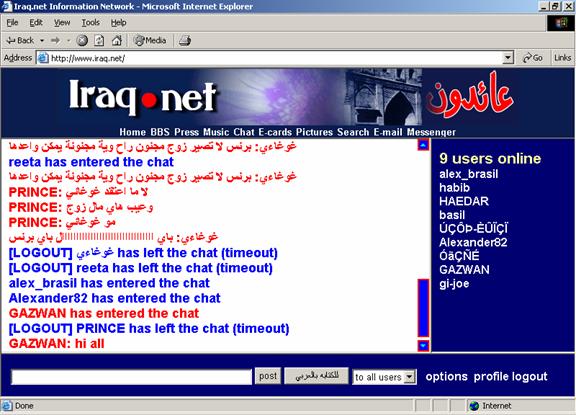
(Iraq-Net chatroom on the day the
The formatting of chat entries is
immediately recognizable, even when in Arabic script, as is the convention of
name-tagging – right-to-left, even in a left-to-right texting language such as
Arabic. The list of users on-line to the right indicates the fusion of cultural
representations available: Anglo or Arabic names in Roman script (<basil>
or <Haedar>); Arabic coded into Roman script with accent markers – not
reproducible in the Word Processing package I am using for this discussion: see
tags 5 and 7 in the list. At the same time, within these selections,
participants are able to code their tags for effect – not only in the overt
Even where chat participants enter from
different language and cultural contexts, IRC conventions are observable.
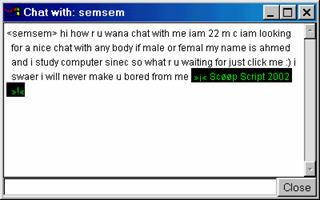
Lebanon-based chatroom
On this
Lebanon-based chatroom, which has an instant translator, the speaker is not
demonstrating good command of English. But common abbreviations are used that
would be found in any English-speaking chatroom, such as <how r u> - and
the emoticon < :) > is used in standard form. Even in the dual-language
situation, where threads cross in scripts as well as in topics, chatters build
response relations in familiar ways:
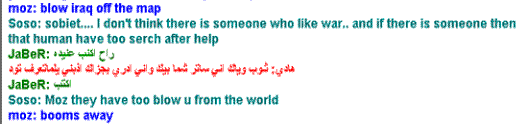
Soso’s careful attempt to suggest that
Moz “serch after help” for his violence finally devolves into reciprocal
personal abuse: “they have to blow u from the world”.
This study has shown is that on-line chat
communities do take on social agendas as much as they would in person-to-person
meetings. Communities of practice can be communities marked by acceptable and
non-acceptable behaviours registered at the level of the doubled speech of
chat, with its semiotic loadings of meaning and familiarity. In Case Study One
it was apparent that there was an ease among the speakers in discussing Mexican
roofers in the midst of a discussion of a national emergency. In Case Study
Seven the baseball chatroom has a community of practice where the participants
are comfortable with their specialised sports talk. Here the participants have
not developed an in-depth discussion or a site-specific set of codes - but
there are the same practices of greetings, abbreviations and quickly
accelerating shifts from mitigation to abuse, as seen across all case studies. Topic and situation it seems, do not prevail
against the standard features of on-line chat behaviour.
5.3 Research Questions and answers
My approach to examining on-line chatrooms
began with the posing of the following five questions[196] as a starting point toward analysing
a culture of electronic-talk:
Question
1. How is turn-taking negotiated within chatrooms?
There is no set protocol or netiquette regime
outlining turn-taking negotiations on-line.
“Rules” of engagement common to interaction in off-line conversation are
deployed in chat sessions – but there are both obstacles and creative
variations to this. Chat itself has taken steps to regulate behaviours. The
list[197] below
appears on many chatroom sites, with suggestions on how to use chatrooms
effectively.
·
Latecomers to the session should scan the
previous 10 -20 posts to get oriented before submitting a post.
·
Upon entering the chat session, greet everyone
and announce yourself.
·
If you do not wish to contribute to the
discussion, you should still make your presence known by announcing that you
are lurking. This is considered polite, especially if you join in the
discussion later.
·
Wait for others to respond to your initial post
before joining the discussion.
·
Address individual people you are responding to
by name so they know you are talking to them.
·
Do not post more than three sentences at a time.
·
Allow a few moments for others to read and
respond to your message before posting again. This turn-taking strategy will
allow the dialog to flow between you and the others and avoid crossed messages.
·
Break lengthy messages into short segments, each
ending with “More…” then continue the message in the next post.
·
Be as clear and concise as possible - if you
think you have been misinterpreted, reword your message and post it again.
·
Ask for clarification if you do not understand
something posted by someone else.
·
Capitalize words only to highlight an important
point, otherwise it is considered SHOUTING and is rude.
·
When you are ready to leave the chat session,
announce that you are leaving but stay long enough to respond to final messages
directed to you.
·
Say good-bye when you are ready to log off. Your
last message should end with an indicator such as “LP” (last post).
In seven case studies, looking at hundreds of
turn-taking events, I have found that turn-taking is negotiated in only one
standard way: that is, the response is
entered into the chatroom by pressing the enter button. This is true in all
unmoderated chatrooms, where there is no control over the text one puts
in. Content, format and style are all
“controlled” only to the extent of exerting the power of conventional practice
over individual chat participants. Although such conventions have proven
capable of exerting considerable power, in a range of ways, the relative
indeterminacies in the conversational flows, which arise from the
technologisation of on-line talk, leave many problems within chat. For example in
the chunk of chat below within four seconds four turns were taken[198]. Although they were all on the same topic none
were answered. Given that they arrived in a timeframe of less than five
seconds, and the normal response-reply-posting time appears to be closer to
twice that, these entries only appear as consecutive because of the software.
There is no conversational control operating: no turn-taking relation, in CA
terms – and no clear emergence yet of a discursive ordering under way.
|
|
< |
|
|
<1Bone!!>: please, say ricght |
|
|
<MissMaca>: nuke bomb, i don't thinks so! |
|
|
<oscar>: |
My
case studies have shown that as chat continues, given time, there will be both
topic-sensitivity and turn negotiation. For instance, in the case of the group
excluding some players in Case Study Five, when participants in the
astrology-chat group did not respond to <B_witched_2002-guest>, or in
Case Study One when some in the chatroom did not want to continue the
discussion on Mexican Roofers because of the racist flavour of the utterances,
we can observe regulatory impulses finding strategies of control. But in quite
ordinary chat circumstances controls are also observably in play. Only those
chat participants able to “perform” chat almost immediately within the
discursive frames and chat relational forms of the given chatroom – or at least
within commonly established regulatory codes established for IRC as a whole –
can expect to command response and maintain threads. “Turn-taking” thus appears
to be reliant not just on the CMC technology which permits entry by pressing
the enter button, but on uptake: the notice afforded a posting by others – and
that depends on a complex mix of overtly regulated behaviour – for instance,
correct use of greeting rituals – and more subtle and linguistic forms of
meeting the address codes of the group – in terms of both specialist topic
lexis and on-line codes and forms. Only when all of these are evident will
“turns” actually be exchanged, rather than simply offered.
Question
2. With the taking away of many cues to participant identity (gender,
nationality, age etc.) are issues of cultural sensitivity, such as racism, sexism
and political correctness generally, as relevant as in face-to-face talk?
In unmoderated chatrooms (e.g. Case Studies
One, Two, Four, Five and Seven) there seems to be a “free for all” stream of
conversation, where anything anyone wants to say is said with little restraint.
However as has been shown in these case studies, others in the group will
respond to someone who is being “difficult”:
not continuing with the immediate topic or flow of discussion, or
displaying attitudes or behaviours unacceptable to the majority.
Other chatters can and will both criticize
and seek to correct and control a person who is annoying them - but they are
not able to make them leave a chatroom unless they are the systems operator for
the server. People will, however, leave voluntarily because of how others are
reacting. An example of this occurs in
Case Study Five when [OHI] is repeated 37 times in 89 turns by
<B_witched_2002-guest>, and other chatters comment directly on the
unacceptability of this behaviour. The response can also escalate into the
on-line equivalence of physical violence. Borrowing from the action-direction
techniques of MUDs and MOOs on-line chat participants may use verbal formulae
to indicate how they would like errant fellow-chatters to be “punished”.
|
*** proplem_IN_RAK (213.42.1) has been kicked by BoOoOosS! ( bad ) |
In the example below in the unmoderated chat
from the appendix 911 [fRANKIE] comments
directly on another chat participant:
|
<fRANKIE> gina i s a stupid butch (turn 18) |
This is a response to <gina>’s posting
– maybe a reaction to the politics, or perhaps to the “shouted” formatting:
|
<gina> I WANT EVERYONE TO RECOGNIZE US AS A CARING AND
INTELLECTUAL PEOPLE LIKE OUR GREAT
LEADER AHMAD SHAH MASOOD |
Like the Mexican roofers chat thread in Case
Study One, such exchanges appear more common in chat operating during off-line
crises. Ethnographic inquiry could work to establish whether chat participants
enter chat topic spaces deliberately at such moments, seeking to organize their
thinking on events, and so are pre-disposed to argument and even to on-line
“violence”. But at the level of language and text selected for this study, such
moments tell us only that even in unmoderated chat disciplinary action does
occur.
|
<SWMPTHNG> THERE'LL BE PLENTY OF MEXICAN ROOFERS IN |
|
<EMT-Calvin> and those folks will be sent back to |
In a moderated chatroom a person’s statements
are vetted before full-display entry. The moderator acts as a filter, and the
moderator’s “rules” are applied, on behalf of a consensual community standard.
For example, sexual or racial content may be “moderated” out. Moderation also
occurs in these chatrooms as “self” moderation.
Words are entered more carefully in a moderated chatroom, where the
community standard is more carefully crafted into the language, with less
variation demonstrated. There are therefore two types of control operating in
these chatrooms: self-control and control by the moderator. Chatroom control by
community standard is evident in Case Study One. When <SWMPTHNG> says,
Turn 77. < THERE'LL BE PLENTY OF MEXICAN
ROOFERS IN N CAROLINA NEXT WEEK> and begins a thread, this new topic focus
is challenged by <guest-MisterD1>
16 turns later - but it is <Zardiw> in turn 125 who achieves a
powerful censure: <smptthing................go
back to your SWAMP>. It is this posting which brings this line of talk to an
end with <SWMPTHNG> making only one last remark, in turn 130. While it is
difficult to calculate the relation of cause and effect here: turn 130 could have been typed before
<Zardiw> had entered his or her turn and <SWMPTHNG> could have
pressed the enter key without reading <Zardiw>’s comment – but whatever
the case there is no more mention of Mexican Roofers in this segment.
|
78. <SWMPTHNG> THERE'LL
BE PLENTY OF MEXICAN ROOFERS IN |
|
82. <EMT-Calvin> and
those folks will be sent back to |
|
85. <EMT-Calvin> the
locals will be the ones to get jobs |
|
88. <playball14> they
work hard here |
|
89. <SWMPTHNG> WHOSE GONNA SEND THEM -
THEY'LL BE CLIMBING ALL OVER EVERY HOUSE ON THE COAST SE HABLO ESPANOL |
|
91. <guest-MisterD1>
sigh... |
|
96. <EMT-Calvin> folks
need to be careful for con artest after the storm |
|
101. <KBabe1974> i agree
with emt-calvin |
|
102.
<guest-MoreheadCityNC> Fortunately our best friend is a roofer! |
|
103. <playball14>
everybody out for a buck unfortuneately |
|
104. <SWMPTHNG> YOU AINT
TALKING ABOUT MEX ROOFERS ARE YOU? |
|
106. <KikoV> you mean
carpet baggers |
|
114. <SWMPTHNG> i SAW A
BUS LOAD HEADING ACROSS THE |
|
125. <Zardiw> smptthing................go back to your SWAMP |
|
130. <SWMPTHNG> WHAT
AABOUT THE CONTRACTORS WHO HIRE THEM?? THEY OUGHT TO BE TRIED FOR TREASON
DURING A NATIONAL EMERGENCY LIKE THIS |
It seems then that chatters are prepared to
act both inside and outside chat conventions, to discipline chat behaviours.
Question
3. Will chatroom discourse become a universally understood language?
The Word Wide Web provides text-based chat
facilities which permit Internet users to communicate with others in
Other than the technologisation, which
aspects of chat are observable as common across language groups and cultures?
As I have shown in my research, some emoticons are already common to a number of
languages. Here are examples of a Dutch and a German list. In Case Study Three I have shown how emoticons
are used to represent feelings – and to control responses from others. Examples
from Dutch, Spanish and Japanese chatrooms show that emoticons have become a
universally understood language.

Dutch emoticons
|
Die Standard-Emoticons: |
|
|
:-) |
lachendes Gesicht,
“nicht-alles-so-ernst-nehmen” |
|
:-( |
trauriges Gesicht, “find' ich schade!”, unglücklich, ... |
|
;-) |
Augenzwinkern, “War nicht so ernst
gemeint”, ... |
|
:-O |
“Oh!”, Erstaunen, Erschrecken, “Aaa”
beim Zahnarzt... |
German emoticons[201]
|
En attendant je fais du gros boudin |
French chat
|
<ÇÞæáå> ããßä ÈäÊ ãä
ÇáÞØíÝ Êßáãäí ÇÐÇ ããßä ¿¿ (^_^) |
Arab chat see http://www.qatifkids.com/
At this
simplest of levels, IRC has already indicated some elements of global
commonality. What is required to test whether this extends to further chat
elements, is the comparative linguistic examination of chat sites: perhaps of
same-topic sites in different language groups – including the use of
simultaneous translation software. As such work progresses, it may be possible
to see variations in use arising from the cultural embeddedness of CMC, and the
evolution of the sorts of differences known from the global dissemination of
older communications technologies – such as radio or television.
Question
4. How is electronic chat reflective of current social discourses?
This was one of five questions I asked at the
start of this project in early 1998. After five years of research into
text-based Internet chat I suggest that the question should also consider how
electronic communication itself is changing all forms of social discourse. How far and in which ways is all current
social discourse now influenced by electronic chat?
One answer is that electronic chat has in
itself become a dominant form within current social discourse. As people, at
least in Western societies, have access to communicative devices from cell
phones (mobile phones) to computers in all sizes and modes of portability,
discourse modes are taking on many of the features that have been discussed in
this section. As devices become smaller, texted-message formats become shorter
and abbreviations and emoticons are recognised as taking less space. The more people go
on-line the more such texted conversation will need to be understood in the
electronic environment – at least until, or maybe unless, the voice-activation
mode is perfected.
One of the perennial problems with on-line
conversation is with understanding what is being said when the traditional
physical cues are deleted. Can conversation even exist without knowing anything
about the participants or who the audience is? My research says yes! People are fully able to communicate, as long
as there are structures to communicate within: structures which, as this
research shows, themselves define the sorts of cultural context seemingly
“lost” inside CMC sociality. These on-line structures have an increasingly well
defined specialist linguistic base, which “stands in” for our categorisation of
speakers, as demonstrated in the case studies.
It is the shared language and the rules of e-chat that make on-line
communication meaningful.
People are communicating with on-line social
groups as never before, as shown by the number of people on-line worldwide (see
section 1.4 On-line usage) - close to one in six people being
connected.
The growing universality of on-line chat
practice is clear in a comparison made below with chat from Case Study Seven, a
|
Case Study Seven – baseball chatroom |
Chinese chatroom[202] |
|
<NMMprod> if you like the yanks press 3 <dhch96> 1111111111 <smith-eric> 5555555 <CathyTrix-guest> 2I hate the Yankees <Pizza2man> 12456789 |
<wu~yuan~you> ZZZZZZZZZZZZZZZZZZZZZZZZZZ <h-h-h-h-h->o-o-o-o-o-o-o--o-oo-o--o-o-o-o-! <wu~yuan~you>: guy ni bu shi dui bu qi wo. ni dui bu qi ziji hehehe |
In each case however the
conversation is perfectly meaningful, on its own terms: within the conventions
of chat itself.
Question
5. Is meaning communicated within Chatrooms?
I suggest then that each of the case studies
above has shown plentiful evidence that meaning is communicated within
chatrooms – both in terms of conventional conversation, and within the new
techniques established to firstly compensate, and then creatively extend, the
repertoires of on-line texted-talk in its own right. As I have shown throughout
this study, and especially in Case Study Three, emoticons and other on-line
specialist devices and texting practices provide added meaning to what is
“said”. Abbreviated forms add both efficiency, and a mode of witty play, adding
to topic or semantic load, the capacity to enact and read back technical proficiency
at on-line chat: an “on-line credibility” for skilled users, which appears to
be used to assess and rank utterances and threads in the sorts of social ways
found in off-line conversation and communication. In other words “meaning”
on-line is conveyed in different ways, but for the same reasons, as off-line.
Both instrumental and social-relational, it operates both as language and as
discourse: directed to both linguistic systems and social-regulatory systems.
It is, to that extent at least, a fully-fledged communicative apparatus – even
if, as this study shows, it is still very much under development.
5.4 Assumptions
at the beginning
The current study however presents no
overarching hypotheses on the nature of on-line communication, beyond the view
that the texted-talk emerging in Internet chatrooms has so far remained undescribed,
and requires a very broad review of all possible analytical approaches, in
order to isolate which features of existing techniques best address its
particular properties. This study is, to that degree, entirely empirical. It has sought only to capture examples of
on-line chat, examine all of the features which existing linguistic and
discourse analytical methods allow us to detect, and suggest wherever possible
new avenues for inquiry.
I posed five assumptions at the beginning of
this research, based on the reading of the literature on discourse theory and
how it might be applied to examination of text-based chatrooms. On-line
communication, like all new communicative modes, has raised issues not only for
researchers, but for society more broadly; many of them frequently discussed in
the media, as societies and communities react to the new communicative
relations and their influence on communicative conventions and cultural
traditions. Since these have in turn influenced the early academic research into
on-line behaviours, my own research data also needs to be scrutinized to
examine whether evidence has been found to confirm, or allay, some of these
socio-cultural concerns.
Assumption 1. That people create a different
“textual self” for the chatroom environment they are in.
This was my original assumption when I begin
looking at text-based chatrooms in mid-1997, before putting in a proposal to
begin this research. It appeared to be the popular wisdom at the time – only
two years into the “Internet Super-Highway” moment – that on-line chat was
largely about concealment of “true” identity, and even that it was largely a
space of “identity play” at best, and criminal intent at worst.
When I visited a dozen chatrooms I found that
there were indeed quite different “speech” styles being carried on in different
rooms. This would seem reasonable, since in person-to-person off-line (p2p-off)
conversation is also different in different social settings. I therefore
expected to see this on-line. But does this mean that users adapt their
texted-talk repertoires to enter the chat-conventions of each chatroom – and
that, in the absence of the usual off-line physical verification checks on
identity, this actively promotes identity disguise: that simply by changing rooms
and enacting a new discursive technique, chatters can “play” with identity?
Certainly, it remains impossible to tell exactly who is in a given room. If
“judythejedi” or “prettyjenny” say they are female, unless they present the
sorts of talk-texting behaviours which work by Coates and others (1998)
suggests marks hyper-masculinity in communication, we are unlikely to doubt
them. And since on-line communication is so heavily invested in representing
its own special markers of expert talk-texting, we are even less likely to be
easily able to read back markers of other categories contributing to
utterance-form preferences. Without some form of observational ethnography
which can actually contact on-line communicators physically to verify their
identity, it is difficult, and maybe impossible, to amass reliable information
on the issue of on-line identity play. I have asked this question of my
students at the
It is difficult then to know who a chatter
“is”. Some chatters have a link to their “homepage” from their username which
may contain more information about the person - but this information too could
be false. As Daniel Chandler says in his on-line essay, Personal Home Pages and the Construction of Identities on the Web (http://www.aber.ac.uk/~dgc/webident.html):
The created “textual self” is how the author
wishes others to see them. The medium of web pages offers possibilities both
for the ‘presentation’ and shaping of self which are shared either by text on
paper or face-to-face interaction. I suggest that the username or icon depicts
how the chatter wants others to see him or her.
This does of course suggest that the “textual
self” presents itself as less of a constructed “reality” in the more
spontaneous and speedy exchange of on-line presentation. There an identity is
often a fleeting one that is created purely for the chatroom that one is temporarily
in. Even while in a chatroom a user can change names or ikons - but the chatter
retains the same identity in real-life. This new identity can then also assume
a new role and change the type of talk. For example one can change gender, age
or nationality or alter an avatar or icon, perhaps from an animal to an object.
Because the user is logged into the chatroom there may be an indicator in the
chat space which signals that the user has changed: <boomrat> is now
known as <sillycat>. Others in the chatroom have the information that the
chatter is still, in real-life, the same person – and that even on-line, they
have made a visible identity-switch. The
chatter may now switch from being aggressive to being passive, or from loving
to hateful, textually acting out the new username. What remains to be seen is
what impact this public-presentational work – conducted as either concealed or
open disguise - will have on longer term communicative behaviours.
Assumption 2. That conversation within chatrooms will change how we
come to know others.
Traditionally we have
come to know others through meeting them person-to-person. People now meet
through chatrooms as well, work through problems, meet in person, get married,
or else learn about someone’s culture as well as they would if they were
together in person. Within the text-based chat form there appears to be only
mind present, and people are attracted initially to another person or group
based solely on the written text. How far a more embodied presence – the
“hexis” bearing self of Bourdieu’s account of culturally defined social
identity – is also present in on-line texted-talk is only partially analysable
within these texts themselves – and even then it may be a carefully enacted
“disguised” self. How far then are we likely to be under pressure to evolve new
ways of discerning “self” within “text”?
Misunderstandings can easily occur due to the
absence of verbal cues or body language; in addition, such communicative
strategies as sarcasm or irony can be easily misinterpreted. Emoticons, now
acting as “tonal” indicators, if not fully understood can add to confusion –
however, standard emoticons such as a smiley are understand by most who use the
new electronic media for communication.
But even this simplest of all codes has had to undergo confirmation
within widespread usage before it could communicate anything at all. It remains possible to communicate only to
the extent that participants have some common ground for shared beliefs,
recognize reciprocal expectations and accept rules for interaction which serve
as necessary anchors in the development of conversation (Clark and Shaefer,
1989).
Our meeting of others in a social context has
of course already changed because of the various technologies of communication
(Meyrowitz, 1985). The influence of social context on the construction of
identity is beginning to change, especially in younger people, as reference
communities like the family, school or church, which in the past anchored
social contexts in shared sets of rules, gradually lose their appeal and their
power, and as what Castells (1996) calls “legitimizing identity” gives way to
“project identity”. A description of what this world could be is by William
Mitchell in his “City of
… a worldwide, electronically mediated
environment in which networks are everywhere, and most of the artefacts that
function with it (at every scale, from nano to global) have intelligence and
telecommunications capabilities. Commercial, entertainment, educational, and
health care organization will use these new delivery systems as virtual places
to cooperate, and compete on a global scale (pp. 167-168).
If this becomes the new reality: Castells’
“real virtuality”, where CMC communication becomes the new reality and the
primary source of interpersonal communication, then the sorts of communicative
strategies we have seen already developing on-line are likely to become
intensified, subtler, more complex, and far more widespread.
Assumption 3. That observational study of chatroom conversation can
capture some of the adaptations of conversational behaviours.
Community for persons living in a
technological environment, using textual chat forms as a major or even primary
communicative means, is shifting from culture-defining mass media to a
proliferation of interactive media as sources of mediated experience. This
shift into person-computer interaction is beginning to orient chat users to
forms of interaction based on new psycho-social and conversational models, but
at the same time it has introduced new types of interactional structuration,
which both build on and differ from traditional psychosocial descriptions of
interaction. Even in telephonic communication, which predates digital computer
technology, there can be no doubt that interlocutors do interact, even though
they cannot see each other. CA analysis shows clearly that regulatory systems
developed in and for natural off-line conversation are being adapted to on-line
texted-talk – but that variations have been forced by the technologisation of
CMC, and have in turn provided outlets for new and creative use of these
adapted conventions. By adapting some
of the elements of linguistic and socio linguistic analysis not conventionally
used in CA, it is already possible to detect and describe some of these new
techniques. Further studies – including ethnographic studies of chat users in
action – will help to establish how chat participants themselves react to and
create their talk-texts, so that methodologies such as CA can perhaps be
formally extended into electronic forms.
Assumption 4. That this work gives us a better understanding of how,
and why, chatrooms are an important area in which to create a new
conversational research theory.
The purpose of this study has been to
establish at least some of the means by which to construct a theory of on-line
communication. I chose chatrooms over other forms of electronic discourse
firstly because of their widespread usage and the amount of data that is
collectable. Unlike e-mail that is private, chatrooms are a public, viewable
platform in which to do work. Even as electronic chat moves from desktop
computers to Palm computers and cell phones (mobile phones) with Short Message
Service (SMS)[204]
text, the origins of these textual communication forms will remain the
chatrooms of IRC systems. Instant Messaging emoticons
and abbreviations are already clearly the same as those used in chatrooms on
computers – and there is evidence from media reporting that these texted-talk forms
are already appearing in other communicative forms – such as children’s school
essay writing, and advertising texts. Both the degree of expertise in on-line
communicative forms illustrated by this study and others, and the suggestion
that these specialist skills appear to be expanding and constituting new
relational forms and expressive techniques, suggests that IRC is not a devalued
and disempowered form of talk, but something asserting its own cultural space
and powers. To understand better what this new form is, and how it works, is
not only to prevent ourselves from being overly critical of it, or regarding it
as some deficit form, but to permit expert intervention at the point of future
IRC or related CMC design. By knowing how users operate in electronic talk
spaces, we can improve the technologisation as a communicative mechanism of
enablement, rather than as an engineering-centred system. At the same time, by
discovering, as this study has begin to do, the different range of uses and
styles in IRC, we can select and allocate systems more carefully and more
consciously. The kinds of institutionally appropriate communicative services
often projected within both technophile literature and Government policy may
then become possible.
Assumption
5. That “chat” does not differ from natural conversation.
My findings are that chatroom conversation is
strikingly similar to “natural language” in many ways, but unlike my original
assumption, there are clearly “conditions” for such similarities.
1. In natural language or face-to-face
conversation there is an exchange of meaning. In chatrooms meaning is similarly
exchanged, via turn-takings of written text. As I have shown in this study,
chatters will for instance ask to be re-informed on a topic if they are unsure
of what a prior participant is saying, and a chatter will “re-pair” their
utterance to make it clear if someone questions what he or she has said, or if
a set of turns creates accidental effects.
|
Case Study Four |
|
57) <IroquoisPrncess> hey Judy did a get my car inthe link
thingy |
|
63) <judythejedi> car in the link? |
|
66)<IroquoisPrncess>card |
In such ways continuity is established with
natural conversational techniques – despite the intervention of other “turns”,
caused by the technologisation of chat, which does not separate responding
threads. Chat, in relation to the basic CA technique of turn-taking, is both
like and unlike natural conversation – and this discovery holds up across all
of its other features.
2. Chatters in a chatroom will ask for clarification
of an utterance, as in face-to-face chat.
|
Case Study One |
|
105) <SWMPTHNG> YOU
AINT TALKING ABOUT MEX ROOFERS ARE YOU? |
This both continues a conversation, and opens
it to a new thread – thus operating as precisely the sort of consensual
strategy central to developing natural conversation, within a context of
anticipated and “tested” social or cultural consensus. Here the chat
participant believes he or she sees a commonly held attitude, and pushes deeper
into the topic, to launch their own views. The fact that they ultimately prove
wrong in this belief in no way weakens the attempted community formation in
this chat – instead, strengthening it, if in a negative way, as this
participant is openly reprimanded by others.
3. Chatters that are of the same community
can easily converse in a similar “culture-bound” text base, which is similar to
a group’s “anti-language” or slang[205].
|
98. |
<NMMprod> |
if you like the yanks press 3 |
|
99. |
<dhch96> |
1111111111 |
|
100. |
<BLUERHINO11> |
got it |
|
101. |
<dhch96> |
1111111 |
|
102. |
<smith-eric> |
5555555 |
|
103. |
<dhch96> |
11111111 |
|
104. |
<dhch96> |
111111 |
|
105. |
<CathyTrix-guest> |
2I hate the Yankees |
|
106. |
<smith-eric> |
don't have a 3 |
|
107. |
<Pizza2man> |
12456789 |
|
108. |
<CathyTrix-guest> |
2blech |
4. Turn-taking can take place as it would in
a face-to-face conversation, however, it is easier to maintain in an Instant
Messenger service chatroom than in a multivoiced chatroom, where turn-taking
can make conversational exchange seem more like a random event.
As one of the latest interaction
communication forms through which to exchange meaning, chatroom “talk”, despite
being regulated by techniques still in
development, is beginning to be uniform.
Behaviours expected of chat participants are becoming clearer and more
defined. As has been discussed in the
individual case studies, different chat environments may well have different
rules of “talk”. And just as every
social grouping has rules of conversational engagement, on-line “talk” has to
have some order, sometimes exacting it more strictly than at other times, for
discourse to continue. Examples of rules that would be considered standard
protocol can be found on the Xena chat site (on the CD at xena.doc) as well as
on many other sites which discuss Netiquette (a comprehensive one is at:
http://www.fau.edu/netiquette/net/netiquette.html).
But beyond these protocols, chat participants can be seen to be demanding and
commanding, consciously or otherwise, many subtle variations to off-line
communicative practices. This study has shown how some of these might be
captured and examined, but also how creative on-line chat users already are in
achieving these variations.
5.5 Summary
After analysis of seven different locations
for and modes of Internet chat, this study can be used to suggest that in the
chatrooms captured and analysed for the period 1995 to 2001 there is evidence
for a new genre of writing, or “talk-texting”. While awaiting (and perhaps
assisting in) the evolution of new methods of analysis for this hybrid
communicative form and technologically transitional format, this study has
tested a broad range of existing text and speech based analytical techniques,
to uncover what we can know of how Internet chat forms currently operate. This
genre – or set of genres - must then be regarded as historical and time bound,
because the technology of delivery is in itself already changing; for example
to include images and sound, so that communication within chatrooms is no
longer simply text-based.
Nor is this transience within the format the
sole aspect marking the ephemerality of chat. Chatters themselves know that
their text may be lost forever; and yet ideas, offerings in creative prose,
experiments with personal and social identity, debates and discussions and
inquiries and statements are being written, posted and lost from moment to
moment: communicative effort that in other more conventional writing genres
would be saved, reflectively reassessed and elaborated on. On chatsites text is
speech – with all of the misdirection, rapidity of onward flow, focus on the
inter-relational, and lack of attention to permanence experienced in speech
communities. It is surely significant that at the very moment that this attempt
to capture and catalogue at least some of the behaviours of this communicative
genre was being prepared for the processes of printing and binding, a major
service for the activity of chat was, without warning, curtailed. In September
2003 Microsoft announced the closure of its IRC services.
While IRC services of various types remain
available to users, and it seems likely, given the use of chat in various
functions from education to industrial design and conferencing, that the genres
will in some form prevail, a central moment of chat as a social activity is
passing. This document may then, as it has so often suggested, be already on
its way to being an historical study. It is important therefore to note that,
despite the wide variations in chat purpose and performance found in the seven
case studies used here, chat has in its short life evolved a solid central
repertoire of communicative techniques. Each case study revealed some unique
talk-texting features, but the primary outcome of each of the case studies
proved that there were more common features in chat spaces and styles than
differences.
There is a new genre of “text-based
conversation” text – that found in chatroom postings. The chief characteristics of this genre
include recognising how users create a distinctive, but site and talk-category
regulated, “textual self” for each chatroom environment they enter.
Conversation within chatrooms, without all the cues of previous forms of
conversation, changes how we come to know and interact with others, so that new
cues based on written conversation become as important as the physical ones
which we rely on now. Observational study of chatroom conversation can capture
some of the adaptations of standard conversational behaviours to the demands of
on-line chat. Observation, description and analysis of chat, using existing
analytical methodologies from both text and speech traditions, lets us take a
first step towards recognition and analysis of new, hybrid, communicative
forms. But it is already possible to uncover a consistency and replicability in
findings across chat types and sites, which suggests that chatroom conversation
has certain features which make it different from off-line, person-to-person
conversation, including the following standard features:
That the author or “speaker” role can be
complex, requiring a rapid mixing of the reader and writer roles, as well as
the capacity for multiple simultaneous engagement in a number of conversational
threads – even using multiple log-on identities.
That chatrooms use an on-line-specific
adapted language which incorporates semi-graphic elements such as emoticons, a
specialist “anti-language” of abbreviations, an expressive range of
self-selected “tailored” settings involving font colours and styles, and the deployment
of pre-formed phrases and ikons as representative of the author.
There is, above all else, an intensified
emphasis in chat practice, on the fleeting nature of this texted conversation,
since the Internet is itself an unstable, and even experimental, place. This
set of studies of contemporary on-line chat behaviours has produced above all
else, a foregrounding of the complex, interactive nature of on-line
conversation, demanding upfront attention to inter-relational aspects of the
talk-texting exchange, signalled in the complex braiding structure of the
conversational threads and the inherent discontinuity of talk-exchanges
introduced by the technology of the posting software. It is, in itself, a
braided study, at the level of description, theorisation, case selection,
methodology, and even of presentational design.
And that is, in the final analysis, the
nature of the research object: Internet chat.
5.6 Future Research
Electronic communication is becoming an established form of communication. However, there are many areas within electronic and online communication which remain unexamined, yet which are undeniably generating new forms of communicative behaviour – and which have potential to feed back into further developments of the Computer Mediated Communication technologies and applications available to today’s and perhaps tomorrow’s communicators.
Among these experientially new social forms of communication evident in online chat, are some curiously invisible forms of communicative practice, qualitatively new and outside the scope of even the broad range of communicative methods of data-capture and analysis used in this study. Research into silence in a chatroom, referred to as lurking (see 2.2.1.3 in this thesis) has not been fully explored. In person-to-person communication, silence does have readable meaning. A participant’s silence in “natural” conversation is observable to both other participants and to analysts. It literally “speaks”, as a conscious act of non-participation. In electronic communication without visual cues, we cannot fully know the purpose of a person’s silence – and in the rapid stream of other conversational postings and responses, may not even notice it. What then is the social or relational impact of online silence? And beyond this more “absolute” silence, what of the uses of lag-times in active participation? Is there for instance an acceptable time lag between chats entries? If a participant is a slow typist, or considers a response for a length of time – or conducts multi-stranded exchanges and so is slower to each response, does this alter the communicative relation? How long can a response gap stretch, before it becomes too difficult to re-connect? In Instant Messenger chats there is a notice that appears that reads the “respondent is writing a reply,” but in multivoiced chatrooms it is impossible to know whether a person is slow in responses, otherwise occupied, or is actively “lurking” for a reason.
The impact of participation
in casual electronic chat on privacy is another area of research that is still
under formulation. While this research shows that chat has tendencies towards
the establishment of casual and even intimate social relations, the literature
suggests that many participants consider this non-proximate and non-physical
social relation to be a secure space in which to interact with a broader than
usual range of others, and to test out various ideas, behaviours, and even
personae.. Attitudes to online security have however altered after aspects of
the 9/11 events were connected to the capacities of the Internet to offer ease
of international communication to terrorist groups. Subsequent security
measures taken in the
- Law enforcement monitoring of Internet
discussions in chat rooms and other forums: favored by 55%, down from 63%;
and
- Expanded government monitoring of cell phones
and email, to intercept communications: now favored by only 44% and
opposed by 51%.
Will chatrooms remain an open sphere of communication, or have they lost their “innocence” as a place of play and experimentation?
Research into similarities between chatroom and mobile phone messaging (and image exchange) would seem to be an inviting field of study, with Internet based and phone based codes (especially of abbreviations for instance) appearing to converge. Are they in fact the same? And if differences exist, what might explain them? Study into how mobile phone text-messaging is used to convey meaning in place of a voice message on mobile phones would help to show whether messaging conveyance is as effective with the abbreviations and emoticons used in phone text as speaking. It would also provide some interesting guidance on the possible communicative impact of moving to voice-activation on the Internet – and on some of the ways to interlink aural and text systems. Text-messaging is as short as chatroom text, but is more accessible – a rapid disseminator of the short-form texted message into new communities of users. SMS was launched commercially for the first time in 1995 and by 2002 there were one billion SMS per day exchanged globally (December 2002)[207]. It may prove that my predictions in this study that IRC will be a short-lived technology, may in part be wrong – if SMS and mobile telephony become heir to the form.
|
|
|


Finally, this research raises questions in relation to the “global” or universal use of electronic and online translation software, offering instantaneous contact between speakers of different languages. With electronic chat becoming global, whether online or on a mobile phone, the need to exchange rapid messages across language barriers becomes more pressing. But how accurate are the translation devices that are used for online communication? Online translators are available from services such as
http://www.worldlingo.com who offer “WorldLingo Chat,” giving one the ability to chat
instantly in ten languages; or Alta Vista’s Babel at http://world.altavista.com/ while at http://www.freetranslation.com/ there is Instant Multilingual Messaging for American On Line
Instant Messenger and SMS
Translators that gives translations from one’s mobile phone. But how accurate
are the translated messages? More importantly, how can one use abbreviations in
this environment and still be understood? The examples of the two phones above
are the full sentence translated - but what happens with shortened typical chat
writing? Imagine the message: Will
U wed me @ Gretna tomorrow pls darling? Translated into Dutch on Alta Vista’s
Further research into online discursive
communication will undoubtedly be driven by rapidly changing technologies as it
becomes more intensified, more complex, more globalised, subtler and far more
widespread.
But no matter the design outcomes, or the
decisions taken technologically, or the platforms chosen for communicative
exchange, we can be sure that users themselves, across an ever increasing range
of language forms, will respond to these new “chat” formats in ways just as
lively and variable; just as practically directed to communication, yet
displaying just as much experimentation and pleasure, as the Internet chat
participants captured here.
Bibliography
Abelson, R. (Ed.). (1976). Script processing in
attitude formation and decision making.
Agar, M.
(1983).
Microcomputers as field tools. Computers and the Humanities, 17, 19.
Akrich, M.
(1992).
The De-Scription of Technical Objects. In
Albright, J. (1995). On-line Love: Sex, Gender, and Relationships
in Cyberspace. Retrieved
Allen, D.,
& Guy, R. (1974). Conversation
Analysis: The Sociology of Talk. The
Alvarez-Cáccamo, C. (1990). Rethinking conversational code-switching: codes, speech varieties, and
contextualization. Paper
presented at the Sixteenth Annual Meeting of the Berkeley Linguistics Society,
Berkeley.
Ang,
Anders, P.
(2000) MUDS : Cyberspace Communities.
http://www.mud.co.uk/richard/ec.htm
Last accessed on-line
Appadurai, A. (1996). Modernity at large: cultural dimensions of
modernity.
Appleton, J. (1995).
Analysing qualitative interview data: addressing issues of validity and
reliability. Journal of Advanced Nursing, 22, 997-999.
Archangeli,
D., & Langendoen,
D. (1997). Optimality Theory: An
overview.
Aristotle. (1950).
“Categories” (translator: E.M. Edghill), in W.D. Ross (ed.), The Works of
Aristotle Translated into English, Vol.1, Oxford University Press.
Atkinson, D.,
& Ulevich, J. (2000). Digital Government: The Next Step To Reengineering The Federal Government. Paper presented
at the Progressive Policy Institute, Technology and new Economy Project,
Audi, R. (1998). Epistemology: A Contemporary Introduction to
the Theory of Knowledge.
Auslander, M. (1997,
May 5-6). Customization
Lite. Workshop
on Hot Topics in Operating Systems. Paper presented at the
Proceedings of The Sixth Workshop on Hot Topics in Operating Systems,
Austin, J. (1962). How to do things with words.
Austin, J. (1975). How to Do Things with Words. (2nd ed.).
Ayer, A.
(1968).
The Origin of
Pragmatism.
Bakhtin, M.
(1981).
The Dialogical
Imagination.
Bakhtin, M.
(1994).
The Bakhtin Reader.
Barber, C. (1972). The Story of Language (2nd ed.).
Barnes, D.,
& Todd, F. (1977). Communication
and learning in small groups.
Barr, T.
(2000).
Newmedia.com.au: The Changing Face Of
Barthes, R. (1970). Mythologies.
Barthes, R. (1972). Critical Essays (R. Howard,
Trans.).
Barthes, R. (1975). S/Z (R. Miller, Trans.).
Barthes, R. (1977). The Death of the Author
(S. Heath, Trans.).
Barthes, R. (1978). A Lover's Discourse: Fragments. (R. Howard,
Trans.).
Barthes, R. (1981). Theory of the Text: Untying The Text.
Bauer, L. (1979). Some thoughts on dependency grammar. Linguistics, 17, 301-315.
Baym, N. (1993).
Interpreting Soap Operas and Creating Community: Inside a Computer-Mediated Fan
Culture. Journal of Folklore Research,
30(2/3), 143-177.
Baym, N. (Ed.).
(1998). The Talk of Fandom: The Importance of the
Social Practices of Soap Opera Fans in a Computer-Mediated Discussion Group.
Bays, H.
(2000).
Framing and face in Internet exchanges: A
socio-cognitive approach [PhD. Paper]. Retrieved
Bechar-Israeli, H.
(1998). From <Bonehead> TO <cLoNehEAd>: NICKNAMES, PLAY, AND
IDENTITY ON INTERNET RELAY CHAT <1>. Retrieved
Beck, A.
(1988).
Love is never enough.
Berelson, B. (1952). Content Analysis in
Communication Research. Glencoe: Free Press.
Berge, Z.,
& Collins, M. (Eds.). (1995). Computer-Mediated
Communication and the On-line Classroom (Vol. 1-3).
Berger, A. (1998). Signs in Contemporary Culture An Introduction to Semiotics (2nd ed.).
Berger, C.,
& Bradac, J. (1982). Language and social
knowledge.
Bergvall, Victoria L.,
Janet M. Bing, and Alice F. Freed (eds.) (1996): Rethinking language and
gender research: Theory and practice.
Birkerts, S. (1995). The Gutenberg Elegies: The Fate of
Bizzell, P. (1982).
Cognition, convention and certainty: What we need to know about writing. PRE/TEXT, 3, 113-143.
Blackmer, E.,
& Mitton, J. (1991). Theories of monitoring and the timing of repairs in spontaneous
speech. Cognition, 39, 173-194.
Blake, B. (1990). Relational grammar.
Blommaert, J. (1991).
How much culture is there in intercultural communication? In J. Blommaert & J. Verschueren
(Eds.), The Pragmatics of Intercultural and
International Communication.
Bloom, H.
(2000).
Global Brain.
Blum-Kulka,
S., House, J., & Kasper, G. (1989). Investigating
cross-cultural pragmatics: An introductory overview. In S. Blum-Kulka & J. House & G. Kasper (Eds.), Cross-cultural Pragmatics: Requests and
Apologies (pp. 1-36).
Blumer,
H. (1969). Symbolic Interactionism: Perspective and Method.
Boden, D. (1994). The Business of Talk: Organizations in Action.
Bolter, D.,
& Grusin, R. (2000). Remediation -- Understanding
New Media.
Bolter, J.
(1991).
Writing Space: The
Computer, Hypertext, and the History of Writing.
Bolter, J.
(1991).
The Computer, Hypertext
and the History of Writing.
Boudourides, M. (1995,
October 12-13). Social
and Psychological Effects in Computer-Mediated Communication. Paper
presented at the TEI of Neties '95,
Bourdieu, P. (1989). From the sociology of academics to the sociology of the
sociological eye. Social Theory,
7(1), 32-55.
Bourdieu, P. (1989). Social space and symbolic power. Sociological Theory, 7(1),
14-25.
Bowers, J.,
& Churcher, J. (1988). Local and Global Structuring of Computer
Mediated Communication: Developing Linguistic Perspectives on CSCW in COSMOS.
Computer-Supported Cooperative Work ( CSCW).
Bradley, N. (1999). Sampling for Internet Surveys. An
examination of respondent selection for Internet research.
Bresnan, J. (2001). Lexical-Functional Syntax.
Brody, F.
(1999).
The Medium is the Memory. In P. Lunenfeld (Ed.), The Digital Dialectic: New Essays on New
Media.
Bromberg, H. (1996). Are
MUDs communities? Identity, belonging and consciousness in virtual worlds. In
Shields, R. (Ed.), Cultures of Internet: Virtual Spaces, Real Histories,
Living Bodies, 143-152.
Brown, M. (1994). Soap Opera and Women's Talk.
Bruckman, A. (1992). Identity Workshops: Emergent Social and
Psychological Phenomena in Text-Based Virtual Reality. Retrieved
Bruner, J. (1956). A Study of Thinking.
Bruti, S.
(1999).
Approaching Writing Skills through Fairy Tales. The Internet TESL Journal, V(11).
Buckingham,
D. (1987). Public Secrets: EastEnders and its Audience.
http://www.aber.ac.uk/media/Modules/TF33120/bucking1.html
Calvert, S. (2002). The Social Impact of Virtual
Reality Environments.
Camballo, D.,
& Joseph, L. (1998). The IRC Prelude. Retrieved
Carey, J. (1985). Communication as Culture: Essays on Media
and Society.
Cassell, J.,
& Vilhjlmsson, H. (1999). Fully embodied conversational avatars: Making communicative behaviors autonomous. Autonomous Agents and Multi-Agent Systems(2), 45-64.
Castells, M.
(1996).
The Rise of the Network
Society.
Castells, M.
(1997).
The Information Age: Economy, Society and Culture (Vol. 2).
Blackwell:
Castells, M.
(2000).
The Rise of the Network
Society.
Cavanagh, S.
(1997).
Content analysis: concepts, methods and applications. Nurse Researcher, 4(3), 5-16.
Cherny, L. (1994). Gender Differences in Text-Based Virtual Reality.
Paper presented at the Proceedings of the Berkeley Conference on Women and Languag, Berkeley.
Cherny, L. (1995). The
MUD register: conversational modes of action in a text-based virtual reality.
Chierchia, G. (1995). Dynamics
of Meaning: Anaphora, Presupposition and Syntactic Theory.
Chierchia, G., &
McConnell-Ginet, S. (1990). Meaning and Grammar:
An Introduction to Semantics.
Childress,
C., & Asamen, J. (1998). The Emerging
Relationship of Psychology and the Internet: Proposed Guidelines for Conducting
Research. Ethics and Behavior, 8(1), 19-35.
Chomsky, N. (1957). Syntactic Structures.
Chomsky, N. (1972). Language and Mind.
Chomsky, N. (1980). Rules
and representations: behavioral and brain sciences.
Chomsky, N. (2000). Language
and Mind: Current Thoughts on Ancient Problems (Part 1). Retrieved
Chomsky, N. (2001). Censored
2001: 25 Years of Censored News and the Top Censored Stories of the Year.
Churchill, E., & Bly, S. (1999). Virtual Environments at Work: ongoing
use of MUDs in the Workplace. Paper presented at
the WACC'99,
Churchill, E., & Bly, S. (2000). Culture Vultures: Considering Culture
and Communication in Virtual Environments [Internet]. Retrieved
Cicognani, A. (1996,
Cicognani, A. (1997). On
the linguistic nature of Cyberspace and Virtual Communities [Special
Journal Issue]. Retrieved
Cicognani, A. (1998). A Linguistic Characterisation of Design in Text-Based Virtual
Worlds.
Cicognani, A. (2000).
Language and Design in Text-Based Virtual Worlds. Journal of Network and
Computer Applications (23),
1-28.
Clark, H. (1973). The
language-as-fixed-effect fallacy: a critique of languagestatistics
in psychological research. Journal of Verbal Learning and Verbal Behaviour,
12, 335-359.
Clark, H., & Shaefer, E. (1989). Contributing to discourse. Cognitive Science, 13, 259-294.
Coates, J. (Ed.).
(1998). Language and Gender: A Reader.
Coates, J. (1998).
Gossip revisited: language in all-female groups. In J. Coates (Ed.), Language
and Gender: A Reader (pp. 226-253).
Cobb, N. (1996, Tuesday
13 August). Welcome to the Girl Wide Web. The
Collins, M.,
& Murphy, K. (1999). Communication Conventions
in Instructional Electronic Chats [Internet]. First
Monday. Retrieved 8.30.1999, from the World Wide Web: http://www.firstmonday.dk/issues/issue2_11/murphy.html
Comber, B., Kamler,
B., & Cook, J. (1998). Introduction: Critical Discourse Analysis, or
Life After the Linguistic Turn Discourse. Discourse,
18, 325-327.
Comte, A. (2002). Use of Feminist Literary Theory in Developing a Critical Language
for Hypertext. The Journal of the Australian
Association of Writing Programs, 6(1).
Cruttenden, A. (1986). Intonation.
Crystal, D. (1985). A dictionary of linguistics and phonetics.
Crystal, D. (1987).
Crystal, D. (Ed.).
(1992). The
Crystal, D. (2001). Language and the Internet.
Cyberrdewd. (1999). IRC on AusNet - an example of a virtual community [Internet]. Retrieved
http://members.aol.com/Cybersoc/is2cyberdude.html
Danet, B. (1998). Text as Mask: Gender, Play, and Performance on the Internet in
Steve. In S. G. Jones (Ed.), Cybersociety 2.0.
Revisiting Computer-Mediated Communication and Community.
Danks,
J., & End, L. (1985). Processing strategies for
reading and listening. Retrieved
http://homepage.tinet.ie/~ciaranmac19/reading.htm
Davies, S.
(2001). Semiotic Analysis of Teenage Magazine Front
Covers. Retrieved
http://www.aber.ac.uk/media/Students/sid9901.html
de Saussure, F. (1916). Course in General
Linguistics (W. Baskin, Trans.).
December, J. (1993,
July, 8). Characteristics of Oral Culture in Discourse on
the Net. Paper presented at the Twelfth annual Penn State
Conference on Rhetoric and Composition, University, Park,
Denzin, N. (1999). Cybertalk and the Method of Instances. In S. Jones (Ed.), Doing
Internet Research: Critical Issues and Methods for Examining the Net.
Desser,
D. (2000). Gender
Morphing in Cyberspace.
http://www.press.umich.edu/jep/06-01/desser.html
Dewey, J. (1966). Democracy and Education.
Dillon, A.,
& Gushrowski, A. (2000). Genre and
the Web: Is the personal home page the first uniquely digital genre. Journal
of The American Society for Information Science, 51(2),
202-205.
Dingley,
K. (2001). Using Conversational Analysis to
ascertain whether commercially available synchronous messengers can support
real world ad hoc interactions.
http://www.scs.carleton.ca/~liscano/AdhocCCUCEFinalPapers/Dingley.pdf
Donath, J. (1998,
21 February). Identity and Deception in the Virtual
Community. Retrieved, 2000, from the World Wide Web:
http://smg.media.mit.edu/people/Judith/Identity/IdentityDeception.html
Donath, J. (1999). Identity and deception in the virtual community. In P. Kollock & M. Smith (Eds.), Communities in Cyberspace
(pp. 29-59).
Döring, N. (2002).
Personal home pages on the Web: A review of research. Retrieved
http://www.ascusc.org/jcmc/vol7/issue3/doering.html
Dryer, M. S.
(Ed.).
(1995). Frequency and Pragmatically Unmarked Word Order.
Eagleton, T.
(1983).
Literary theory: an introduction.
Eckert, P., &
McConnell-Ginet, S. (1995). Constructing meaning,
constructing selves: Snapshots of language, gender and class from Belten High. In B. Mary & H. Kira
(Eds.), Gender Articulated: Language and the Culturally Constructed Self (pp.
469-507).
Eco, U. (1979). The Role of the Reader.
Eco, U. (1986). Travels in Hyperreality (W. Weaver, Trans.).
Eco, U. (1995). The
Search for The Perfect Language (J. Fentress, Trans.).
Edwards, B. (1979). The Tagmemic Contribution to Composition Teaching. Occasional Papers in Composition Theory and History, No. 2.
Edwards, J. (1985). Language, society and identity.
Eggins, S., &
Slade, D. (1997). Analysing Casual Conversation.
Eisenstein, E. (1993). The printing revolution in early modern Europe. Cambridg:
Emerson, C. (1981).
Discourse in the Novel (M. Holquist, Trans.). The dialogic Imagination (pp. 239-422).
Ess, C.
(Ed.).
(1996). Philosophical Perspectives on Computer-Mediated
Communication.
Fairclough, N. (1982).
Review of Bolinger, Language - the loaded weapon. Language
in Society, 11, 110-120.
Fairclough, N. (1989). Language and power.
Fairclough, N. (1992). Discourse and social change.
Fairclough, N. (1995). Critical
Discourse Analysis: The Critical Study of Language.
Featherstone,
M. (1996). Cyberspace/Cyberbodies/Cyberpunk:
Cultures of Technological Embodiment (Theory, Culture & Society).
Fillmore, C. (1976). Topics in lexical semantics. Current
issues in linguistic theory. In Roger W. Cole, (ed.) Current Issues
in Linguistic Theory.
Firbas, J. (1992). Functional Sentence Perspective in Written and Spoken
Communication.
Firth, J. (1957). Papers in Linguistics 1934-1951.
Firth, John Rupert. (1964). The Tongue of Men and Speech. (With
Editor's Preface by Peter Strevens)
Fish, S. (1980). Is
There a Text in This Class? The Authority of Interpretive
Communities.
Fish, S. (1990). Doing
What Comes Naturally: Change, Rhetoric and the Practice of Theory in Literary
and Legal Studies.
Fishman, P. (1978).
Interaction: The work women do. In B. Thorne & C. Kramara
& N. Henly (Eds.), Language, Gender and Society
(Vol. 25, pp. 89-101).
Fishman, P. (1980). Conversational insecurity. In H. Giles & W. Robinson
& P. Smith (Eds.), Language: Social psychological perspectives (pp.
127-132).
Fiumara, G. (1995). The Other Side of Language: A Philosophy of
Listening.
Fiumara, G. (1995). Metaphoric Process: Connections between
Language and Life.
Foucault, M.
(1969).
What is an Author? In R. C. Davis & R. Schleifer
(Eds.), Contemporary Literary Criticism (pp. 262-275).
Foucault, M.
(1994).
The Order of Things: An Archaeology of the Human Sciences.
Fouser, R. (2001). Culture, Computer Literacy, and the Meida in Creating Public Attitudes toward CMC in
Frankel, M.,
& Siang, S. (1999). Ethical
and Legal Aspects of Human Subjects Research in Cyberspace (A Report of A
Workshop. June 10-11): American Association for the Advancement of Science.
Fraser, N. (1994). Dependency grammar. In R. Asher (Ed.), Encyclopedia of Language and
Linguistics (pp. 860-864).
Freeze, J.
(1998).
Introducing WebTV.
Frick, T.
(1991).
Restructuring education through technology.
Fromkin, V.,
& Rodman, R. (1998). An Introduction to Language (6 ed.).
Gadamer, H. (2000). The Beginning of Philosophy (R. Coltman, Trans.).
Galegher, J.,
& Kraut, R. (1994). Computer-mediated communication for
intellectual teamwork: An experiment in group writing. Information Systems
Research, 5(2), 110-138.
Gallagher, D. (2002,
Sunday, November 10). Mr. Qaddafi, You've Got Mail: Hope 2cu Soon Again in the
Desert. The New York Times, pp. 7.
Garcia, A.,
& Jacobs, J. (1999). The Eyes of the Beholder: Understanding the
Turn-Taking System in Quasi-Synchronous Computer-Mediated Communication.
Research-on-Language-and-Social-Interaction(32), 337-367.
Garfinkel, H., Lynch,
M., & Livingston, E. (1972). Common Sense Knowledge of Social Structures:
The Documentary Method of Interpretation. In J. Manis
& B. Meltzer (Eds.), Symbolic Interaction: A Reader in Social Psychology
(2nd ed.).
Gass, S., & Neu, J. (Eds.). (1995).
Speech Acts across Cultures. Challenges to Communication in a Second Language.
Gates, R.,
& McDaniel, C. (1999). Contemporary Marketing Research
(4th ed.).
Gazdar, G.,
Klein, E., Pullum, G., &
Sag,
Giddens, A. (1991). Modernity and self-identity.
Giddens, A. (2000). Runaway World. How Globalization is Reshaping Our
Lives.
Giese, M.
(1998).
Constructing a Virtual Geography: Narratives of Space in a
Text-Based Environment. Journal of Communication Inquiry, 22(2),
152-176.
Giese, M.
(1998).
Self Without Body: Textual Self-Representation in an
Electronic Community. First Monday, 4(3).
Gilbert, P. (2000). On Space, Sex and Stalkers. Retrieved
Giles, D. (2000). Illusions
of Immortality: A Psychology of Fame and Celebrity.
Giles, H., &.
Powesland, P. (1975). Speech
style and social evaluation.
Giles, H.,
& Clair, R. (1979). Language and Social
Psychology.
Giles, H., Clair, R.,
& Klaus, S. (1979). Social Markers in Speech.
Giordano, R.
(2000). The Genre of Electronic Communication: A Virtual Barbecue Revisited
http://www.nyu.edu/its/humanities/ach_allc2001/papers/giordano/
Goffman, E. (1959). The Presentation of Self in Everyday Life.
Goffman, E. (1971). The Presentation of Self in Everyday Life.
Goffman, E. (1972). Relations in Public.
Goffman, E. (1974). Frame
analysis.
Goffman, E. (1981). Forms of Talk.
Goldberg, A. (1995). Constructions:
A Construction Grammar Approach to Argument Structure.
Goodwin, C. (1981). Conversational
organization: Interaction between speaker and hearer.
Grabe, W.
(1992).
What every ESL teacher should know about reading in English. In R. Rodriguez
& R. Ortega & F. Macarthur (Eds.), New
directions in foreign language teaching theory and practice.
Grandin, T.
(1999).
Social Problems: Understanding Emotions and Developing Talents.
Greimas, Algirdas Julien.
The Social Sciences: A Semiotic View. Trans. Paul Perron and Frank
Collins.
Gruber, H. (1996). Aspects of power and communication in scholarly e-mail
discussion lists. Excluding practices and
peer-group formation. Paper presented at
the 1st Knowledge and Discourse Conference,
Grusin, B. (2000). Remediation -- Understanding New Media.
Guba, E.,
& Lincoln, Y. (1989). Fourth generation
evaluation.
Guba, E.,
& Lincoln, Y. (1994). Competing paradigms in
qualitative research. In N. Denzin &
Gudykunst,
W., & Kim, Y. (1997). Communicating With Strangers: An Approach To
Intercultural Communication.
Gudykunst, W. B. (2001).
Asian American ethnicity and
communication.
Gumperz, J. (1982). Discourse
Strategies.
Guy, R. (1974). Conversation
Analysis: The Sociology of Talk.
Habermas, Jürgen (1992b)
“On Morality, Law, Civil Disobedience and Modernity”, in P. Dews (ed.) Autonomy
and Solidarity: Interviews with Jürgen Habermas, revised edn.
Halliday, M.
(1978).
Language as Social Semiotic.
Halliday, M. (1985a).
Systemic background. In J. Benson
& W. Greaves (Eds.), Systemic Perspectives on Discourse (Vol. 1, pp.
1 -15).
Halliday, M.
(1994).
An Introduction to Functional Grammar (2nd ed.).
Hamman, R. (1996). Cyborgasms: Cybersex
among Multiple-Selves and Cyborgs in the
narrow-Bandwidth space of
Hamman, R. (1998). One
Hour in the eWorld Hot Tub: a brief ethnographic
project in cyberspace. Retrieved
Hamman, R. (1998). Rhizome@Internet using the Internet as an example of Deleuze and Guattari's “Rhizome” [Internet].
Retrieved
Hamman, R. (1998). The
Role of Fantasy in the Construction of the On-line Other: a selection of interviews
and participant observations from cyberspace. Retrieved
Hamman, R. (1999). Computer
Networks Linking Network Communities: A study of the Effects of Computer
Networks Use upon Pre-existing Communities. Retrieved
Hammersley,
M., & Atkinson, P. (1995). Ethnography: Principles in Practice
(2nd ed.).
Harasim, L., Hiltz, S., Teles, L., & Turoff, M. (1995). Learning Networks:
A Field Guide to Teaching and Learning On-line.
Harnad, S.
(1991).
Post-Gutenberg Galaxy: The Fourth Revolution in the Means of Production of
Knowledge. Public-Access Computer Systems Review, 2(1), 39 - 53.
Harnad, S.
(2001).
Back to the Oral Tradition: Comments on Roger Chartier's
Paper: “Readers and
Harrison, T.,
& Stephen, T. (1995). The electronic journal as the
heart of an on-line disciplinary community. Library Trends(43), 592-608.
Harvey, B. (1998). Computer
Hacking and Ethics [Internet]. Retrieved
Hawisher, G., &
Moran, C. “Electronic Mail and the Writing Instructor.” College English 55.6
(1993): 627-643.
Hayles, K. (1999). How
We Became Posthuman: Virtual Bodies in Cybernetics,
Literature, and Informatics.
Hebdige, D. (1999). The Function of subculture. In S.
During (Ed.). The Cultural Studies Reader
(Vol. 2nd, pp. 441-450).
Hegel, G.W.F. (1961). The
Phenomenology of Mind. (trans.J.B. Baillie). Allen & Unwin.
Henderson, G., &
Brown, C. (1997, March 31). Glossary of Literary Theory.
Heritage, J., Atkinson, J. (1984) “Introduction”. In: J.M. Atkinson,
J. Heritage, eds. Structures of Social Action: Studies in Conversation
Analysis.
Herring, S. (1994). Gender
Differences in Computer-Mediated Communication: Bringing Familiar Baggage to
the New Frontier. Retrieved
Herring, S. (2002).
Computer-mediated Discourse. In D. Schiffrin & D.
Tannen & H. Hamilton (Eds.), The
Handbook of Discourse Analysis.
Hiltz, S.,
& Turoff, M. (1978). The
Networked Nation: human communication via computer.
Høivik, H. (1995). The
Digital Field: Library models and professional roles. Department
of Journalism, Library and
http://home.hio.no/~helge/fag/notater/notat4/analysis/paper.htm
Holmes, Janet. 2000.
(ed.) Gendered speech in social context: Perspectives from gown and town.
Holquist, M.
(1986).
Introduction. Speech
Genres and Other Late Essays by M. M. Bakhti.
Holquist, M.
(1990).
Dialogism: Bakhtin and his world.
Holtzman, S.
(1995).
Digital Mantras: The Languages of Abstract and Virtual Worlds.
Hopper, R. (1991). Hold
the phone.
Horvath, B., & Eggins, S. (1995). Opinion texts in
conversation. In P. Fries & M. Gregory (Eds.), Discovery in Society:
Systemic Functional Perspectives (Vol. 1, pp. 29-46). Ablex:
Howell-Richardson,
C., & Mellar, H. (1996). A
Methodology for the Analysis of Patterns of Participation within Computer
Mediated Communication Courses. The Internet TESL Journal.
Retrieved
Hu, W.
(1996).
“Inverted” Sentences, Pragmatics, and the Emergent Grammar.
[Ph.D
dissertation]. Retrieved
Hudson, D. (1995). Word Meaning. Retrieved
Huttar, G. (1996).
Review of the grammar of space, by Svorou, Soteria. Notes on Linguistics(74), 34-36.
Hymes, D. (1974).
Ways of speaking. In R. Bauman & J. Sherzer (Eds.), Explorations in the
ethnography of speaking.
Ihde, D. (1973). Postphenomenology: Essays in the Postmodern Context.
Ihde, D. (1991). Instrumental
Realism: The Interface between Philosophy of Science and Philosophy of
Technology.
Iser, W.
(1974).
The Implied Reader: Patterns of Communication in Prose Fiction from Bunyan
to Beckett.
Iser, W.
(1978).
The Act of
Iser, W.
(1989).
Prospecting: From Reader Response to Literary Anthropology (Vol. ix).
Iser, W.
(2000).
The
Jakobson, R. (1960). Concluding statement: Linguistics and poetics. In T. Sebeok
(Ed.), Style in language (pp. 350-377).
Jakobson, R. (1980). Framework
of Language.
James, W.
(1907).
Pragmatism.
Jardine, L. (1996). Worldly
Goods: A New History of the Renaissance.
Jasper, M.
(1994).
Issues in phenomenology for researchers of nursing. Journal of Advanced Nursing,
19, 309 314.
Jefferson, G. (1972).
Side sequences. In D. Sudnow (Ed.), Studies in social interaction (pp. 294-338).
Jenkins, H. (1992). Textual
Poachers: Television Fans & Participatory Culture.
Jenlink, P.,
& Carr, A. (1996). Conversation as a medium
for change in education. Educational
Technology. Retrieved
Jones, S. (Ed.). (1995).
CyberSociety: Computer-mediated
communication and community.
Jones, S. (1997). The Internet and its Social Landscape. In S. Jones (Ed.), Virtual
Culture: Identity and Communication in Cyberspace.
Kehoe, C.,
& Pitkow, J. (1996). Surveying the Territory. GVU's Five WWW
User Survey. The World Wide Web Journal, 1(3).
Kempson, R. (1988). Grammar and conversational principles. In F. Newmeyer (Ed.), Linguistics, The
Kevin,
Robins. (1995). “Cyberspace and the world we live in,” In M. Featherstone and
R. Burows, (Eds) Cyberspace, cyberbodies,
cyberpunk: Cultures of technological embodiment.
King, S. (1996). Researching Internet communities: Proposed ethical guidelines for
the reporting of the results. The Information Society, 12(2),
119-127.
Kollock, P. (1996). Managing the virtual commons: cooperation and conflict in computer
communities. In S. Herring (Ed.), Computer-Mediated
Communication: Linguistic, Social, and
Cross-Cultural Perspective (pp. 109-128).
Kolstrup, S. (2000).
Narratives: Different Narratives, Different Theories for Different Media? In
L. Qvortrup (Ed.). Virtual Interaction: Interaction in
<Virtual Inhabited 3D Worlds. (pp. 275 - 291).
Korzybski, A. (1958). Science
and Sanity: An Introduction to Non-aristotelian
Systems and General Semantics (Fourth ed.).
Kristeva, Julia.
(1980) Desire in Language: A Semiotic
Approach to Literature and Art, ed. by Leon S. Roudiez, trans. by Thomas
Gora, Alice Jardine and Leon S. Roudiez.
Kristeva, J. (1984). Revolution in Poetic Language.
Kristeva, J. (1986). Word, dialogue, and the novel. In T. Moi
(Ed.), The Kristeva
Reader.
Kristeva, J. (1987). In
the beginning was love: psychoanalysis and faith (A.
Goldhammer, Trans.).
Kristeva, J. (1989). Language--the
unknown : an initiation into linguistics (A. Menke, Trans.).
Labov, W.,
& Waletzky, J. (1967). Narrative
analysis: oral versions of personal experiences. In J. Helm
(Ed.), Essays on the Verbal and Visual Arts. American Ethnological Society, proceedings of Spring Meeting 1996 (pp. 12-14).
Landow, G. (1987). Context32:
A Web of English Literature.
Landow, G. (1992). Hypertext
The Convergence of Contemporary Critical Theory and
Technology.
Landow, G. (1994). Hypertext and Critical Theory.
Landow, G. (1997). Hypertext
2.0: The Convergence of Contemporary Critical Theory and Technology.
Landow, G.,
& Delaney, P. (Eds.). (1993). The Digital Word: Text-Based
Computing in Humanities.
Langer, E. (1978). Rethinking the role of thought in social interaction. In J.
Harvey & W. Ickles & R. Kidd (Eds.), New directions in attribution research (Vol. 2).
Langer, E. (1989). Mindfulness.
Langston, L. (1996). Scholarly
Communication and Electronic Publication: Implications for Research,
Advancement, and Promotion.
Larsen, E. (2002). Internet Cafe Guide (2 ed.): Internet Cafe Guide.
Lea, M.,
O'Shea, T., Fung, P., &
Spears, R. (1992). “Flaming” in computer-mediated communication:
Observations, explanations, implications. In M. Lea (Ed.), Contexts of
Computer- Mediated Communication (pp. 89-112).
Lea, M.,
& Spears, R. (1991). Computer-mediated
communication, de-individuation and group decision-making. International
Journal of Man- Machine Studies, 39, 283-301.
Lee, A.,
& Poynton, C. (Eds.). (2000). Culture
& Text: Discourse and methodology in social research and cultural studies.
NSW,
Leech, G. (1983). Principles of pragmatics.
Lefebvre, H. (1995). Introduction
to Modernity: Twelve Preludes (J. Moore, Trans.).
Levinson, S.
(1983).
Pragmatics.
Levinson, S. (Ed.).
(1996). Rethinking linguistic relativity.
Lewis, J. (2000). Virtually
a star - Japanese company creates digital teen idol. Retrieved April, 2000,
from the World Wide Web: http://www.cnn.com/TECH/9702/04/japan.date/
Lewis, L. (1992). The Adoring Audience.
Lisette, C.,
& Ciskowski, D. (1995). MUDS:
Exploring Virtual Worlds on the Internet.
Lury, Celia. (1996) Consumer
Culture,
Lynch, K. (2002). Timeline of net related terms and concepts. Retrieved
Lyons, J. (1981). Language and Linguistics.
Ma, R.
(1996).
Computer-mediated conversations as a new dimension of
intercultural communication between East Asian and North American college
students. In S. Herring (Ed.), Computer-Mediated Communication: Linguistic, Social, and Cross-Cultural
Perspectives. (pp. 173-185).
Mabry, E.
(2000). Framing Flames: The structure of argumentative
messages on the net. Retrieved
http://www.ascusc.org/jcmc/vol2/issue4/mabry.html
Malinowski, B. (1923.) “The problem of meaning in primitive
languages”. Supplement 1 (pp. 296-336) to C.K. Ogden and I.A. Richards. The
Meaning of Meaning.
Manning, C.,
& Schütze, H. (1999). Foundations of Statistical Natural Language Processing.
Mantovani, G. (1995).
Virtual reality as a communication environment: consensual hallucination,
fiction and possible selves. Human Relations, 48(6), 669-683.
Mantovani, G. (1996). New
communication environments: from everyday to virtual.
Mar, J. (2001). On-line
on time: The language of Internet. In D. Gibbs & K. Krause (Eds.), Cyberlines: Languages and Cultures of the
Internet. Albert Park,
Marby, E. (2000) Framing
Flames: The structure of argumentative messages on the net. Department of
Communication, University of Wisconsin-Milwaukee. Retrieved
http://www.ascusc.org/jcmc/vol2/issue4/mabry.html
Marshall, G. (Ed.).
(1994). The Concise
Mason, R. (1992). Evaluating Methodologies for Computer Conferencing Applications.
In A. Kaye (Ed.), Collaborative Learning Through Computer Conferencing (pp.
105-116).
Maynor, N. (1994). The
Language of Electronic Mail: Written Speech? American Dialect Society,
Centennial Usage Studies Series.
McCarthy, C. (1999). Reading Theory as a Microcosm of the Four Skills. The
Internet TESL Journal (5),
5.
McConnell-Ginet,
S. (1990). Meaning and Grammar: An Introduction to Semantics.
McConnell-Ginet,
S., & Eckert, P. (1995). Constructing meaning, constructing
selves: Snapshots of language, gender, and class from Belten
High. In K. Hall & M. Bucholtz (Eds.), Gender
articulated; Language and the socially constructed self.
McElhearn, K. (2000). Writing Conversation: An Analysis of Speech Events in E-mail
Mailing Lists.
McGinn, C. (1999,
November, 4). Freud Under Analysis. The New York
Times, pp. 20.
McLuhan, M.
(1962).
The Gutenberg galaxy.
Mead, G. (1934). Mind, Self, and Society.
Mena, J. (1999). Data Mining Your Website.
Meyrowitz, J. (1985). No
Sense of Place: The Impact of Electronic Media on Social.
Miles, M. A. &
Huberman, A. (1994b). Data management and analysis methods.
In N. Denzin & Y. Lincoln (Eds.), Handbook of qualitative research
(pp. 428-444).
Miller, G. R., & Steinberg, M. (1975).Between
people: A new analysis of interpersonal communication.
Mitchell, W.
(1996).
City of
Modleski, T.
(1982).
Loving With a Vengeance, Mass-Produced Fantasies for Women.
Moerman, M.,
& Sacks, H. (1988). Talking Culture:
Ethnography and Conversation Analysis.
Mogge, D. (1999).
Seven Years of Tracking Electronic Publishing: The ARL Directory of Electronic
Journals, Newsletters and Academic Discussion Lists. Library Hi Tech, 17(1),
17-25.
Morgan, M.
(2000).
A First Look at Conversational Maintenance by Men and Women in Computer
Discussions: The Maintenance and the Meaning.
Morrill, G. (1994). Type
Logical Grammar: Categorial Logic of Signs.
Morris, C. (1971). Foundations of the theory of signs. In Writings on the Theory of Signs.
Murphy, K., &
Collins, M. (1997, March 24-28). Communication conventions
in instructional electronic chats. Paper presented at the
Annual Convention of the American Educational Research Association,
Murphy, L.,
& Collins, P. (1999). Mauri Communication
Conventions in Instructional Electronic Chats. Retrieved, August
30, from the World Wide Web: http://www.firstmonday.dk/issues/issue2_11/murphy/
Nadin, Mihai (1977).
Sign and Fuzzy Automata (Max Bense, Ed.). In Semiosis, Heft 1, 19-26.
Natoli, J. (1987). Tracing Literary Theory.
Nelson, T.
(1965).
The Hypertext. Paper presented at the
International Documentation Federation Annual Conference,
Nelson, T.
(1993).
Literary Machines.
Neuage, T.
(1995).
Graffiti as Text.
Newby, G. B. (1993). The
Maturation of norms for computer-mediated communication, Internet Research, Volume 3, Number 4, pp. 30-38.
Niese, A. (2001). ICQ
Celebrates Five Years. Retrieved
Nightingale,
V. (1996). Studying Audiences: The Shock of the
Real.
Noble, W.,
& Davidson,
Nofsinger, R. (1991). Everyday Conversation.
North, T.
(1994).
The Internet and Usenet Global Computer Networks: An investigation of their
culture and its effects on new users. Retrieved, from the World Wide Web: http://www.scribe.com.au/timn/thesis/index.html
Nua. (2000, May
5). Nua Internet Surveys. Retrieved, from the
World Wide Web: http://www.nua.ie/surveys/
Nunamaker,
J., Dennis, R., Valacich,
S., Vogel, D., & George, J. (1993). Electronic meeting
systems to support group work. In R. Baecker (Ed.),
Ocock,
M. (2002). Why are text messages so popular? Retrieved
http://www-users.cs.york.ac.uk/~alistair/projects/reports/pdf/ocock.pdf
Ong, W.
(1993).
Orality and Literacy: the Technologizing of the Word.
Oshagan, H. (1995). Gender,
Pseudonyms, and CMC: Masking Identities and Baring Souls. Paper presented
at the 45th Annual Conference of the International Communication Association,
Park, H. (2002). The Electronic Journal of Communication. Retrieved
Parks, M. R. (1995).
Webs of influence in interpersonal relationships. In C. R. Berger & M. E.
Burgoon (Eds.), Communication and social
influence processes (pp. 155-178).
Parret, H. (1989). Semiotics Theory. In P. Perron & F.
Collins (Eds.), Introduction to
Parrish, R.
(2000). Conversation Analysis of Internet Chat Rooms.
Retrieved
http://polisci.wisc.edu/~rdparrish/Chat%20Rooms%20for%20Web%20Site.htm
Partee, B.
(1980).
Montague Grammar. Journal of Philosophy, 77(6), 278-312.
Pastore, M. (2001,
March 8). Physicians’ Internet Use Excludes Clinical Application. Retrieved
http://cyberatlas.internet.com/markets/healthcare/article/0,1323,10101_708321,00.html
Pennycuick,
D., & Murphy, R. (1988). The impact of
graded tests.
Perrolle, J. (1998). Computers
and Social Change: Information, Property, and Power. Wadsworth Publishing
Company. Retrieved
Perron, P.,
& Collins, F. (Eds.). (1988).
Pierce, C. (1966). Selected Writings.
Pike, K. (1983). Tagmemics, Discourse, and
Verbal Art. Richard Bailey (Ed.).
Pinker, S.
(1994).
The Language Instinct: How the Mind Creates Language.
Pomerantz, A. (1978).
Compliment responses. Notes on the co-operation of multiple
constraints. In J. Schenkein (Ed.), Studies in the Organization of Conversational
Interaction (pp. 79-112).
Pomerantz, A. (1984). Giving a source or basis: The practice in conversation of telling
“how I know”. Journal of
Pragmatics, 8, 607-625.
Poster, M.
(Ed.).
(1988). Jean Baudrillard:
Selected Writings.
Poster, M.
(1990).
The Mode of Information.
Poster, M.
(1995).
The Second Media Age.
Poster, M.
(1999).
CyberDemocracy: Internet and the Public Sphere.
Poster, M.
(2001).
What's the Matter with the Internet?
Prince, E.
(1981).
Toward a taxonomy of given/new information. In P. Cole (Ed.), Radical
pragmatic. NY: Academic Press.
Propp, V.
(1968).
Morphology of the folk tale (2 ed.):
John Wiley & Sons, Inc.
Raith, J. (1987). Sprachgemeinschaft (speech community). In
U. Ammon & D. Dittmar
& K. Mattheier (Eds.), Sociolinguistics. An international
hand-book of the science of language and society (pp.
200-207).
Reid, E. (1991). Electropolis: Communication and Community on Internet
Relay Chat. Retrieved
Reid, E. (1993).
Electronic Chat: Social Issues on
Internet Relay Chat. Media Information
Reid, E. (1996). Virtual
Worlds: Culture and Imagination. In S. G. Jones (Ed.), Cybersociety: Computer Mediated Communication and Community.
Reid, E. (1996).
Informed Consent in the Study of On-line Communities: A reflection on the
Effects of Computer-Mediated Social Research. The Information Society, 12,
169-174.
Rheingold, H. (1985). Tools for Thought.
Rheingold, H. (1991). Virtual Reality.
Rheingold, H. (1993). The Virtual Community.
Rheingold, H. (1994). A slice of life in my virtual community. In L. Harasim (Ed.), Global
Networks: Computers and International Communication.
Rheingold, H. (1995). The Virtual Community.
UTNE Reader, 68, 60-64.
Rheingold, H. (1999). Rethinking Virtual Communities.
Retrieved, from the World Wide Web: http://www.rheingold.com/VirtualCommunity.html
Rheingold, H.
(2000). Community Development In The Cybersociety of the Future.
Retrieved
http://instruct1.cit.cornell.edu/courses/govt312/Rheingold.htm
Rice, D. (1990).
Computer-mediated communication system network data: theoretical concerns and
empirical examples. Man-Machine Studies,
32, 627-647.
Rice, R.,
& Love, G. (1987). Electronic Emotion: Socioemotional
content in a computer-mediated communication network. Communication Research, 14(1), 85-108.
Ricoeur, P. (1981). Hermeneutics and the Human Sciences (J. Thompson Trans.). In
J. Thompson (Ed.), Essays on Language,
Action and Interpretation (pp. 197-221).
Rivera,
K., Cooke, N., & Bauhs,
J. (2002). The Effects Of Emotional Ikons On Remote Communication. Retrieved
http://www.informatik.uni-trier.de/~ley/db/indices/a-tree/r/Rivera:Krisela.html
Roberts, J. (1992). Review of Modern transformational grammar by Jacobsen, Bent.
Language and Linguistics in
Roberts, L.,
Smith, L., & Pollock, C. (1996). Social Interaction in MOOs: Constraints and
Opportunities of a Text-Based Virtual Environment for Interpersonal
Communication. Paper presented at the Virtual Information Digital Workshop,
The Centre for Research in Culture and Communication,
Roberts, P.
(2000). Protecting the participant in the contested private/public terrain of
Internet research: Can computer ethics make a difference? AiCE 2000. Retrieved
http://www.aice.swin.edu.au/events/AICE2000/papers/rob.pdf
Roberts-Young,
D., &
Robins, K. (1995).
Cyberspace and the World We Live. In. M. Featherstone and R. Burrows (Eds.), Cyberspace/Cyberbodies/Cyberpunk:
Cultures of Technological Embodiment. (pp. 135-155).
Rola, R. (2000,
Romaine, S. (Ed.). (1982b). Sociolinguistic
Variation in Speech Communities.
Rommetveit, R. (1972). Language games, deep syntactic structures, and hermeneutic circles.
In J. Israel & H. Tajfel (Eds.), The Contet of Social
Psychology: A Critical Assessment (pp. 212-257).
Rommetveit, R. (1972).
Deep structure of sentences versus message structure, Some
critical remarks on current paradigms, and suggestions of an alternative
approach. Norwegian Journal of Linguistic,
26, 3-32.
Rommetveit, R. (1974). On Message Structure A Framework for the
Study of Langauge and Communication.
Rosenblatt, L. (1938). Literature as exploration (Third ed.).
Rosenthal, S.
(2000).
The Tao Te Ching:
An Introduction. Retrieved
Ruberg, L.,
Moore, D., & Taylor, C. (1996). Student participation,
interaction, and regulation in a computer-mediated
communication environment: A qualitative study. Journal of Educational Computing Research, 15(3), 243-268.
Ruedenberg,
L., & Rosenbaum-Tamari,
Y. (1995). Virtual virtuosos: Play and performance at the computer
keyboard. Electronic
Journal of Communication, 4(4).
Russell, P. (1983). The Global Brain: speculations on the
evolutionary leap to planetary consciousness.
Saarinen, L. (1995). The War of Desire and
Technology at the Close of the Mechanical Age.
Sacks H
(1992) Lectures on Conversation.
Sacks, H.,
Emanuel, S., & Jefferson, G. (1974). A
simplest systematics for the organization of turn-taking for conversation.
Language, 50, 696-735.
Sapir, E. (1929). The Status of Linguistics as
a Science. In
D. Mandelbaum (Ed.), Culture, Language and Personality.
Sarte, J. (1949). What Is Literature and Other Essays (J. Mehlman, Trans.).
Schaap, F.
(2001).
The Words That Took Us
There. Ethnography
in a Virtual Reality.
Schegloff, E. (1979). The relevance of repair to syntax-for-conversation. In T. Givón (Ed.), Syntax
and Semantics 12: Discourse and Syntax (pp. 261-286).
Schegloff, E. (1987).
Recycled turn beginnings: a precise repair mechanism in conversation's
turn-taking organisation. In G. Button & J. Lee (Eds.), Talk and Social Organisation (pp.
70-85).
Schegloff, E. (1991). Reflections on talk and social structure. In
D. Zimmerman (Ed.), Talk and Social
Structure: Studies in Ethnomethodology and Conversation Analysis.
Schegloff,
E.,
Schegloff,
E., & Sacks, H. (1973). Opening up closings. Semiotica, 7,
289-327.
Schiano, D. (1997).
Convergent Methodologies in Cyber-Psychology: A Case Study. Behavior Research Methods, Instruments and Computers, 29(2), 270-273.
Schickel, R. (1985). Intimate Strangers: The Culture of
Celebrity. Garden City, NY: Doubleday & Company, Inc.
Schiffrin, D. (1987). Discourse Markers.
Schiffrin, D. (1997). Approaches to Discourse.
Schilb, J. (1990). On Personally Constructing
“Social Construction” A Response to Richard Rorty. JAC, 10(1).
Schneider, S. (1997). Expanding the Public Sphere
through Computer-Mediated Communication: Political Discussion about Abortion in
a Usenet Newsgroup. Retrieved
Searle, J. (1965). What is a Speech Act. In A. Martinich (Ed.), The Philosophy of Language (pp. 130-140).
Searle, J. (1969). Speech Acts: an essay in the philosophy of
language.
Seiter, E., Borchers,
H., & Kreutzner, W. (1989). Don't treat
us like we’re so stupid and naive: Toward an
ethnography of soap opera viewers. In E. Seiter &
H. Borchers & W. Kreutzner
(Eds.), Remote Control (pp. 223-247).
Shank, G.
(1993, March 22). Abductive Multiloguing: The
Semiotic Dynamics Of Navigating The Net. Arachnet Electronic Journal on Virtual Culture. Retrieved
ftp://ftp.lib.ncsu.edu/pub/stacks/aejvc/aejvc-v1n01-shank-abductive
Shawver, L. (1996). Wittgenstein's language games (Message
Board). Retrieved
http://ksi.cpsc.ucalgary.ca/PCP/1996Q2/0377.html
Shuy, R. (1998).
Dialects: How They Differ. In V. Clark & P. Eschholz
& A. Rosa (Eds.), Language:
Siemieniuch,
C., & Sinclair, M. (1994). Concurrent
engineering and CSCW: The human factor. In Computer support
for cooperative work.
Silverman, D. (2000). Doing Qualitative Research.
Singh, R. (Ed.). (1996). Towards a Critical
Sociolinguistics.
Slembrouck, Stef. (2002).
What is meant by "discourse
analysis"? Retrieved
Sloman, A. (1978). The computer revolution in
philosophy.
Spears, R.
(1992).
Social influence and the influence of the “social” in
computer-mediated communication. In M. Lea (Ed.), Contexts of computer-mediated communication
(pp. 30-65).
Spears, R., Lea, M.,
& Lee, S. (1990). De-individuation and group polarization
in computer-mediated communication. British
Journal of Social Psychology, 29, 121-134.
Spender, D. (1980). Man Made Language.
Spender, D. (1995). Nattering on the Net, Women,
Power and Cyberspace.
Spooner,
M., & Yancey, K. (1996). Postings on a genre of e-mail. The Eng328 Archives.
Retrieved
https://list.emich.edu/pipermail/eng328/2002-July/000056.html
Still, J.
(2001).
Wittgenstein's Philosophical
Investigations: The Muddle of Understanding as a Mental Process. Retrieved
Stocking, G.
(1968).
Race, Culture, and Evolution: Essays in
the History of Anthropology.
Stocking, G.
(Ed.).
(1983). Observers Observed: Essays on
Ethnographic Fieldwork.
Stone, A. (1995). The War of Desire and
Technology at the Close of the Mechanical Age.
Strassmann, P. (1997). Information Systems and Literacy. In G. Hawisher & C. Selfe (Eds.), Literacy, Technology, and Society (pp. 134-141).
Stubbs, M.
(1996).
Text and Corpus Analysis:
Computer-assisted Studies of Language and Culture.
Stubbs, P. (1998).
Conflict and Co-Operation in the Virtual Community: e-mail
and the Wars of the Yugoslav Succession. Sociological Research On-line, 3(3).
Tannen, D. (1984). Analysing Conversation.
Tannen, D. (1989). Talking voices: Repetition,
dialogue, and imagery in conversational discourse.
Tannen, D. (1995). Talking from 9 to 5 Women and
Men at Work.
Tannen, D. (1998). Framing in Discourse.
Taylor, P. (1992). Social epistemic rhetoric and social discourse. In G. Hawisher
& P. LeBlanc (Eds.), Re-imagining
computers and composition (pp. 131-148).
ten Have, P.
(1998). Doing
Conversation Analysis: A Practical Guide.
ten Have, P.
(1999). Methodological issues in conversation analysis. Bulletin de Methodologie Sociologique, 27(June), 23-51.
ten Have, P.
(2002). Methodological
Issues in Conversational Analysis.
Thompson, J. (1995). The Media and Modernity: A social theory of
the media.
Titscher, S.,
Meyer, M., Wodak, R., &
Vetter, E. (2000). Methods of Text and Discourse Analysis.
Triandis, H. (1977). Interpersonal behavior.
Tulloch, J. (2001). Watching Television Audiences:
Cultural Theories and Methods.
Turkle, S.
(1982).
Computers as rorschach. In G. Gumpert (Ed.), Inter/Media: Interpersonal Communication in
a media world.
Turkle, S.
(1984).
The Second Self: Computers and the Human
Spirit.
Turkle, S.
(1995).
Life on the Screen: Identity in the Age
of the Internet.
Turkle, S.
(1996).
Virtuality and its discontents: Searching for community in cyberspace. The American Prospect,
24(1), 50-57.
Turkle, S. (1998). Cyborg Babies and Cy-Dough-Plasm: Ideas about
Self and Life in the Culture of Simulation In Cyborg Babies: From Techno-Sex to
Techno-Tots. Robbie
Davis-Floyd and Joseph Dumit (eds.).
Turner, L.
(1994) “And if We Lose Our Name, then
What About Our Land?’ or, What Price Development?” in Differences That Make a
Difference, Examining the Assumptions in Gender Research, eds. Lynn H.
Turner and Helen M. Stark.
Utz, S.
(2000).
Social information processing in MUDs: The
development of friendships in virtual worlds. Journal of On-line Behavior, 1(1).
Vacheks, J. (1966). The
Vallis, R. (1999).
Members' Methods for Entering and Leaving #IRCbar: A
Conversational Analytic Study of Internet Relay Chat. In K. Chalmers & B. Bogitini & P. Renshaw (Eds.), Educational Research in New Times (pp. 117-127). Flaxton, Qld: Post Pressed.
Vallis, R. (2001). Applying membership categorization analysis to chat-room talk.
In A. McHoul & M. Rapley
(Eds.), How to Analyse Talk in
Institutional Settings: A Casebook of Methods. (pp. 86-99).
van Dijk, T. (Ed.). (1986). Handbook of Discourse Analysis (Vol. 4).
Vandergrift, K. (Ed.).
(1987). Using Reader-Response Theory to
Influence Collection Development and Program Planning for Children and Youth.
Veselinova,
L., & Dry, H. (1995). Queries
on the Linguist List: Acquisition of a Subregister's
Paper. Paper presented at the
Violi, P. (2000). Electronic dialogue between orality and literacy. A semiotic approach. Retrieved
Walther, J. B. (1992).
Interpersonal effects in computer-mediated interaction: A relational
perspective. Communication Research (19), 52-90.
Warshauer, S.
(1995).
Aesthetic Approaches to the Design and
Study of MUDs (Multi-User Domains) in English and
Performance Studies: Interface, Realism and the Dialectic of Interacting. CWRL E-journal. Retrieved
March, 23, 20001, from the World Wide Web: http://www.cwrl.utexas.edu/cwrl/v1n1/article3/mudmain.html
Watson, J. (1930). Behaviorism.
Watt,
Wernick, A. (1991). Promotional Culture: advertising, ideology
and symbolic expression.
Werry, C. (1996). Linguistic and interactional features of Internet Relay Chat. In S. Herring (Ed.), Computer-Mediated Communication: Linguistic, Social, and Cross-Cultural
Perspectives (pp. 47-63).
Whelan, L. (2000). EDT In
Whiteside,
J., Bennet, J., & Holzblatt,
K. (1988). Usability engineering: our experience and evolution. In M. Helander
(Ed.), Handbook of Human Computer
Interaction (pp. 91-817).
Whorf, B. (1940). Science and Linguistics. Technology
Review, 42(6), 229-231.
Whorf, B. (1956). Language, thought, and
readily.
Williamson, J. (1978). Decoding Advertisements; Ideology and
Meaning in Advertising.
Winston, B. (1998). Media Technology and Society: a History:
From the Telegraph to the Internet.
Wittgenstein, L. (1965).
Philosophical
Investigations.
Wold, A.
(1978).
Decoding Oral Language.
Wood, M.,
& McGee, M. (1993). Categorial Grammars.
Wray, D.,
& Medwell, J. (1991). Literacy and Language in the
Early Years.
Wrolstad, J. (2002). U.S Late to Global SMS Party
Wireless News Factor. Retrieved
http://www.wirelessnewsfactor.com/perl/story/16968.html
Yates, S. (1996). Oral and written Linguistic aspects of
computer referencing: A corpus based study in Computer-Mediated Communication.
LinguisticSocial and Cultural Perspectives. Amsterdam/Philadelphia.
Yee, T.
(2000).
In Defence of Chatrooms. Retrieved
Zakon, R. (1993). Hobbes' Internet Timeline.
Retrieved
Zholkovskij,
A., & Mel'chuk, A. (1965). O vozmozhnom metode i instrumentax semanticheskogo sinteza. (On a possible method and
instruments for semantic synthesis.) Nauchno-texnicheskaja
informacija. Retrieved
Zimmerman, D. (1991).
Structure-in-action: an introduction. In D. Boden & D. Zimmerman (Eds.), Talk and Social Structure: Studies in Ethnomethodology and Conversation Analysis.
Appendices ON CD
These files and the one folder are on the accompanying CD. For example, logs.doc: is the raw data of all seven case studies
1a.doc: Additional tables for Case Study 1
2a.doc: Additional tables for Case Study 2
3a.doc: Additional tables for Case Study 3
table7_8.htm: Additional tables for Case Study 3
table8.htm: the words for Case Study 3 in alphabetic order as well as number of occurrences for each word and word type.
4a.doc: Additional tables for Case Study 4
5a.doc: Additional tables for Case Study 5
6a.doc: Additional tables for Case Study 6
7a.doc: Additional tables for Case Study 7
911_Chat.doc: Raw data of chat during
the September 11 crisis in
911_compare.doc: Raw data
Afghanistan_chat.doc: Raw data
All.doc: Thesis in its entirety
All.htm: Thesis in its entirety with hyperlinks
bondage.doc: Raw data
Christian_Bondage_chat.doc: Raw data
christianchat.doc: Raw data
CNN_com - Community - Discussion.doc 911: Raw data
emoticons.doc: A large list of emoticons collected over five years
emoticons2.doc: A large list of emoticons collected over five years
hurricane Floyd message board.doc: data
from message board
lifeline_amid_tragedy.doc: Article Net offers lifeline amid tragedy
lurking.com: All responses to a
question posed in a discussion group on lurking.
logs.doc: raw data of all seven case studies
moderated_unmoderated.doc: Comparison of a Moderated chat room (below) and an un-moderated chat (right frame).
online_articles.doc: the description of each
article in the “VC” folder
postscript.doc: These are notes in progress on September 11 tragedy (911) and not an
official part of the PhD thesis.
proposal.doc: The original
thesis proposal submitted to the
Tables from Case Studies.doc: Table 01 Case Study + Theory + word count, Table 2 Code of utterances, Table 3 Percent instances, Table 4 Greets/Statements/Answers/Questions %.
unmoderated.doc: Chat: Terror From the Sky
VC: (folder) Online articles on chatrooms – articles that have been saved in
their entirety.
xena.doc: Example of chatroom rules, “Below are the rules for
the cartoon site of xena WARRIOR
PRINCESS”
youth_slang.doc: Social Meanings of Slang in California Youth Culture